Benchmarking
Week 1 : Challenge 1
Benchmarking
Benchmarking is an activity wherein firm bid their products or services against current best in the market, find ways to improve to close gaps and developing better products or services to its customers and setting new standards to the market. The point of benchmarking is to identify internal opportunities for improvement by studying companies with superior performance. That might mean tweaking a product’s features to more closely match a competitor’s offering, or changing the scope of services you offer, or installing a new customer system to enable more personalized communications with customers.
Steps involved in Benchmarking:
- Choosing a product or service to benchmark
- Finding best product or service to benchmark against.
- Gathering information on internal performance, or metrics
- Comparing the data from both organizations to identify gaps in performance
- Adopting the processes and policies in place to match or outweigh the best’s standards.
Benefits
In addition to helping companies become more efficient and profitable, benchmarking has other benefits as well:
- Helps keeping employees more informed of the cost structures and various performance parameters.
- Aids in building better teams and ignites among the employees a spirit of competition.
- Familiarises key performance metrics and the effects and means of improving them.
In essence, benchmarking helps employees understand how one small piece of a company’s processes or products can be the key to major success, just as one employee’s contributions can lead to a big win.
Problem statement:
1. Benchmark with presently available cars in the market for the following case.
Mr. D.S. Pughazhyendhii is a married man who lives in Bangalore which is a highly crowded city. His Family comprises five members including his wife, five-year-old boy, his father, and his mother. He visits his native place Madurai which is 500kms away from Bangalore once in a month. Also, he will be using his car to commute to his office. His budget falls between 8 to 10 lakhs on road. Please suggest to him with options so that he will buy a good car for his family.
The given conditions are
- D.S. Pughazhyendii lives in Bangalore which highly crowded city
- His family comprises of 5 members (4- adults, 1- child)
- He visits his native Madurai once a month (500 km drive)
- He’ll use this car for his daily office commutes.
- He is fond of big cars (good road presence)
- Budget for car – 8 to 10 lakhs (assuming on road price)
His requirements
- Hassle free driving (As he lives in a crowded city and he commutes in this car to office daily)
- Car that can comfortably accommodate 4 adults and a child (He has a family of 5 and makes 1000km trips every month)
- Good road presence
- Budget 8 to 10 lakhs
Conclusions drawn from Mr. Pughazhyendii’s requirements.
Hassle free driving ----> Automatic transmission
4 adults + 1 children ----> 5-Seater car
Good road presence in budget 8 to 10 lakhs ----> Compact SUVs
Now we have boiled down to a 5-seater compact SUV with automatic transmission that falls that falls under 10 lakhs.
So, the cars satisfying all these conditions are Renault Kiger, Nissan Magnite, Tata Nexon and Hyundai Venue
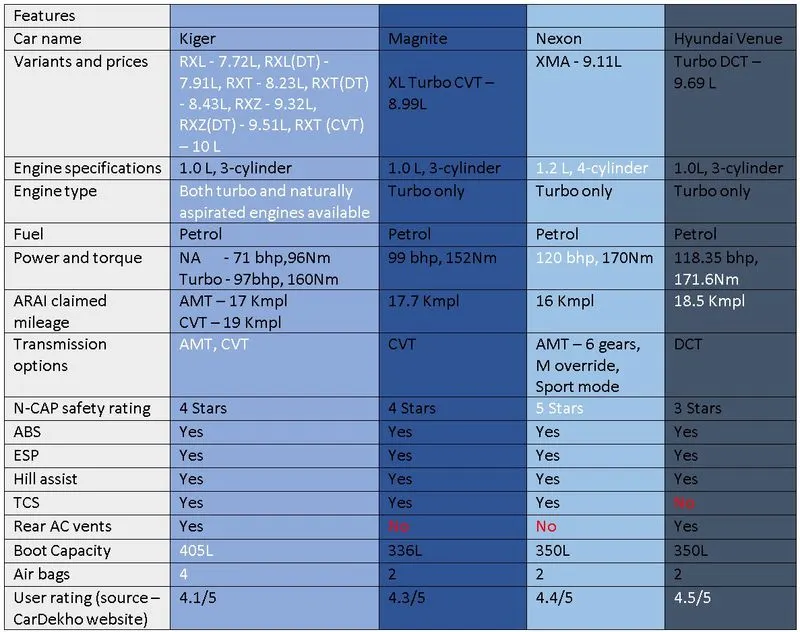
The detailed comparison of the 4 fours is displayed in the table below
Renault Kiger
The Renault is the latest in the lot and was launched on 15th of Feb this year. This car packs a feature rich cabin and a quirky design language. This car offers a long list of feature, engine and transmission variants to choose from. This car packs in 2 engine options which are a 1.0 L three cylinder Naturally aspirated petrol engine and 1.0 L three-cylinder turbo petrol engine, each churning a (71 bhp,96Nm) and a (97bhp, 160nm) respectively.
Pros
- Quirky design
- Engine and transmission options
- AMT variant can be bought for as low as 7.72L
Cons
- Rear shoulder room for three
- Feel and build quality is less premium
- Rear boot has higher loading lip
Ratings for Pughazhyendii’s requirements
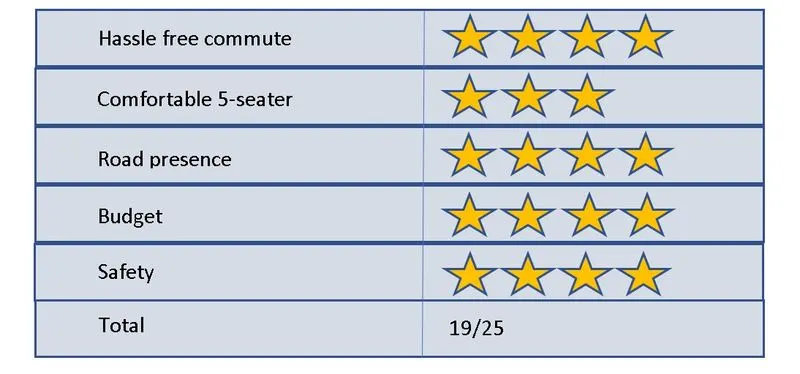
Why should Mr. Pughazhyendii pick the Kiger?
- Various engine and transmission options to choose
- Different trims available with Automatic transmission
- Lowest trim with an AMT can be driven home for just 7.72 L
Nissan Magnite
This car is the platform sibling of Renault Kiger and so shares the same 1.0L 3-cylinder Naturally aspirated and Turbo charged engines. The Magnite offers a modern design packed in a compact dimension, decently spacious cabin with a long list of features and a peppy turbo-petrol motor which is easy to live with. Sure, to keep prices competitive, you have to live with a cabin quality which isn’t on par with its rivals. Another downside is Nissan India’s scanty service network.
Pros
- Peppy turbo-petrol powertrain
- Spacious and feature-loaded cabin
- Good road presence
Cons
- High-speed ride is not pliant
- Interior quality not on par with the rivals
- Nissan’s sales network in the country
Ratings for Pughazhyendii’s requirements
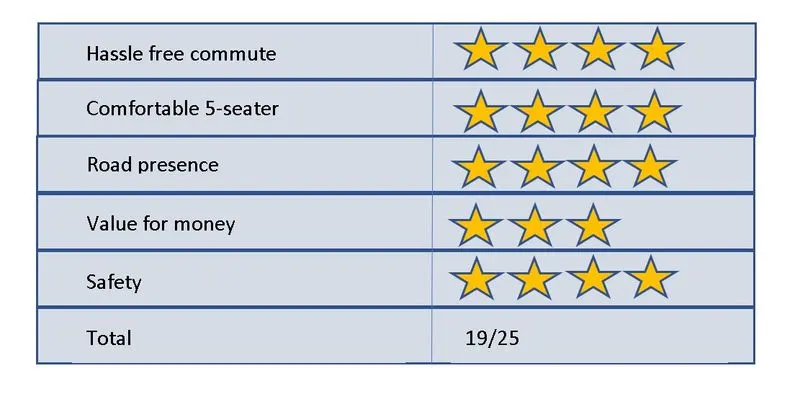
Why should Mr. Pughazhyendii pick the Magnite?
- It offers a turbocharged engine with a CVT transmission.
- Bold looks
- Better rear seat occupancy
Tata Nexon
The Tata Nexon is a compact SUV from the Indian automaker. Launched, in 2017, it received a facelift in 2019 and is offered across eight trim levels with BS6 compliant powertrain and added equipment. Considered to be one of the best in its segment, the Tata Nexon got tricks up its sleeve in a variety of departments. It comes with a 1.2 L turbo-petrol and a 1.5 L turbo-diesel which churns a healthy 120PS and 110PS respectively. This car shines in the features front too, it gets 3 drive modes, electronic Traction Control, Roll-over Mitigation, Emergency Brake assist, Hill Hold Control, Electronic Brake Pre-fill, Brake Disc Wiping to name a few. The most attractive offering of this car is its 5-star NCAP crash score, which makes this the safest in its class.
Pros
- The sharper styling makes the Nexon look upmarket
- Five Star G-NCAP safety rating
- Long list of useful features
Cons
- Interior cabin quality could have been better
- Petrol engine lacks low-end grunt
- Infotainment screen not as good as rivals
Ratings for Pughazhyendii’s requirements
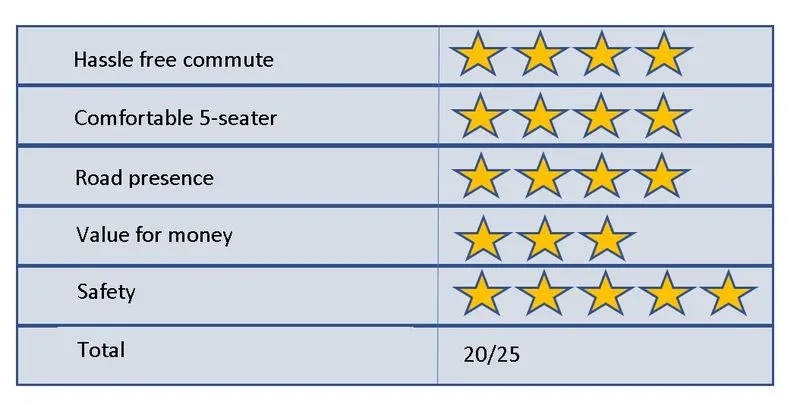
Why should Mr. Pughazhyendii pick the Nexon?
- Packs a 1.2 L turbocharged engine with an AMT gearbox (most powerful engine in this comparison)
- Offers drives modes
- Holds 5-star NCAP crash rating (Safest car in the segment)
Hyundai Venue
The Venue from Hyundai like all Hyundai cars checks all right boxes to be a good family SUV. It is powered by refined engine options and has a comfortable cabin that’s well stocked with features. The Hyundai Venue gets a single-tone all-black interior. The vehicle is loaded with features such as electric sunroof, eight-inch touchscreen infotainment system, projector headlamps with LED DRLs, automatic climate control with rear AC vents and more. As for safety and convenience, the Venue will get six airbags, ABS with EBD, rear parking sensors with camera, electronic stability control, hill launch assist and more.
Pros
- Good SUV-ish stance.
- Quality interiors coupled with long features list.
- It is the only DCT automatic in the segment.
- Hyundai’s strong service network and resale value in India
Cons
- Pricing is relatively higher
- Misses out on 1.2L engine options for DCT
- Lesser crash test rating
Ratings for Pughazhyendii’s requirements
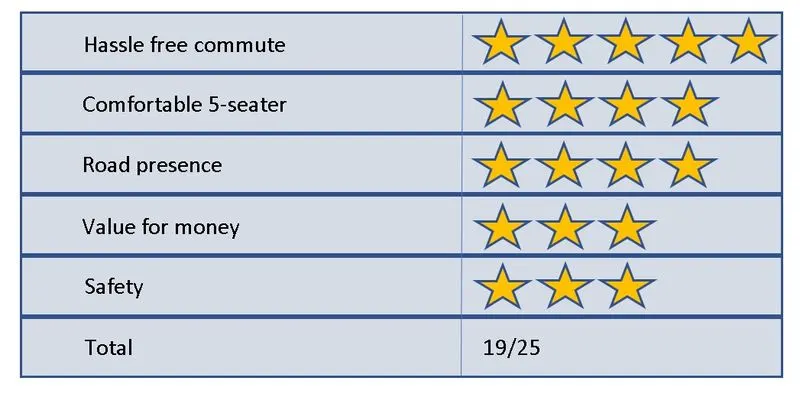
Why should Mr. Pughazhyendii pick the Venue?
- Only car in its segment that’s got a DCT transmission
- Impressive mileage figures
- Plush and rich cabin and interiors
The score for each of the cars in our comparison turns out to be (scores normalized to 5)
- Tata Nexon 4/5
- Renault Kiger 3.8/5
- Nissan Magnite 3.8/5
- Hyundai Venue 3.8/5
So, the top recommendation for Mr. Pughazhyendii considering all his requirements is Tata Nexon for its all-rounder package.