Challenge 7 : Concept Modelling of Steering Wheel
Concept modelling of Car Steering Wheel
Objective
To create a proper curve network and further develop surfaces to create a car steering wheel.
Introduction
The steering wheel is the part of the steering system that is manipulated by the driver to control the direction of motion of an automobile. Steering wheels are used in most modern land vehicles, including all mass-production automobiles, buses, light and heavy trucks, as well as tractors. Steering system in automobiles can be direct mechanical contact as in rectangular ball or rack and pinion steering gears, hydraulic or electronic powered steering. Power steering gives the driver an easier means by which the steering of a car can be accomplished. Modern power steering has almost universally relied on a hydraulic system, although electrical systems are steadily replacing this technology.
This project involves concept modelling of a car steering wheel. This project was designed in Autodesk’s Alias AutoStudio 2021.
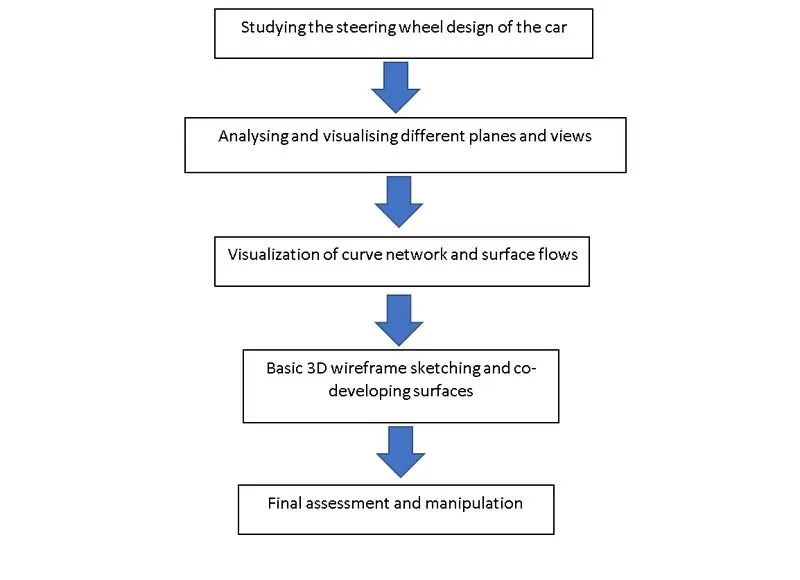
Design methodology / approach
Description of features/tools used
Concepts Involved:
- Importing model design canvas of steering wheel
- Adding canvas to layers
- Tracing the curves using basic curve functions and utilities
- Visualizing and manipulating curves structures to obtain proper surfaces.
- Generating symmetries.
Features used:
1.Various pick options:
- Pick object
Used to pick and place objects from one place to another.
- Pick nothing
Used to unselect previously selected objects, components, curves etc...,
- Pick Curves
Used to specifically pick curves
- Pick blend points
Used to pick blend points in the workspace.
2. Some Transform options
- Move
Used to move around selected objects, curves etc...,
- Rotate
Used to rotate selected items about a point.
- Scale
Used to scale up/down the size of selected items.
- Snap
It's essentially not a transformation tool yet comes very handy. It's used to snap desired items to particular an object, a curve or a point.
3. Curves options
- cv, ep curves
Used to draw curved features.
- Blendcrv tools (new, edit)
Used to blend to lines/curves to form a single entity. Blends can be edit to achieve optimum accuracy.
- Keypoint curve box (Ellipse, arc, line, drag)
Contains tools like Ellipse, arc, line, drag which comes handy while drawing.
4. Features associated with layers and canvas.
- Attaching canvases to layers.
- Hiding and unhiding canvases using hide/unhide functionality in layers.
5. Surface generation features
- Rail
This surface creation tool is used when there are generation and rail curves available. Depending upon the no. of generation, rail curves present, one can easily toggle among for more appropriate versions of rail tool and generate surfaces.
- Square
This is another surface generation tool that comes very handy. This tool can be used when surfaces are to be generated within 4 bounding curves.
- Skin
To build a surface bridging two curves
- Ffblend
This feature is primarily used to bridge surfaces.
- Srfillet
This feature is used to add fillets betwwen two edges.
6. Surface edit tools
- Project
Project tool can be used to project curves onto surfaces which can be later used for trimming purposes.
- Intersect
This tool is similar to project tool but used to project surfaces and objects.
- Trim
This option is used to trim away parts that are unnecessary. This tool can be used only after project/intersecting curves or bodies onto surfaces that are later trimmed/altered.
- Trimcvt
This feature is similar to trim function except for its ability to reorient the CVs of the trimmed surface.
7. Object edit tools
- Align
This feature can be used to align curves/surfaces to form continuous flowing entities.
- Attach/detach
This feature is used for attaching/detaching two surfaces or curves.
- Extend
This feature is used to extend or lessen the cross sections of curves or surfaces.
- Qryed
This feature takes us back to the feature that’s been previously applied to the selected object.
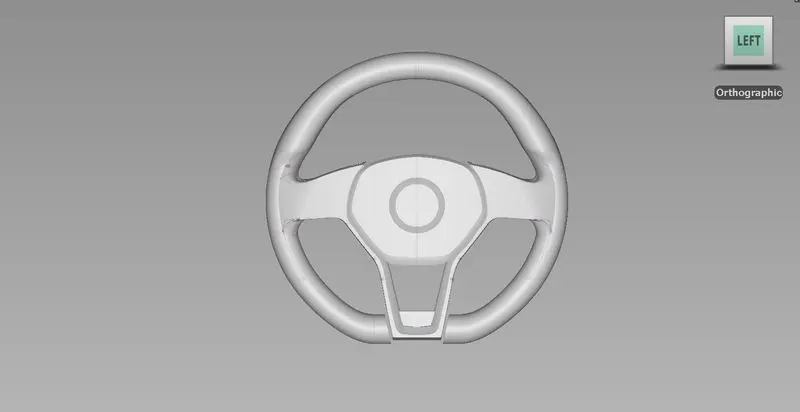
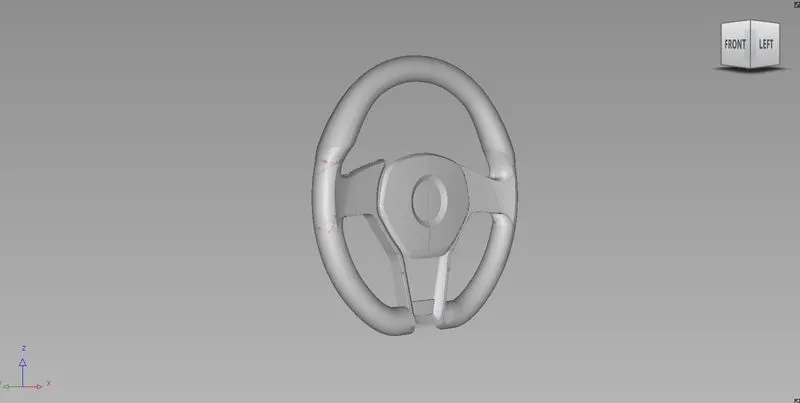
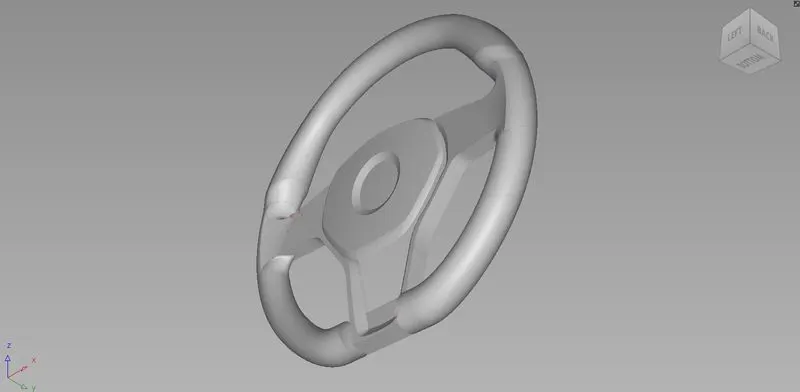
Images of Models:
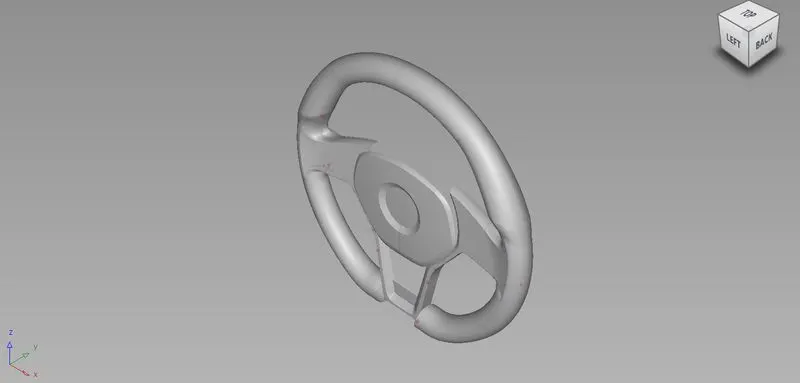
Conclusion
Working on this project gave insights of how to go about designing the car steering wheel using a single view and visualizing the rest. Interpreting 2D design blue prints and converting them to 3D curve structures gave understanding of different views and planes. Practised the basics concepts of continuities in curves and surfaces. Ventured through different features and approaches of design in Alias.