Basics of Probability and Statistics Week 1 Challenge
Aim:-
- Why there is a difference in the formula of variance for population and sample
- Difference between stratified and clustered sampling
- How many different samples can be created out of population of size n
- What is the probability of drawing 2 jacks from a pack of card
- What is the probability that both the numbers on dice are same while rolling 2 dice
- Why standard deviation when variance can measure the dispersion in data
Solutions:-
1.Why there is a difference in the formula of variance for population and sample.
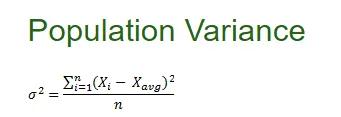
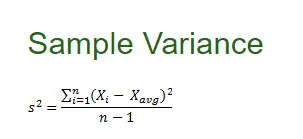
The population and sample variance is shown above and there is a small change in the denominator, the population variation has denominator 'n' which is the number of items in the population and for sample varience is one less i.e., 'n-1'.
The calculated sample varience is slightly higher than the calculated population varience. This slight difference in formula is to get better and unbiased estimate from the populationn's varience.
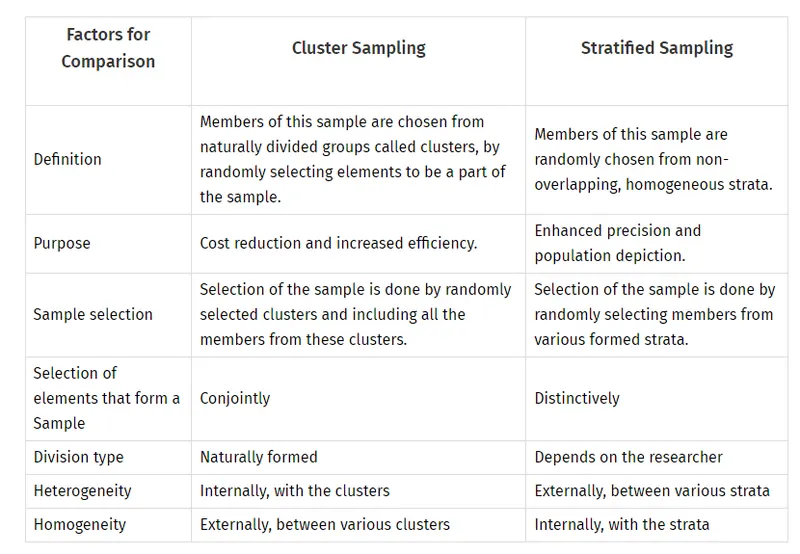
2.Difference between stratified and clustered sampling.
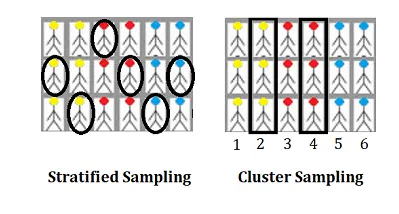
The main difference between stratified sampling and cluster sampling is that with cluster sampling, you have natural groups separating your population. For example, you might be able to divide your data into natural groupings like city blocks, voting districts or school districts. With stratified random sampling, these breaks may not exist, so you divide your target population into groups (more formally called "strata").
Cluster Sampling is a method where the target population is divided into multiple clusters. Some of these clusters are selected randomly for sampling or a second stage or multiple stage sampling is carried out to form the target sample. Depending on the number of steps followed to create the desired sample, cluster sampling is divided using a single-stage, two-stage or multiple stage sampling techniques. This sampling method is extremely cost-effective as it requires minimum efforts in sample creation and also convenient to execute.
Stratified Sampling is a probability sampling method, also called random quota sampling, where a large population is divided into unique, homogeneous strata and further, members from these strata are randomly selected to form a sample. Elements of each of the samples will be distinct which will give the entire population an equal opportunity to be a part of these samples. Segregation on the basis of age, religion, nationality, socioeconomic backgrounds, qualifications etc. can be done using this sampling technique.
3.How many different samples can be created out of population of size n.
If the population has 'n' elements in it, Then the no.of samples that can be created is
Where 'n' is the no.of individual elements in the population.
If A {11, 13, 17} is the population containing three elements then the all possible sunsets of A are {}, {11}, {13}, {17}, {11,13}, {11,17}, {13,17}, {11, 13, 17}.
Therefore, the no.of possible subsets of A is 8, which is equal to `2^3` including the null set.
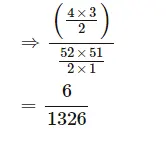
4.What is the probability of drawing 2 jacks from a pack of card.
The probality of drawing 2 jacks from a pack of card is `frac{4_C2}{52_C2}`
5.What is the probability that both the numbers on dice are same while rolling 2 dice.
Total no.of favourable outcomes = 6 i.e.({1,1}, {2,2},{3,3},{4,4},{5,5},{6,6})
Total no.of possible outscomes = `6^2`=36
Probality = `frac{6}{36}``=frac{1}{6}`
6.Why standard deviation when variance can measure the dispersion in data.
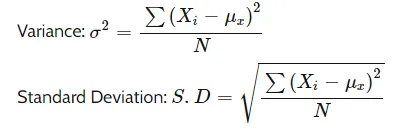
The varience is calculated as shown above (Ref:Ques No:1) and then take the sqaure root of the varience we get the standard deviation. Taking square root of varience gives us the units used in original scale also it shows how far the members are from the mean value.
Variance is an intermediate stage to obtain standard deviation. Variance can messure the dispersion of data, but the units are in the second power which do not match the orginal units of data.