Assignment 4-RADIOSS Material Laws Challenge
Objective :
To create a simple drop test simulation using three different materials with the help of Radioss solver and Hyperview.
I. Mat law 2 Johnson cook.
II. Mat law 27 Plast_Brit.
III. Mat law 36 Elastic - Plastic.
Explanation of Radioss materials :
These three laws comes under Elasto - Plasticity isotropic materials i.e, material beahves like elastic and by hardnening material contributes more plasticity and properties are same in all direction of the material.
The strain hardening behavior of materials is a major factor in structural response as metal working processes or plastic instability problems. A proper description of strain hardening at large plastic strains is generally imperative.
For many plasticity problems, the hardening behavior of the material is simply characterized by the strain-stress curve of the material. For the proportional loading this is generally true. However, if the loading path is combined, the characterization by a simple strain-stress curve is no longer adequate.
The incremental plasticity theory is generally used in computational methods. Plasticity models are written as ratedependent or independent. A rate-dependent model is a one in which the strain rate does affect the constitutive law. This is true for a large range of metals at low temperature relative to their melting temperature.
1. Mat law 2 Johnson cook :
In this law the material behaves as linear elastic when the equivalent stress is lower than the yield stress. For higher value of stress, the material behavior is plastic. This law is valid for brick, shell, truss and beam elements. The relation between describing stress during plastic deformation is given in a closed form:
`sigma = ( a + bepsilon^n )( 1 + cln (epsilon^./epsilon_0)) ( 1- T^m)`
2. Mat law 27 Plast_Brit :
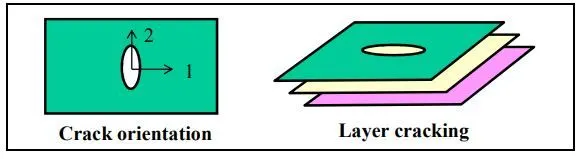
Johnson-Cook plasticity model is presented in section . For shell applications, a simple damage model can be associated to this law to take into account the brittle failure. The crack propagation occurs in the plan of shell in the case of mono-layer property and through the thickness if a multi-layer property is defined. The elastic-plastic behavior of the material is defined by Johnson-Cook model.
3. Mat law 36 Elastic - Plastic :
The elastic-plastic behavior of isotropic material is modeled with user-defined functions for work hardening curve. The elastic portion of the material stress-strain curve is modeled using the elastic modulus, E, and Poisson's ratio.
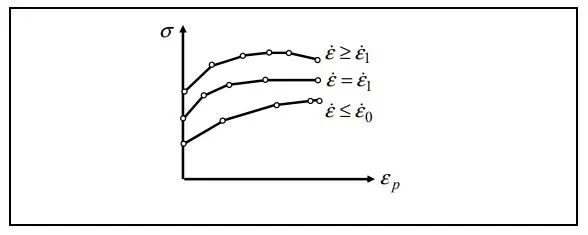
The hardening behavior of the material is defined in function of plastic strain for a given strain rate . An arbitrary number of material plasticity curves can be defined for different strain rates. For a given strain rate, a linear interpolation of stress for plastic strain change, can be used. This is the case of law 36 in RADIOSS.
Procedure :
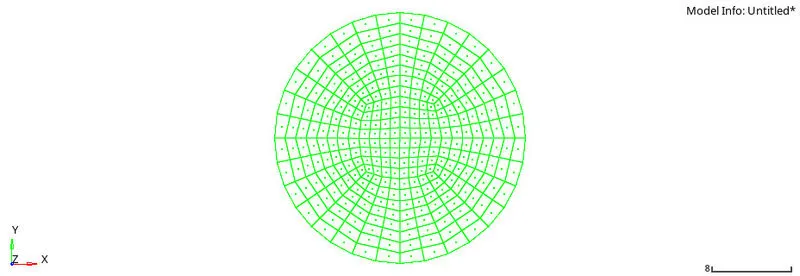
1.Import.rad files to the Hypermesh software and before importing solver deck file switch solver to Radioss. Here we need to perform 7 different cases, first start with the mat law 2 and later perform with mat law 27 and mat law 36.
Case 1 :
For first case mat law 2 failure card is used and it contains eps max failure condition where element can fail and without changing this solver deck solve the file using Radioss and results are explained in results and discussion.
Case 2 :
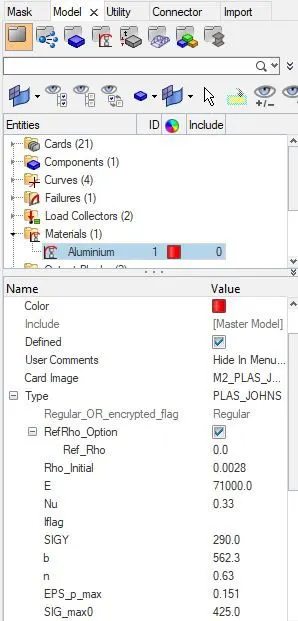
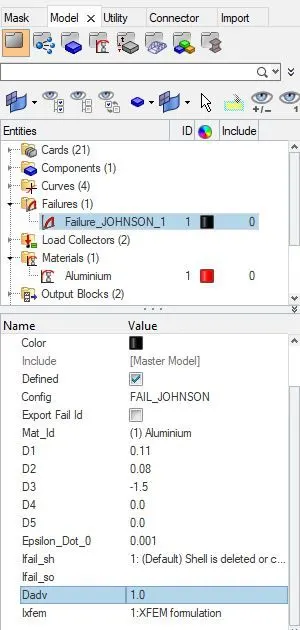
For second case open new session and import same solver deck which is used for case 1 but here we change the value ifail_shell 2 to 1 and Dadv to 1 and ixtem to 2 and run the deck file in Radioss.
Case 3 :
For case 3 solver deck delete the failure Jonson card and change the name of solver deck and run deck file in Radioss.
Case 4 :
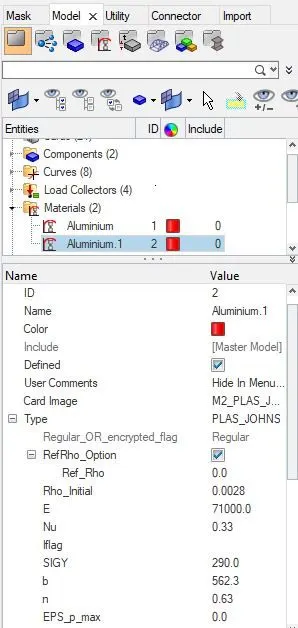
For case 4 solver deck change the epsmax value to zero which is in material card and run the deck file in radioss.
Case 5 :
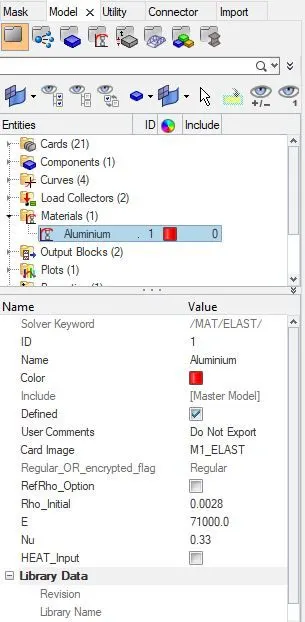
For case 5 solver deck chnage the material card to matlaw1 i.e, elastic card and give the values same as for johnson cook law. Now run the deck file in radioss.
Case 6 :
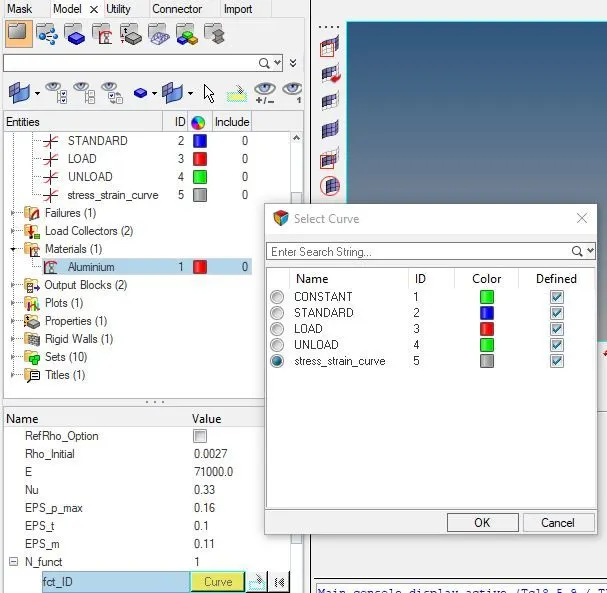
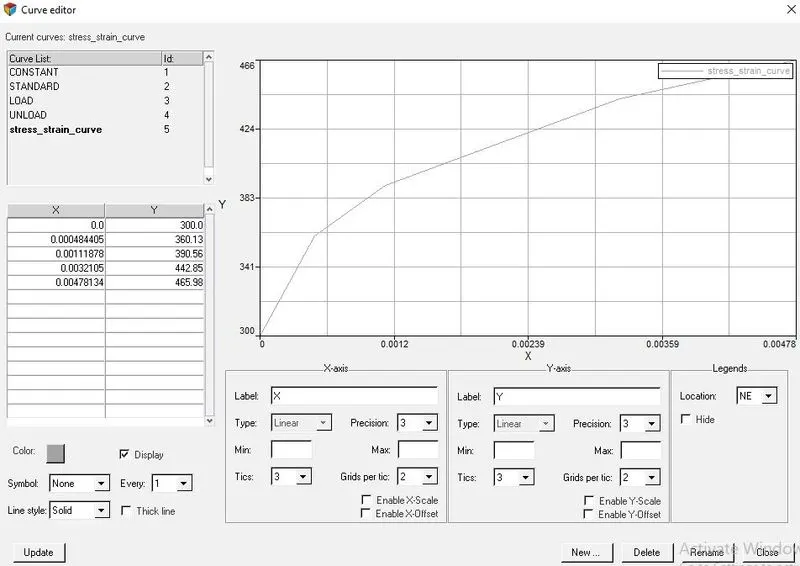
For case 6 solver deck we change the material card to mat 36 and in this card material curve card is applied which is created using curve card option as shown below and run the deck file in radioss.
Case 7 :
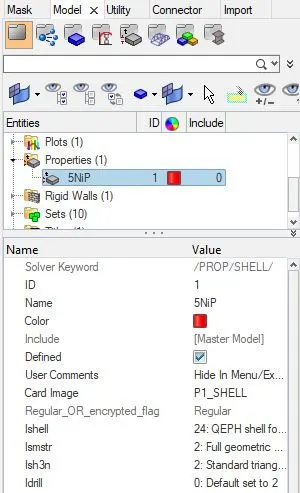
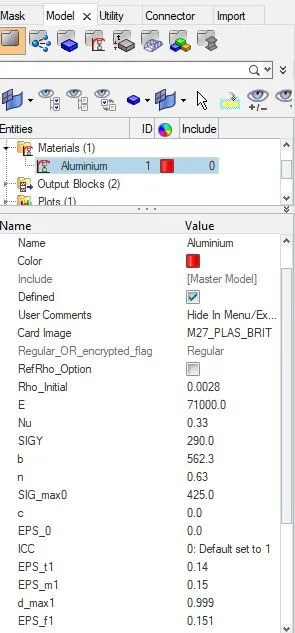
For case 7 solver deck we will use mat27 card and give different eps failure value and we will use recommended properties and solve the deck file in radioss.
2. Now we have solved all different files and now switch the application from hypermesh to hyperview.
Results & Discussion :
1. After solving first we need to check the number of cycles, time taken to solve, error percentage and mass error. This can be check after completion of solving or open 0001.out file using notepad++ here we can see all solver details. For all seven case solver details are represented using table which is shown below.
| No | Number of cycles | Time taken to solve | Energy error % | Mass error |
| case 1 | 49383 | 277.4 s | 0.8% | 0.0 |
| case 2 | 49406 | 149.17 s | 3.7% | 0.0 |
| case 3 | 49404 | 265.34 s | 0.8% | 0.0 |
| case 4 | 48736 | 153.7 s | 3.0% | 0.0 |
| case 5 | 47968 | 157.79 s | 0.3% | 0.0 |
| case 6 | 53156 | 287.31 s | -1.2% | 0.0 |
| case 7 | 49322 | 159.3 s | 0.9% | 0.0 |
2. Now extract the von mises simulation using contour option and by selecting the component and simple average we can see the simulation.

Case 1 :
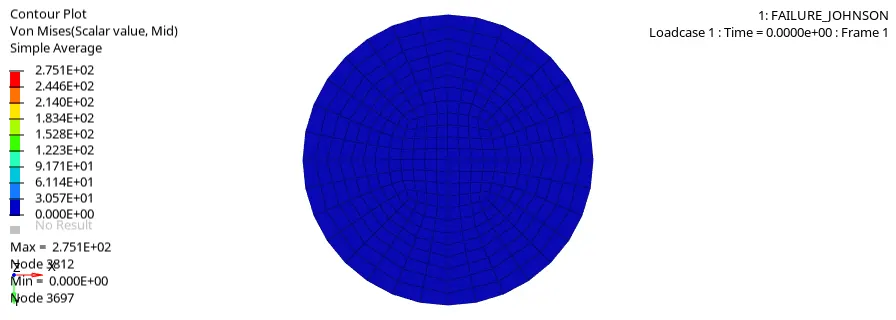
When the maximum stress is reached during computation, the stress remains constant and material undergoes deformation until the maximum plastic strain. Element rupture occurs if the plastic strain is larger than Emax. Here we kept deviatoric stress tensor as zero so there will be no deletion of element.
Case 2 :
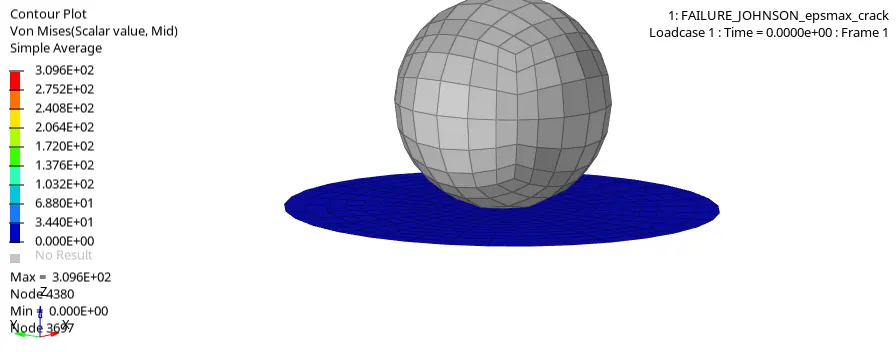
For case 2 we modified the failure card and applied deviatoric stress tensor as 1 and Ifail shell as 1, so in this case elements got deleted and we can see more damge effect in this model.
Case 3 :
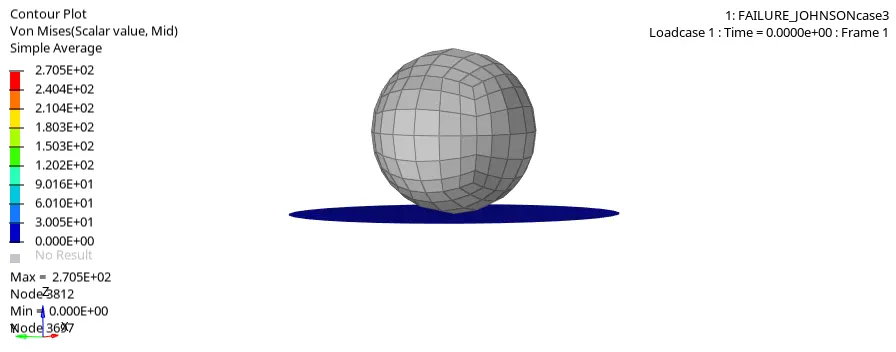
For case 3 we have deleted the failure card and we can see in simulation it performs same as case 1 and here also elements are not deleted and due to deviatoric stress tensor is not inroduced the maximum damage effect is reduced. Here we intoduced Eps max so rupture is occured.
Case 4 :
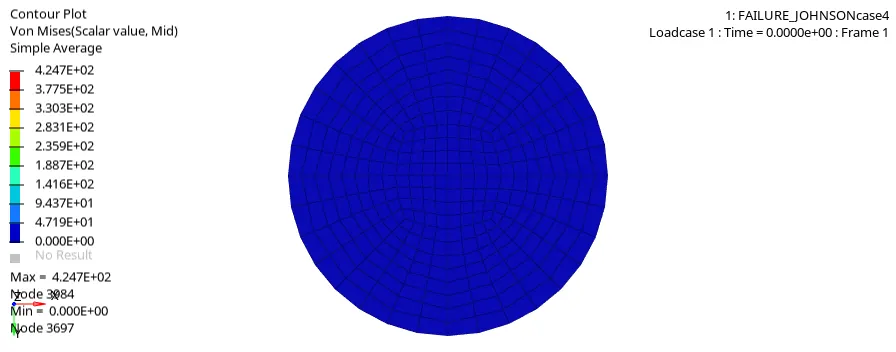
For case 4 we used same as case 3 model but we did not give eps max value and it is zero, due to this reason elements are not ruputred and it almost act as elastic material but more stress is produced in the model.
Case 5 :
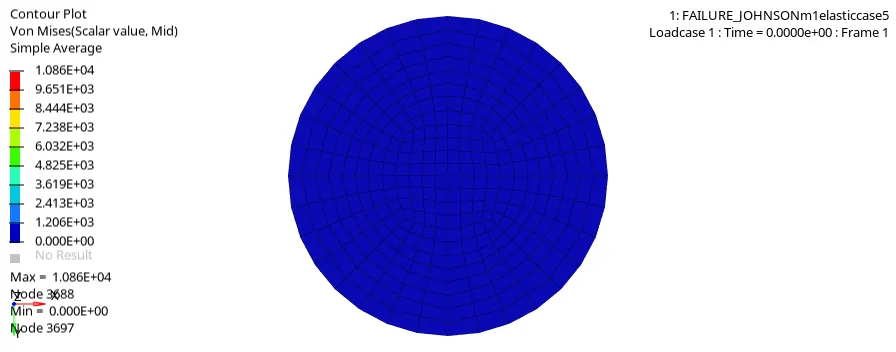
For case 5 we introduced elastic material law after seeing the results it is perfectly simulated as elastic material with same values which is used for mat law 2. For case 4 and case 5 difference between these two is cas 4 model acted as plastic hardening material and case 5 model acted as elastic material.
Case 6 :
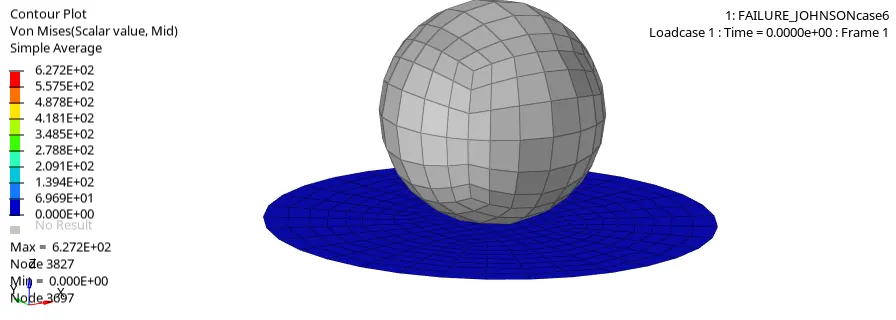
For case 6 model we introduced mat law 36 that is elasto - platic material and we can see that model is failed after reaching the maximum stress of 465MPa and starts to break. Mat36 is a user defined material card and it simulates perfectly.
Case 7 :
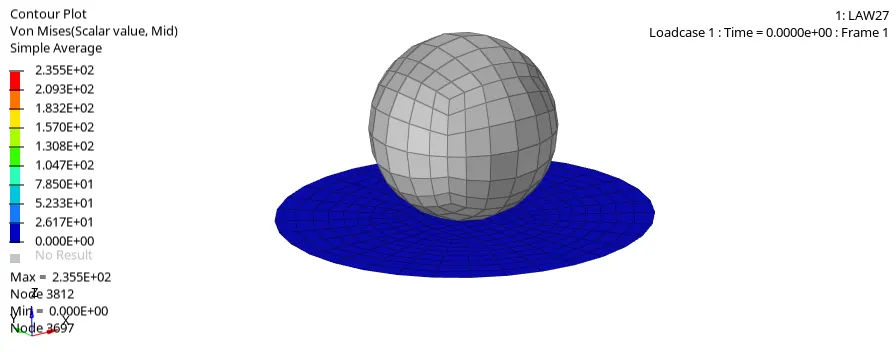
For case 7 we used brittle type of jonson cook model i.e, mat law 27. The elastic-plastic behavior of the material is defined by Johnson-Cook model. However, the stress-strain curve for the material incorporates a last part related to damage phase. The element is removed if one layer of element reaches the failure tensile strain Ef1. From our model we can see elements are removed after model reaching maximum stress value. This material card is only preffered for brittle material.
3. Now switch hyperview to hypergraph 2d and extract the energy plots for all seven cases.
Cae 1 :
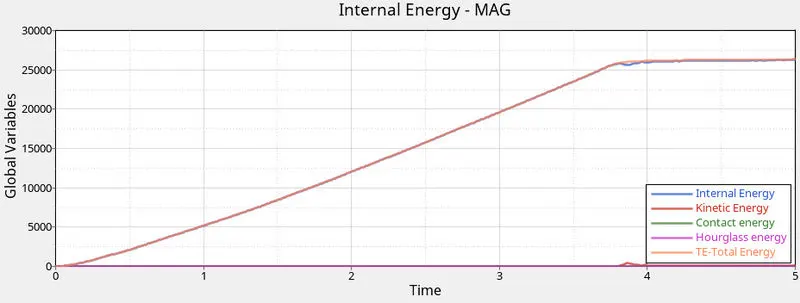
From plot we can see that maximum energy is above 25000 and hourglass energy is almost zero but after failure hourglass enrgy is increased and again becomes almost to zero. Here breakage of energy occurs at after 3.5 sec.
Case 2 :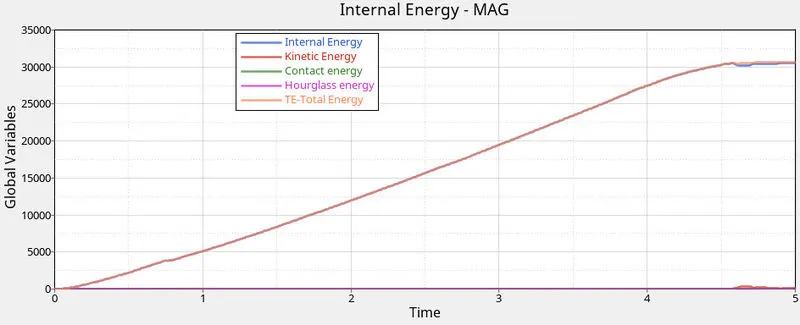
For case 2 maximum energy is increased i.e, above 30000 this is due to we introduced Ifailshell as 1 and it will delete the elements and to delete the elements more energy is required. Here breakage of energy occurs after 4.5 sec this after deleting the element.
Case 3 :
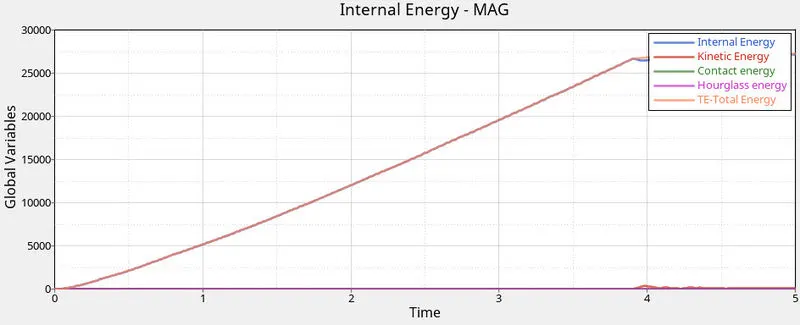
For case 3 plot the energy plot is same as case 1 and in simulation also both models gave same results.
Case 4 :
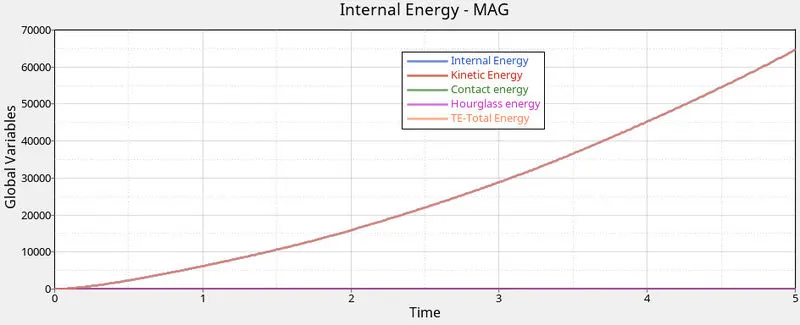
For case plot we know from simulation it absorbed maximum energy and there is no breakage of energy and hourglass energy is almost zero.
Case 5 :
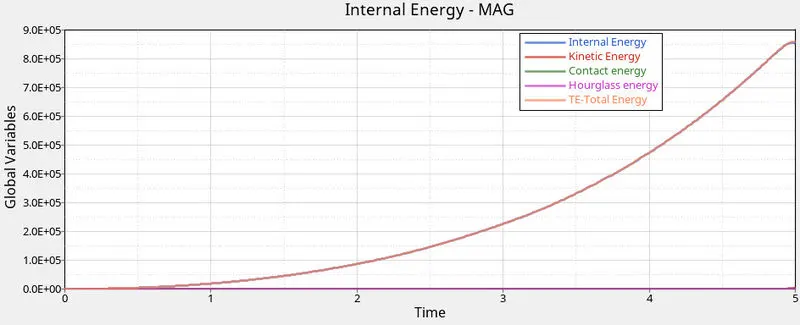
For case5 we can see that more energy is created and for this case also there is no breakage and most of the energy is absorbed by all th elements due to this reason we see less stress but more energy.
Case 6 :
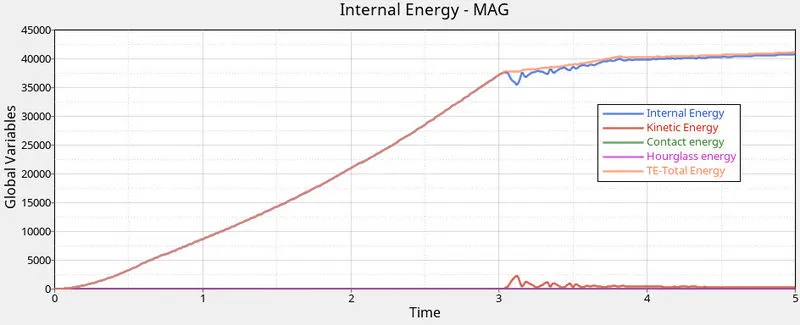
For case 6 brekage of energy occured at 3.0 sec and created energy distotions this is due to the breakage or failure of model due to more maximum stress than required.
Case 7 :
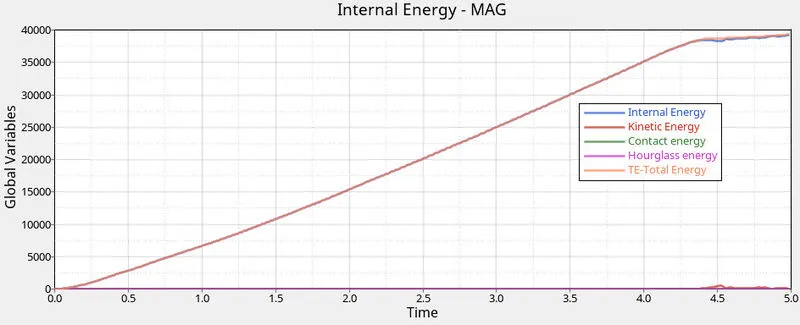
For case 7 the breakage of energy is greater when compared to other model that is after .45 seconds this is due to we taken brittle material card and most of energy is absorbed up to ultimate strength and after failing the model energy also breakes.
Conclusion :
Thus we have performed seven different simulations using the mat law 2, 27 and 36 snd we can conclude that mat law 2 can be used for multi purpose material card in this we can intoduce elastic cards, elasto - plastic cards and failure cards. But mat law 36 is user defined card and it is best card because we can not know the exact failing condition of material in that we can define the stress strain curve and then we can decide where material is failing. Where mat law 27 is used only for brittle materials.