Assignment 4-RADIOSS Material Laws Challenge
Objective:
To Compare for different material properties as follows.
1. Total number of cycles, Energy error, mass error and simulation time.
2. Notice the animation of all 5 and describe the animations in brief on the
basis of whether the elements are being deleted or cracked.
3. Plot energies and notice any difference.
Case Setup:
-Firstly, open HYPERMESH software and choose RADIOSS profile to run the analysis.
-Now, import the geometry to HYPERMESH RADIOSS profile.
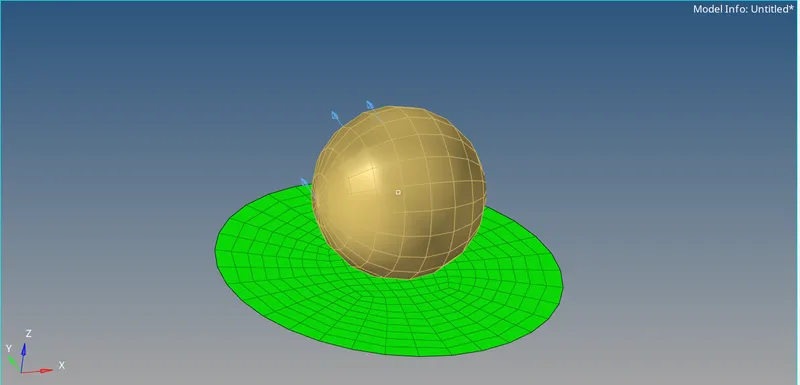
-Now, for case-1. We need to run the model as it is without making any changes to the material card or property card.
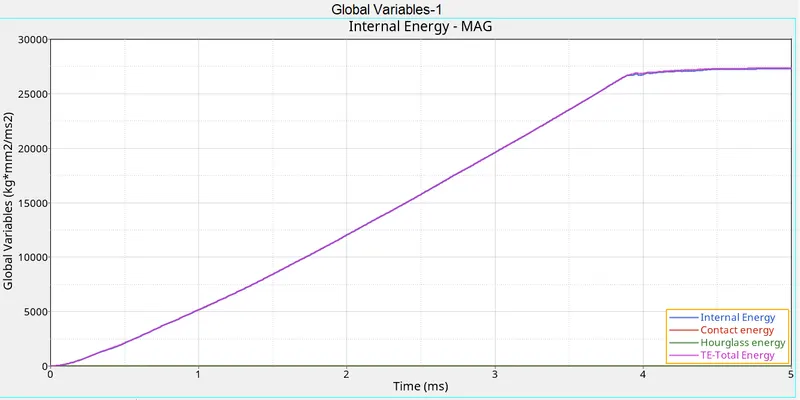
-Now, for case 2 we need to change the values in fail Johnson card as recommended.
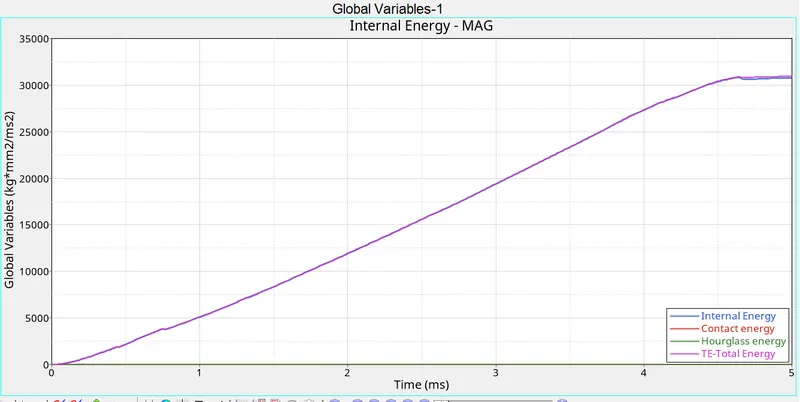
-Now, for case 3 we need to delete the fail Johnson card and run the analysis.
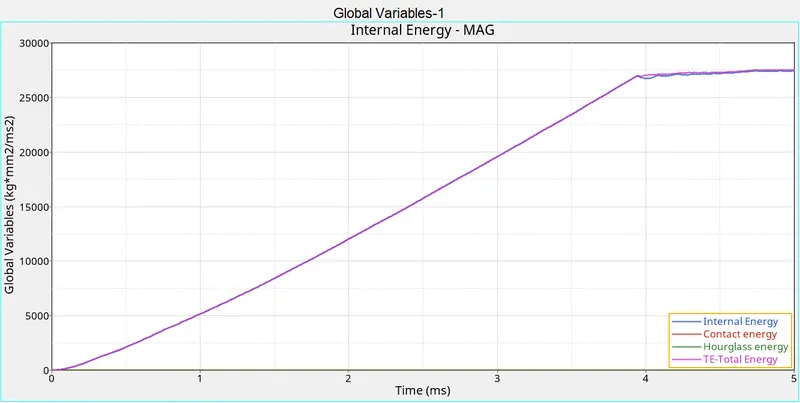
-Now, for case 4 we need to delete the value of EPS_p_max from the material card and run anlaysis.
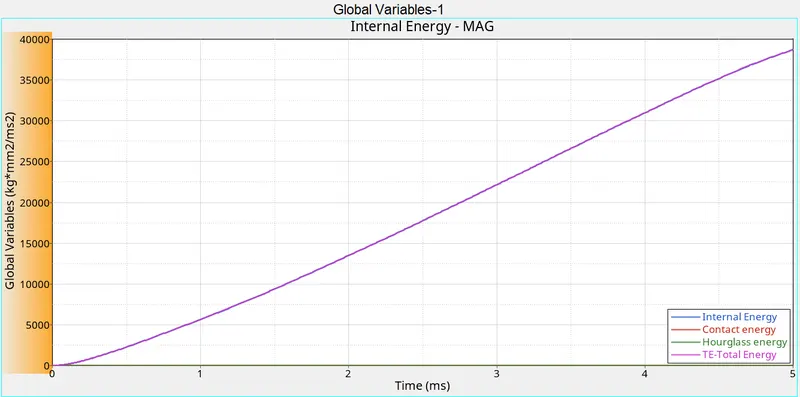
-Now, for case 5 we need to convert the material model to law 1 with same Density, Young's modulus and nu. Then run the analysis. Here, law 1 is elasticity.
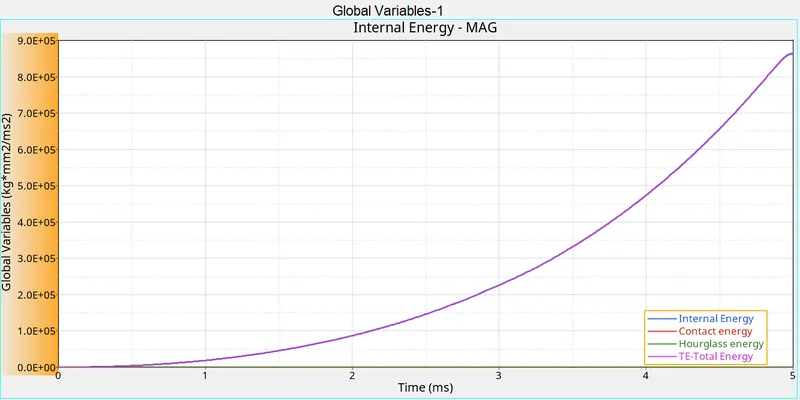
-Now, for case 6 we need to open the Law27_0000.rad file and change the material properties as mentioned and run the analysis.
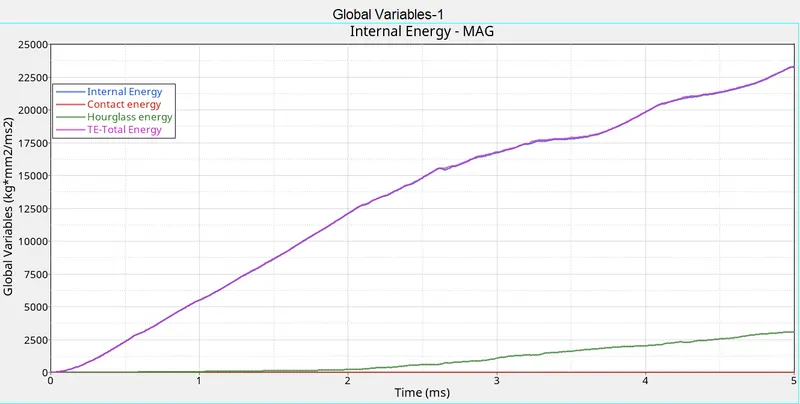
Table:
Cycles Energy Error Mass Error Time(s)
Case-1: 49379 0.8% 0.2721E+05 107.97
Case-2: 49216 4.1% 0.2980E+05 116.07
Case-3: 49407 0.8% 0.2736E+05 120.25
Case-4: 49303 1.1% 0.3838E+05 114.53
Case-5: 47968 1.3% 0.8568E+06 100.93
Case-6: 41112 -7.1% 0.2547E+05 85.36
Result:
Here, we have run the analsyis for 6 cases, and each case with specific material properties as such:
For case-1: When we run the analysis the rigid material which is the ball will be piercing through the aluminium sheet. Because, basically this law2 material in HYPERMESH is a elasto-plastic material, which have a strain rate but when the material is induced to a force which is far grater than that of the materials elastic limit then the material fails.
For case-2: We change the material properties of teh law2 material and run the analysis. Here, in this case also the ball pierces the aluminium sheet.
For case-3: In this case we are deleting the fail johnson card and running the analysis. Even then the ball pierces through the aluminium sheet.
For case-4: Here, in this case we are changing the EPS_p_max values to zero(0) and running the analysis. In this case too the ball pierces through the aluminium sheet. Here, the EPS_p_max is a law 36 parameter where when this parameter is used Plastic Strain beyond that value will cause element deletion. Hence, in this case tehre will not be any elemental deletion.
For case-5: Here, in this case case we are converting the material property from law-2 to law-1. Hence, by doing so the aluminium sheet undergoes an elastic properties. Hence, when the rigid ball falls on the aluminium sheet it does not pierce but the sheet acts like a trampoline.
For case-6: Here, in this model we will be using Law27 and change the material properties as recommended. Now, as the law27 is combination of an isotropic elasto-plastic Johnson-Cook material model with an orthotropic brittle failure model. Material damage is accounted for prior to failure. Failure and damage occur only in tension. Hence, when the rigid ball falls on the aluminium sheet the sheet gets teared.
Thus from the result and from the graphs shown above. I would recommend Case-5 i.e LAW1 material property for this model.