Assignment 4-RADIOSS Material Laws Challenge
Aim
==============================================================================
Perform the simulation as per the following cases
Case 1 : Import the FAILURE_JOHNSON_0000.rad file and run the model as it is , give this file named as Law2_epsmax_failure.
Case 2 : Import the Law2_epsmax_failure.rad file and perform the simulation with failure plastic strain(EPS_p_max) and fail johson card enabled.
Changes to be made in /FAIL/JOHNSON card:
- ifail_sh = 1
- Dadv = 1
- Ixfem = 1
- Use the recommended values for the property card
- Give the title name as Law2_epmax_crack
Case 3 : Import the case 2 rad file and perform the simulation by removing the fail_johnson failure card.Give the title name as Law2_epsmax_nofail.
Case 4 : Import the case 3 rad file and perform the simulation by removing both the failure plastic strain and johnson failure card.
Case 5 : Import the case 4 rad file and perform the simulation by changing the material card to law 1. Keep the same value for rho,E and Nu.
Case 6 : Import the case 1 rad file and perform the simulation with the law 36 material card.
Rho_initial = 0.0027
E = 71000.0
Nu = 0.33
EPS_p_max = 0.16
EPS_t = 0.1
EPS_m = 0.11
N_funct = 1
Fct_ID = create curve
Case 7 : Open the law27_0000.rad file and perform the simulation with the law 27 material card. Use the recommended shell properties.
Now after completing all these different cases compare results in tabulated format based on:
- The total number of cycles, Energy error, mass error and simulation time.
- Notice the animation of all 5 and describe the animations in brief based on whether the elements are being deleted or crack.
- Plot energies and notice any difference.
- Based on all the results, which case would represent the on-field scenario.
- Give reason why the failure happened.
Objective
==================================================================================
- Get to familiar with different material card in the Radioss.
- How these materials cards are defined.
- What are the different parameters are required for defining material card.
Theory
==============================================================================
Law 1 : This law defines for the Isotropic Linear elastic material. It uses Hooke’s law which means there is a relationship between stress and strain. The material stiffness is determined by only two values Young’s Modulus (E), and Poisson’s ratio(Nu).
Law 2 : This law is for Isotropic elasto-plastic material using the Johnson-cook material model.
In this law the following parameters need to be filled density, Young’s Modulus, Poisson’s ratio,Input type flag, Yield stress, Failure plastic strain, Plastic hardening exponent, Plastic hardening parameter.
- This is an elasto-plastic material model that includes strain rate and temperature effects with true stress and strain output.
- In this model the material behaves as a linear-elastic material when the equivalent stress is lower than the plastic yield stress. For higher stress values, the material behavior is plastic, and the true stress is calculated as:
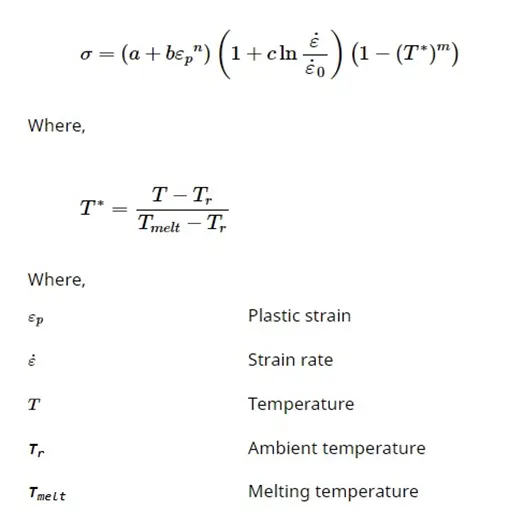
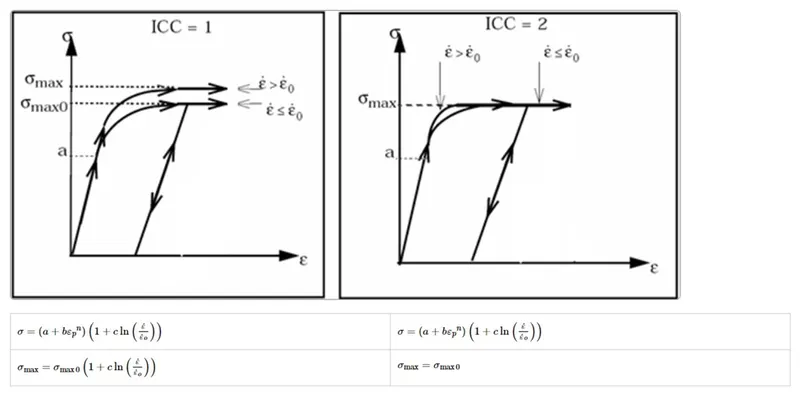
3.The ICCflag defines the effect of strain rate on the maximum material stress σmax. Figure below shows the value of for σmax the corresponding ICC.
Law 36 : This law models an isotropic elasto-plastic material using user-defined functions for the work-hardening portion of the stress-strain curve (for example, stress versus plastic strain) for different strain rates. In this law the following parameters need to be filled density, Young’s Modulus, Poisson’s ratio, Failure plastic strain, Tensile strain failure,Maximum tensile failure strain at which the stress in element is set to zero, Number of functions (1 ≤ Nfunct ≤ 100).
Law 27 : This law combines an isotropic elasto-plastic Johnson-Cook material model with an orthotropic brittle failure model. Material damage is accounted for prior to failure. Failure and damage occur only in tension. This law is applicable only for shells. In this law the following parameters need to be filled Density, Young’s Modulus, Poisson’s ratio, Plastic yield stress, Plasticity hardening parameter, Plasticity hardening exponent etc.
Procedure
==============================================================================
Case 1 :
Simulation of Law2_epsmax_failure file.
Import solver deck < File name FAILURE_JOHNSON_0000.rad
After importing the FAILURE_JOHNSON_0000.rad file export the same into a new folder named case1 and file name will be Law2_epsmax_failure.
Import solver deck < File name Law2_epsmax_failure
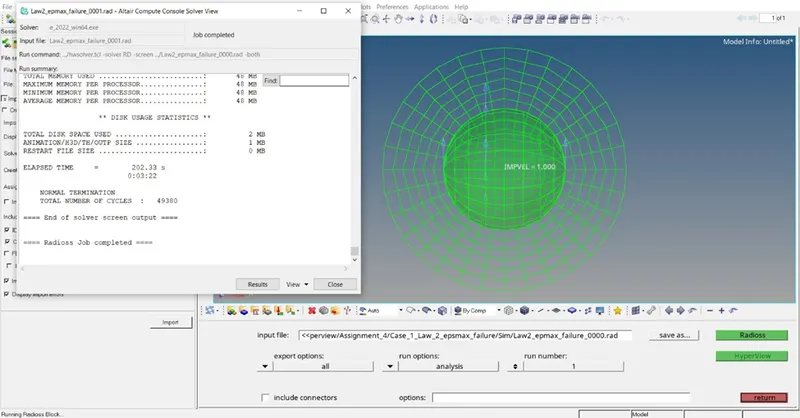
Finally the Law2_epmas_failure is runed.
Case 2 :
The starter file from case 1 is imported and modification is done as per the case 2.
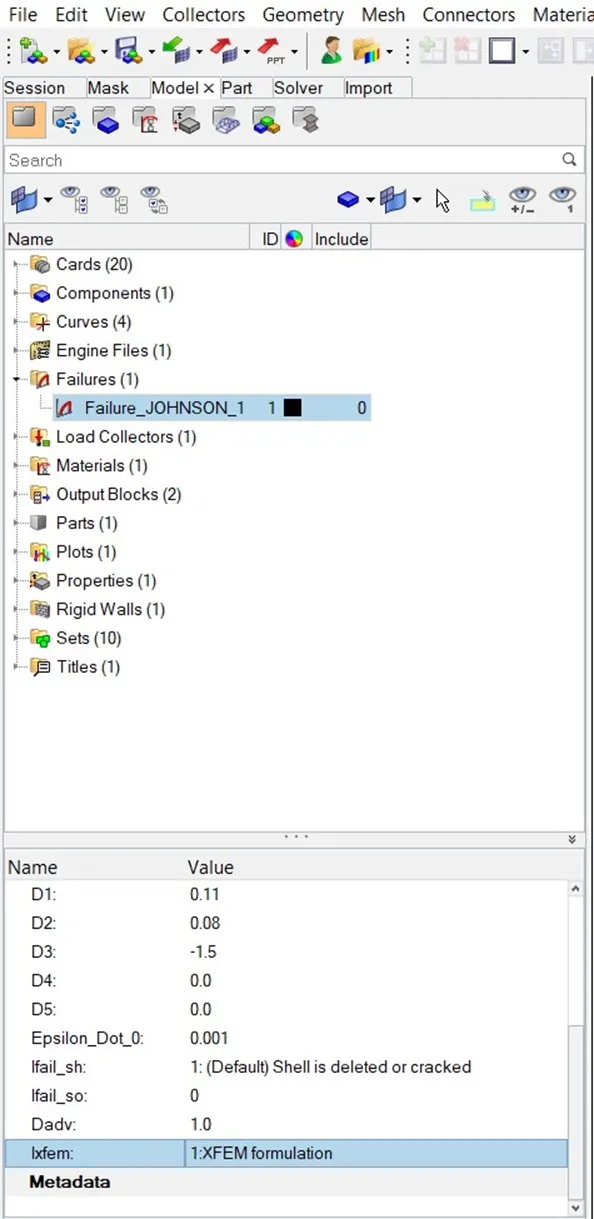
The property card is recommended as the following
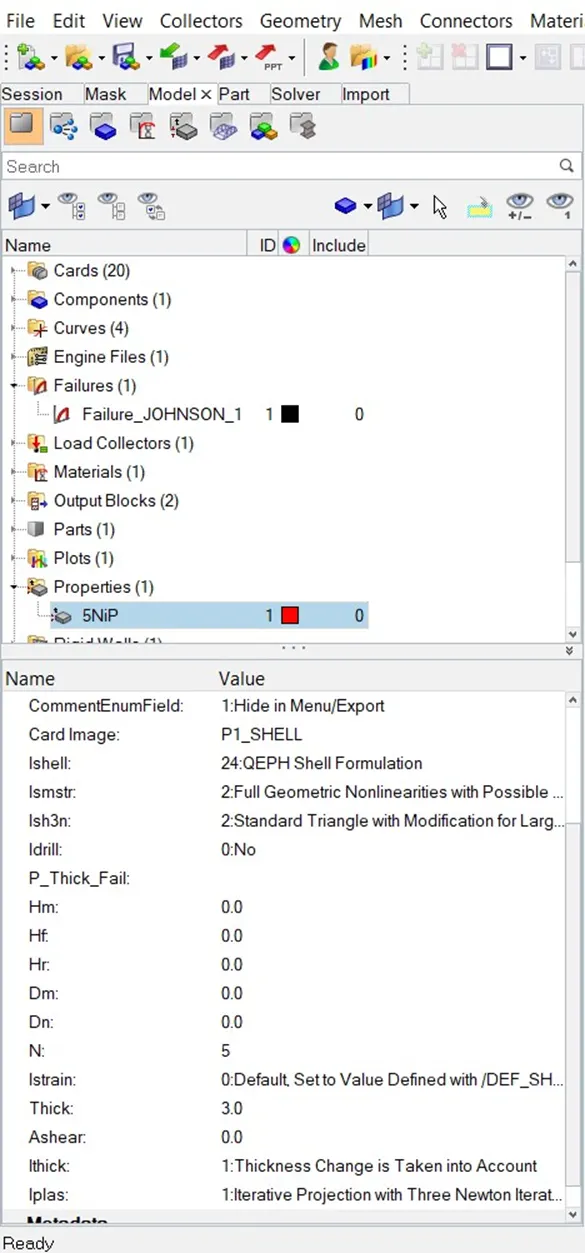
After setting this file is exported named as Law2_epsmax_crack into a new folder named as case2.
Export < Law2_epsmax_crack
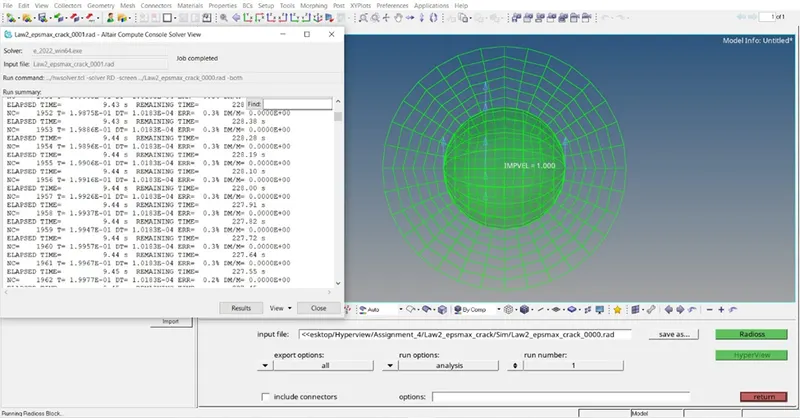
Now for this file also the simulation is done.
Analysis < Radioss < Law2_epsmax_crack
Case 3 :
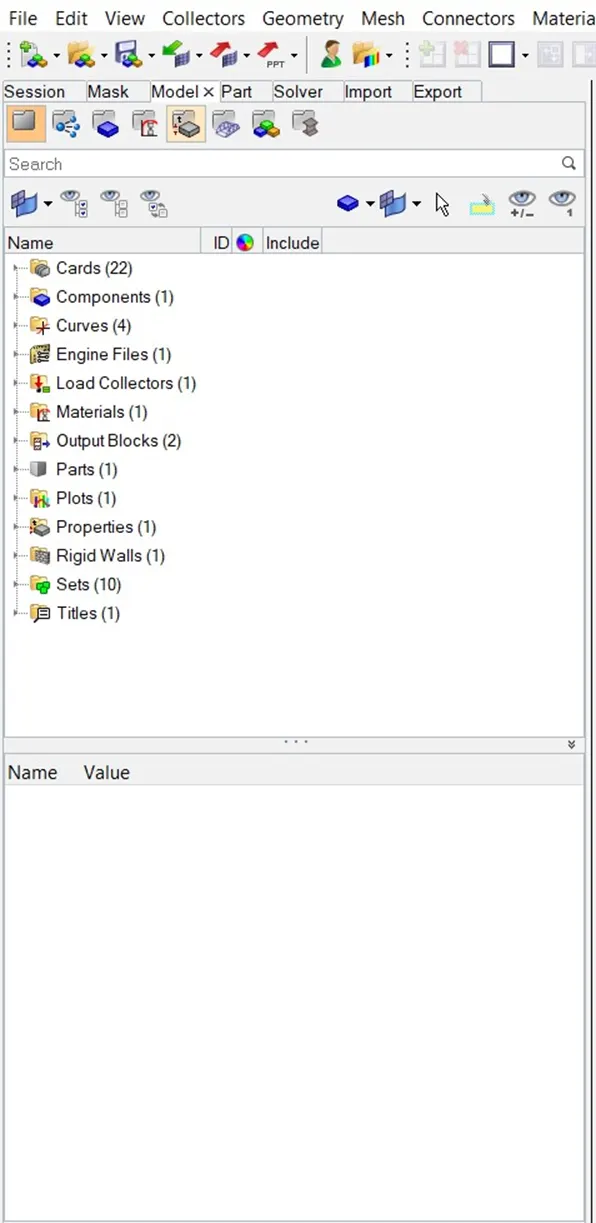
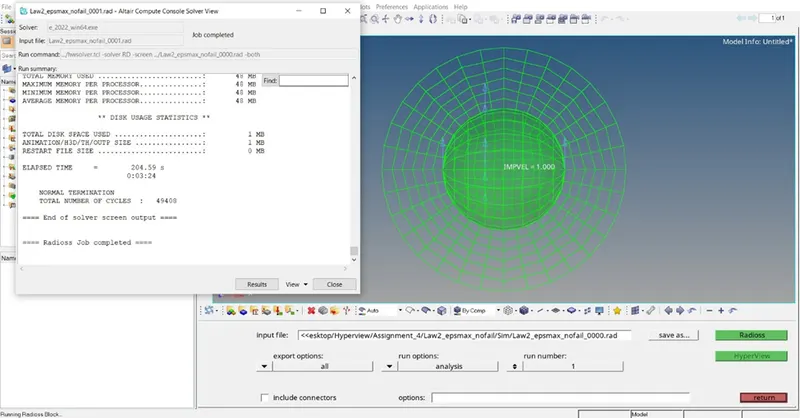
Starter file from the case 2 is imported and johnson failure is removed and the file is exported in the name as Law2_epsmax_nofail and finally simulation is done.
Case 4:
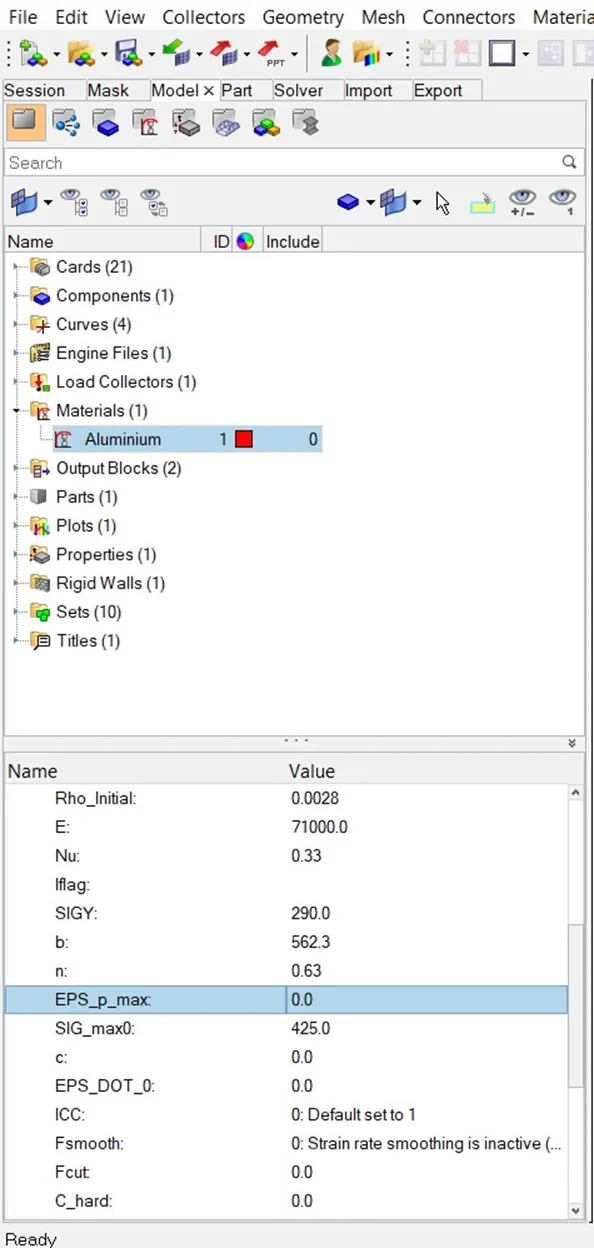
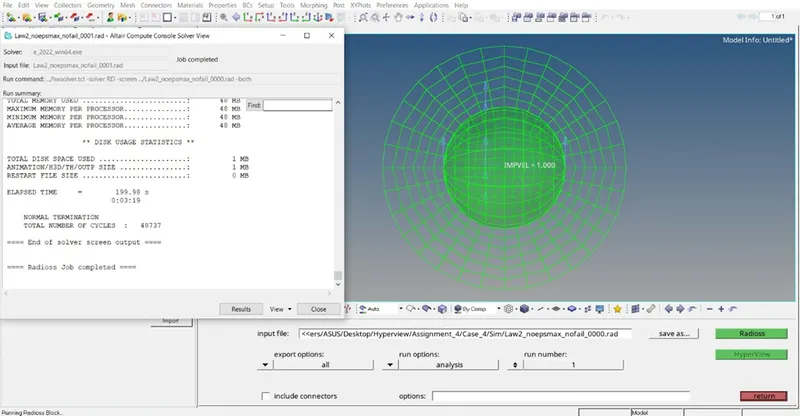
Here the starter file from case 3 is imported and both the failure Plastic strain and Johnson failure is removed and simulation is performed.
Case 5:
The starter file of case 4 is imported and material card law is changed however the values of rho, E and Nu is same.
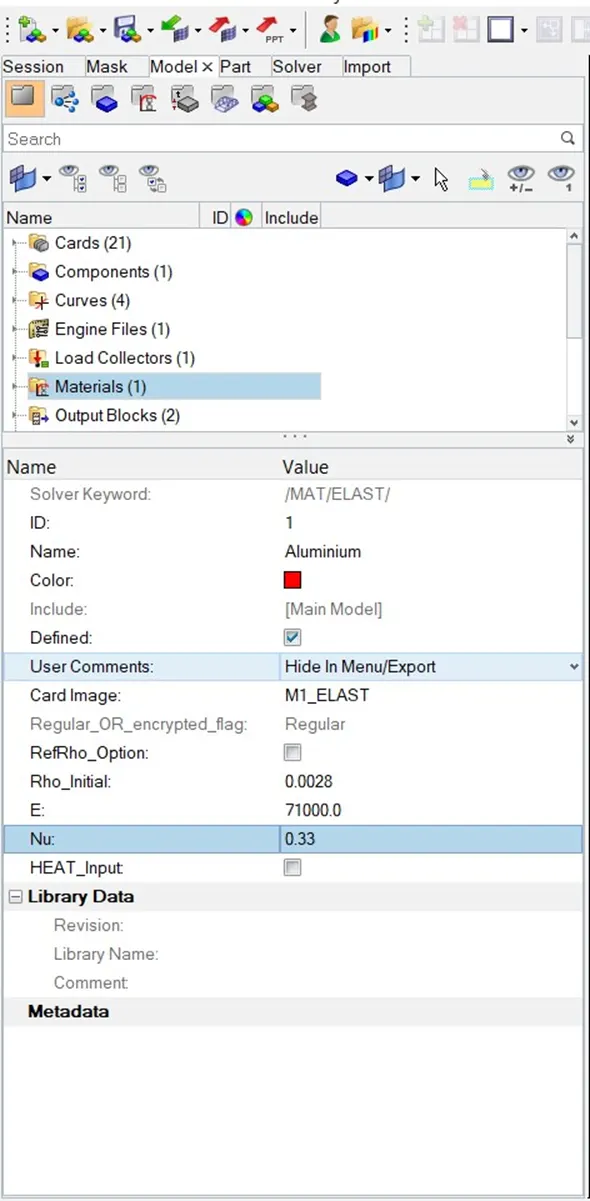
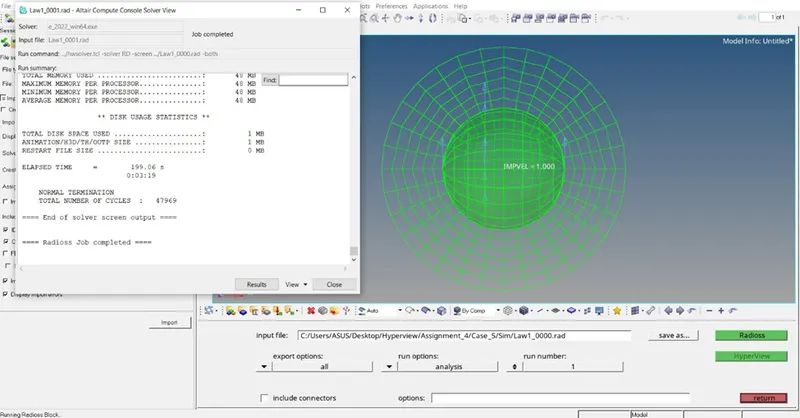
After this arrangement the file is imported named as Law1 and finally simulation is performed.
Case 6 :
In this case the case 1 starter file is imported and in this material card is changed to Law 36 and following values are mentioned at respective place.
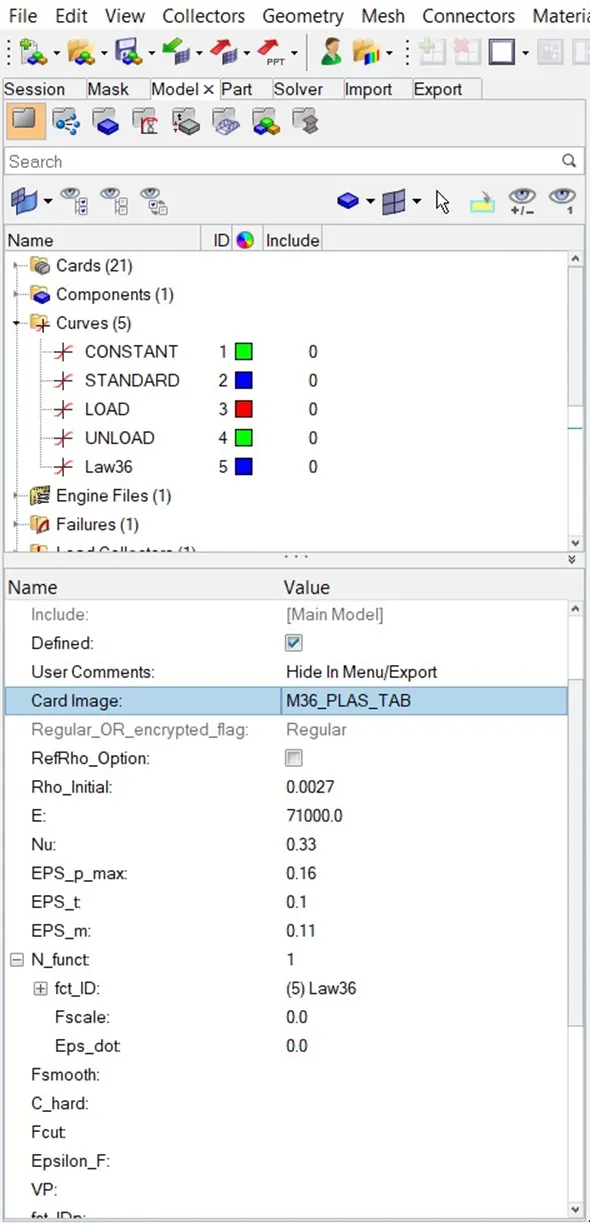
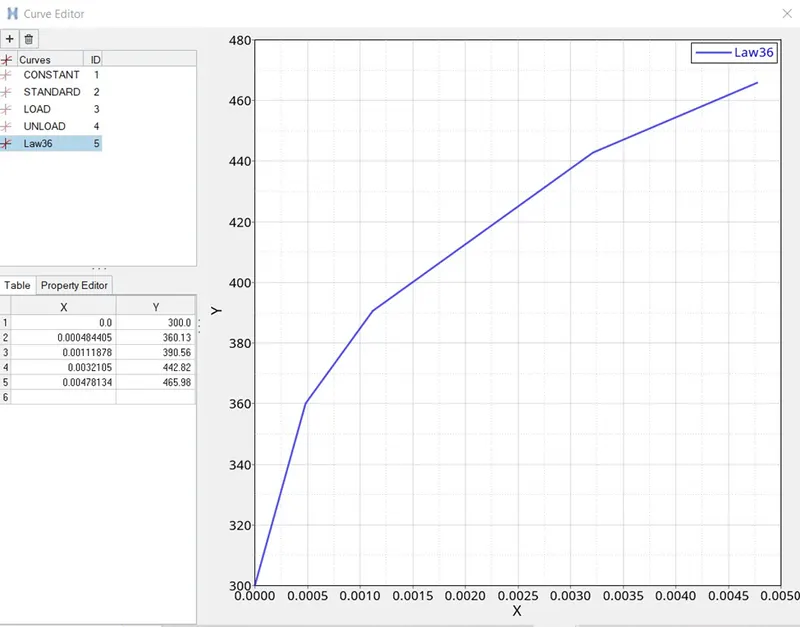
For N_funct =1 the curve has to be defined in model browser.
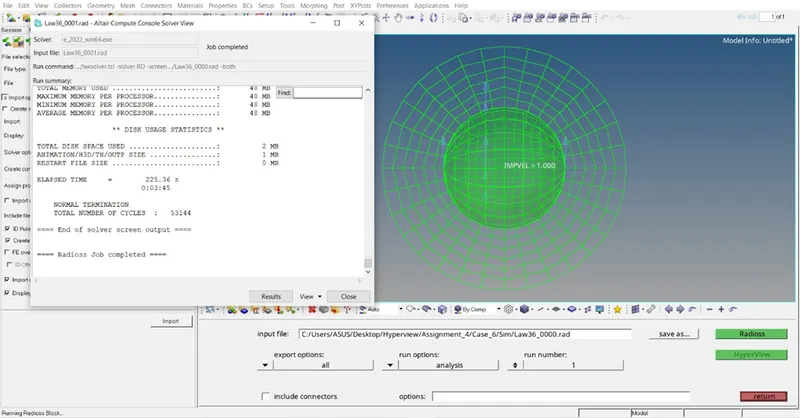
After all the input the file is exported named as Law36 and finally performed simulation.
Case 7:
For this case a separate file is imported and shell properties are mentioned same as case 2.
After this input the file is exported as Law 27 and finally simulation is performed.
Results
==============================================================================
|
Material form |
No. of Cycles |
Energy Error |
Mass Error |
Simulation Time |
|
Law2_EPSmax_failure |
49380 |
0.8% |
0.000 |
204.97s |
|
Law2_EPSmax_crack |
49217 |
4.1% |
0.000 |
207.16s |
|
Law2_EPSmax_nofail |
49408 |
0.8% |
0.000 |
207.34s |
|
Law2_noEPSmax_nofail |
48737 |
3.0% |
0.000 |
202.64s |
|
Law1 |
47969 |
1.3% |
0.000 |
201.69s |
|
Law36 |
53144 |
-1.8% |
0.000 |
227.97s |
|
Law27 |
49508 |
0.8% |
0.000 |
87.11s |
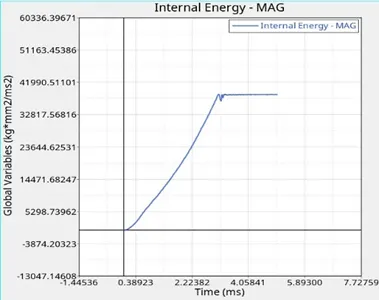
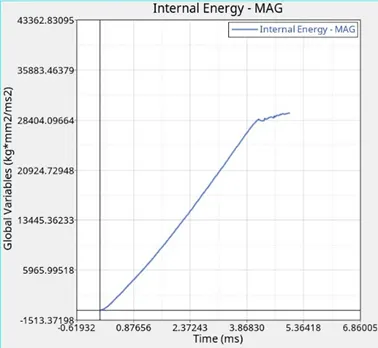
Energy Plot
|
Material form |
Elements condition |
Max stress |
Energy plot |
|
Law2_EPSmax_failure |
Break into pieces |
2.752E+02 |
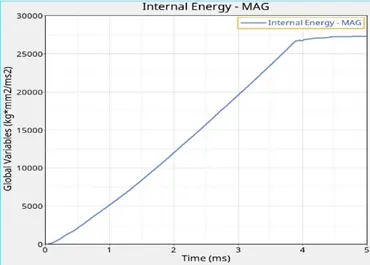 |
|
Law2_EPSmax_crack |
Break into pieces |
2.752E+02 |
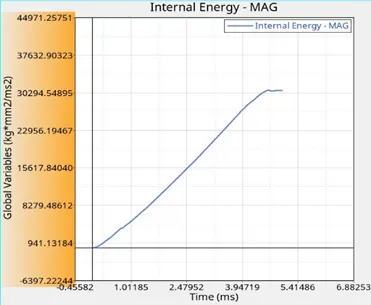 |
|
Law2_EPSmax_nofail |
Break into pieces |
2.707E+02 |
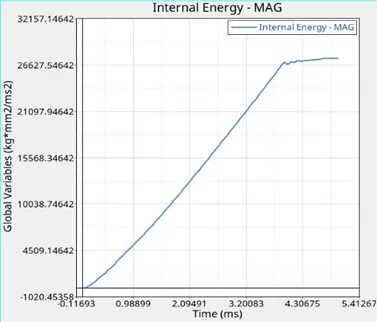 |
|
Law2_noEPSmax_nofail |
Not break |
4.247E+02 |
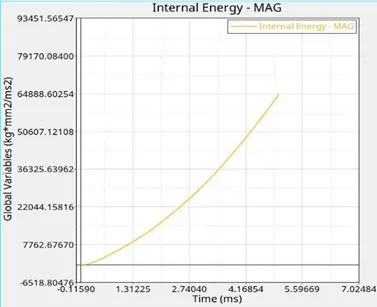 |
|
Law1 |
Not break |
1.089E+04 |
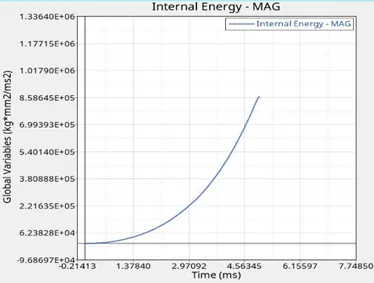 |
|
Law36 |
Break into pieces |
6.031E+02 |
 |
|
Law27 |
Break into pieces |
2.875E+02 |
 |
Conclusion
==============================================================================
According to the results it is found from the observation that every material card is specified for different materials i.e.
Law 1 is for elastic material which following Hooke’s law.
Law 2 can calculate the stress according to the strain, strain rate and temperature. It is basically applied when multiple loading, large deformation and temperature generation is happened.
Law 27 is for brittle material like Glass, mica etc. In this law failure is only occur in tension stress.
Law 36 is mostly used for the user defined data points of material.