Assignment 4-RADIOSS Material Laws Challenge
MATERIAL LAW
OBJECTIVE: To run the simulation for different cases of material laws and study its effects on the results.
CASE SET UP AND EXECUTION: Upload the given 0000.rad file and edit the properties as asked in the question.Now run the simulation with 4 threads(-nt 4).Then open the h3d file in hyperview to view the animation and use the hypergraph 2d to obtain the graphs.
CASE1:
ERROR PERCENTAGE:
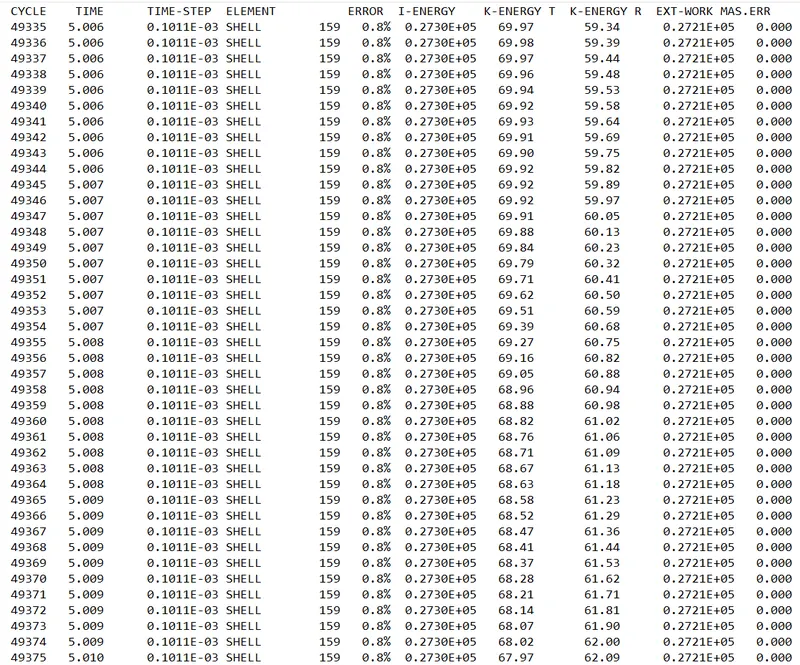
TIME TAKEN : 60.32s.
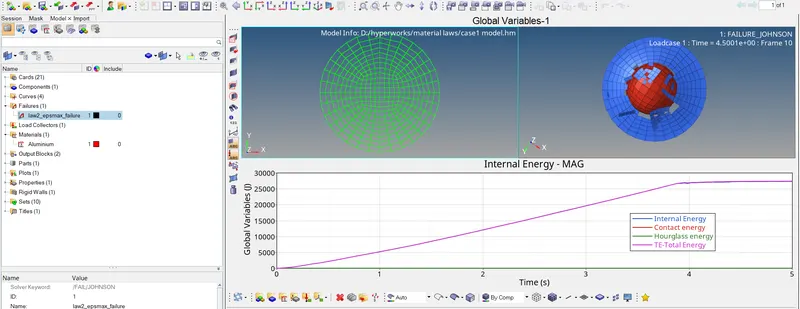
RESULT:The ball will penetrate through the plate by causing plastic deformation. This is because we have used the value of eps_p_max as 0.151 along with johnson failure card. The energy error is about 0.8% while the mass error is 0%.
CASE2:
IMAGES AND GRAPHS:
ERROR PERCENTAGE:
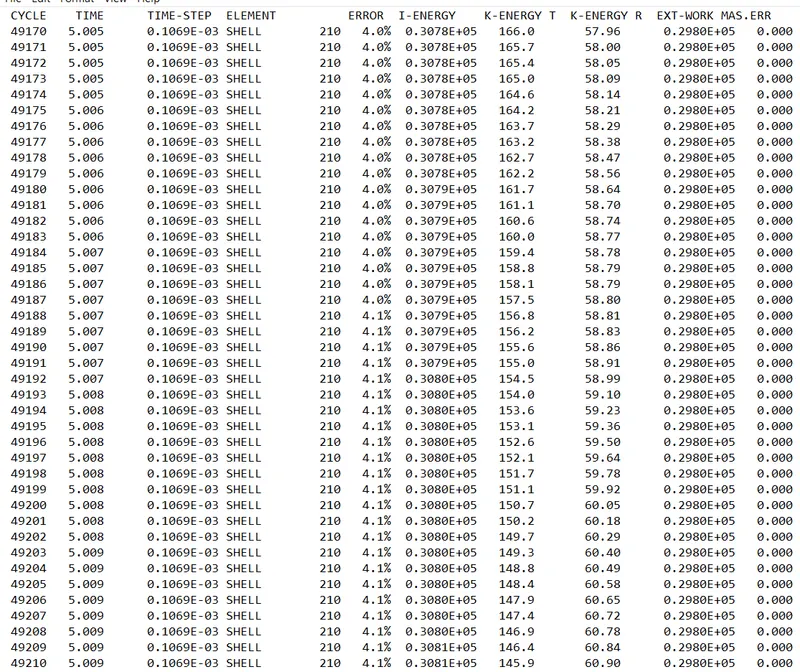
TIME TAKEN: 53.94s
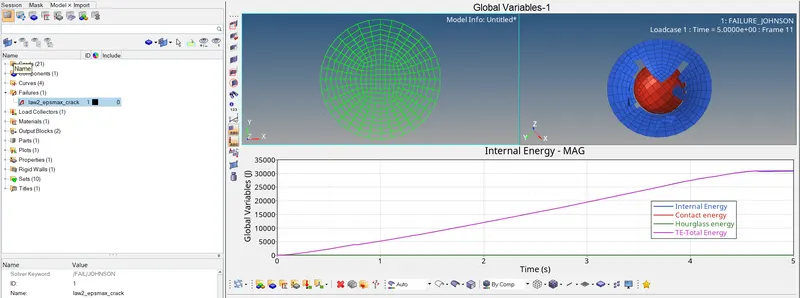
RESULTS: Here the results are almost similar to the first case, the ball penetrates through the plate.The plate undergoes a platstic deformation.There is a significant difference in the energy error that is being generated because of the johnson cook card parameters that we entered.
ifail_sh=1
dadv=1
ixfem=1
The energy error here is 4.1% while the mass error remains at 0%.
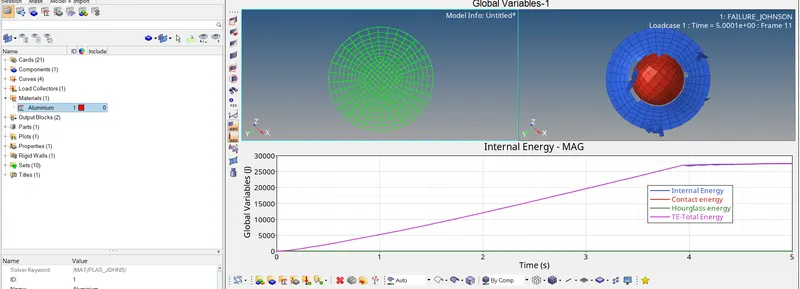
CASE3:
IMAGES AND GRAPHS:
ERROR PERCENTAGE:
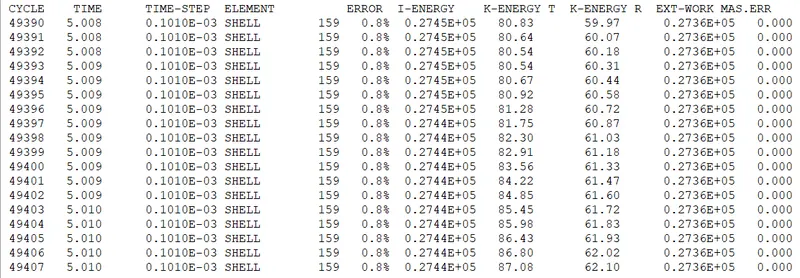
TIME TAKEN:50.28S
RESULT: The ball once again penetrates through the plate since we have still not deleted the eps_p_max value,therefore when one integeration point reaches the eps_p_max value the plate fails and undergoes plastic deformation.The enrgy error observed here is similar to that of the first case, it is about 0.8% while the mass error is 0%.
CASE4:
IMAGES AND GRAPHS:
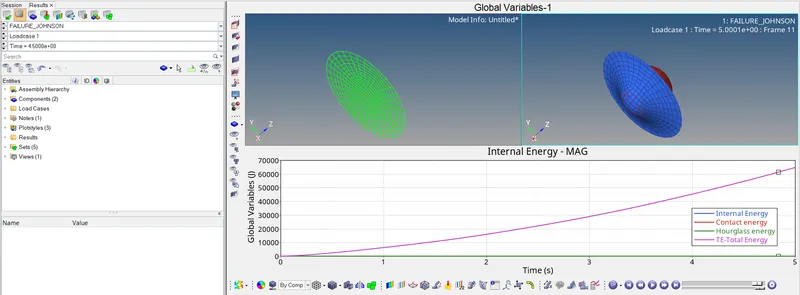
ERROR PERCENTAGE:

TIME TAKEN:50.47S
RESULT: The result observed here is different from what we saw in the above three cases. Since we have removed both the johnson failure card and the failure plastic strain, we observe that the plate behaves like an elastic material. Therefore we observe no plastic deformation in this case. The energy error is 3% and the mass error is 0%.
CASE 5:
IMAGES AND GRAPHS:
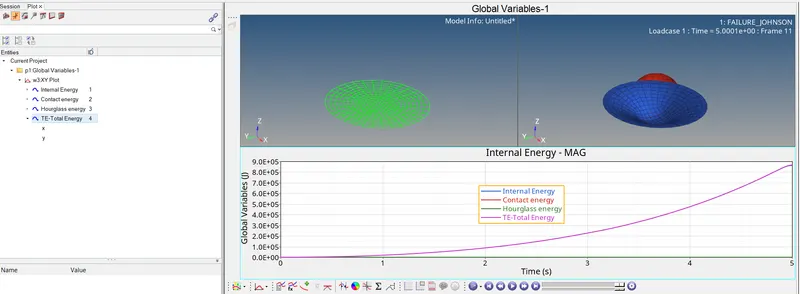
ERROR PERCENTAGE:

TIME TAKEN:47.56S
RESULT: Here since we have used the material law1 , as the law itself says its an elastic property, we hence observe no permenant deformation in the model. The deformation happening here is purely elastic. The energy error is 1.4% and mass error is 0%.
CASE6:
IMAGES AND GRAPHS:
 C
C
ERROR PERCENTAGE:

TIME TAKEN:54.19S
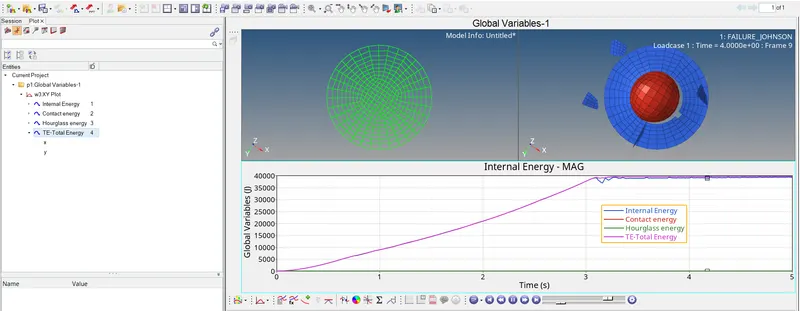
RESULT: The ball will completely penetrate through the plate and causes a deformation hole similar to that of the ball. This is because we have used material law 36 and used an user defined function curve to simulate the model,due to this the plate will undergo plastic strain. The energy error is observed to be -1.7% and the mass error is 0%.
CASE7:
IMAGES AND GRAPHS:
ERROR PERCENTAGE:

TIME TAKEN:50.31S
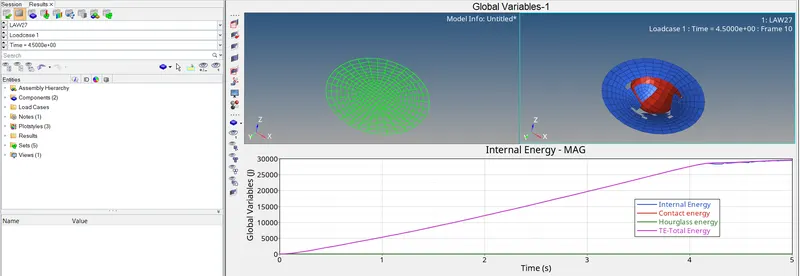
RESULT: The ball penetrates through the plate fully since we make use of the material law 27 which is the plastic brittle material.Since its a brittle material it undergoes permenant deformation.The energy error is 0.8% and the mass error is 0%.
COMPARISON: The below table represents the comparison between different cases.
| cycles | TIME TAKEN(S) |
ENERGY ERROR(%) |
MASS ERROR(%) |
|
| CASE1 | 49375 |
60.32 |
0.8 | 0 |
| CASE2 | 49210 | 53.94 | 4.1 | 0 |
| CASE3 | 49407 | 50.28 | 0.8 | 0 |
| CASE4 | 48736 | 50.47 | 3 | 0 |
| CASE5 | 47968 | 47.56 | 1.3 | 0 |
| CASE6 | 53136 | 54.19 | -1.7 | 0 |
| CASE7 | 49506 | 50.31 | 0.8 | 0 |
CONCLUSION:
Therefore from the above results we can observe that there are lots of variations in different material laws, hence we have to chose the material law appropriatly for the simulation according to our requirements.