Assignment 4
:STUDY ABOUT FAILURE OF DIFFERENT MATERIALS CARDS:
OBJECTIVE:
The ultimate aim of this assignment is to study all the material cses and transfer the observation during the simulation and record the results. By doing so, we can understand the materials laws and their behaviour in depth.
PROCEDURE:
Here the Sphere is defined as rigid body and the plate is analyzed by appling different material laws.
CASE I:
The first case deals with a model which is runned with the given parameters or condition.
STEP 1) Import the given starter file.
STEP 2) Run the simulation using Anlaysis > Radioss option.
STEP 3) Material Definition is under as follows:
Material Law 2 - JOHNSON COOK MATERIAL - It represents an isotrophic elasto plastic material.
Young's modulus (E) = 710000 MPa
Initial Density (rho) = .0028 g/mm3
Poisson's Ratio (nu) = .33
Yield Stress (a) = 290
Hardening modulus (b) = 562.3
Hardening exponent (n) = .63
Max Failure PLastic Strain (EPS_p_max) = 0.151
Max Stress (sig_max0) = 425 MPa
In addition to this Johnson failure card is also added to this model to find the effect of stress.
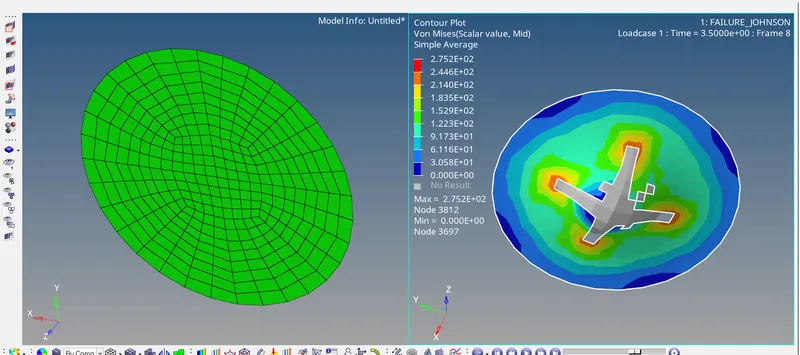
FIG 1. VON MISES STRESS REPRESENTATION
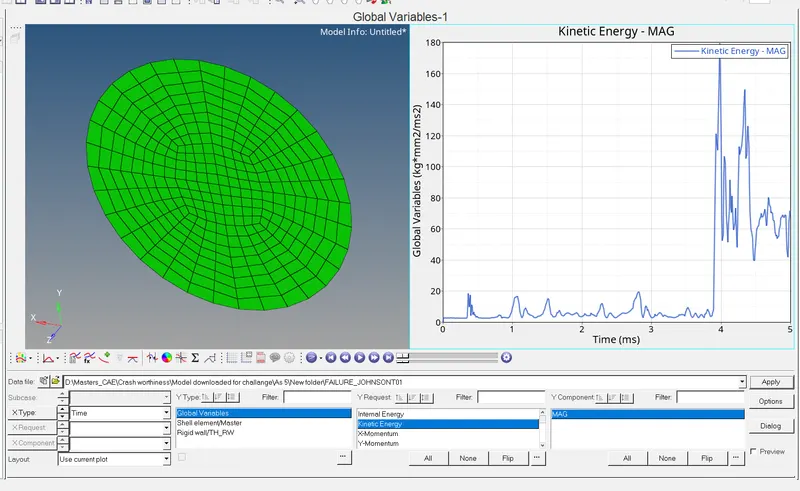
FIG 2. KINETIC ENERGY REPRESENTATION
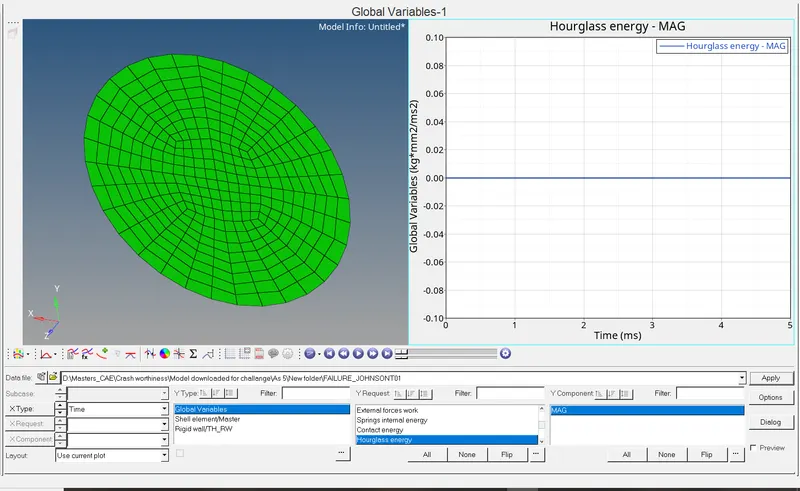
FIG 3. HOURGLASS ENERGY REPRESENTATION
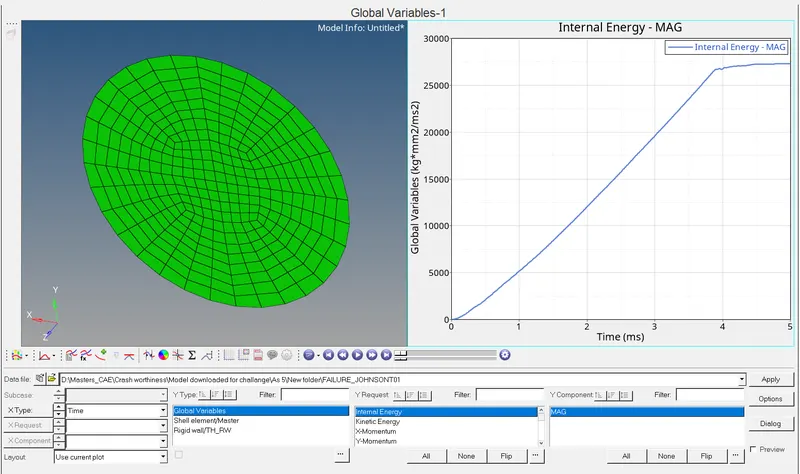
FIG 4. INTERNAL ENERGY REPRESENTATION
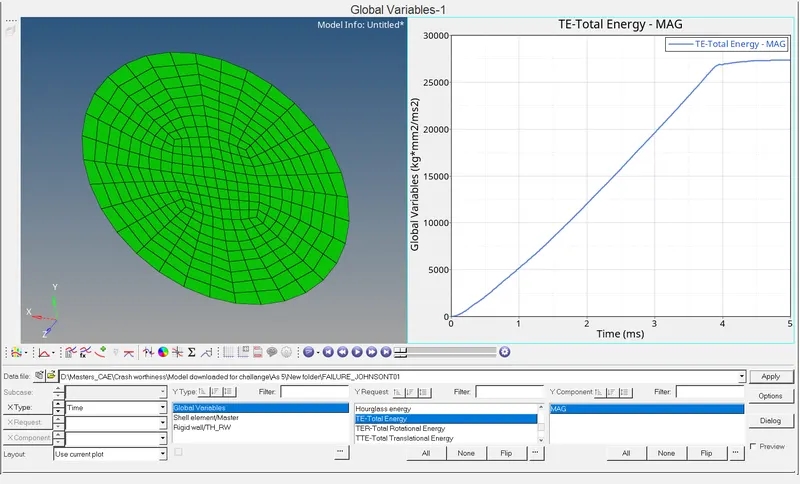
FIG 5. TOTAL ENERGY REPRESENTATION
OBSERVATION:
From the above simulation, we infer that rupture of elements takes place initially which ultimately give rises to deletion of elements with no crack formation. The elasticity property is visible upto certain aspect of yield stress and further experiences plasticity. This indicated the ductlie material property. Elements failure is encouraged when the strain rate exceeds the EPS_p_max value at atleast one of the integration point for any element. Also Hour glass energy is stabilized using Physical Stabilization method.
FAILURE TYPE: DELETION
MATERIAL PROPERTY EXHIBITED: DUCTILE
CASE II:
The next case deals with a model modified with Failure Johnson parameters (Introducing Shell Failure Flag & criterian for crack) and all other parameters remains the same.
STEP 1) Import the given starter file.
STEP 2) Modily the failure card with the parameters given below.
STEP 3) Run the simulation using Anlaysis > Radioss option.
STEP 4) Material Definition is under as follows:
Material Law 2 - JOHNSON COOK MATERIAL - It represents an isotrophic elasto plastic material.
Shell Failure Flag (Ifail_Sh) = 1
Criteria for Crack advancement (Dadv) = 1
XFEM Flag (Ixfem) = 1
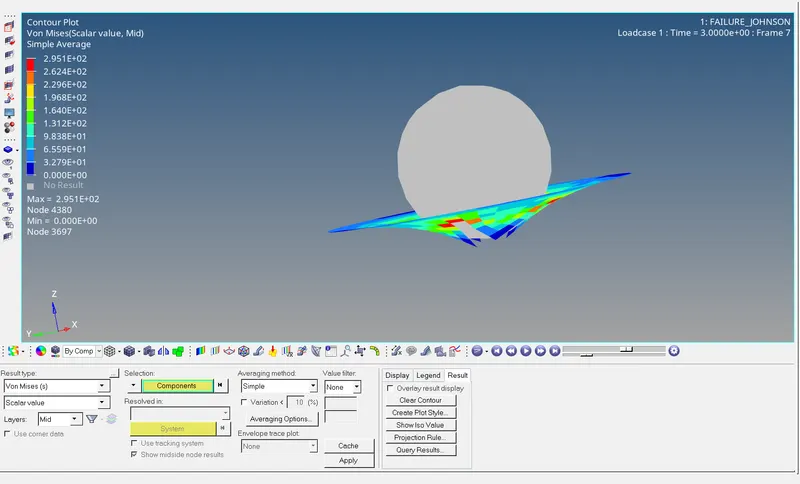
FIG 6. VON MISES STRESS REPRESENTATION
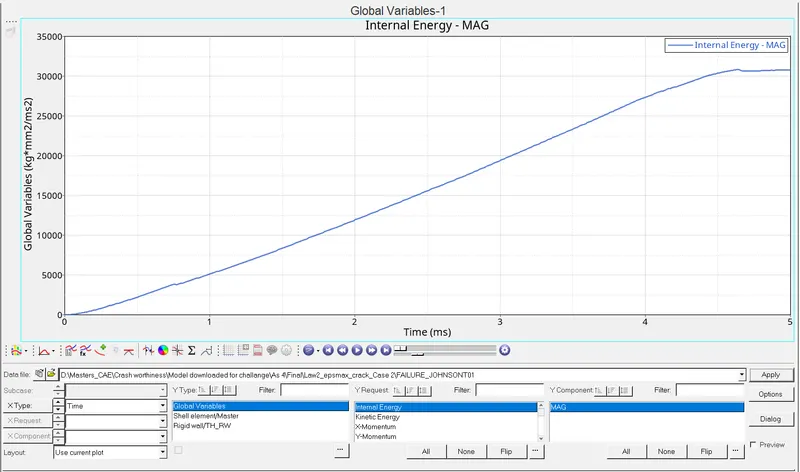
FIG 7. INTERNAL ENERGY REPRESENTATION
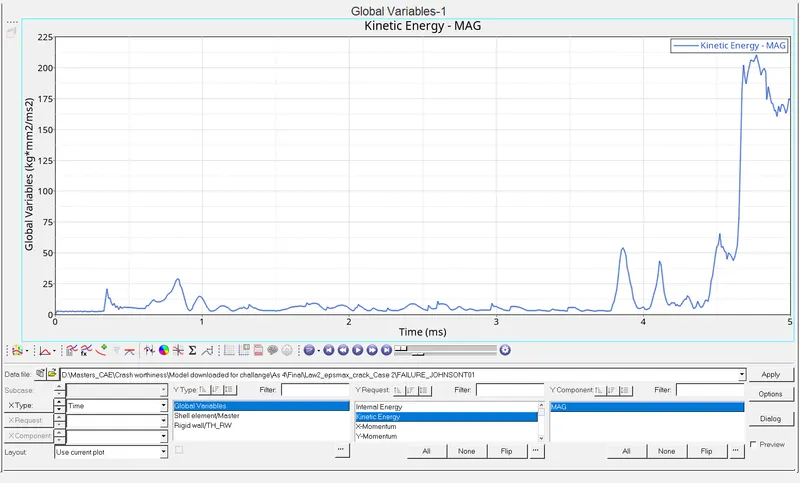
FIG 8.KINETIC ENERGY REPRESENTATION
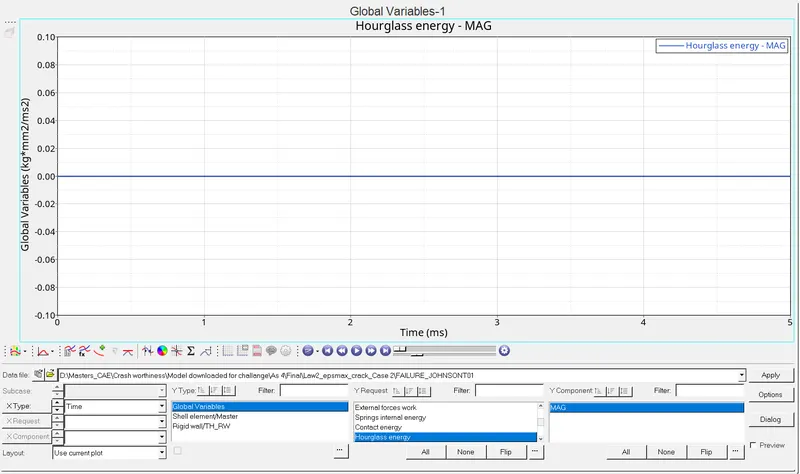
FIG 9. HOURGLASS ENERGY REPRESENTATION
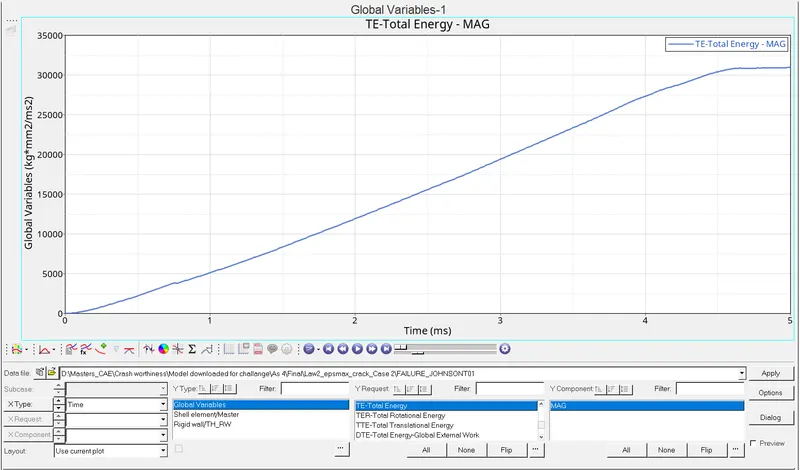
FIG 10. TOTAL ENERGY REPRESENTATION
OBSERVATION:
In this simulation, compared to previous scenario, element deletion takes place with crack advancement. If element has no failed neighbors and D > 1, then, new crack initialization happens in the element.
and if element has failed neighbors and D > Dadv then, Dadv is used for crack advancement. Crack criterian will be used if existing crack arrives to a boundary of an element & element gets deleted, if a second crack arrives to the same element.
FAILURE TYPE: CRACK
MATERIAL PROPERTY EXHIBITED: DUCTILE
CASE III:
The next case deals with a model which is runned without Failure Johnson criteria.
STEP 1) Import the given starter file.
STEP 2) Delete the Johnson failure criteria.
STEP 3) Run the simulation using Anlaysis > Radioss option.
STEP 4) Material Definition is under as follows:
Material Law 2 - JOHNSON COOK MATERIAL - It represents an isotrophic elasto plastic material.
Young's modulus (E) = 710000 MPa
Initial Density (rho) = .0028 g/mm3
Poisson's Ratio (nu) = .33
Yield Stress (a) = 290
Hardening modulus (b) = 562.3
Hardening exponent (n) = .63
Max Failure PLastic Strain (EPS_p_max) = 0.151
Max Stress (sig_max0) = 425 MPa
Unlike case I, Johnson failure card is removed in this model to study the effect of stress.
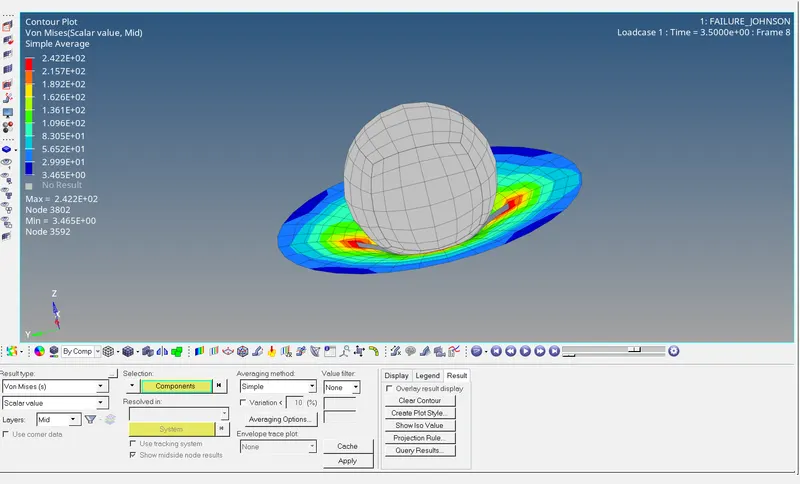
FIG 11. VON MISES STRESS REPRESENTATION
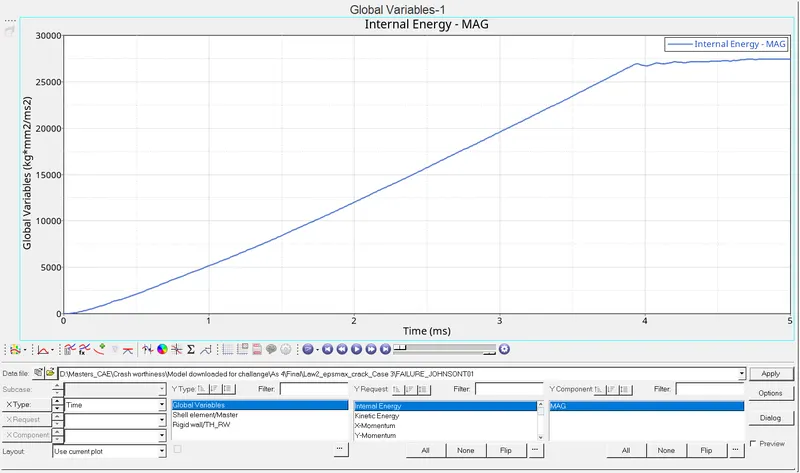
FIG 12. INTERNAL ENERGY REPRESENTATION
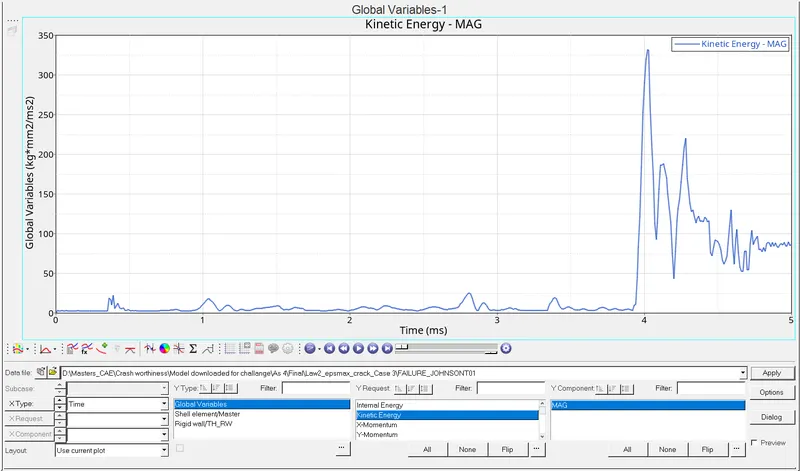
FIG 13. KINETIC ENERGY REPRESENTATION
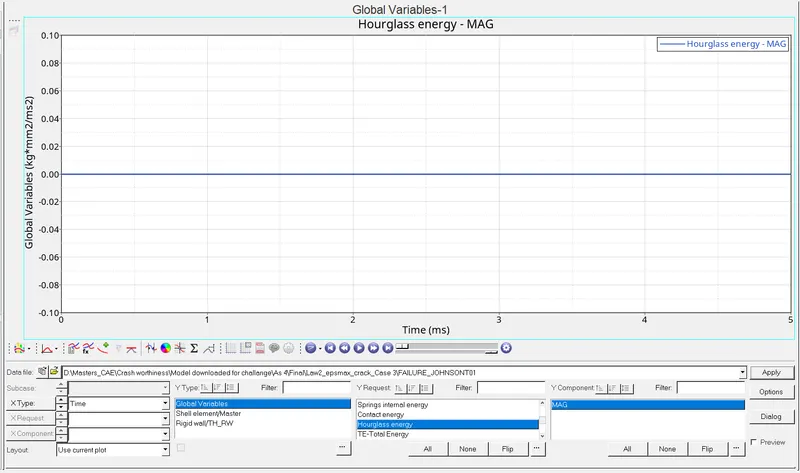
FIG 14. HOURGALSS ENERGY REPRESENTATION
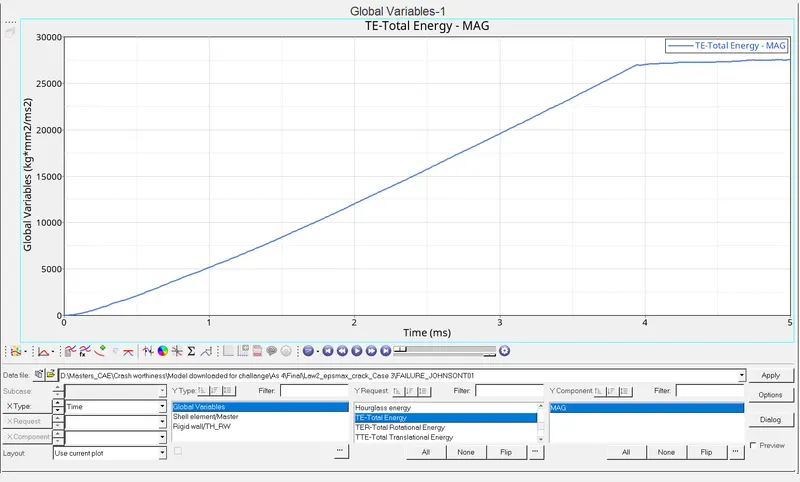
FIG 15. TOTAL ENERGY REPRESENTATION
OBSERVATION:
Due to the absence of Johnson failure card, the failure rate in more compared to previous caeses. The elements gets deleted before the time at which elements gets deleted in the above cases. The overall stress is quite high and elements gets deleted at a rapid speed.
FAILURE TYPE: DELETION
MATERIAL PROPERTY EXHIBITED: DUCTILE
CASE IV:
The next case deals with a model without Eps_p_max value.
STEP 1) Import the starter file from the previous case.
STEP 2) Change the Epsmax value to 0, so that Epsmax is disabled.
STEP 3) Run the simulation using Anlaysis > Radioss option.
STEP 4) Material Definition is under as follows:
Material Law 2 - JOHNSON COOK MATERIAL - It represents an isotrophic elasto plastic material.
Young's modulus (E) = 710000 MPa
Initial Density (rho) = .0028 g/mm3
Poisson's Ratio (nu) = .33
Yield Stress (a) = 290
Hardening modulus (b) = 562.3
Hardening exponent (n) = .63
Max Failure PLastic Strain (EPS_p_max) = 0.
Max Stress (sig_max0) = 425 MPa
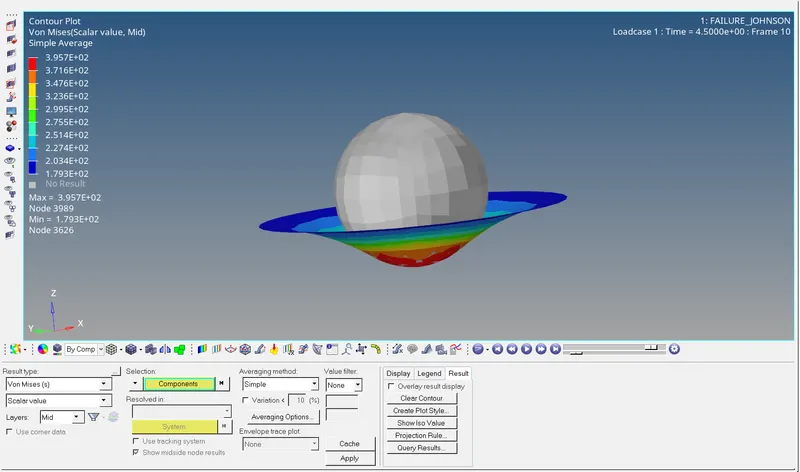
FIG 16. VON MISES STRESS REPRESENTATION
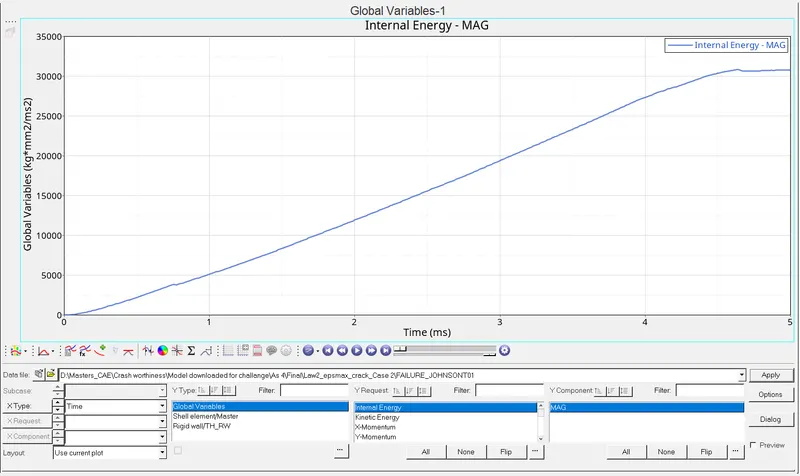
FIG 17. INTERNAL ENERGY REPRESENTATION
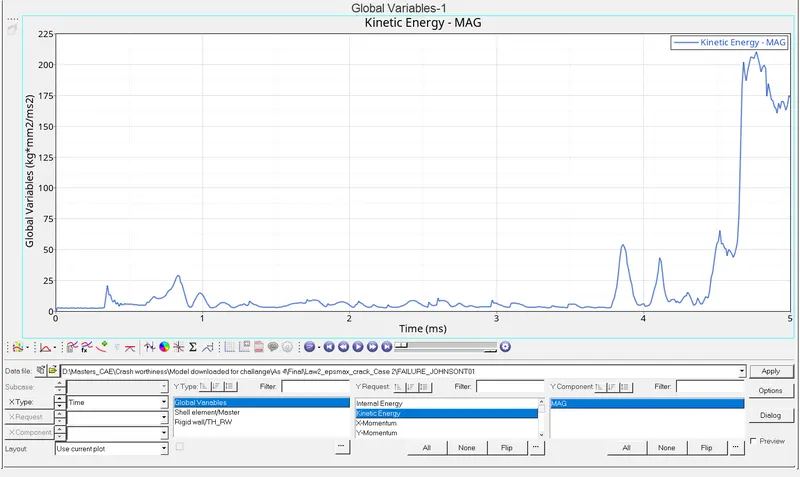
FIG 18. KINETIC ENERGY REPRESENTATION
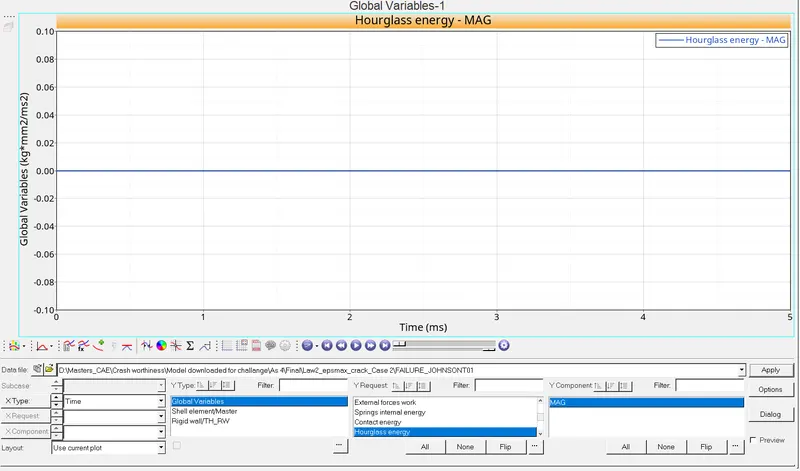
FIG 19. HOURGLASS ENERGY REPRESENTATION
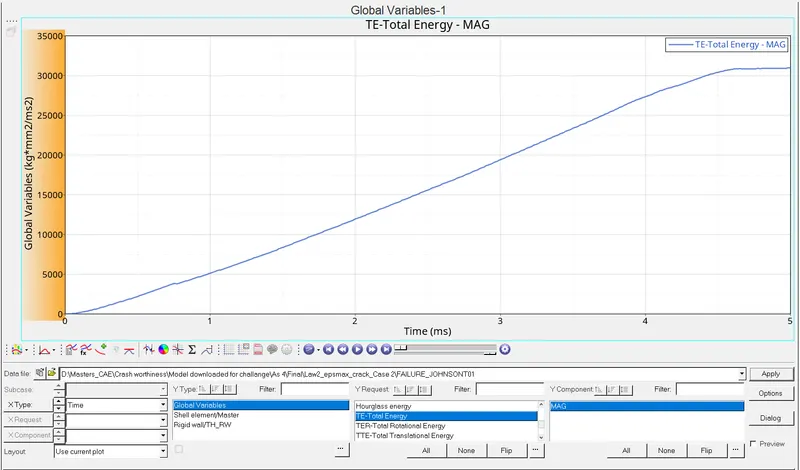
FIG 20. TOTAL ENERGY REPRESENTATION
OBSERVATION:
Since in this case Eps_p_max value is removed in this case, failure of elements is governed by Max stress (Sig_max0) which is 425 MPa. The failure takes place in an uniform rate. All the impact due to rigid sphere is absorbed by the plate as strain energy and hence no elements gets deleted.
CASE V:
The fifth case deals with a model with Material law 1. To define this law Young's modulus, Density, Poisson's Ratio is only required.
STEP 1) Import the starter file from the previous case.
STEP 2) Change the material to law1.
STEP 3) Run the simulation using Anlaysis > Radioss option.
STEP 4) Material Definition is under as follows:
Material Law 1 -Elastic MATERIAL - It represents an isotrophic elastic material.
Young's modulus (E) = 710000 MPa
Initial Density (rho) = .0028 g/mm3
Poisson's Ratio (nu) = .33
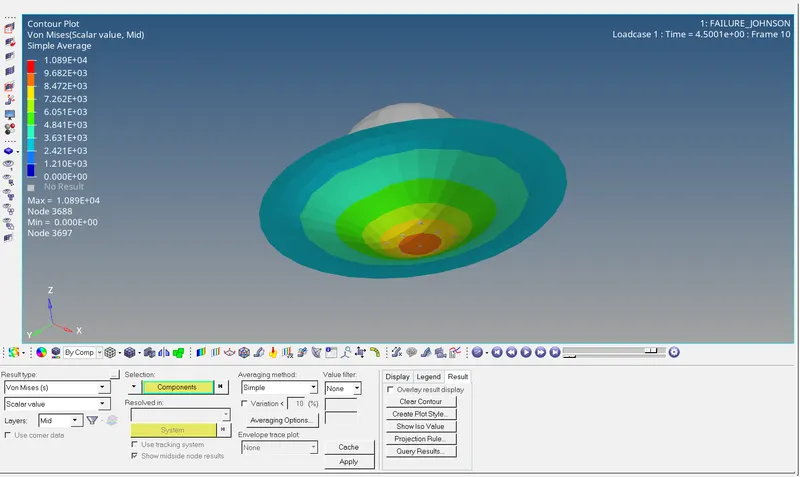
FIG 21. VON MISES STRESS REPRESENTATION
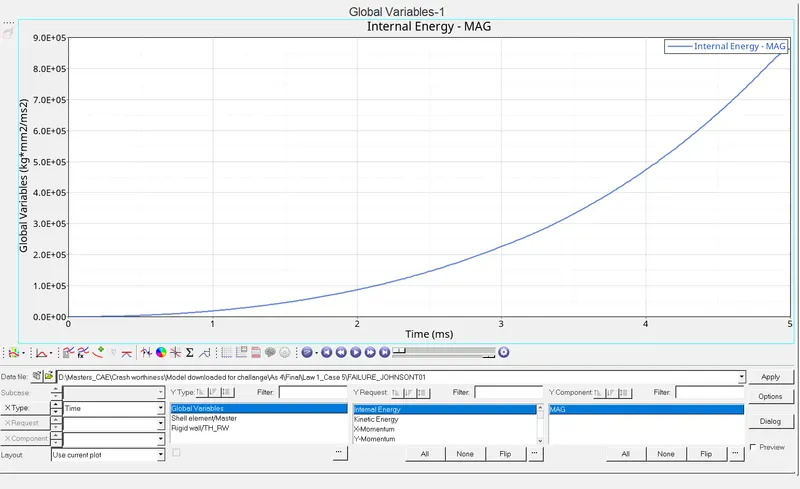
FIG 22. INTERNAL ENERGY REPRESENTATION
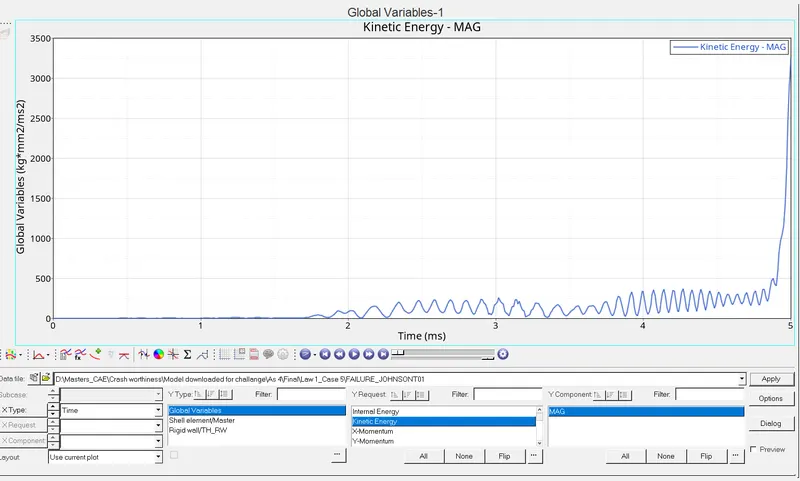
FIG 23. KINETIC ENERGY REPRESENTATION
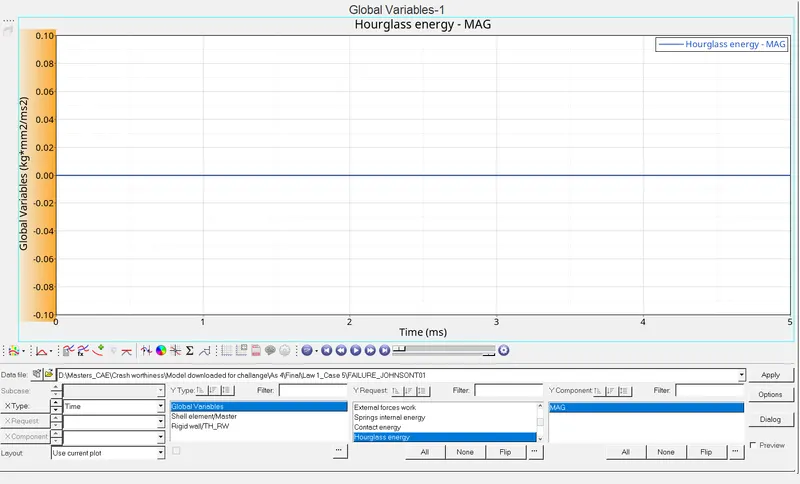
FIG 24. HOURGLASS ENERGY REPRESENTATION
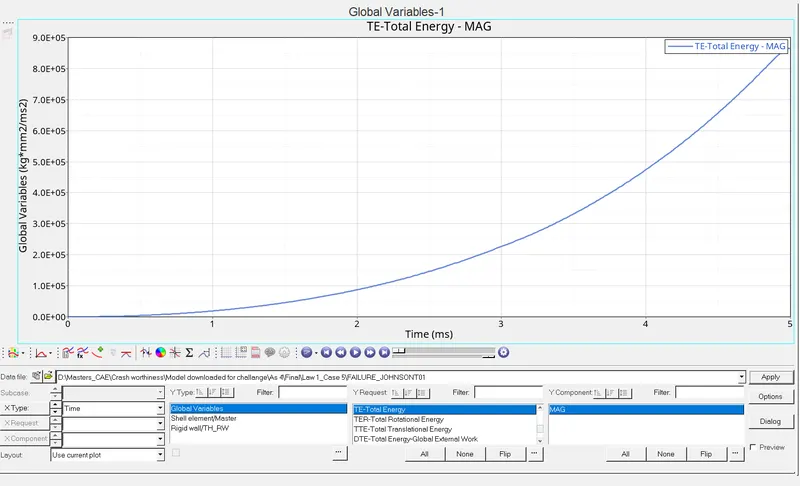
FIG 25. TOTAL ENERGY REPRESENTATION
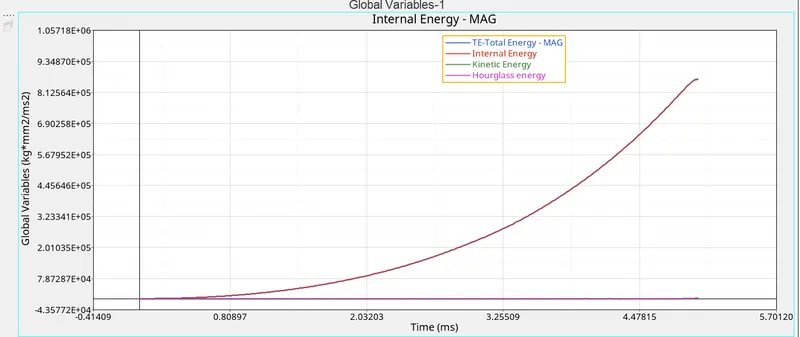
FIG 26. COMBINED ENERGY REPRESENTATION
OBSERVATION:
This case purely pictures the elastic behaviour of the material. As the rigid ball hits the plate, the impact is stored in the plate as strain energy. Hence the total energy is the internal energy stored in the plate as the rigid sphere comes in contact with the same. Hour glass energy is zero.
FAILURE TYPE: NIL
MATERIAL PROPERTY EXHIBITED: ELASTIC
CASE VI:
The sixth case deals with a model with change of material to Law 36.
STEP 1) Import the starter file from the previous case.
STEP 2) Change the material to law6.
STEP 3) Load the curve with the required inputs.
STEP 3) Run the simulation using Anlaysis > Radioss option.
STEP 4) Material Definition is under as follows:
Material Law 36 - ELASTIC-PLASTIC-TABULATED MATERIAL.
Young's modulus (E) = 710000 MPa
Initial Density (rho) = .0027 g/mm3
Poisson's Ratio (nu) = .33
Max Failure PLastic Strain (EPS_p_max) = 0.16
Tensile Failure Strain (EPS_t) = 0.1
N_funct = 1
Curve Input:
| X | Y |
| 0 | 300 |
| 0.000484 | 360.13 |
| 0.001119 | 390.56 |
| 0.003211 | 442.82 |
| 0.004781 | 465.98 |
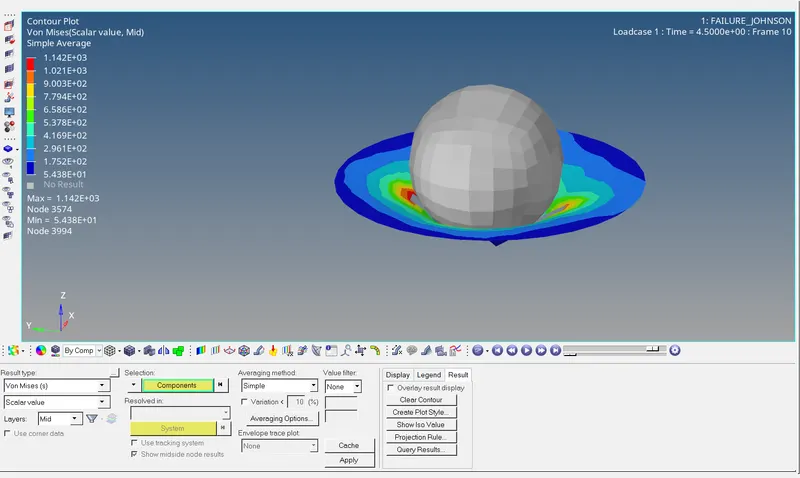
FIG 27. VON MISES STRESS REPRESENTATION
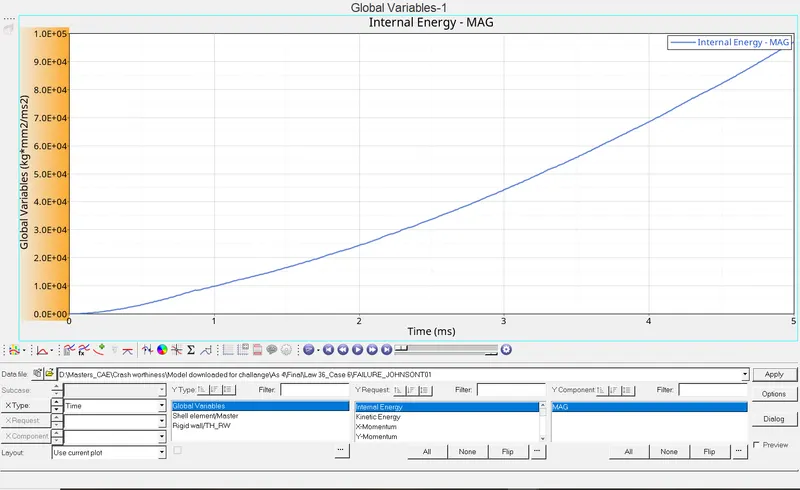
FIG 28. INTERNAL ENERGY REPRESENTATION
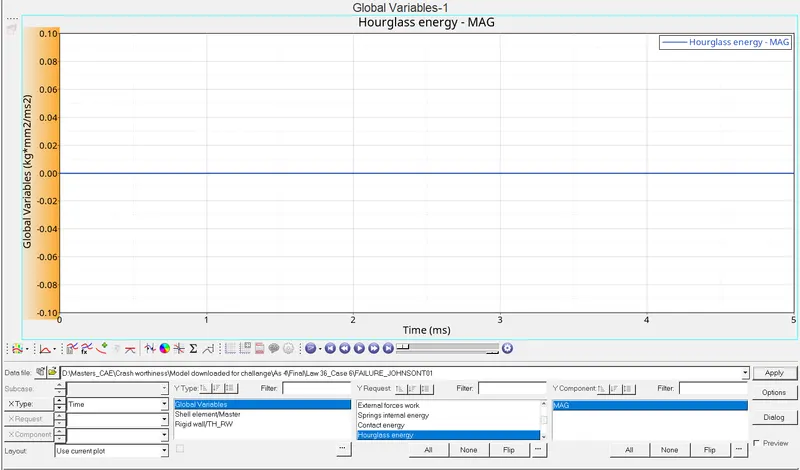
FIG 29. HOURGLASS ENERGY REPRESENTATION
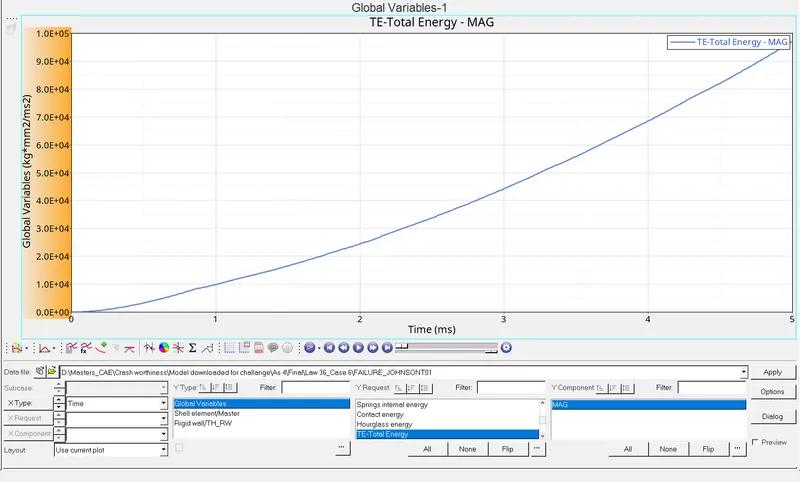
FIG 30. TOTAL ENERGY REPRESENTATION
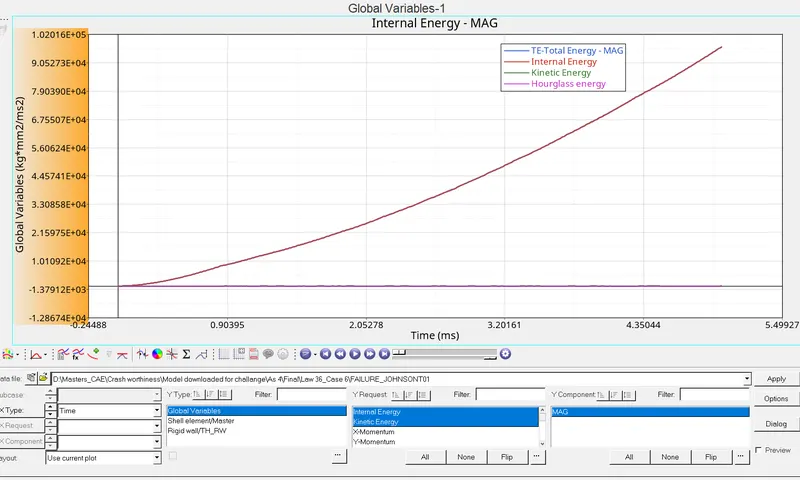
FIG 31. COMBINED ENERGY REPRESENTATION
OBSERVATION:
During this simulation certain plastic behaviour persists in the model and after that the element deletion takes place if any of the integration points in an element reaches EPS_p_max value.
FAILURE TYPE: DELETION
MATERIAL PROPERTY EXHIBITED: DUCTILE
CASE VII:
The final case deals with a model which is applied with MAT LAW 27.
STEP 1) Import the starter file from the previous case.
STEP 2) Run the simulation using Anlaysis > Radioss option.
STEP 3) Material Definition is under as follows:
Material Law 27 - ELASTIC-PLASTIC-BRITTLE MATERIAL. It represents brittle materials.
Young's modulus (E) = 710000 MPa
Initial Density (rho) = .0028 g/mm3
Poisson's Ratio (nu) = .33
Yield Stress (a) = 290
Hardening modulus (b) = 562.3
Hardening exponent (n) = .63
Max Failure PLastic Strain (EPS_p_max) = 0.151
Max Stress (sig_max0) = 425 MPa
Tensile failure Strain in principal strain direction = EPS_t1 = EPS_t2 = 0.14
Max Tensile failure Strain in principal strain direction = EPS_m1 = EPS_m2 = 0.15
Tensile Strain for element deletion in principal strain direction = EPS_f1 = EPS_f2 = 0.151
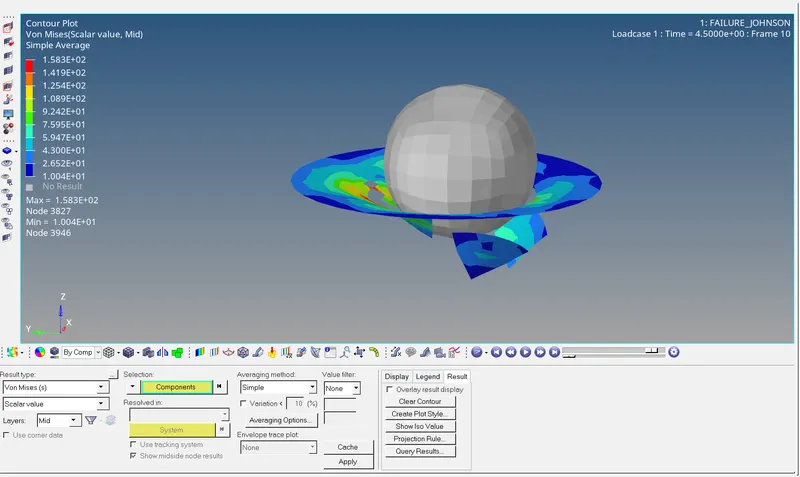
FIG 32. VON MISES STRESS REPRESENTATION
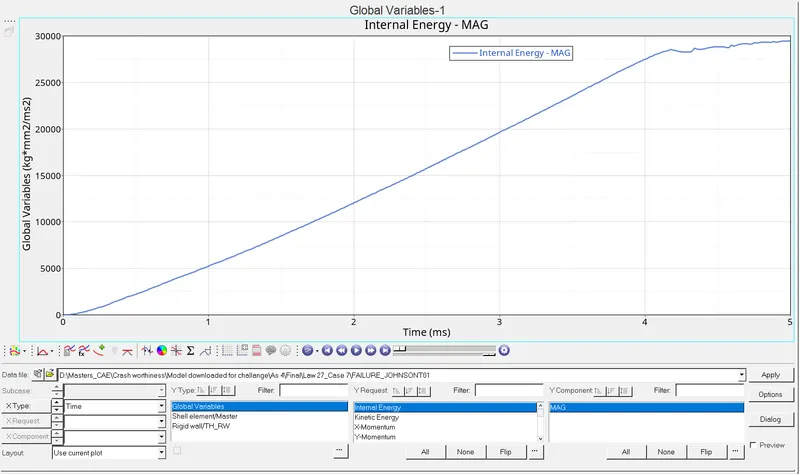
FIG 33. INTERNAL ENERGY REPRESENTATION
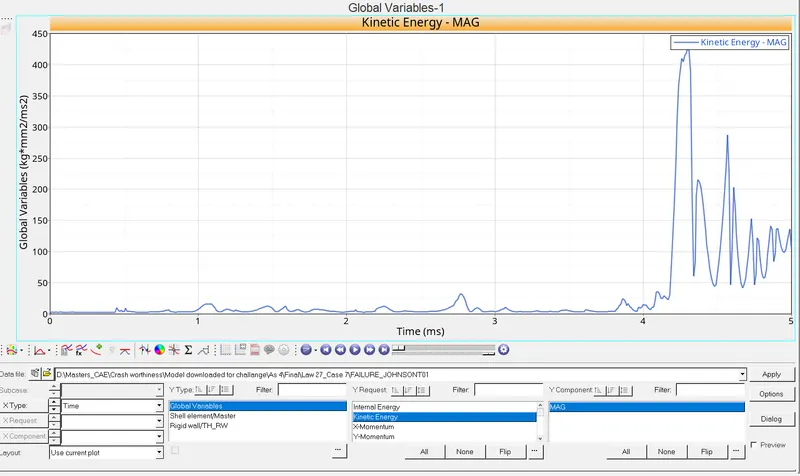
FIG 34. KINETIC ENERGY REPRESENTATION
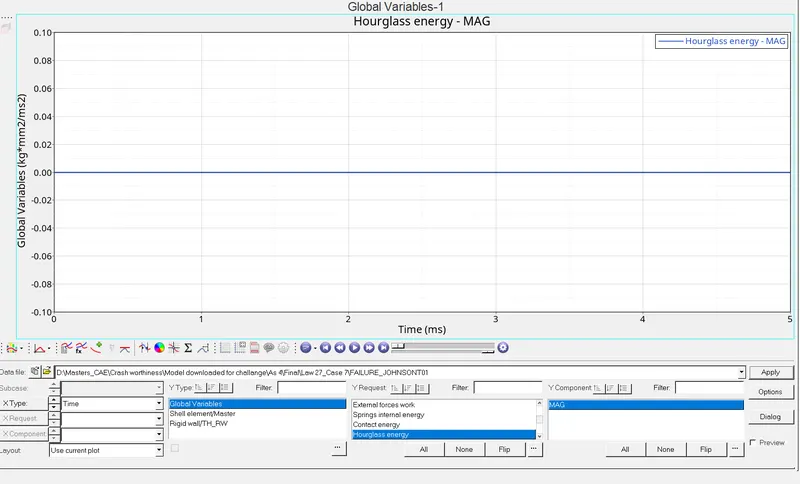
FIG 35. HOURGLASS ENERGY REPRESENTATION
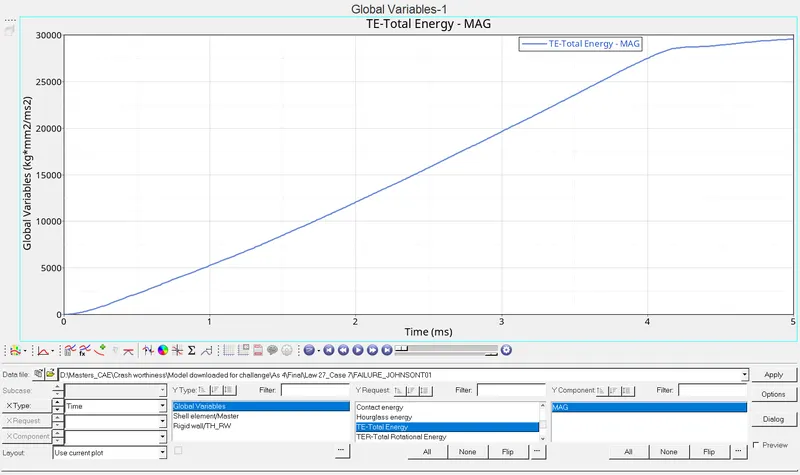
FIG 36. TOTAL ENERGY REPRESENTATION
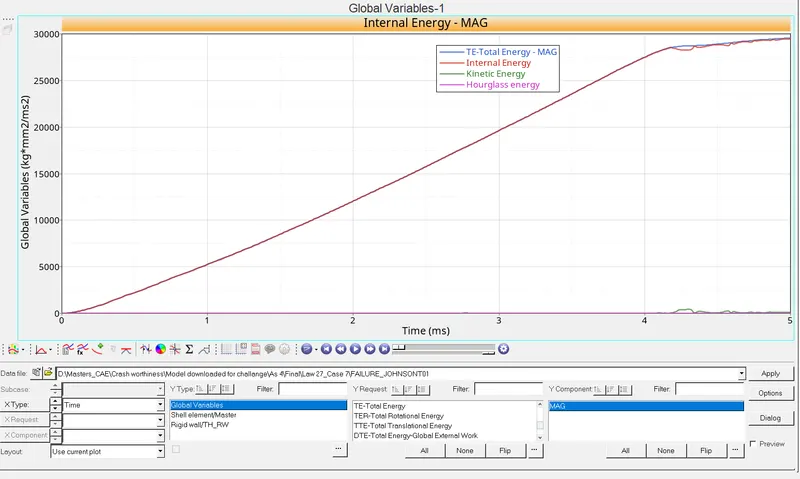
FIG 37. COMBINED ENERGY REPRESENTATION
OBSERVATION:
Due to the absence of EPS_p_max, failure is governed due to EPS_f in this case. If any of the integration points of element reaches the EPD-f value, the element gets deleted suddenly without any rupture. A small sign of elastic property is exhibited before brittle failure happens.
FAILURE TYPE: DELETION WITHOUT RUPTURE
MATERIAL PROPERTY EXHIBITED: BRITTLE
CONCLUSION:
Thus from above all the simulation study and comparsion, the ideal selection depends on the problem involved and purely on the situation. If the material applied on the brittle materials like Aluminium or glass Law 27 is highly preferred or if problem requires elastic behaviour LAW 1 comes into the show.
For practical field scenario, the plate with ductile material in which the elements faile with crack propogation, Law 2(Case 2) is highly recommended for better accuracy.