Assignment 4
AIM: To discuss in detail about the given 7 cases and explain the reason for obtaining such a specific outputs.
Case 1 : Run the given model as it is in Radioss.
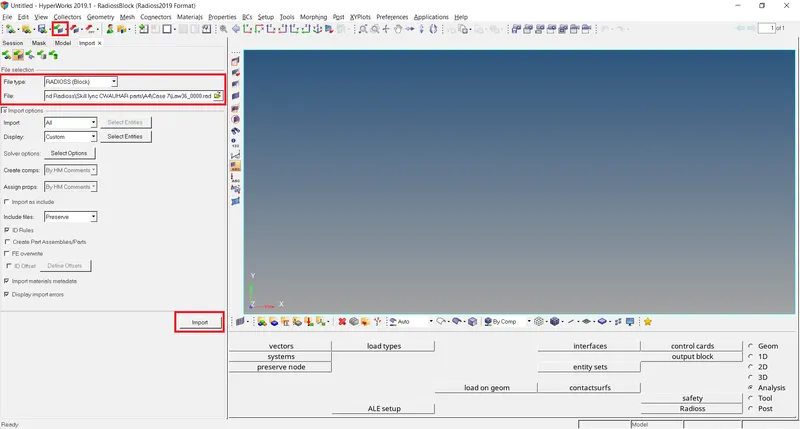
Import "FAILURE_JOHNSON_0000.rad" file to hyperworks by goto file>import solver deck>select the file>import.
To run the analysis go to analysis>radioss>save the file(change rad file name to "Law2_epsmax_failure")>radioss.
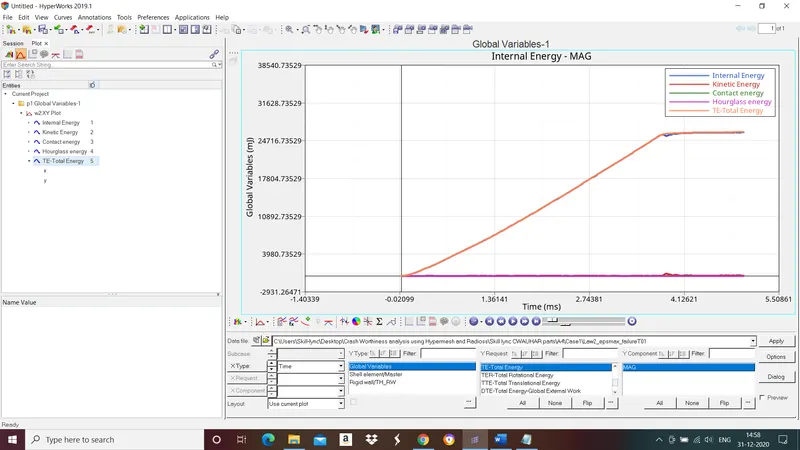
Fig: Energy(Internal energy, kinetic energy and total energy) vs time graph.
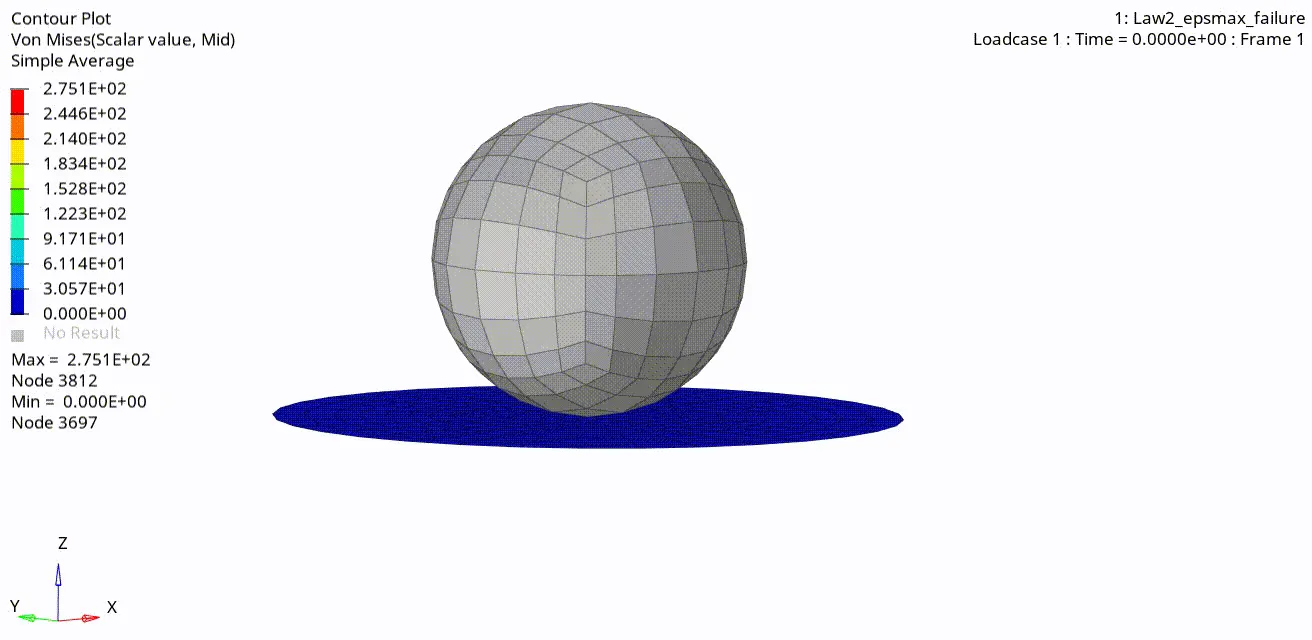
Fig: Animation representation of deformation of plate.
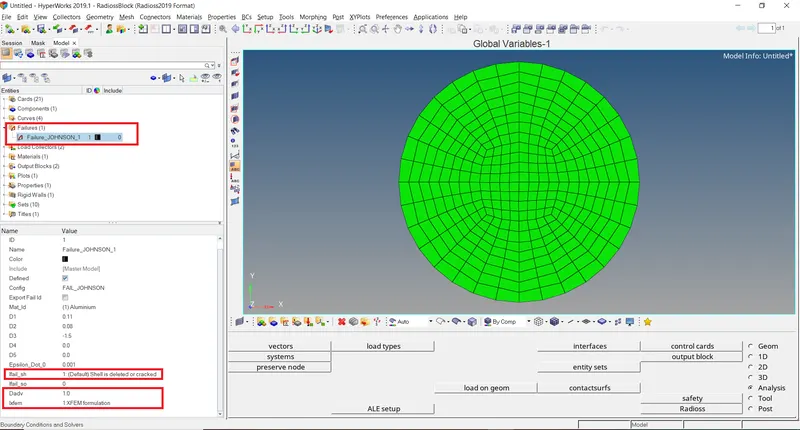
Case 2: In /FAIL/JOHNSON, change Ifail_sh=1, Dadv=1 and Ixfem=1. Run the model as Law2_epsmax_crack.
Open "Law2_epsmax_failure_0000.rad" file in hyperworks as explained in above. In tab bar in failure collector select Failure_Johnson_1 card and edit the parameters.
To run the analysis go to analysis>save the file as "Law2_epsmax_crack">Radioss.
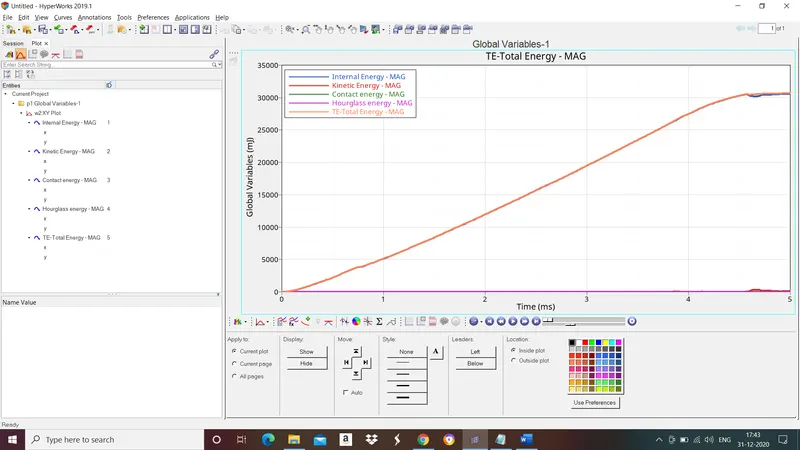
Fig: Energy(Internal energy, kinetic energy and total energy) vs time graph.
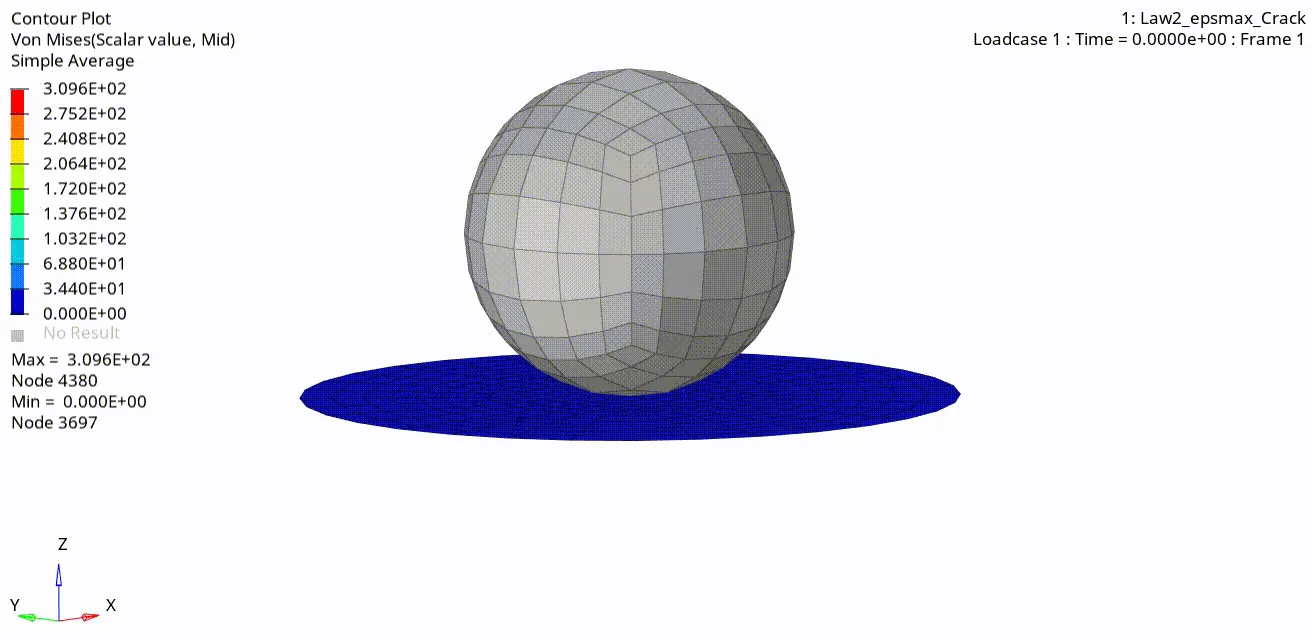
Fig: Animation representation of deformation of plate.
Comaparision between case 1 and case2:
/FAIL/JOHNSON describes the failure criteria by johnsoon cook failure model. In case 1 elements got deleted directly after failure because Ixfem=0(failure-element deleted). In case 2 elements cracks first then got deleted because Ifail_sh=2 Ixfem=1(failure: element cracked) and Dadv=1(Criterion for the crack advancement).
There is sudden hike in kinetic energy in case 1 after elements got deleted. In case 2 There is also hike in kinetic energy but smoother compared to case 1 beacuase elements cracks first then got deleted.
In both cases internal energy increases exponentially vs time then become constant after elements are deleted.
In both cases there is no or little change in Hourglass energy and contact energy because of using QEPH 24 Shell elements.
Case 3:Delete /Fail/JOHNSON card. Run the model as Law2_epsmax_nofail.
Open "Law2_epsmax_crack_0000.rad" file in hyperworks as explained in above. In tab bar in failure collector delete Failure_Johnson_1 card.
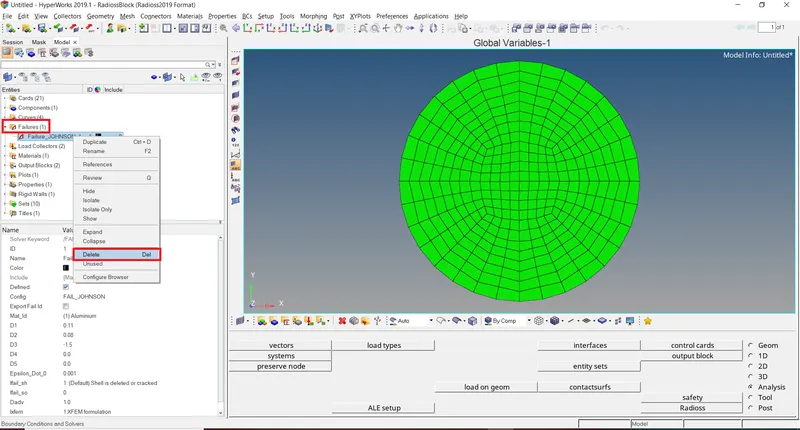
To run the analysis go to analysis>Radioss>Save the file name as "Law2_epsmax_nofail">radioss.
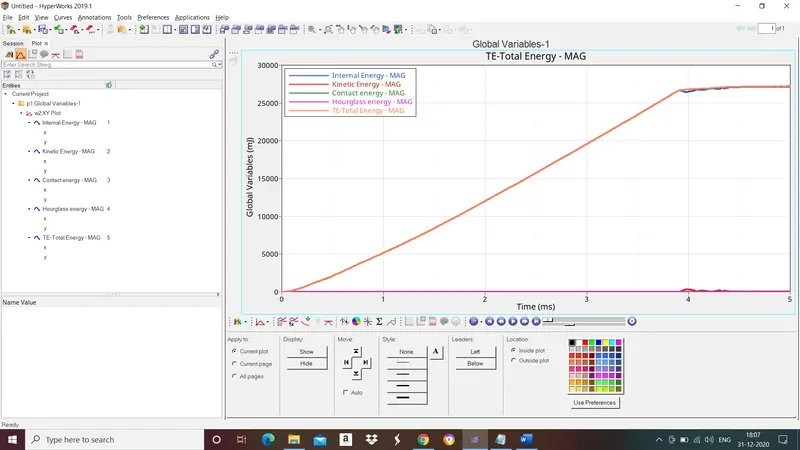
Fig: Energy(Internal energy, kinetic energy and total energy) vs time graph.
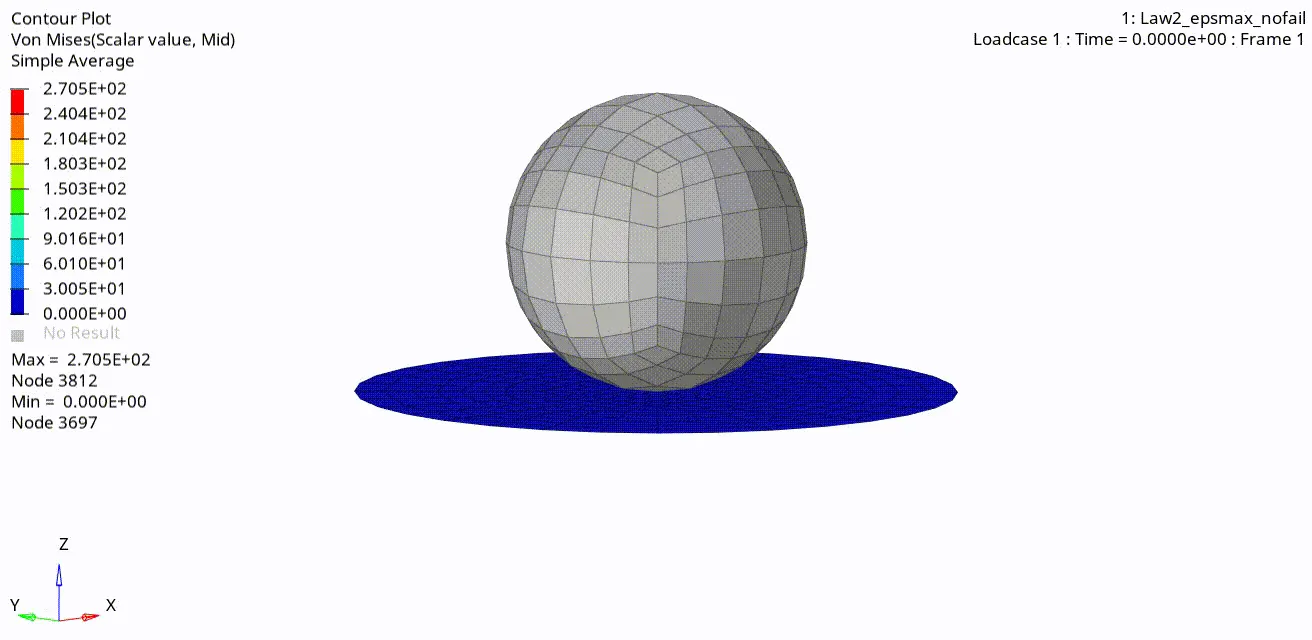
Fig: Animation representation of deformation of plate.
Case 4:Delete the value of EPS_p_max and run the model with name Law2.
Open "Law2_epsmax_nofail_0000.rad" file in hyperworks as explained in above. Go to material collector select "Aluminium" card and delete EPS_p_max value.
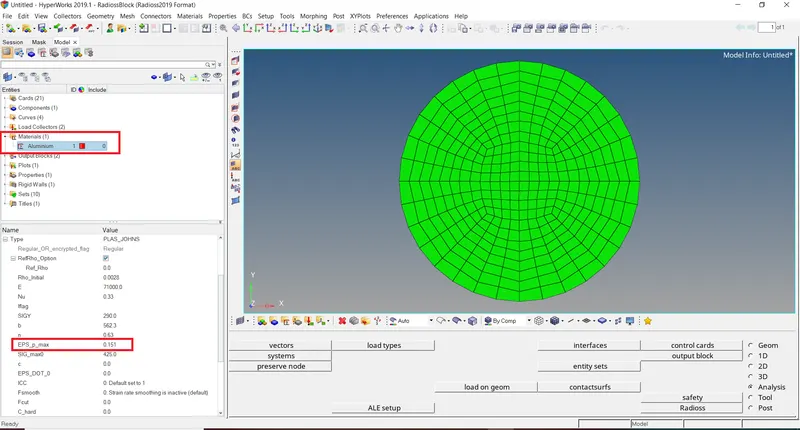
To run the analysis go to analysis>Radioss>save the file name as "Law2">Radioss.
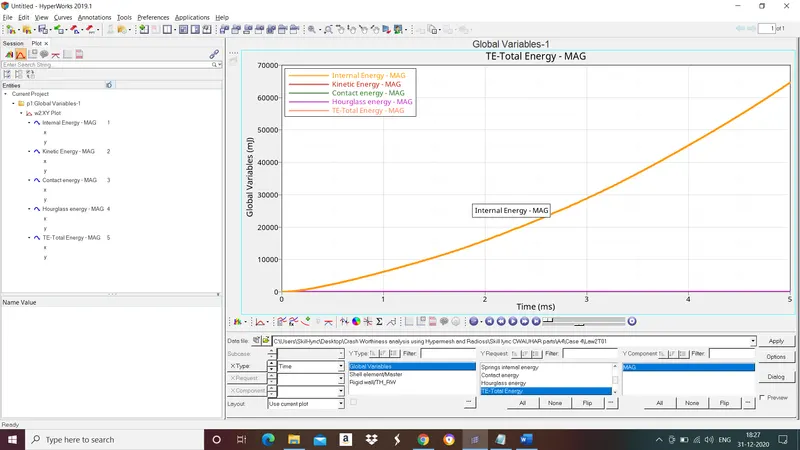
Fig: Energy(Internal energy, kinetic energy and total energy) vs time graph.
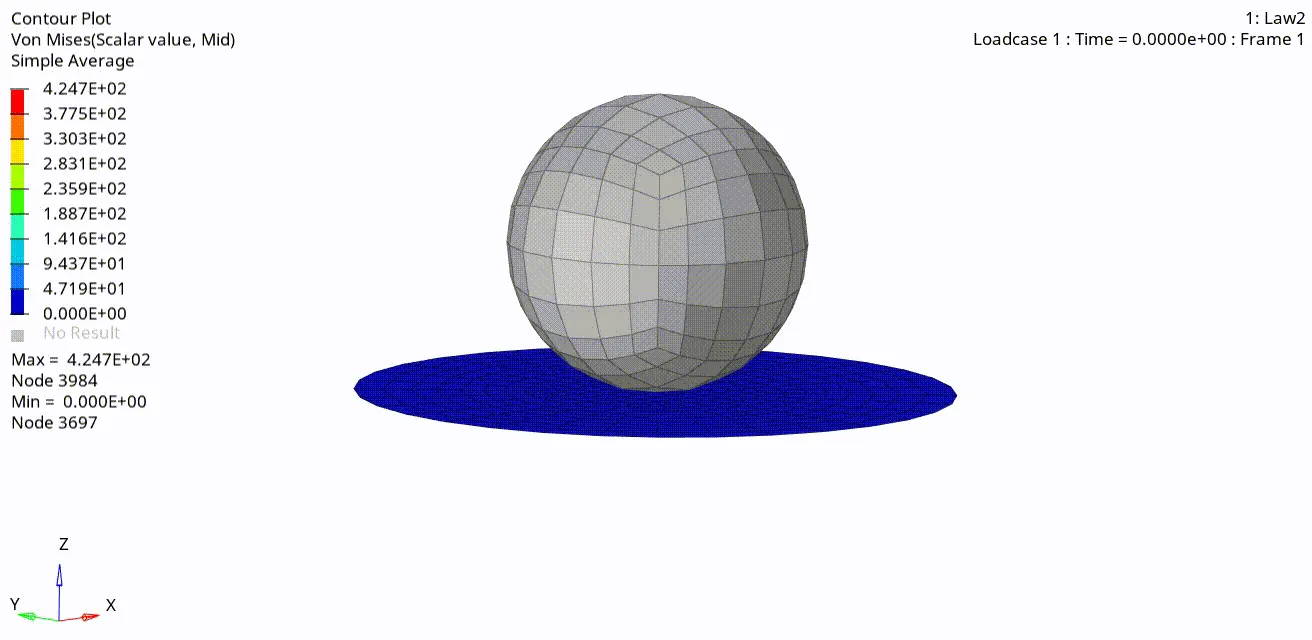
Fig: Animation representation of deformation of plate.
Comparision between Case 3 and Case 4:
In case 3 elements got deleted after crossing EPS_p_max(failure plastic strain) value. In case 4 EPS_p_max value is deleted therefore elements can take infinite strain.
There is sudden hike in kinetic energy in case 3 after elements got deleted. In case 4 there is no change in kinetic energy.
In both the cases internal energy increases exponentially vs time but become constant after elements are deleted in case 3.
In both cases there is no or little change in Hourglass energy and contact energy because of using QEPH 24 Shell elements.
Case 5:Convert this material model to Law1 elastic with same density, E, nu and run.
Open "Law2_0000.rad" file in hyperworks as explained in above. Goto>material collector> select "Aluminium" card>Change card image to "Law1" and give same density, E and nu values.
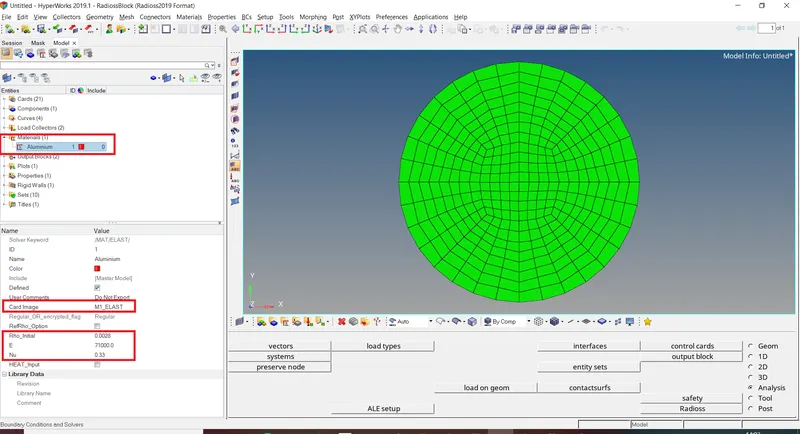
To run the analysis go to analysis>Radioss>save the file name as "Law1">Radioss.
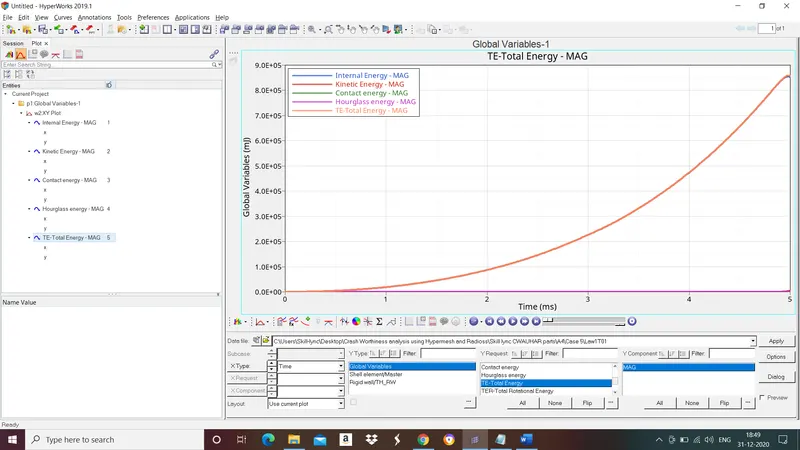
Fig: Energy(Internal energy, kinetic energy and total energy) vs time graph.
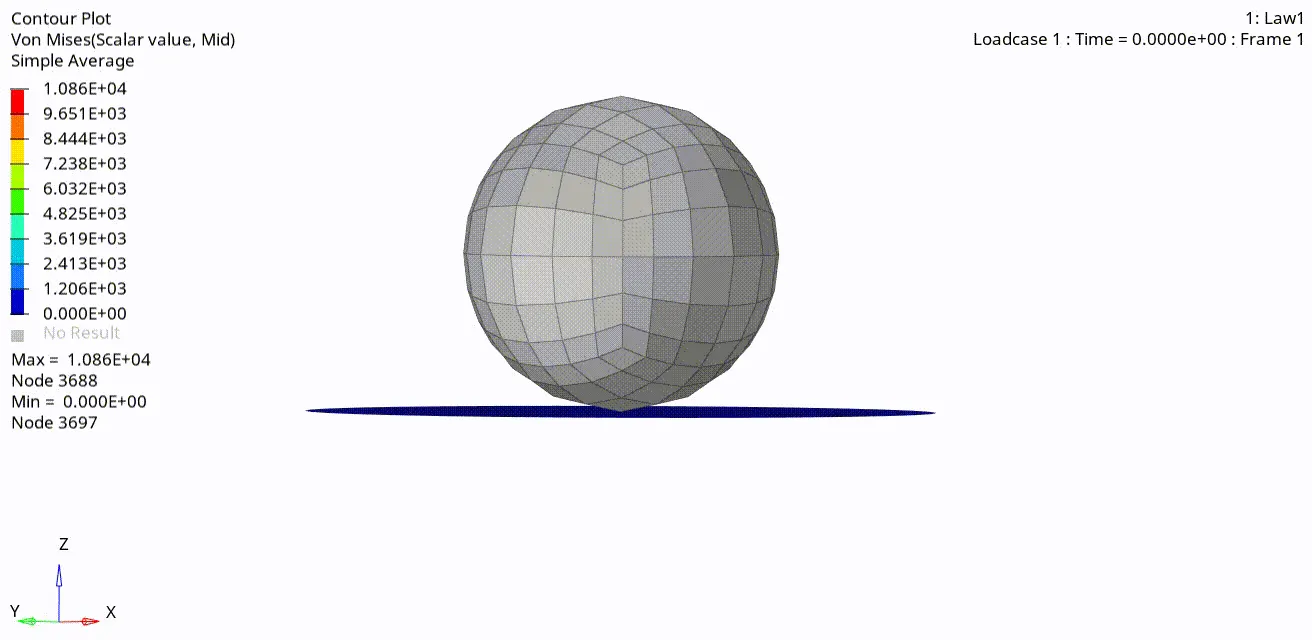
Fig: Animation representation of deformation of plate.
This material law is used to model purely elastic materials.
Internal energy increases exponentially vs time. There is no or little change in Hourglass energy and contact energy because of using QEPH 24 Shell elements.
Case 6:Open "LAW27_0000.rad" file. Change the shell properties to recommended shell properties. Notice the material card Johnson cook parameters but different values for EPS based failure. Run the model with name Law27.
Open "Law27_0000.rad" file in hyperworks as explained in above. Change the shell properties to recommended shell properties.
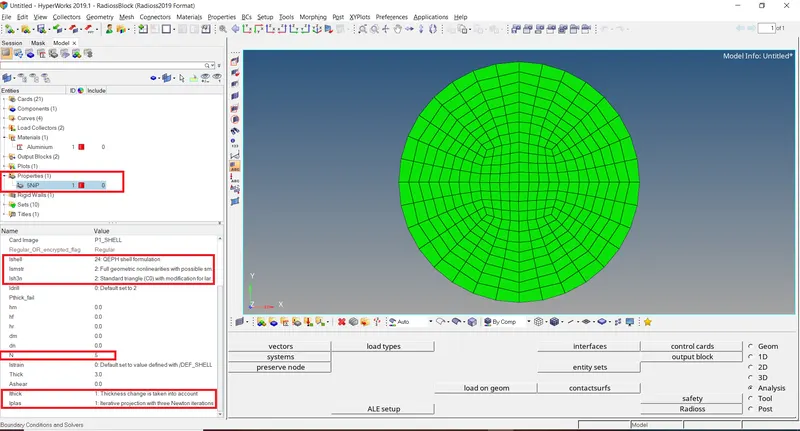
To run the analysis go to analysis>Radioss>save the file name as "Law27">Radioss.
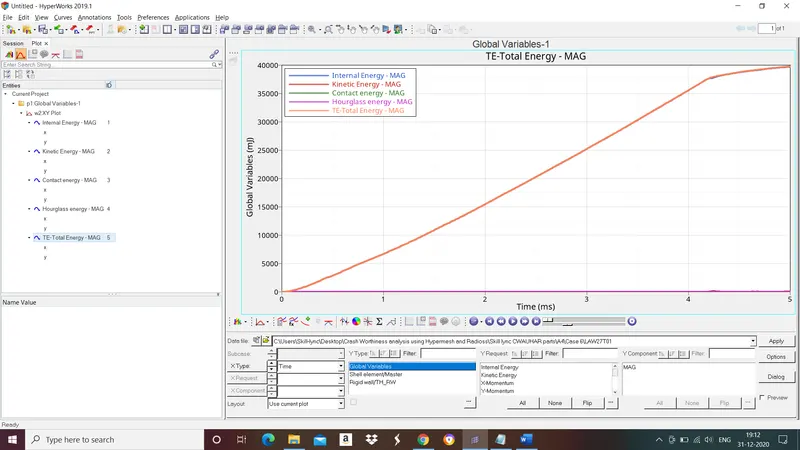
Fig: Energy(Internal energy, kinetic energy and total energy) vs time graph.
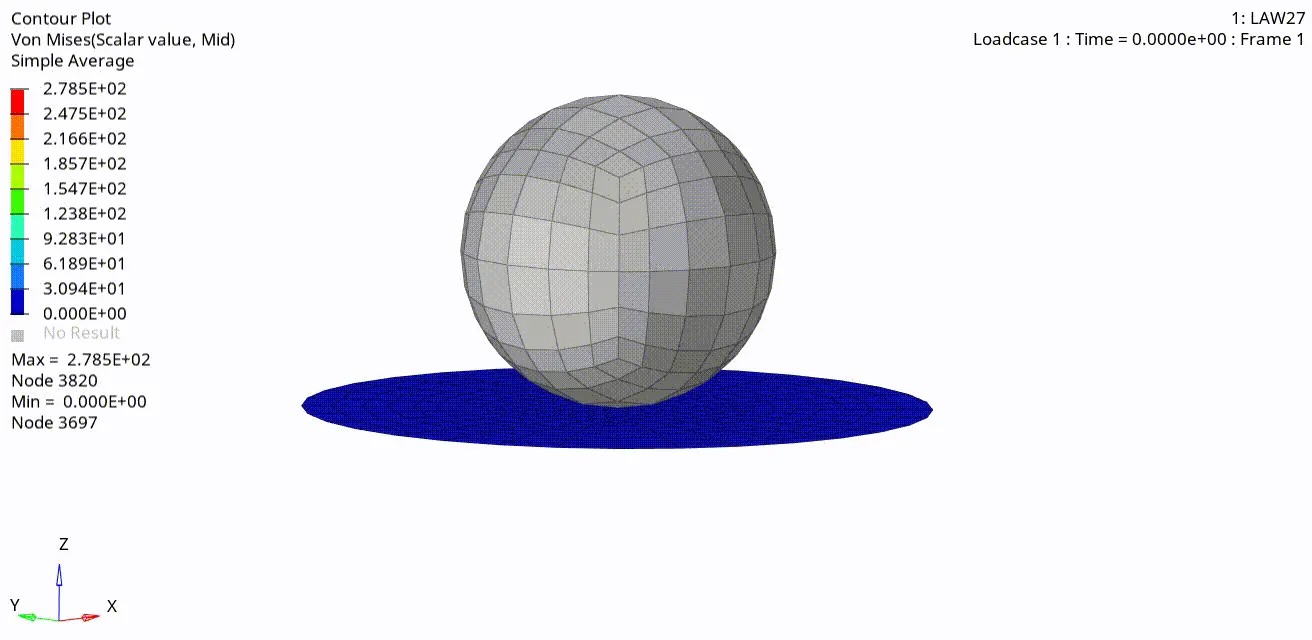
Fig: Animation representation of deformation of plate.
In this model, the material behaves as a linear-elastic material when the equivalent stress is lower than the plastic yield stress. For higher stress values, the material behavior is plastic. This law is only applicable to shell elements.
Internal energy increases exponentially vs time then varies after rupture of plate.
There is no or little change in Hourglass energy and contact energy because of using QEPH 24 Shell elements.
Case 7:Convert the material card to "Law36" elasto plastic and change the material properties values to given values.
- density=0.0028
- E=71000
- nu=0.33
- EPS_p_max=0.16
- EPS_t1=0.1
- Nfunc=1
X y
4.84405e-4 300
0.00111878 360.13
0.0032105 442.82
0.00478134 465.98
- Fscale=1
Open "Law2_0000.rad" file in hyperworks as explained in above. Goto>material collector> select "Aluminium" card>Change card image to "Law36" and change the material properties values to above values.
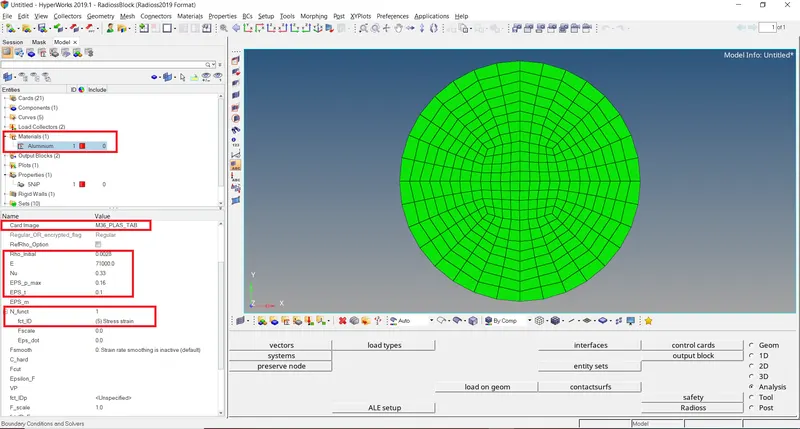
To run the analysis go to analysis>Radioss>save the file name as "Law36">Radioss.
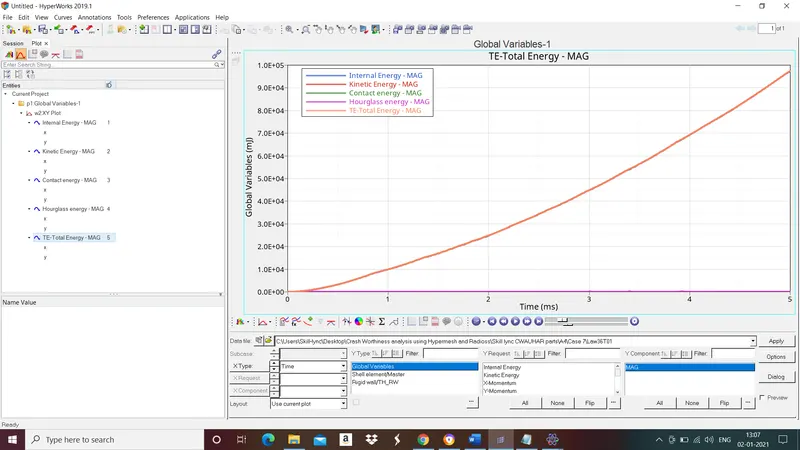
Fig: Energy(Internal energy, kinetic energy and total energy) vs time graph.
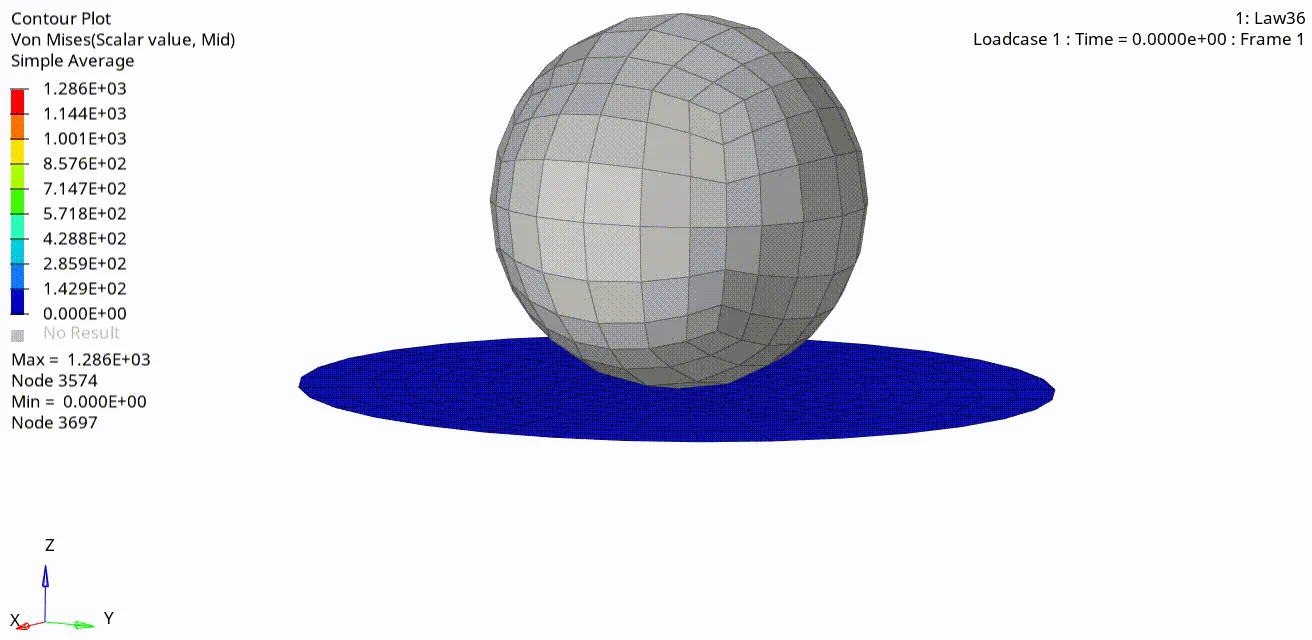
Fig: Animation representation of deformation of plate.
This law models an isotropic elasto-plastic material using user-defined functions for the work-hardening portion of the stress-strain curve for different strain rates.
Internal energy increases exponentially vs time. There is no or little change in Hourglass energy and contact energy because of using QEPH 24 Shell elements.
Comaprision:
| Case | Energy error | Mass error | No.of cycles | Simulation time |
| Case 1:Run the given model as it is in Radioss. | 0.1% - 1.3% | 0 | 49384 | 160.81 s |
| Case 2: In /FAIL/JOHNSON, change Ifail_sh=1, Dadv=1 and Ixfem=1. Run the model as Law2_epsmax_crack. | 0 - 4% | 0 | 49407 | 276.57 s |
| Case 3:Delete /Fail/JOHNSON card. Run the model as Law2_epsmax_nofail. | 0 - 1.2% | 0 | 49405 | 271.38 s |
| Case 4:Delete the value of EPS_p_max and run the model with name Law2. | 0 - 3% | 0 | 48737 | 273.51 s |
| Case 5:Convert this material model to Law1 elastic with same density, E, nu and run. | 0 - 4% | 0 | 47961 | 271.33 s |
| Case 6:Open "LAW27_0000.rad" file. Change the shell properties to recommended shell properties. Notice the material card Johnson cook parameters but different values for EPS based failure. Run the model with name Law27. | 0 - 1.2% | 0 | 49356 | 280.11 s |
| Case 7:Convert the material card to "Law36" elasto plastic and change the material properties values to given values. | 0 - 0.9% | 0 | 52237 | 295.0 s |
LEARNING OUTCOME:
Different types of material models and its properties.