Assignment 3-2D Element Formulation Challenge
Objective:
The Objective of this assignment is to run and compare the anlysis of a body which is rigid at one end and on the other end it is faced to a rigid wall. When the body is said to be in motion by some external force. compare the deformation of the material with the given material parameters and without any parameters. The body also tend to have 1D spring elements. Also, plot rigid wall forces, internal energy of body, hourglass energy of body, contact energy of body, total energy of the body.
Solution:
-First, open HYPERMESH and open RADIOSS module.
-Mow, import the RAD file to the RADIOSS module.
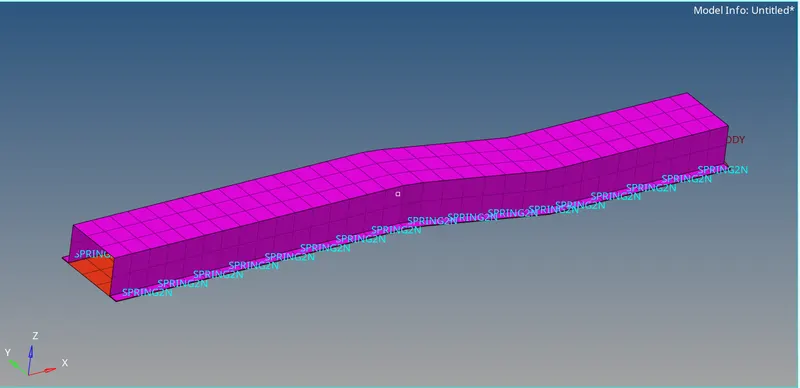
Case-1: With no material parameters.
-Now, we need to check if there are any property parameters assigned in the property card.
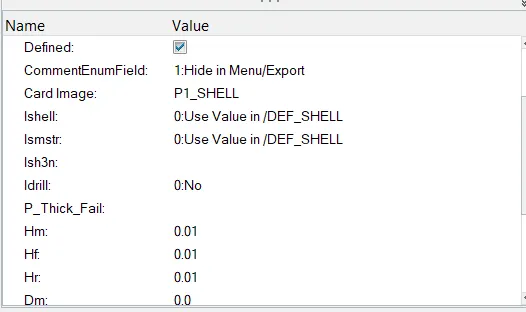
-If there aren't any then choose analysis option and save the file into your computer and run the analysis.

-Now, change profile from HYPERMESH to HYPERVIEW and run the simulation.
-Now, to plot graphs change profile from HYPERVIEW to HYPERGRAPH 2D.
-Now, as mentioned in the question to plot rigid wall forces, internal energy, hourglass energy, contact energy, total energy of the simulations.
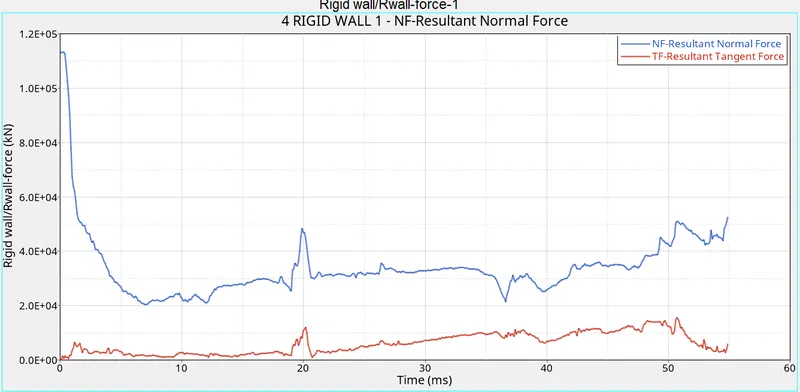
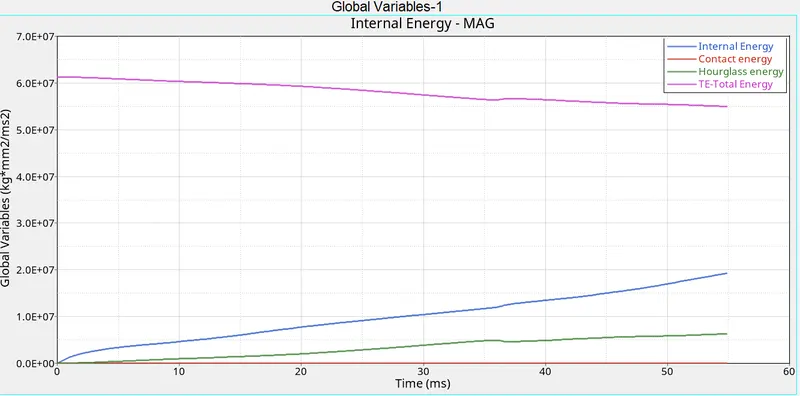
-And the max Energy error and max Mass Error for case-1 are as follows.
-Max Energy Error: -10.3%
-Max Mass Error: 0.1659E-03
Case-2: With Material Parameters.
-Import the RAD file to HYPERMESH.
-Check if the property parameters are as mentioned in the question.
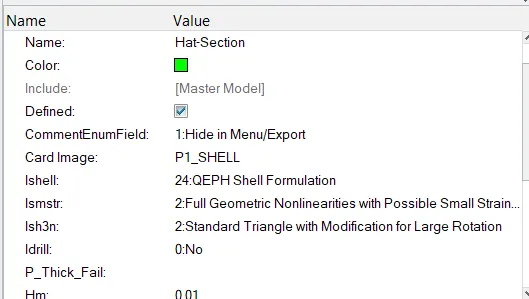
-Now, follow the same steps as of case-1 till the end of analysis and plot the graphs of this analysis.
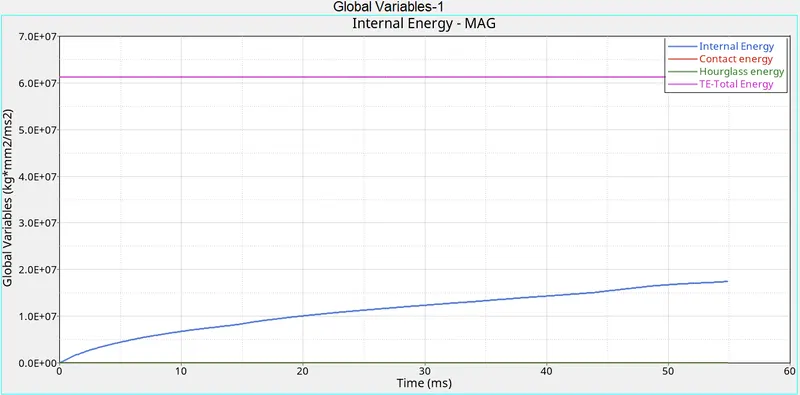
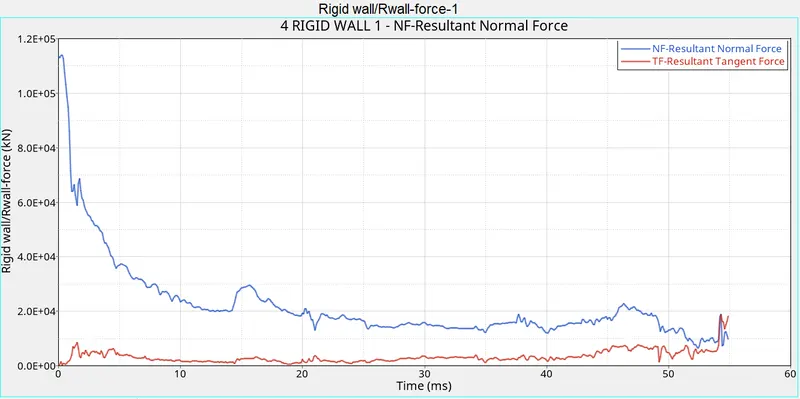
-And as for Max Energy Error and Max Mass Error.
-Max Energy Error: -0.1%
-Max Mass Error: 0.1659E-03
Comparison Table:
Case-1 Case-2
Max Energy Error -10.3% -0.1%
Max Mass Error 0.1659E-03 0.1659E-03
Conclusion:
As you can see from the above table we can say that there is a huge difference in Max Enerey Error from both cases.
Hourglass Effect:
If we consider a single reduced integrated element modelling a small piece of material subjected to pure bending. Where we have a moment at the left side and a moment at the right side, the length or neither the angle of the body doesn't change which means all the components of stress and the element single integration point are zero. This bending mode of deformation is also called as zero energy mode because no strain energy is generated by this kind of destortion. The element is unable to resist this type of deformation since it has no stiffness in this mode. In coarse meshes this zero energy mode can propagate through the mesh, producing meaningless results which is called as hourglass effect.
To avoid this hourglass effect switch to element formulations with fully-integrated or selectively reduced integration.