Assignment 3-2D Element Formulation Challenge
OBJECTIVE:
To compare results of base simulation with improved shell element properties.
Case 1 setup and Procedure:
Step 1:
Change the run time to 55 ms.
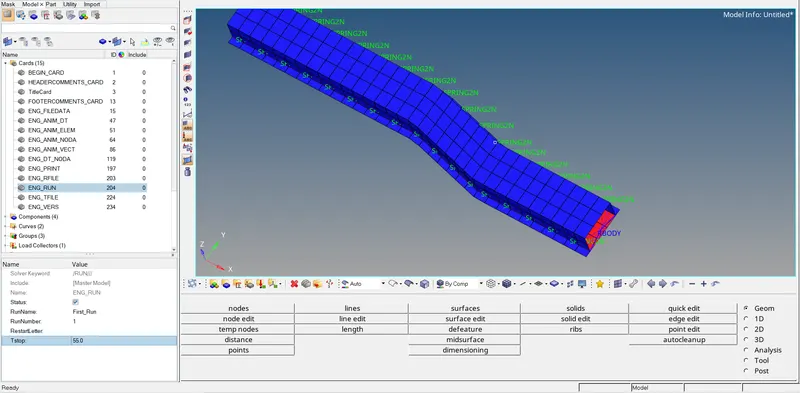
Step 2:
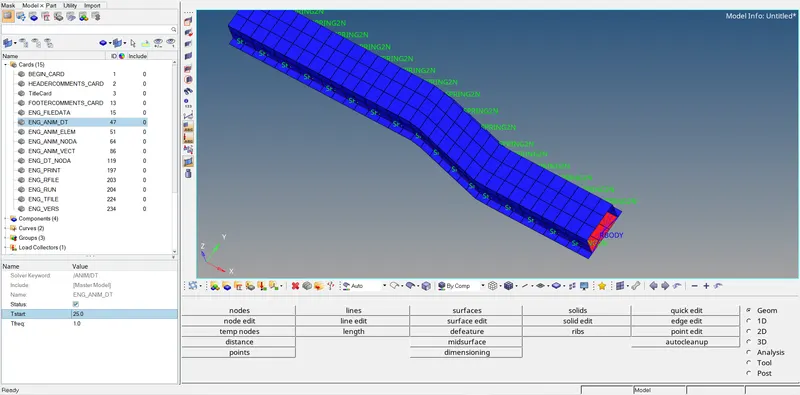
Change the number of animation steps during simulation to a minimum of 25 and maximum of 60.
As the run time is set to 55 seconds. T start of 25 is provided as shown below, with time frequency of 1 ms, 31 frames can be obtained. The simulation can be obtained from start time of 25 ms to 55 ms.
Step 3:
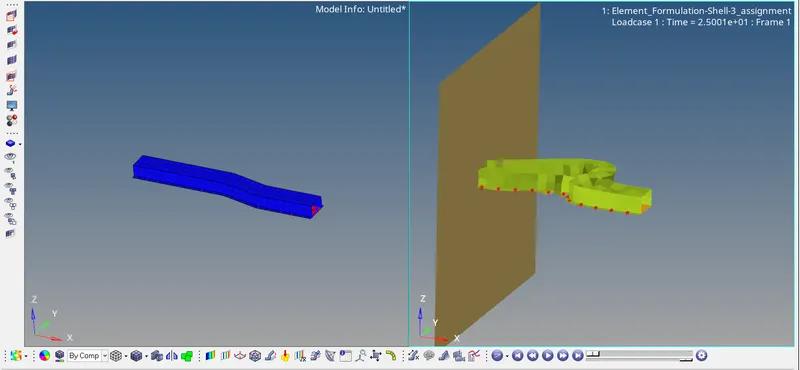
Run the base simulation without any modification to element properties.
Analysis Deck >>> RADIOSS >>> Save as >>> Radioss

-nt 4 represnts the number of threads = 4, signifying that 4 cpu's are running at a time to execute the simulation faster.
Step 4:
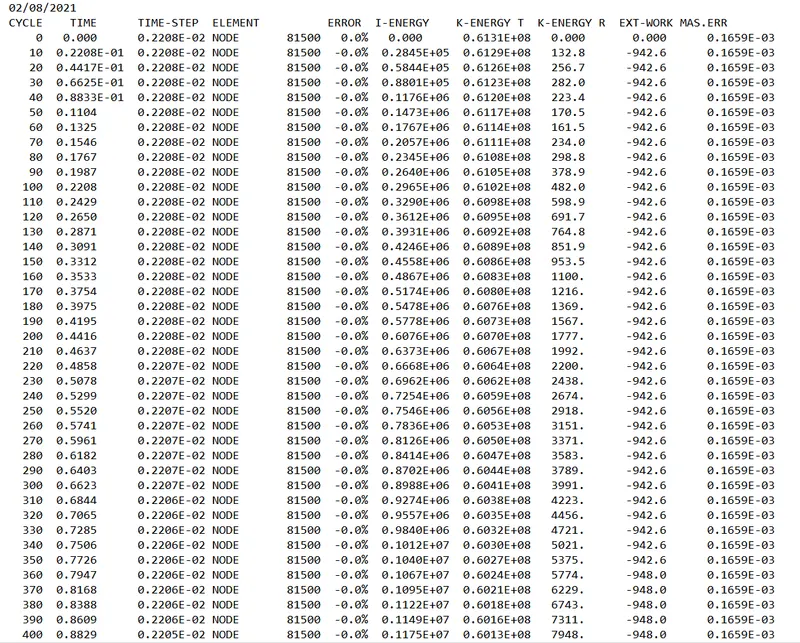
At the end of the simulation, do the energy error and mass error checks and determine whether results would be acceptable.
Open Element_Formulation-Shell-3_assignment_0001 to check for energy and mass errors.
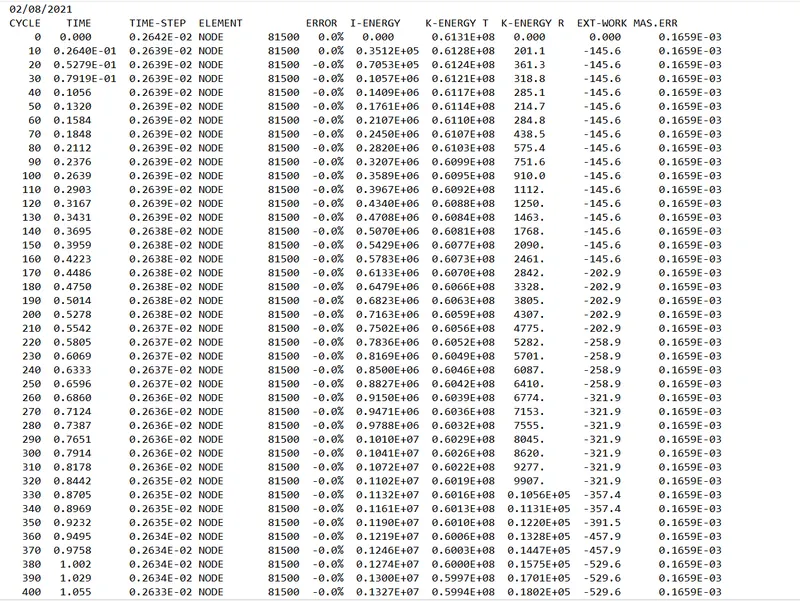
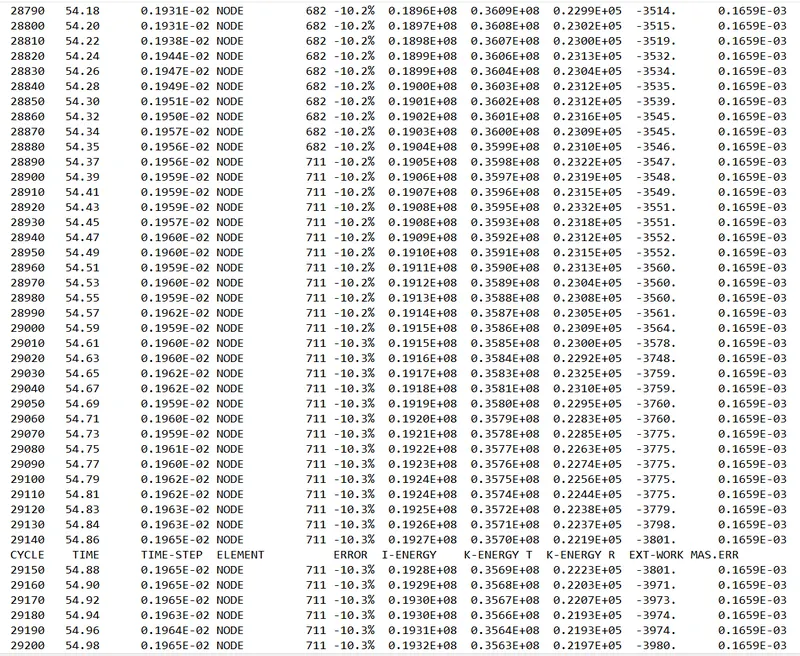
From the above image, we can see the energy error, internal energy, translatory kinetic energy, rotational kinetic energy, external work, mass error.
The maximum values of respective properties can be seen at last cycle.
The energy error is negative which is optimal. The acceptable range of energy errror is -15% to 5%.
Max. Internal energy = 0.1932E+08
Max. translatory KE = 0.3563E+08
Max. Rotational KE = 0.2197E+05
Max. External work = 3980
Energy error = -10.3%
Mass Error = 0.1659E-03
The results are acceptable, therefore rigid wall forces, internal energy, hourglass energy, contact energy, total energy of the simulations are plotted as shown below.
Switch to Hypergraph 2D >>> Open the time history file i.e., generated during the simulation.
Rigid wall forces:
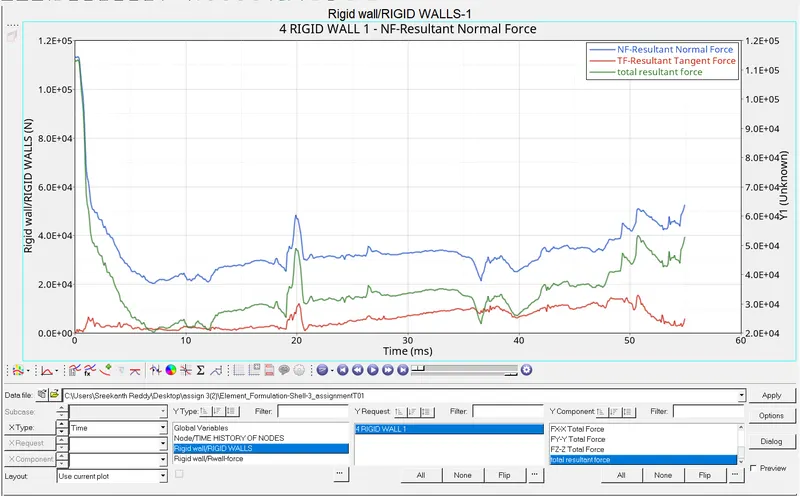
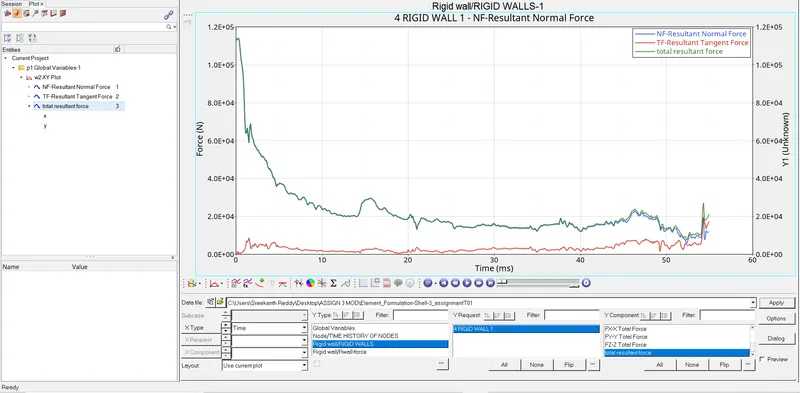
Resultant Normal Force, Resultant Tangent Force, Total Resultant Force are plotted below.
As the force is applied on the component,initially a large force is transferred onto the rigid connection / rigid wall and as deformation of the component occurs the force on rigid wall decreases.
During application of force, Lot of friction is generated betwen the rigid wall connection and the component causing shear force. From the graph we can observe that during initial stage there is no friction and as soon as load is applied, the frictional force is generated.
The resultant of normal and tangential force is shown below.
Internal energy, Total energy:
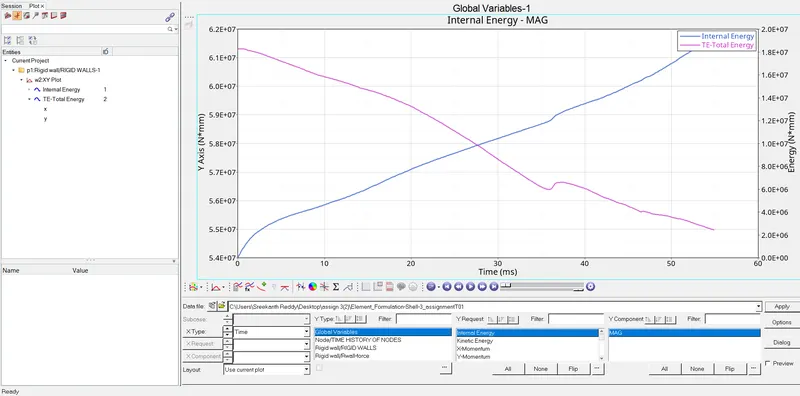
Internal energy is the microscopic energy contained in a substance, given by the random, disordered kinetic energy of the molecules. In addition it includes the potential energy between these molecules, and the nuclear energy contained in the atoms of these molecules.
The total mechanical energy of a system is the sum of the total kinetic energy and total potential energy.
Internal energy at the start of application of load is zero, and increases as the deformation takes place in the component.
Total energy, as load is applied at time = 0, the initial velocity applied on component is high. As deformation occurs on the component, the velocity decreases causing the total energy to decrease as the deformation takes place.
HOURGLASS ENERGY:
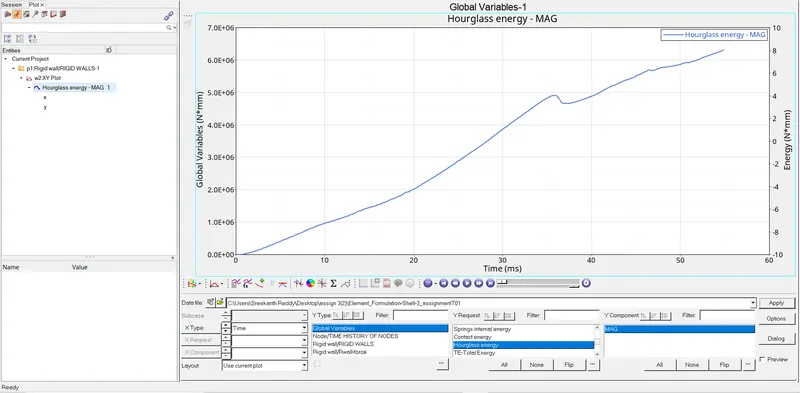
Hourglass modes are the non-physical, zero energy modes of distortion that yield zero strain and no stress.
As the properties of the simulation are not changed and executed, zero energy modes of distortion have taken place causing hourglass effect.
So to balance this we need hourglass energy. Therefore hourglass energy required gradually increases as hourglass effect increases due to deformation.
Contact energy:
The Energy that is generated due to contact between the rigid wall and the component during the deformation.
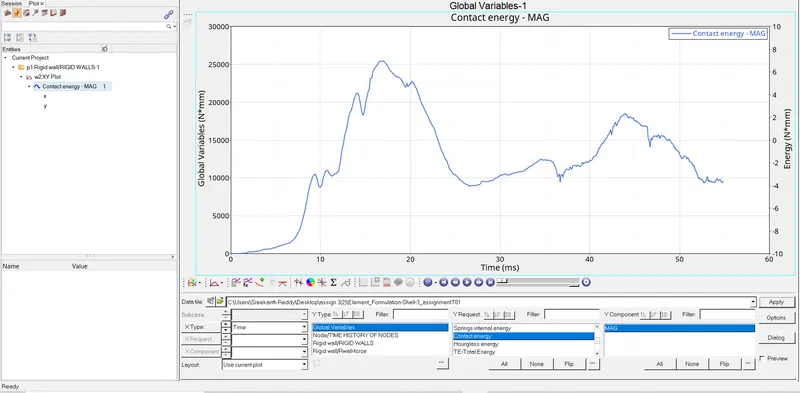
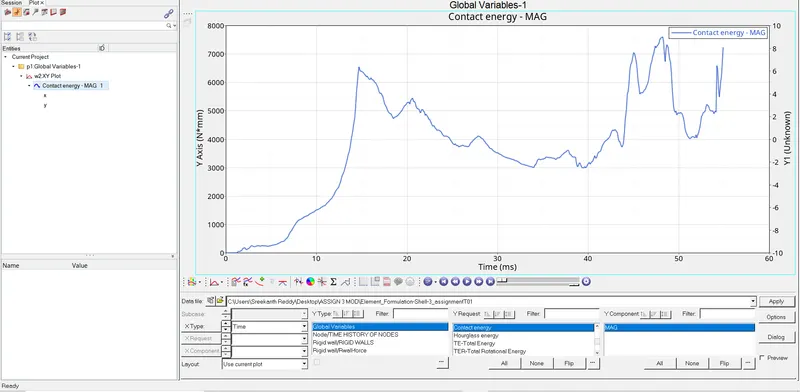
As we can see, from the below graph the contact energy is zero during t = 0, as the deformation occurs due to applied load the contact energy increases.
The increase and decrease trend of the graph is due to variation in the contact forces from t = 0 to t = 55.
Case 2 setup and Procedure:
- Change the run time to 55 ms
- Change the number of animation steps during simulation to a minimum of 25 and maximum of 60.
Recommended properties:
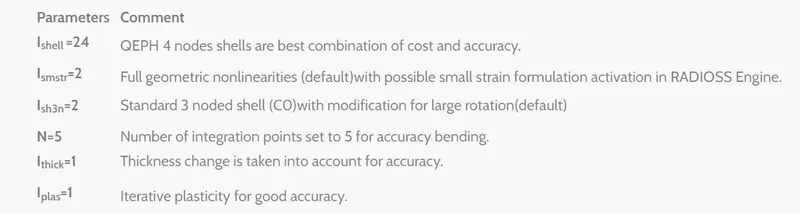
Go to properties of Hat section and close-out panel and make the respective changes in properties as shown below.
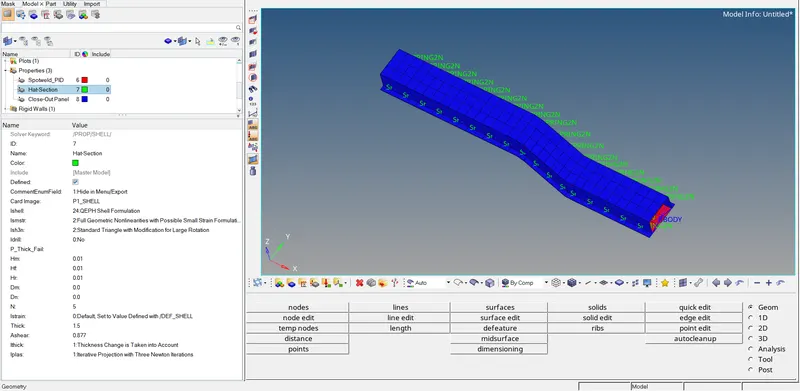
Run the simulation after changing the properties:
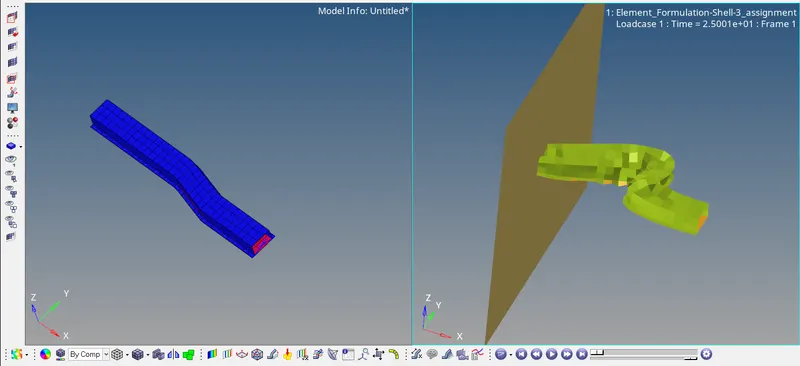
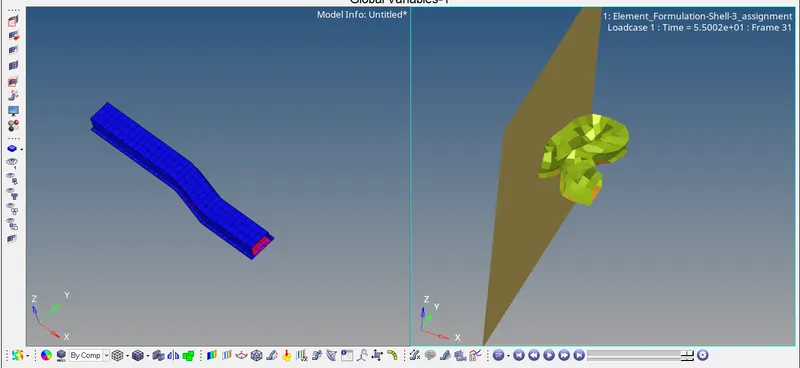
At the end of the simulation, do the energy error and mass error checks and determine whether results would be acceptable.
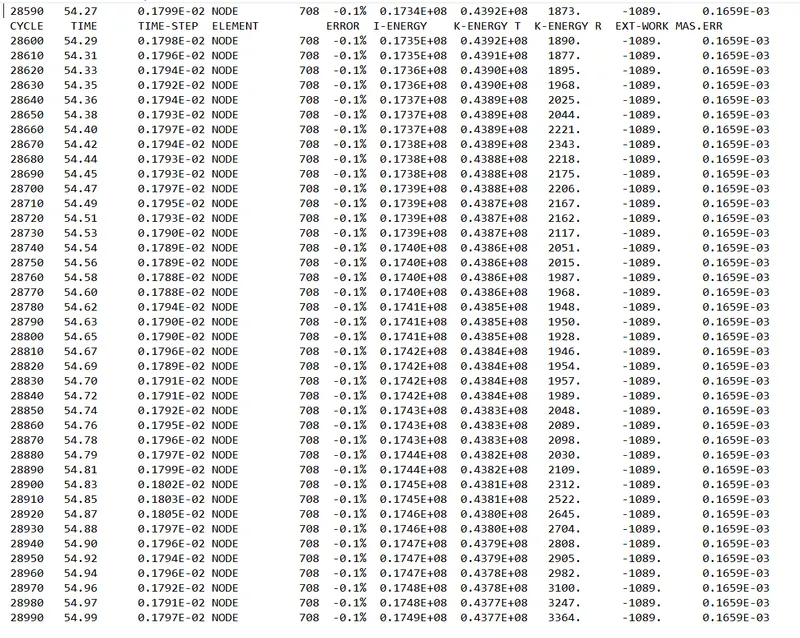
From the below image, we can see the energy error, internal energy, translatory kinetic energy, rotational kinetic energy, external work, mass error.
The maximum values of respective properties can be seen at last cycle.
The energy error is negative which is optimal. The acceptable range of energy errror is -15% to 5%.
Max. Internal energy = 0.1749 E+8
Max. translatory KE = 0.4377 E+8
Max. Rotational KE = 3364
Max. External work = 1089
Energy error = -0.1%
Mass Error = 0.1659 E-3
The results are acceptable, therefore rigid wall forces, internal energy, hourglass energy, contact energy, total energy of the simulations are plotted as shown below.
The below graph represents the resultant Normal force, Resultant tangential force, Total resultant force.
When compared with the graph without the change in properties, we can see the results are more accurate w.r.t recommended properties.
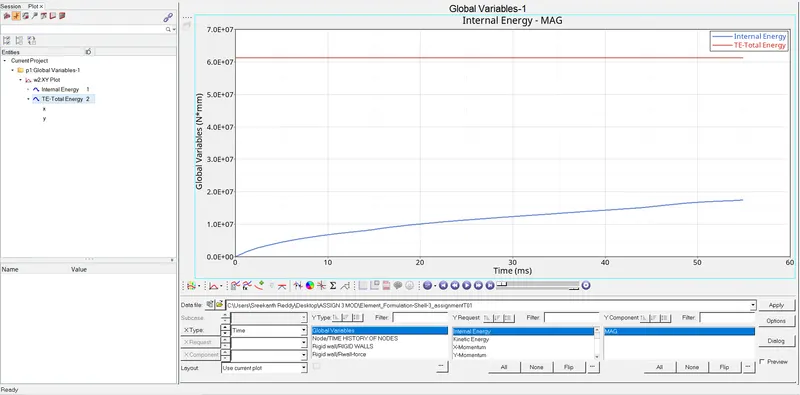
When compared, the internal energy line trend is similar to the above case.
The total energy is constant throughout the simulation.
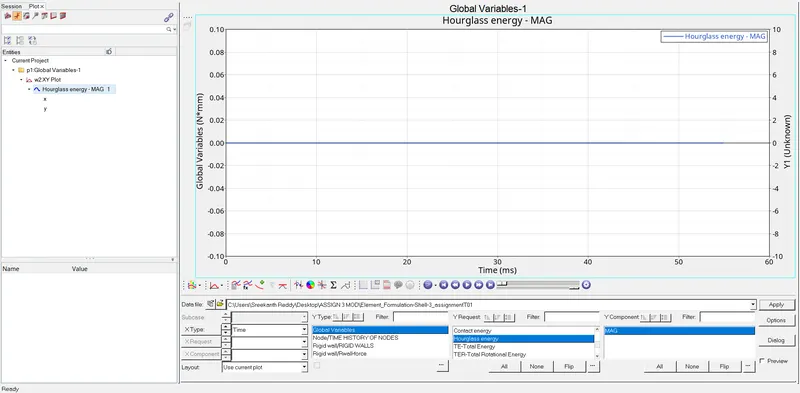
Hourglass energy is zero with improved elemental property.
Contact energy shows the same trend when compared.
Results:
| PROPERTIES | CASE 1 | CASE 2 |
| MAX.ENERGY ERROR | -10.3% | -0.1% |
| MAX. KINETIC ENERGY | 0.3563E+08 | 0.4377 E+8 |
| MAX.INTERNAL ENERGY | 0.1932E+08 | 0.1749 E+8 |
| HOURGLASS ENERGY | VARYING | CONSTANT THROUGHOUT |
| REASONS FOR HOURGLASS ENERGY | Due to default property cards, by under integration that leads to hourglass energy modes. | The elements have physical stabilization due to improved integrated 4 node element with 1 integration point on surface. |
| REQUIREMENTS OF HOURGLASS ENERGY | Requires hourglass energy for energy balancing | No additional energy is required due to physical stabilization of hourglass energy |
| RESULTS | Results are less accurate | Results are accurate |
Conclusion:
- Energy error is reduced from -10.3% to -0.1% by using recommended properties.
- The Hourglass energy with recommended properties is zero, causing the realistic simulation with no zero energy deformations.
- Kinetic energy, Internal energy, Contact energy are almost same in both cases.
- QEPH improved under integrated 4 noded element with 1 integration point provide physical hour glass stabilization and comparatively QEPH elements are good with quality and more economical.
HOURGLASS ENERGY:
Hourglass modes are non-physical modes of deformation that occur in under integrated elements and provide no stress.
Under integrated elements refers to
- solid element with single integration point
- shell element with single in-plane integration point
Reduced integration scheme is used due to dramitical decrease in computation time compared to the 4 point integration, and this is leading to hourglass energy modes.
Methods used to control formation of hourglassing:
- Perturbation for Q4 elements
- Physical stabilization for QEPH elements
Perturbation for Q4 elements:
The hourglass energy is detected with relative motion of the nodes, a force is applied on the node to stabilize the deformation.
The force is applied according to the element stiffness. This force introduces artificial energy called hourglass energy.
Physical stabilization for QEPH elements:
Hourglass yield depends on the natural yield
Hourglass loading stiffness depends on natural tangent modulus
The hourglass treatment is done at material level