Assignment 3-2D Element Formulation Challenge
Objective
Comparison of results with base simulation and improved shell element properties
1.Using the crash beam file from the previous assignment, change the run time to 55 ms.
2. Change the number of animation steps during simulation to a minimum of 25 and maximum of 60.
3. Run the base simulation without any modification to element properties.
4. At the end of the simulation, do the energy error and mass error checks and determine whether results would be acceptable.
5. If acceptable, Plot rigid wall forces, internal energy, hourglass energy, contact energy, total energy of the simulations.
6. Change all the shell elements properties to recommended properties, save this as separate, rad files and run the simulation.
7. Follow steps 5 and 6.
8. Create a brief report comparing all the results from steps 5 and 6 for both simulations.
9. Comment whether there is any change in the results and why there is any change in the result.
Procedure
- From the hypermesh Filename_0000.rad was openedd using import>geometry>solver deck.
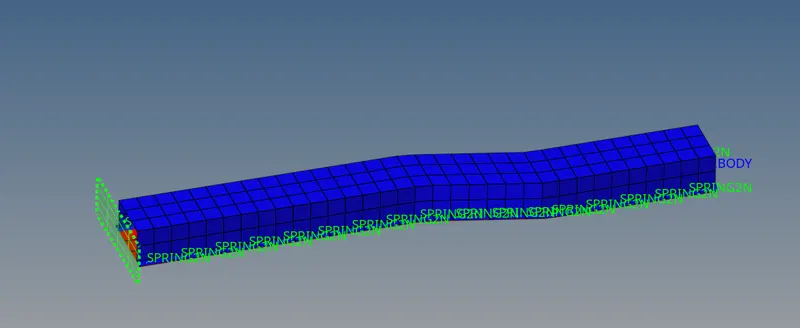
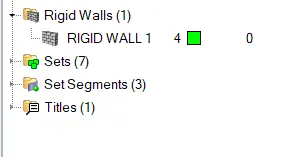
- The rigid wall can be turned on the rigid wall card.
1.
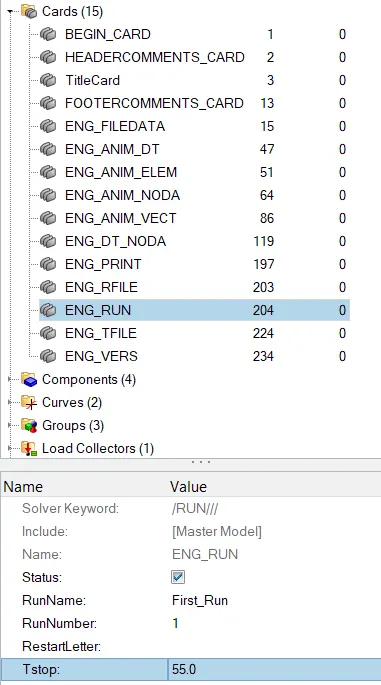
- A total run time of 55ms was changed from ENGINE RUN_card.
2.
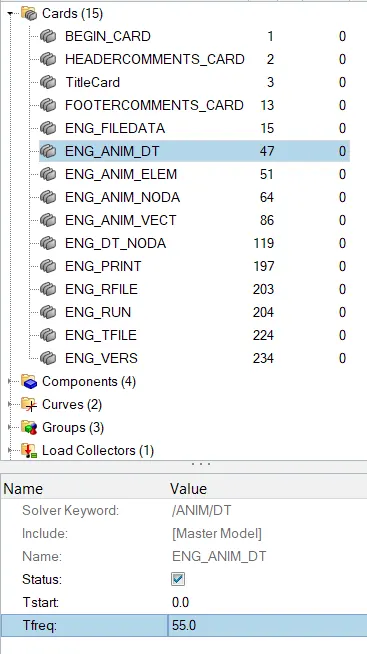
- The number of animation steps during simulation should be kept to a minimum of 25 and maximum of 60. Therefor Tfreq (Time frequency) was kept at 55ms so that to get 55 animations generated during a rum time 55ms.
3.
- The base simulation was run without any modification to element properties. The default formulations other properties can be checked from the property card.
- From the ENG_ANIM_ELEM Card internal energy, Von Mises stress, hourglass energy can be ticked to get an animation countour during the posr processing.
- The edited solver deck was exported from files>Export>Solver deck.
- There will two files formed after exporting, one will be starter file and other will be the engine file. Starter file contains all the model definitions and the engine file contains the run controls.
- The simulation canbe run from the analysis panel>Radiosis.
- The simulation showed a Normal termination which means that the simulation ran sucessfully.
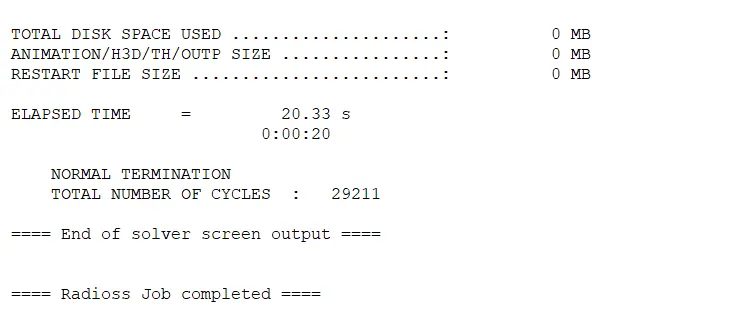
- After running the simulation we will be having few file like Filename_0000.out (This file contains all the details
about the model setup, time step calculation, nodal time step estimation, total mass, mass center and the details about warning and errors if there are any) , Filename_0001.out (This file contains simulation information like energy error, kinetic energy, mass error, cycle time, number of cycles and CPU performance details). Apart from the we will be having .h3d file, T01 file and animation files.
4.
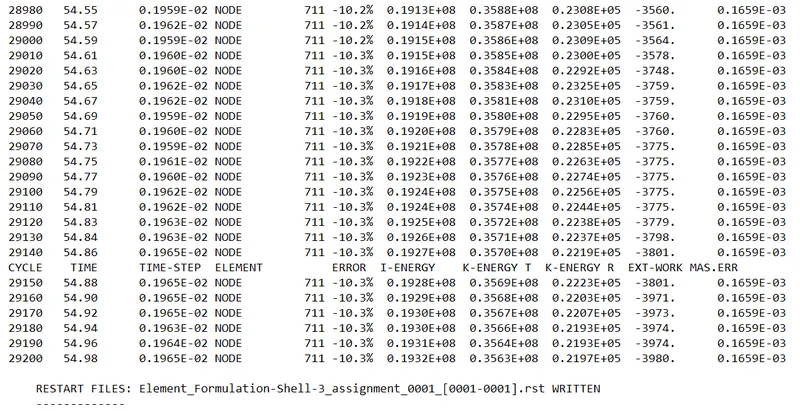
- From the Filename_0001.out file the energy and mass error checks were done to check wheather the results are acceptable or not. Here we got an energy error of -10.3% and a mass error of 0.1659E-03 which are acceptable. The acceptable range for mass energy error is 5-15% and for mass error is 2-3%.
Energy error for case 1.
Energy error for case 2.
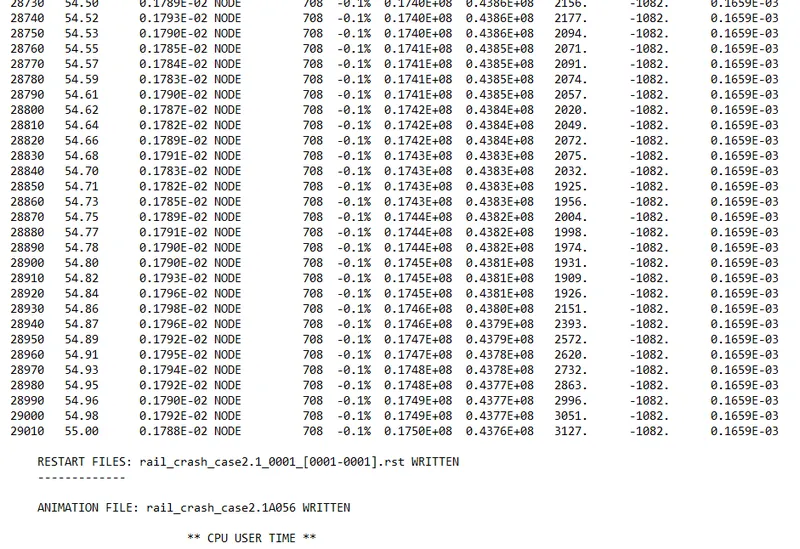
The energy error values was well reduced in the case 2 when the recomendable parameters was given to the property card.
Same process has been carried out with the case 2 by changing the property card with the recomendable variable given the question.
5.
To view the animations for rigid wall forces, internal energy, hourglass energy, contact energy, total energy of the simulations, .h3d file are opened from the hypergraph.
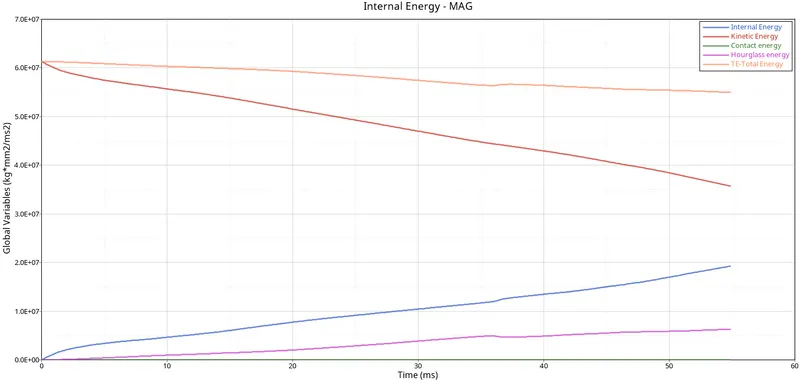
Energy plot for case 1
Energy plot for case 2
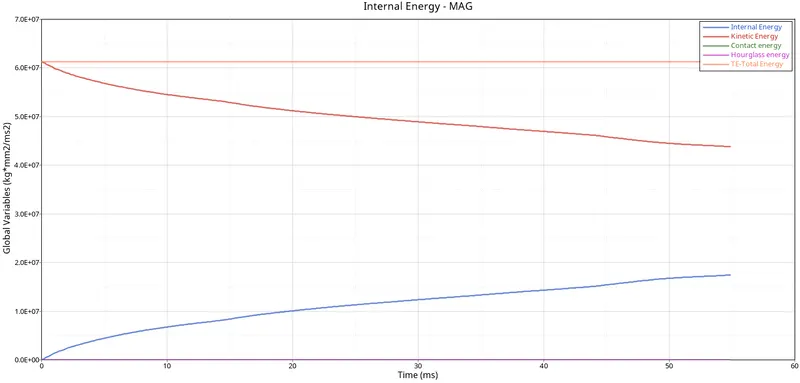
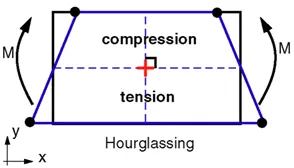
The energy plots for the case 1 and case 2 are shown below. From the plot its seen that there are lots of differnce in the energy values when the recomendable parameters were assinged to the property card in the case 2. Major difference can be noticed in the hourglass energy value. In case 2 since we have used the QEPH element instead of Q4 elemetns we were able to reduce the hourglass energy considerably.
For both cases we can see a decline in the kinetic energy values and a increase in internal energy values. When crash happens the kinetic energy gets converted to internal enerygy. In the both case the contact energy remained zero. The energy was found to be constant in the case 2.