Assignment 3
Objective :
Objective of the assignment is comparing the simulation results of the base setup and improved shell element p roperties for crash tube.
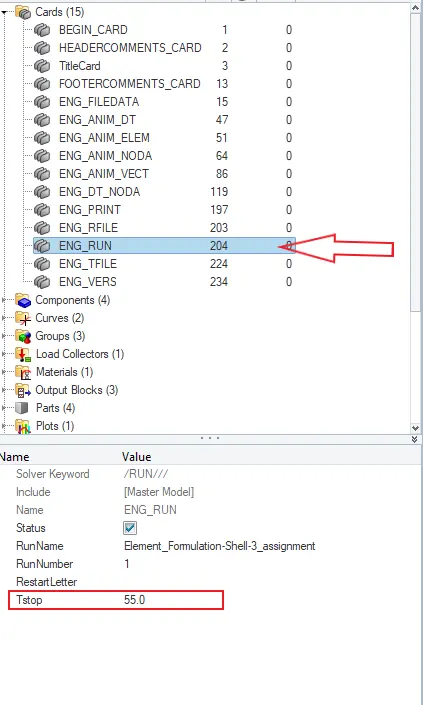
1. Change the run time to 55 ms.
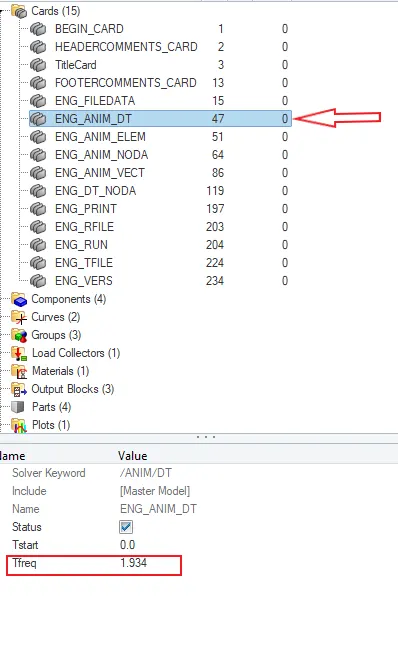
2. Update animation steps during simulation to a minimum of 25 and maximum of 60.
Condition_1 (Base simulation):
FIRST_RUN_0001.out file with text editor.
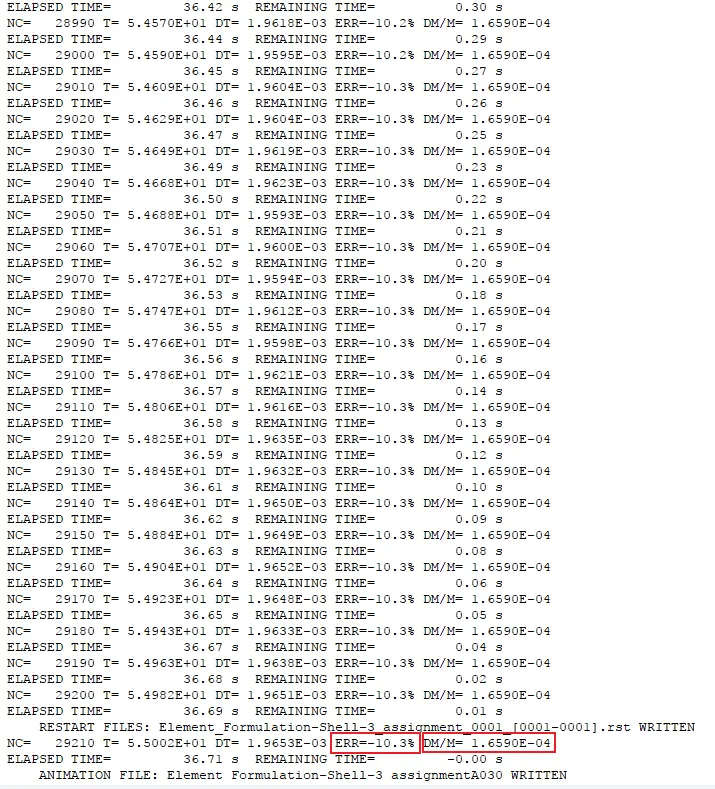
Maximum energy error in above case is -10.3%.
Energy error is acceptable upto -15% , therefore positive signal for further simulation.
Maximum mass error =1.659E-04.
Simulation Result :
1. Internal energy, Kinetic Energy, Hourglass Energy and Total Energy vs Time
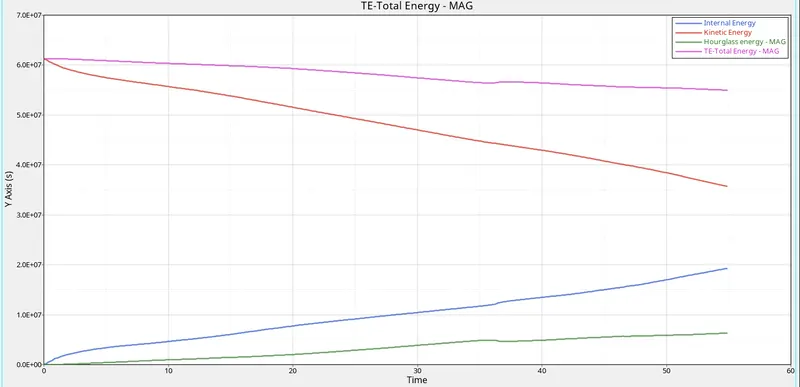
a. Max. Total Energy = `6.1*10^7` and Min. Total Energy =5.5x10^7 . Total energy decrease as time increases.
b. Max. kinetic energy= 6.1x10^7 and min. kinetic energy=3.6x10^7 . Kinetic energy decreases as time increases.
c. Max. Hourglass Energy = 0.6x 10^7 and min. Hourglass Energy=0 . Hourglass energy increases as time increases.
d.Max. internal energy= 1.95x10^7 and min. internal energy=0 . Internal energy increases as time increases.
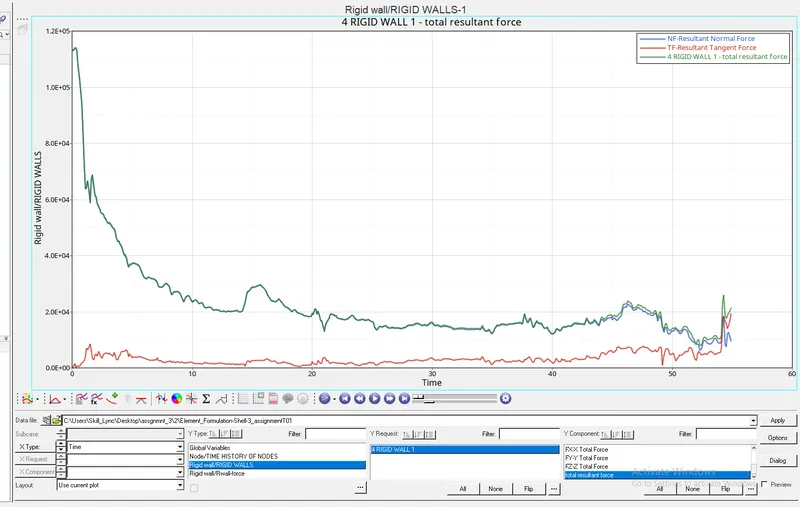
2.Resultant normal force, Resultant tangent force , Total resultant force vs time
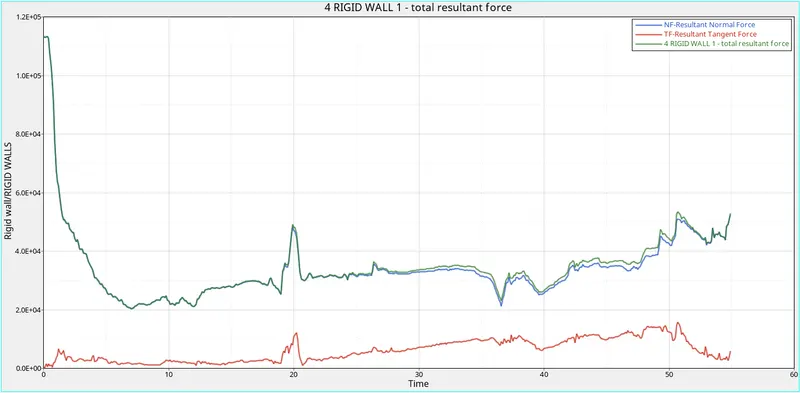
a. Resultant normal force and total resultant force almost similar and decreases with time. Having maximum value at start of collision =1.1x10^5.
b.Resultant tangent force value increase slightly with time.
3. Displacement:
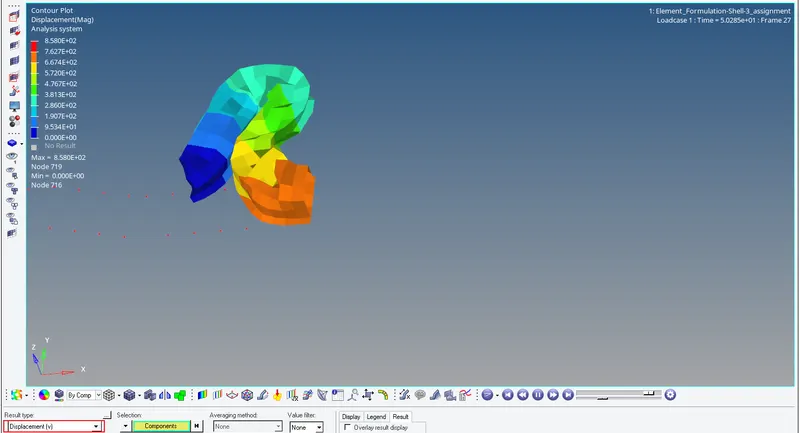
Max Displacement =8.58E+02 at node 719 and Minimum displacement = 0 at node 716.
4. von mises stress :
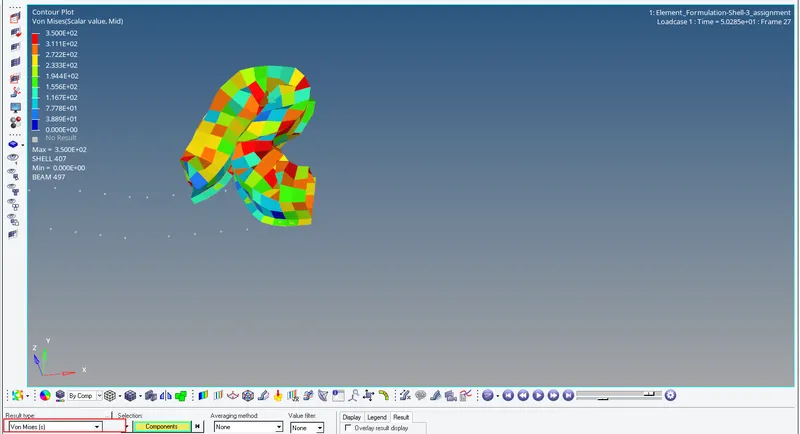
Maximum stress =3.50x 10^2 at node 407 and minimum stress =0 at node 497.
Condition 2 (Improved shell Element Simulation):
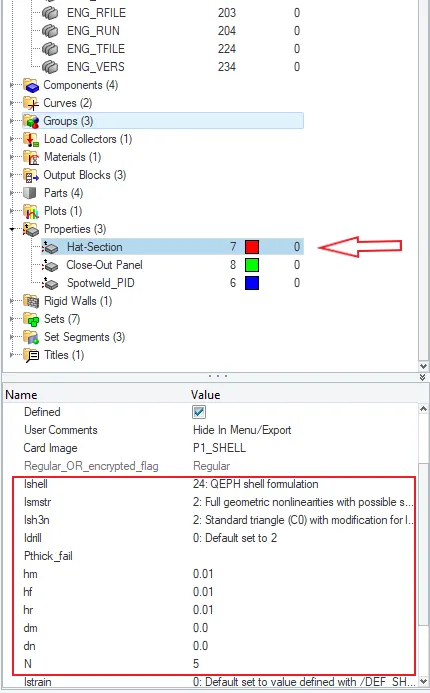
Following Parameter applied for the improved shell element simulation.
Recommended properties:
| Parameters | Comment | |
|
Ishell =24 |
QEPH 4 nodes shells are best combination of cost and accuracy. | |
|
Ismstr=2 |
Full geometric nonlinearities (default)with possible small strain formulation activation in RADIOSS Engine. | |
|
Ish3n=2 |
Standard 3 noded shell (C0)with modification for large rotation(default) |
|
| N=5 | Number of integration points set to 5 for accuracy bending. | |
|
Ithick=1 |
Thickness change is taken into account for accuracy. |
|
|
Iplas=1 |
Iterative plasticity for good accuracy. |
• Now Go to Model Browser>Properties>Select Properties>Change the Value as shown below:
We set the above parameter in the property Tab i;e in Hat-section and in close-out panel
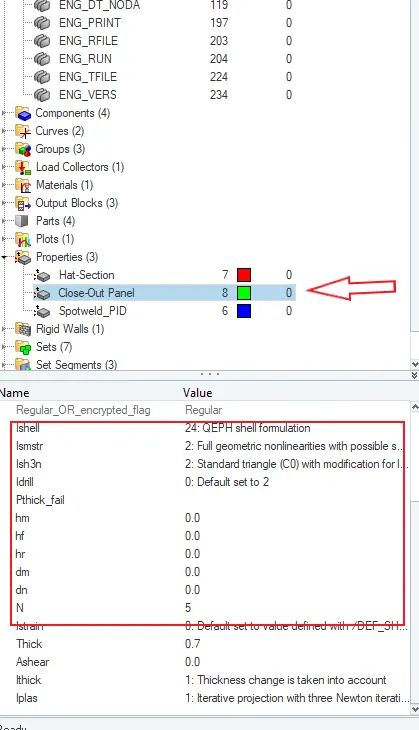
FIRST_RUN_0001.out file with text editor.
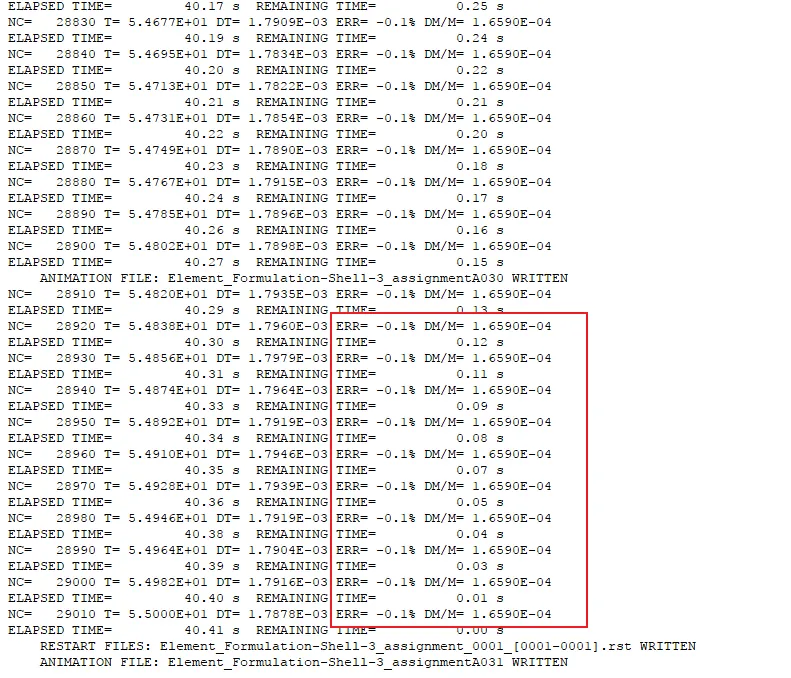
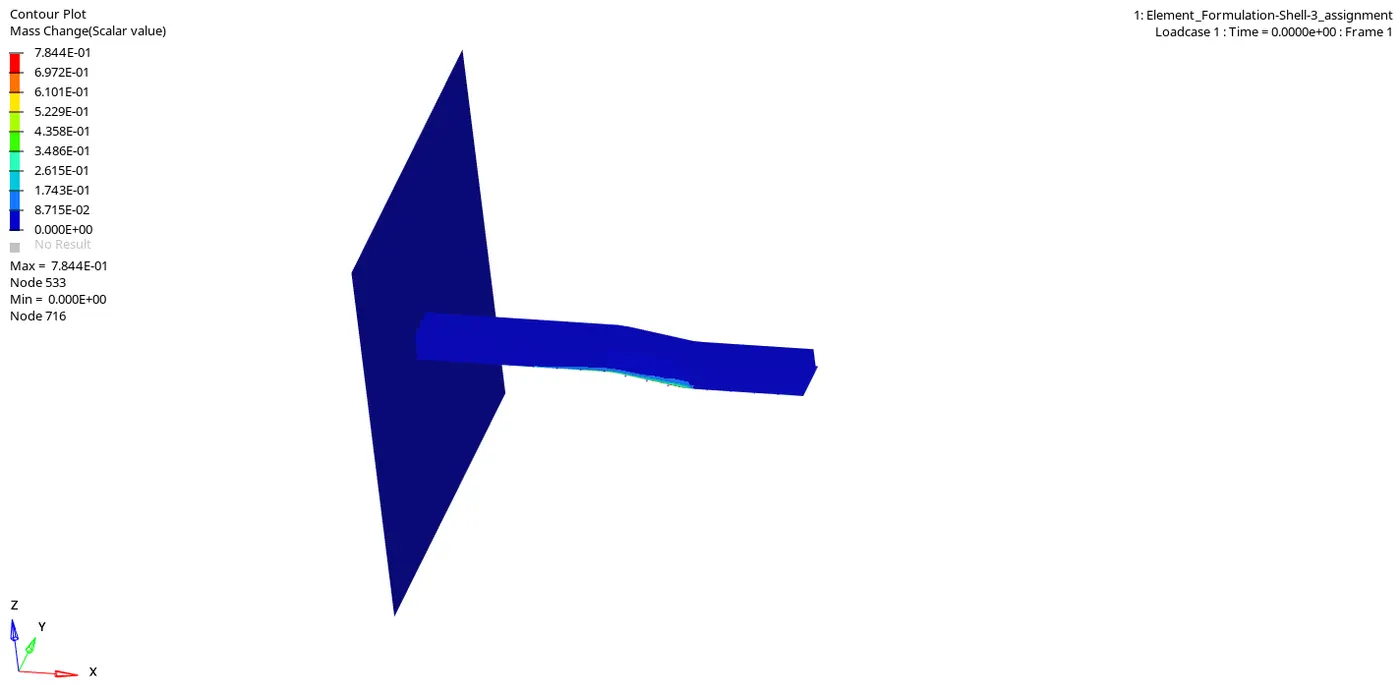
The maximum energy error in above case is -0.1%.It is better to have error closer to zero. Energy error is acceptable upto -15% , therefore positive signal for further simulation.
Maximum mass error = 1.6590E-04
Simulation Result:
1. Internal energy, Kinetic Energy , Hourglass energy and total energy vs time.
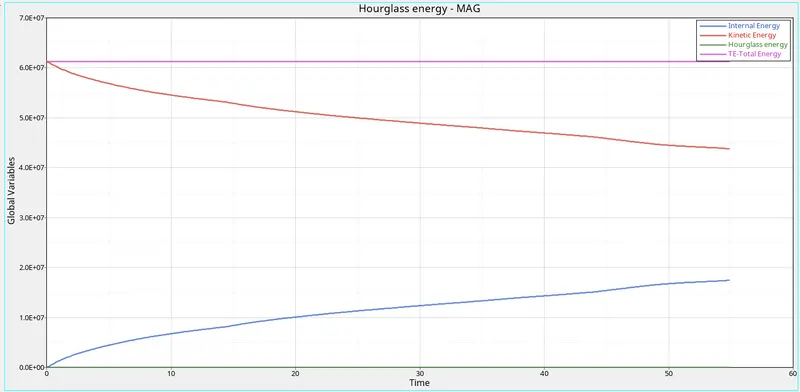
- Total energy remain constant = 6.1 x10^7.
- Maximum kinetic energy = 6.1 x 10^7 and Minimum kinetic energy = 4.3 x 10^7. kinetic energy as time increases.
- Maximum internal energy = 1.8 x10^7and minimum internal energy = 0 . Internal energy increases as time increases.
From the above Graph we can Coclude that ,when the first impact has happened ,there was a huge force applied on the Beam because the internal deformation occurs inside the crush beam.Thereafter the force applied on the rigid walls started decreasing and the significant amount of energy is converted into Frictional force and the Frictional force is developed as shown in the fig below:
Graph for Internal Energy,Contact Energy,Total Energy and Hourglass Energy against Time is shown above :
As a result of Simulation and Plotted graph we can Conclude that,
1. Maximum internal energy =`1.7 text (x) 10^7` at time 55ms and Minimum internal Energy is 0 at time 0.So we can say that Internal Energy increases gradually as the time increses.
2. Hourglass Energy Remain Constant and equal to zero
3. Total Energy Remain constant at `6.2 text(x) 10^7`.
4. Contact Energy Remain Constant and equal to zero.
- Create a brief report comparing all the results from steps 5 and 6 for both simulations
Comprison:
| S.no | Base Simulation | Improved shell element simulation | |
| 1. | Energy Error | Energy Error = -10.3% | Energy Error = -0.1% |
| 2. | Total energy | Total energy decrease as time increase | Total energy remains constant |
| 3. | Hourglass Energy | Hourglass Energy increases as time increases | Hourglass energy remains zero |
| 4. | Contact energy | There is huge fluctuation in energy | Cotact energy remains constanst and equal to zero |
| 5. | Internal energy | Internal energy increases as time increases gradually | internal energy increases as time increases gradually. |
Comment whether there is any change in the results and why there is any change in the result.
Found that there is a huge change in Hourglass Energy as the Hour glass Energy increases as time increases in base simulation whereas the Hourglass energy remain constant and equal to zero in integrated shell element. Whenever the hourglas energy produced,there will be no stress and it reduces the accuracy and the true response of the structure.this leads to inaccurate strain and displacement results in un realistic deformation,thus we can say that with the use of integrated shell element we can reduce the
Hourglass Energy.