Assignment 3
The run time = 55 ms.
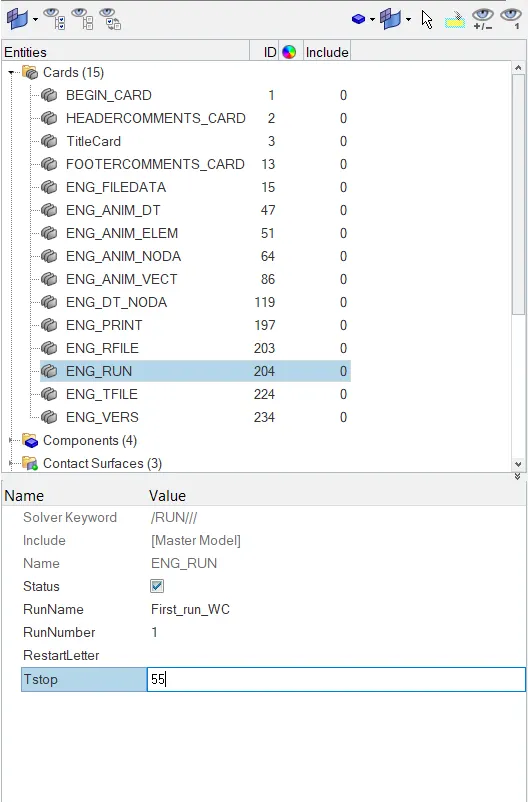
Change the number of animation steps to a minimum of 25 and maximum of 60.
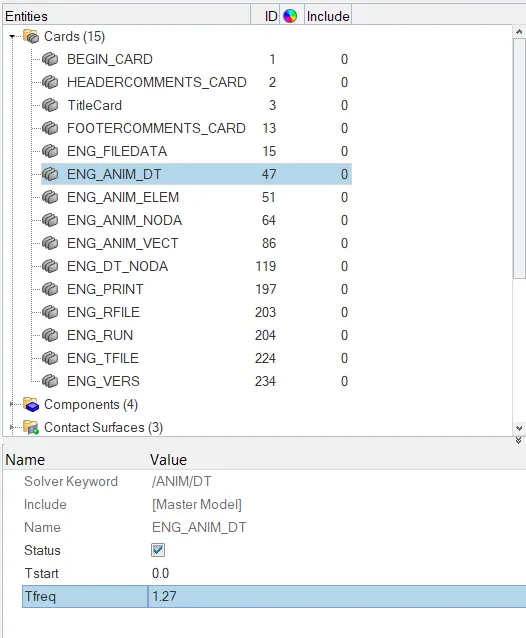
Frequency of writing animation files = End Time/ Steps required
Tfreq = 55/43
Tfreq = 1.27
Running the base simulation without any modification to element properties.
To perform Simulation, Analysis > Radioss
Without changing the element properties ran the simulation by using -nt 4.
Hyperworks solver file displayed.
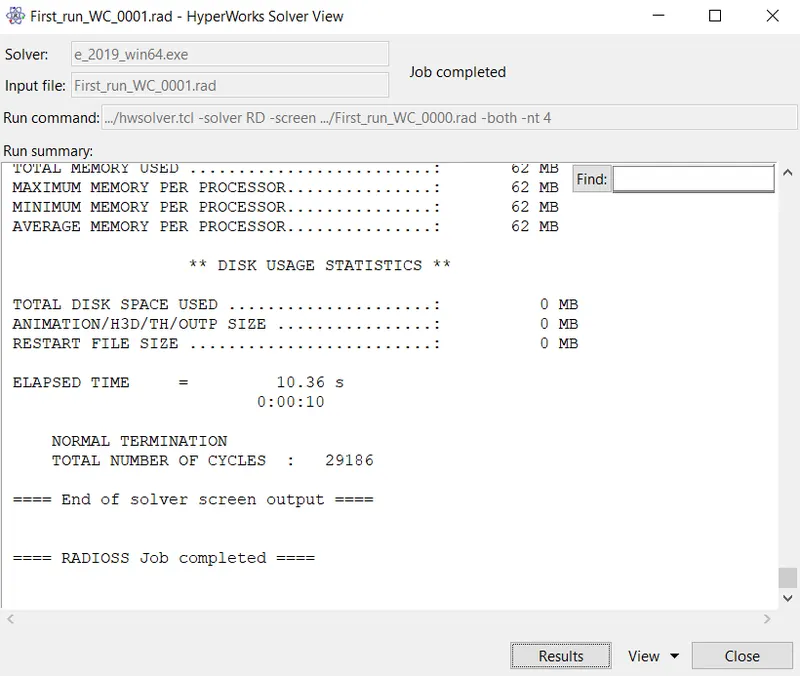
Click on Results, to open the results and animation in hyperview.
HyperView is opened and .h3d file is loaded.
With the help of 'Page Layout Window,' another window is provided for the HyperGraph 2D.
Now, we will plot the energy curves for the model. The time history file, T01 file is uploaded in HyperGraph.
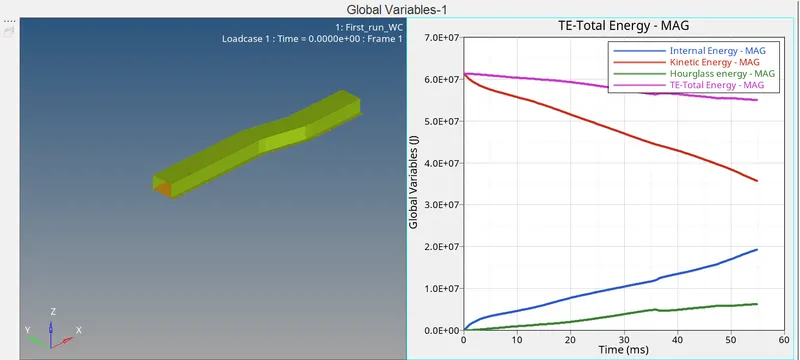
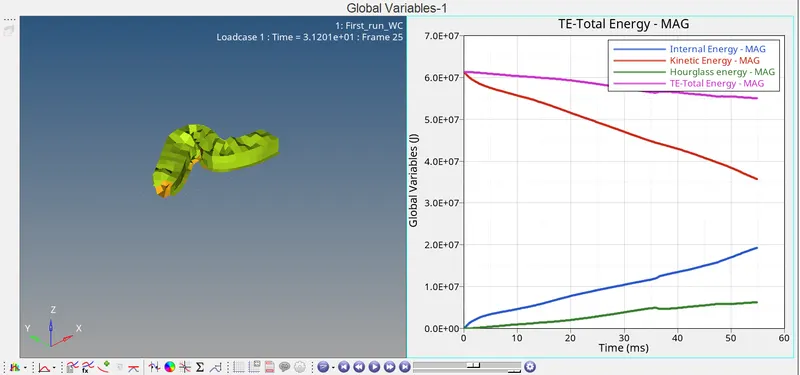
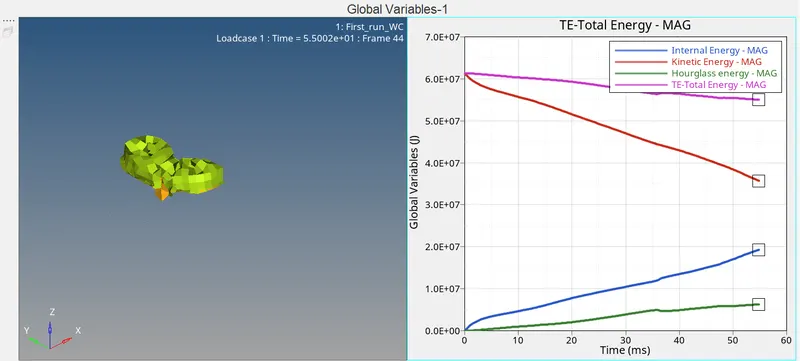
Global energy variables for the total energy, kinetic energy, internal energy and hourglass energy has been plotted for the simulation. The energy graph reflects the change of energy during the crash.
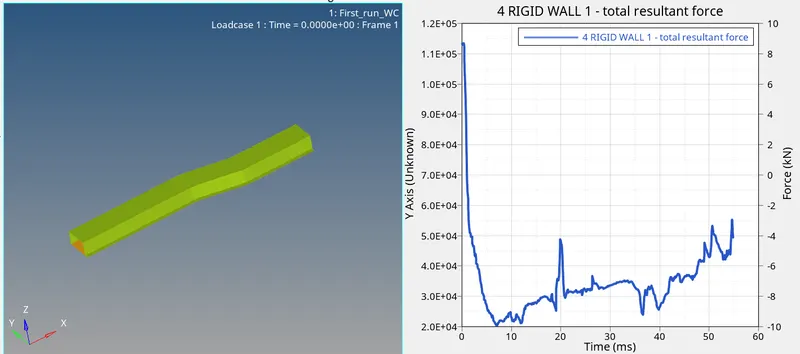
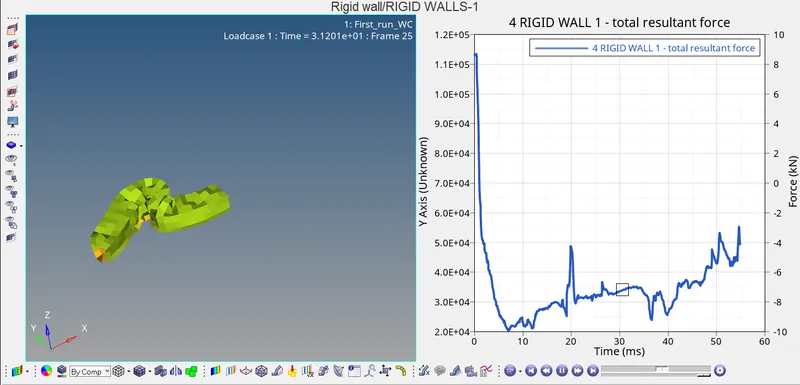
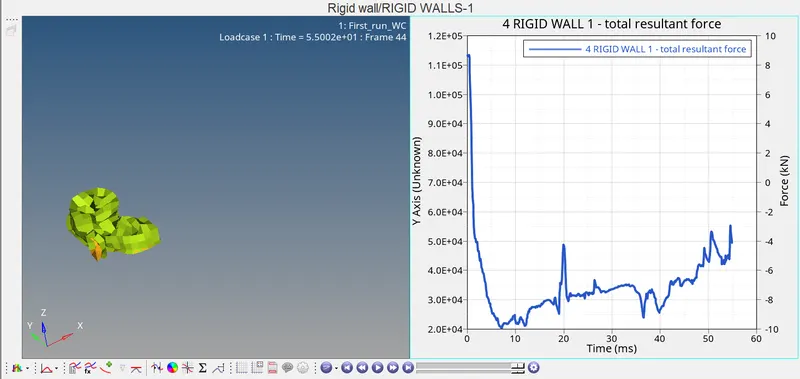
Resultant Force on Rigid Wall

Initially, The Internal energy was 0, later it increases change in work done, approximated 1.9E+07.
kinetic energy is maximum at the initial condition, after crashing in the rigid wall, it slows down and 3.5E+07.
The total energy is the sum of KE+PE+IE, which should be a flat line, decreases due to hourglass energy deflection.
Changing all the shell elements properties to the recommended parameters.
Recommended properties:
| Parameters | Comment | |
|
Ishell =24 |
QEPH 4 nodes shells are best combination of cost and accuracy. | |
|
Ismstr=2 |
Full geometric nonlinearities (default)with possible small strain formulation activation in RADIOSS Engine. | |
|
Ish3n=2 |
Standard 3 noded shell (C0)with modification for large rotation(default) |
|
| N=5 | Number of integration points set to 5 for accuracy bending. | |
|
Ithick=1 |
Thickness change is taken into account for accuracy. |
|
|
Iplas=1 |
Iterative plasticity for good accuracy. |
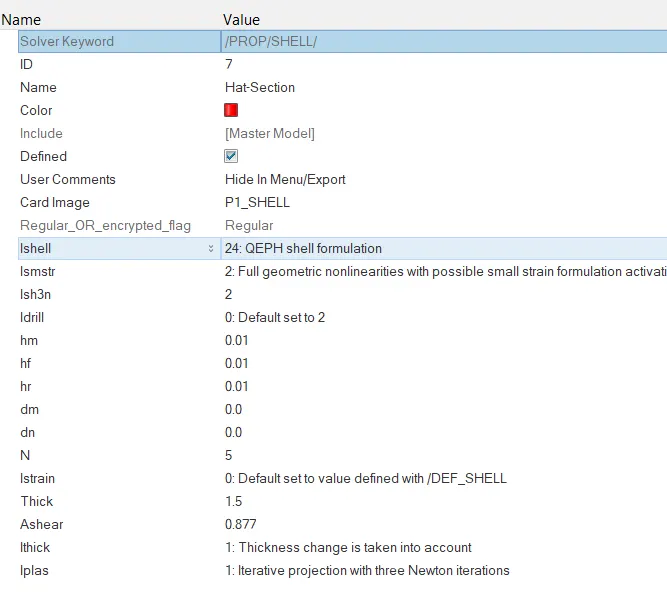
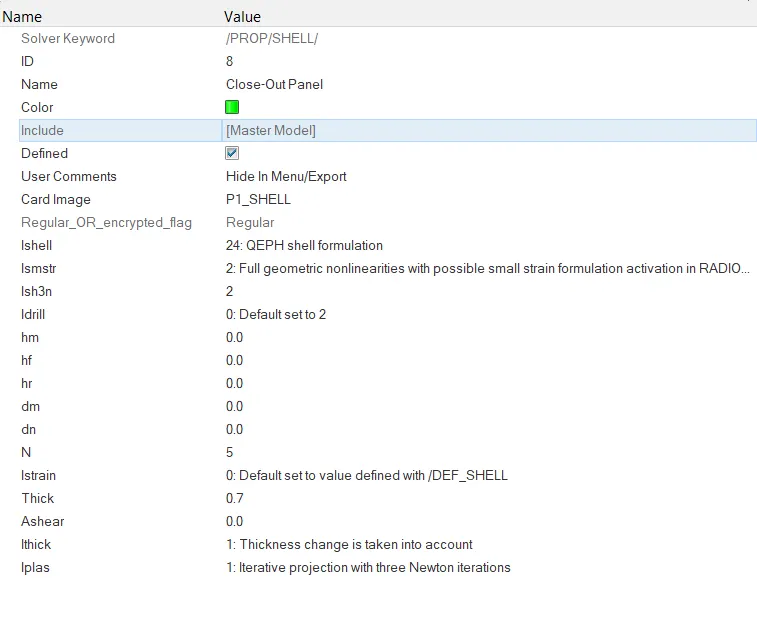
Same properties are used for both Hat Section and closed out panel.
And the same procedure is to be followed for analysis.
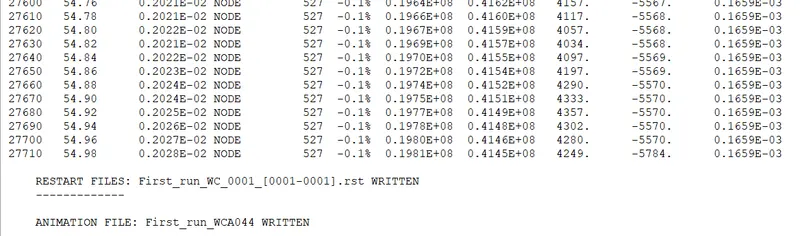
Energy Error = -0.1% and Mass Error =0.1659E-03
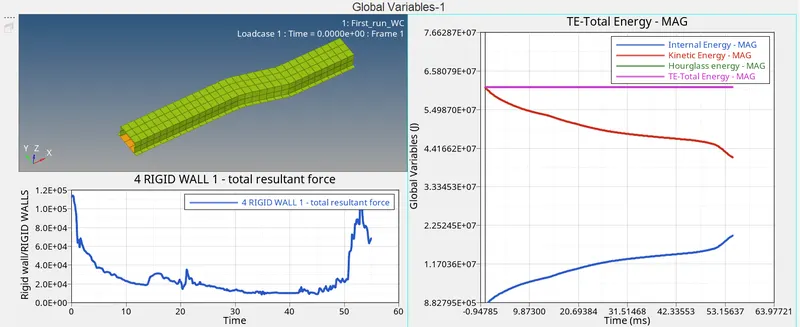
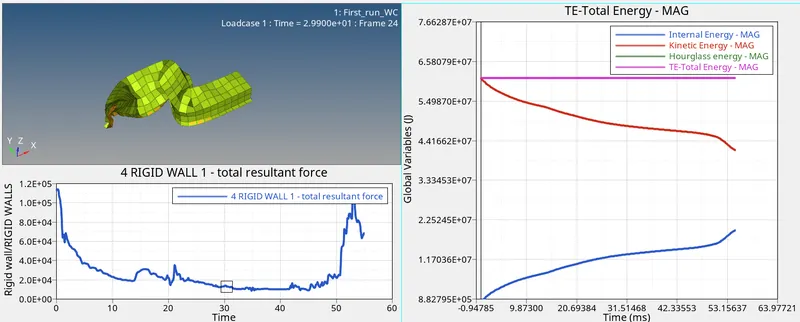
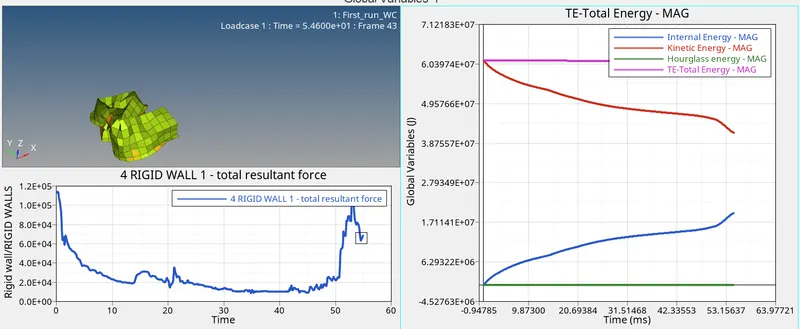
The Internal energy was 0 initially, later it increases change in work done, approximated 1.7E+07
kinetic energy is maximum at the initial condition, after crashing in the rigid wall, it slows down and 4.4E+07
The total energy is the sum of KE+PE+IE, which is a flat line, due to optimization of hourglass energy in modified element property found to be stable.
| Internal Energy | Kinetic Energy | Error | Mass Error | |
| Default | 1.9E+07 | 3.5E+07 | -10.3% | 0.1659E-03 |
| With new parameters | 1.981E+07 | 4.145E+07 | -0.1% | 0.1659E-03 |
Conclusion
Energy Error = -10.3% (Default) & -0.1% (New parameter)
Mass Error =0.1659E-03 (Default) & 0.1659E-03(New parameter)
Hourglass ( HG ) modes are nonphysical, zero-energy modes of deformation that produce zero strain and no stress. Hourglass modes occur only in under-integrated (single integration point) solid, shell, and thick shell elements.
ENERGY ERROR: When the elements are subjected to deformation, there will be multiple forces acting on the elements, the elements will undergo a change in shape, which is unrealistic, without proper shape, in which system induces some opposite forces to rectify the deformation that is induced by hourglass energy, is known as Energy error.
- "If the error is negative, it means that some energy has been dissipated.
In case of under integrated elements (Belytschko shells, solids with 1 integration point), the Hourglass energy can also explain a negative Energy Error since it is not counted in the energy balance. The normal amount of Hourglass energy is about -10% to -15%".
- "If the error is positive, there is an energy creation.
In the case of using QEPH shell formulation (Ishell=24) or fully integrated elements, the Energy Error can be slightly positive since there is no Hourglass energy and the computation is much more accurate. An error of +1% or +2% is acceptable.
MASS ERROR: When there is an energy error affecting the elements, the solver usually add up or removes mass according to the requirement involuntarily, that caused the mass error.
i.e, 0.0001659 < 2-3% and is neglible.
The maximal kinetic energy of the system is 4.145E+07. It descends sharply with the process of the impact. At the same time, due to the distortion of the rail, which is absorbing the energy, the internal energy ascends sharply. Up to the end of the impact, Most of the kinetic energy has been transformed into the internal energy of the distorted component. Also from the energy plot, we can see that hourglass energy is very less or negligible. Ideally, hourglass energy should not exceed 10% of internal energy and the same is also satisfied in this simulation.
QEPH is better in processing the data than Q4. Strain formulation method induced. Continous thickness data taken into account are the factors that created a better impact.