Rayleigh Taylor Instability Challenge
Rayleigh Taylor Instability
Aim: To perform Rayleigh instability simulation on different refined mesh and compare the results and find out the Atwood number and finds its effects on instability by variation.
Rayleigh-Taylor instability (RTI) is the interpenetration of materials that occurs whenever a light fluid pushes on a heavy fluid. It is the instability of an interface between two fluids of different densities which occurs when the lighter fluid is pushing the heavier fluid.
Practical CFD models that based on the mathematical analysis of Rayleigh Taylor waves.
- Richtmyer–Meshkov instability
when two fluids of different density are impulsively accelerated by the passage of a shockwave. The development of the instability begins with small amplitude perturbations which initially grow linearly with time. This is followed by a nonlinear regime with bubbles appearing in the case of a light fluid penetrating a heavy fluid, and with spikes appearing in the case of a heavy fluid penetrating a light fluid. A chaotic regime eventually is reached and the two fluids mix. This instability can be considered the impulsive-acceleration limit of the Rayleigh-Taylor instability.
- Kelvin–Helmholtz instability
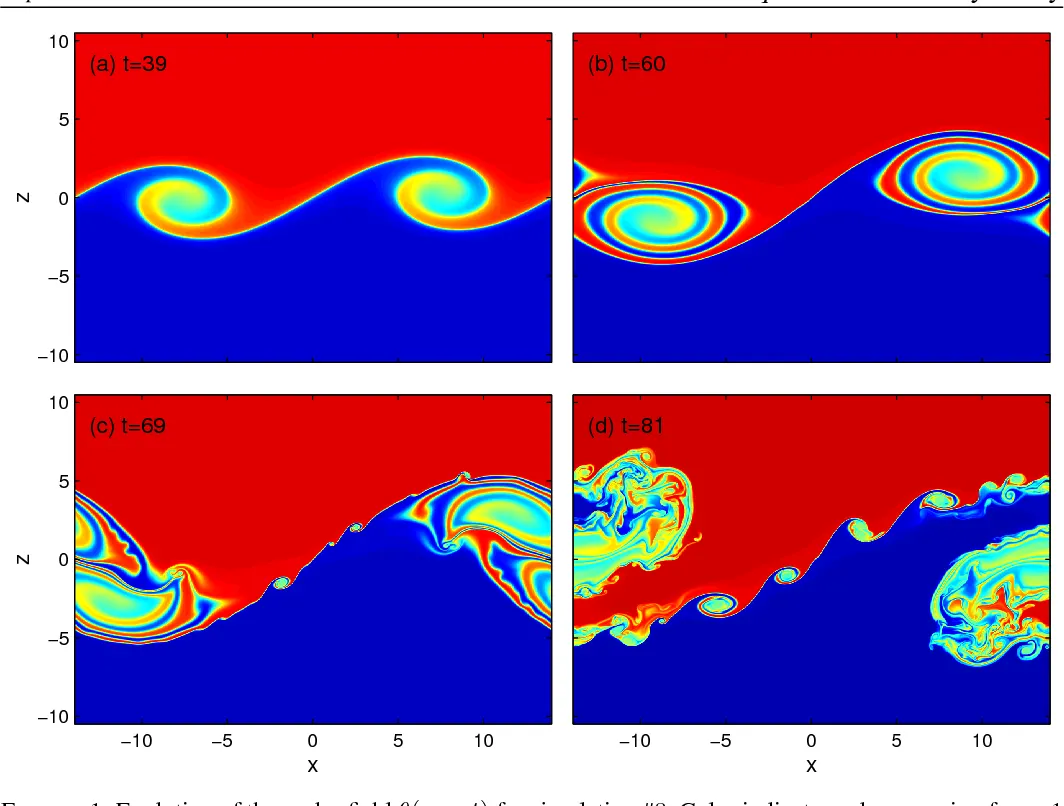
The Kelvin–Helmholtz instability typically occurs when there is velocity shear in a single continuous fluid, or additionally where there is a velocity difference across the interface between two fluids. A common example is seen with the wind blowing over water, the instability constant is able to manifest itself through waves on a water surface.
- Plateau–Rayleigh instability
The Plateau–Rayleigh instability, explains how a falling stream of fluid breaks up into smaller packets with the same volume but less surface area. It is related to the Ryleigh- Taylor instability. and is part of a greater branch of fluid dynamics concerned with fluid thread breakup. This fluid instability is exploited in the design of a particular type of inkjet technology. whereby a jet of liquid is perturbed into a steady stream of droplets. The driving force of the Plateau–Rayleigh instability is that liquids, by virtue of their surface tensions, tend to minimize their surface area. A considerable amount of work has been done recently on the final pinching profile by attacking it with self- similar solutions.
Geometry:
Two 2D surfaces have created of 20x20mm which will act as the fluid domain and their surface has shared to get the conformal mesh.
Meshing :
The simulation is done with 2 different mesh sizes with the base mesh being 0.5 mm
Base mesh-
Nodes-3321
Elements-3200
Part I
SETUP
Solver Type: Pressure base, Transient Velocity with the Laminar Viscous Model
Absolute Gravity:-9.81m/s along with y-direction
Multiphase is used with material Primary Phase -air and Secondary Phase-water
Initialize it and then go to patch to setup.
Solution runs for 1000 time step with time step size 0.005s.
Result
Element Size 0.25
Nodes-13041
Elements -12800
Residuals
Element Size 0.150
Nodes - 35778
Elements - 35378
Residuals
PART II
Rayleigh Taylor instability simulation with water and user-defined material. (for refined mesh)
density = 400 kg/m3, viscosity = 0.001 kg/m-s
Residuals
The steady-state analysis in CFD always gives the end result of the fluid behavior.
In this simulation, we want to study the instability of the 2 different fluid from the moment it mixed together until the steady-state is reached, we need to capture the physical phenomena at each time step, therefore we used transient simulation which is time-dependent.
Atwood number is a dimensionless number that describes the density difference between two adjacent fluids with a common interface. This number is used in the study of hydrodynamic instabilities in density stratified flows.
Atwood number is an important parameter in the study of Rayleigh–Taylor instability and Richtmyer–Meshkov instability

 = density of the heavier fluid
 = density of the lighter fluid
Part I
The density of water =997 kg/m^3
The density of air =1.255 kg/m^3
A= (997-1.25)/(997+1.25) = 0.997
Atwood number (A)=0.997
PART II
Rayleigh Taylor instability simulation with User Definedfluid-Water interface
The density of water =997 kg/m^3
The density of user-defined fluid =400 kg/m^3
Atwood number (A)=0.427
Conclusion -
For the case of small Atwood numbers, the difference in densities are small and the slow process of penetration are seen. RT instability flows take the form of symmetric fingers of fluid.
With the increase in the Atwood number, there is a rapid process of penetration. Lighter fluid below the heavier fluid takes the form of larger bubble-like plumes and move against the gravity very fastly.
With the Finer mesh, the instability captured properly and smaller bubbles are also visible in the finer mesh.