Steady Vs Unsteady flow over a cylinder
Steady Vs Unsteady flow over a cylinder
In this challenge analyzing the flow over the cylinder to study the effects of vortex shedding.
Vortex shedding is an oscillating flow that takes place when a fluid such as air or water flows past a blunt body at certain velocities, depending on the size and shape of the body. In this flow, vortices are created at the back of the body and detach periodically from either side of the body forming a Von Kármán vortex street. The fluid flow past the object creates alternating low-pressure vortices on the downstream side of the object.
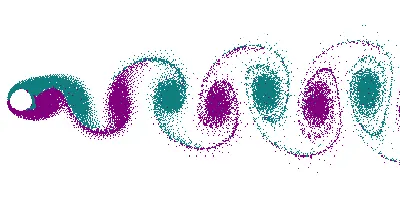
In fluid dynamics, a Kármán vortex street (or a von Kármán vortex street) is a repeating pattern of swirling vortices, caused by a process known as vortex shedding, which is responsible for the unsteady separation of flow of a fluid around blunt bodies. A vortex street will form only at a certain range of flow velocities, specified by a range of Reynolds numbers.
PART-I
Flow with the steady and unsteady case at RE - 100
Geometry -
2D geometry is used as the surface in which the whole body is considered as the fluid region. The circle is considered as the cylinder wall.
Meshing -
Element Size -0.25m
Method- All Triangle
Circle edge sizing - 36 divisions
Inflation Layer - No of layers - 8
First Layer Height- 5mm
Growth Rate - 1.2
Statistics
Nodes - 20764
Elements -40564
Setup
Solving this solution with 2 different condition
1.Steady State 2.Transient state
Fluid Properties - Density - 1 kg/m3 Viscosity - 0.02 kg/ms
Inlet velocity - 1m/s, Outlet is at gauge pressure -0
Solving for Reynolds number -100
Solution
Steady-state
Residuals
The solution got converged at 360th iteration. Velocity Contour
Average Velocity at monitor point. Average Pressure at the monitor point.
Unsteady State (Transient state)
Residuals Velocity Contour
Average Velocity at monitor point. Average Pressure at the monitor point.
Generally, the convergence can be determined easily by monitoring the residuals plot. However, due to the presence of periodic oscillations in the velocity profile, the convergence is effectively captured by monitoring the velocity at a Monitor point. The stability of the amplitude of oscillation indicates the convergence of the solution.
The Strouhal number (St) is a dimensionless number describing oscillating flow mechanisms.
The Strouhal Number represents the ratio of inertial forces due to the unsteadiness of the flow or local acceleration to the inertial forces due to changes in velocity from one point to another in the flow field.
We cannot find a Strouhal number for steady conditions.
For the unsteady or transient condition:
St=f*D/U,
Where St = strouhal number, f= frequency, D= characteristic length, U= velocity of airflow
f= No of ossiclation/ time
f= 8/50=0.16 (values from velocity plot)
D= 2m, U= 1m/s
St=0.16*2/1=0.32
Strouhal number = 0.32
Part II
Flow with the steady-state with the Reynolds number 10, 100,1000, 10000 & 100000.
Using the same geometry, meshing, fluid property, and boundary condition.
Only inlet velocity will vary according to the Reynolds number.
Re= ρ*U*D/μ
RE=10 : U= 0.1m/s
Converged at 150 iteration
Cd= 2.7139031 CI= 0.00020786125
RE 100 : U= 1m/s
Converged at 350 iteration
Cd=1.3195355 Cl=0.007329234
RE= 1000 : U= 10m/s
Converged at 200 iteration
Cd= 0.93444636 Cl= 0.35289341
RE = 10000 : U= 100m/s
Converged at 300 iteration
Cd= 0.85148267 Cl= -0.26289008
RE= 100000 : U= 1000m/s
Converged at 300 iteration
Cd= 0.90907497 Cl= 1.376251
|
RE |
Cd |
|
10 |
2.7139031 |
|
100 |
1.3195355 |
|
1000 |
0.93444636 |
|
10000 |
0.85148267 |
|
100000 |
0.90907497 |
With the increase in Reynolds number, there is a decrease in the drag coefficient acting on the walls.