Assignment 2
Task:- To understand the stress wave propagation mechanics in a structural component and preparing the RADIOSS solver deck to animate the effect.
The speed of sound wave in a material medium talked from a Finite element view-point is rate at which an information (generally a force) will travel across and through the structure. It can be calculated from the material's Modulus of Elasticity (E) and material's mass density (ρ).
If we want to find-out the stress or strain or any other detail at a particular location on the structure spatially, than we can consequently calculate the time it takes for the wave to reach and affect that particular location by simple Distance-Speed-Time formula.
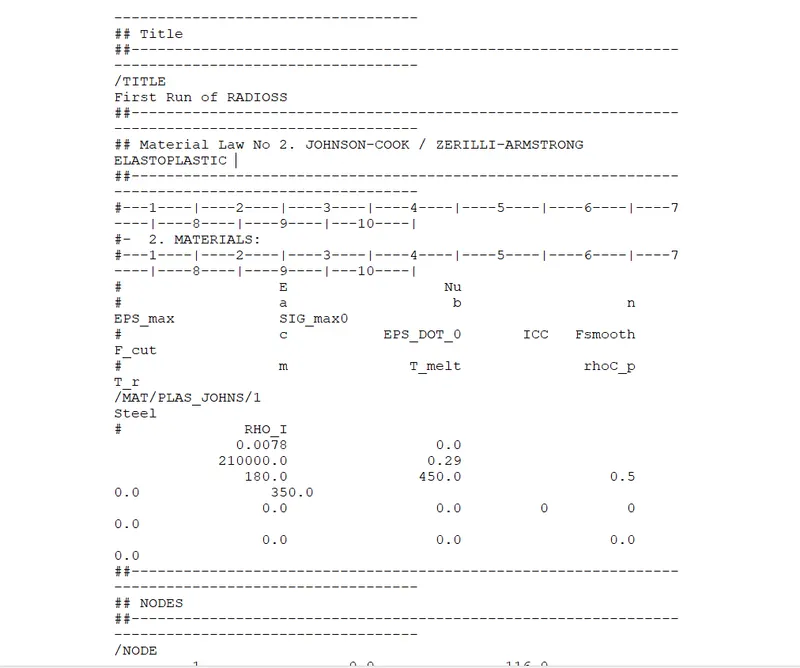
From the First run file provided, we find that the units set in the task are grams, millimeter, milliseconds. And the other information is about E & ρ.
1.) The speed of wave propagation in steel rail: C = √(E/ρ)
C = √ [(210000 {g/mm ms^2} ) / (0.0078 {g/mm^3}) ] = 5188.745 mm/ms
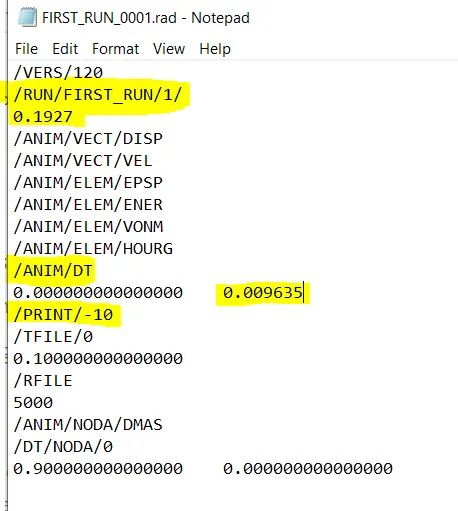
2.) Time it takes for the wave to travel from one end to the far end at 1000 mm is: t = 1000/C = 0.1927 ms
3.) To obtain 20 snapshots during the whole simulation we divide the total time it takes for the wave propagation by 20 to obtain a time step at which one snapshot will be recorded.
Therefore: Tfreq = t/20 = 0.009636 ms
This number Tfreq shall be edited in the Engine input file provided.
The other tasks include performing 3D Tetra & Hex meshing on the given components
Given a cap housing, we can apply a 3D Tetra mesh more conveniently than a 3D Hex mesh because of it's topological features.
To apply 3D terta mesh on the cap-housing assembly, we can use Volume tetra from 3D tools in panel area.
Specify the element size required and utilize the proximity capture and curvature capture feature to obtain better element mesh.
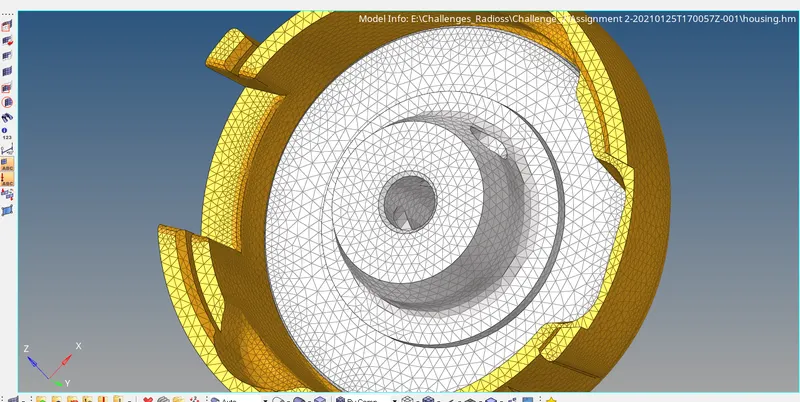
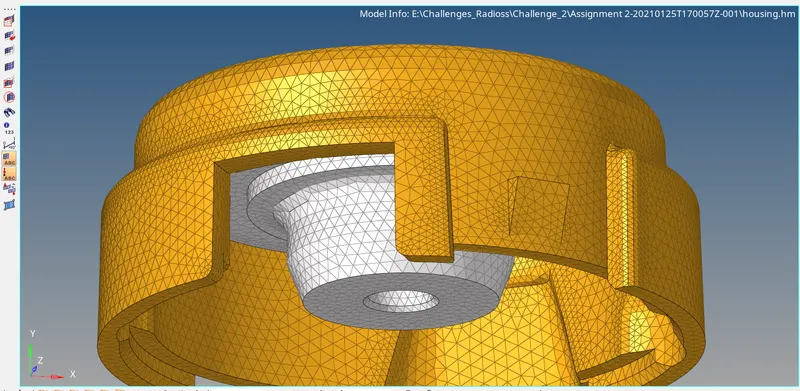
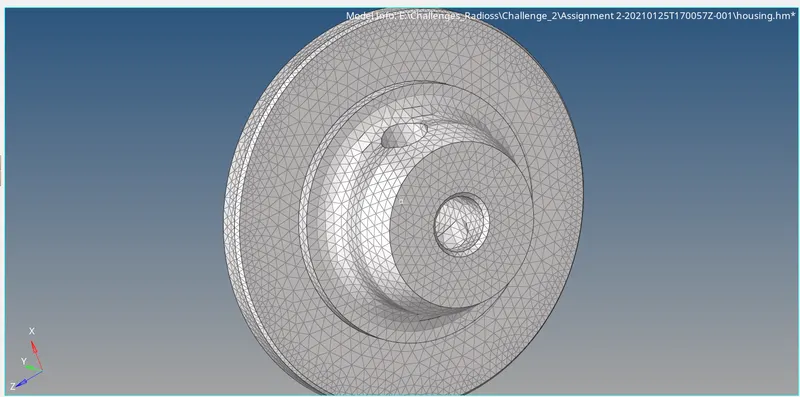
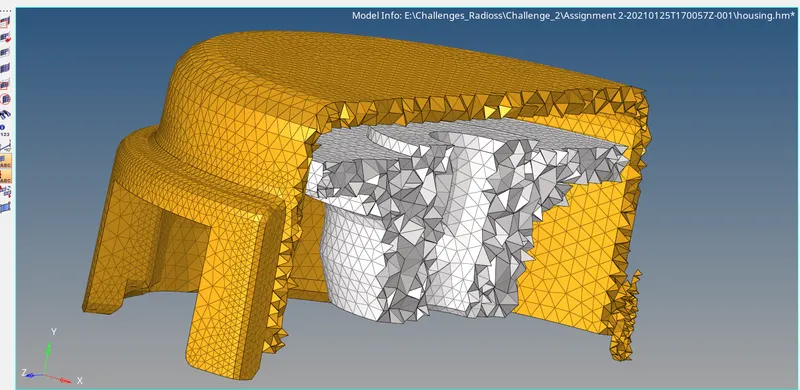
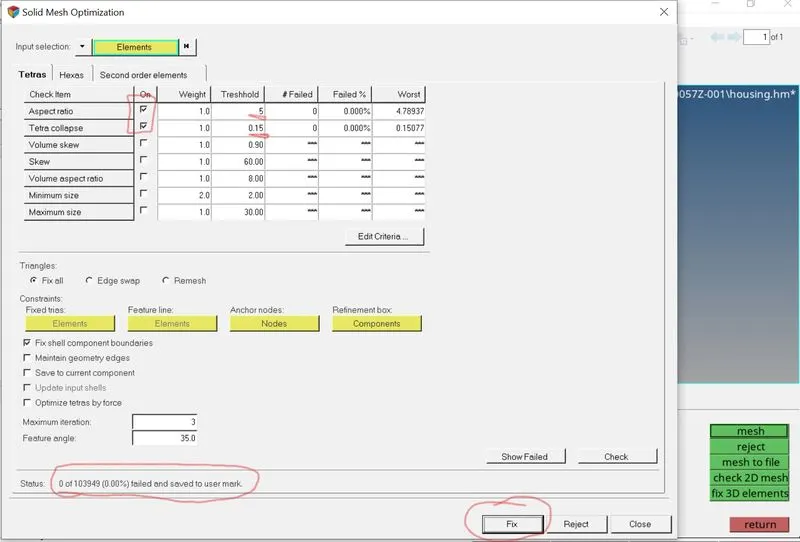
The tet collapse can be monitored and improved by going into solid mesh optimization from "fix 3D elements" sub-option in the tetra mesh option.
Similarly, we have an arm bracket whose geometry features allow us to create 3D Hex mesh conveniently. The body is already splitted into 4 segments which makes it easy for us to create and map 2D elements and sweep them as solid 3D hex meshes.
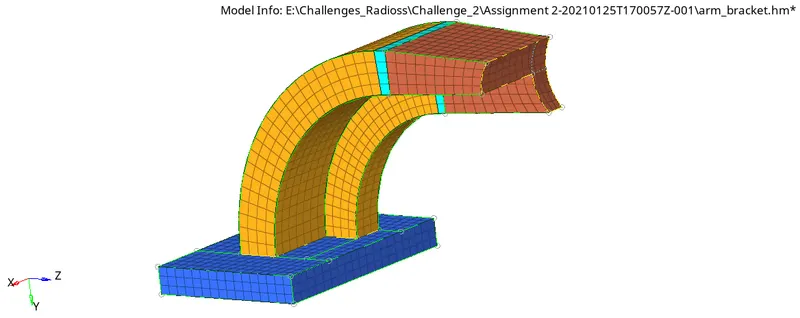
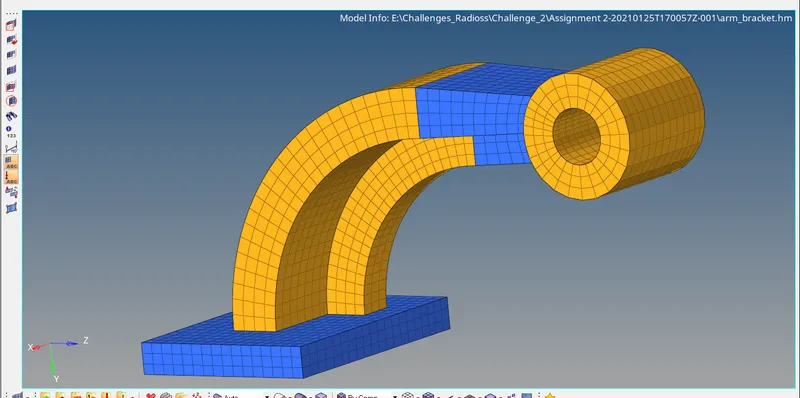
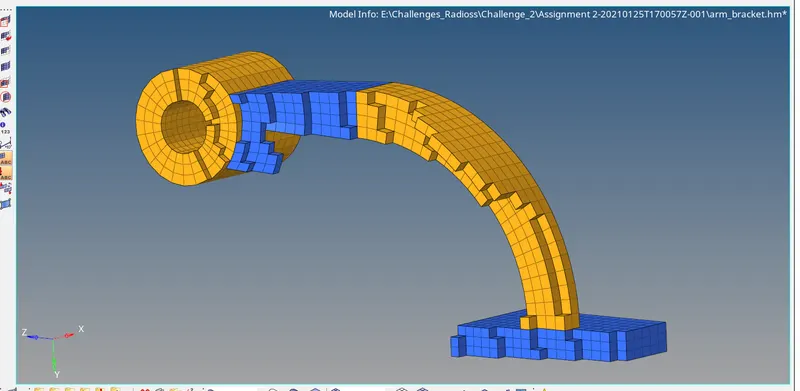
Outcome:- In this exercise, we learned about how the RADIOSS files are prepared and how to utilize a starter and engine file for RADIOSS to make a solver deck.
Additionally, we also learned how to apply 3D Tetra and Hex mesh on some simple components.