#8 Induction Motor characteristics
Question
1. How induction motor operation is similar to the clutch?
2. Calculate the starting time of a drive with the following parameters:
J=10 kg-m2,
T = 15 + 0.5wm
Tl=5+0.6ωm
3. A drive has following equations for motor and load torques:
Tm=(1+2ωm)
Tl= 3 √ωm
Obtain the equillibrium points and determine the stability.
4. Make a MATLAB script file which will plot speed-torque characteristics for frequency control method.
CODE SAMPLE" option to paste your code.
SUBMISSION RULES
Use the "INSERT CODE SAMPLE" option to paste your code and attach screenshots of the output. 10 points will be reduced for not doing so. Just showing the code and not explaing the results. 20 points will be reduced if this happens.
If your program or model fails to compile then you will score 0, in that particular challenge. This is applicable only for challenges where you are asked to code or submit the model files
Create a zip file with all the necessary .m files model files etc. in google drive and them as a single zip file.
Copying code from others - If you copy code from others, your score will be 0. If you copy from others on more than 1 assignments your challenges will no longer be graded. You can still access the course but your challenges will not be graded.
If you have attached links to images or videos, make sure that they work before you hit submit. At the time of grading broken links will not be taken into account.
Once graded future submissions will not be valid
Make sure you provide open links while attaching Google Sheets file
Make sure you follow the constraints given in the question, violating them will results in 0 marks.
GENERAL INSTRUCTIONS:
The codes, plots, images, GIFs, and videos should be submitted only through the answer box.
Use the Google Drive to share only the cad models or other answers which couldn't be done through the answer box.
NOTE:
Violating the above instructions will lead to ZERO marks.
Link sharing should be enabled while sharing the Google Drive link, else the challenge will be awarded ZERO marks.
Your Answers
1. How induction motor operation is similar to the clutch?
Mechanical Clutch:
A clutch is a mechanical device that engages and disengages power transmission, especially from a driving shaft to a driven shaft. In the simplest application, clutches connect and disconnect two rotating shafts.
In these devices, one shaft is typically attached to an engine and other to power unit (the driving member), while the other shaft (the driven member) provides output power for work. Typically the motions involved are rotary, but linear clutches also exist.
The clutch connects the two shafts so they may be locked together and spin at the same speed (engaged), locked together but spinning at different speeds (slipping), or unlocked and spinning at different speeds (disengaged).
There is power loss due to improper engaging while tranmission of power ie) the speed and torque at the driven shaft is not equal as in driving shaft because of losses.
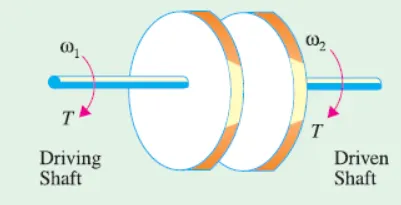
where ω1 and ω2 are the angular velocities at the driving and driven shaft respectively.
S- Slip.
ω2 = ω1(1-S)
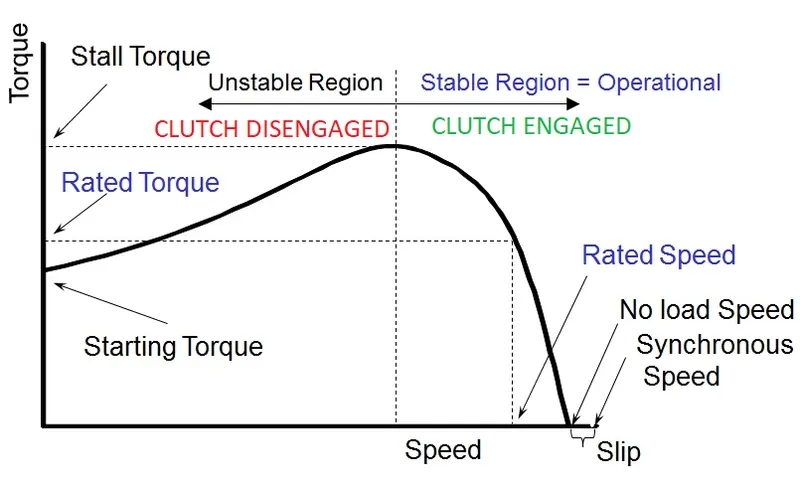
Induction motor:
The operation of the induction motor is also similar to Clutch operation.
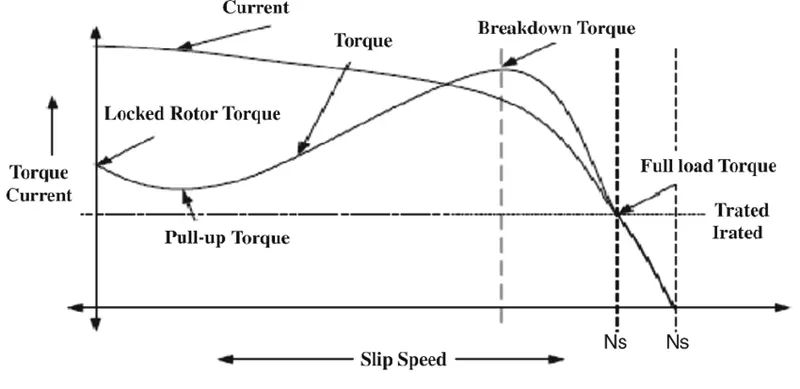
The above graph of Torque speed characteristics of the induction motor is similar to the clutch operation.
The motor is operating only between synchronous speed and breakdown torque where the load is engaged.
Between starting torque to breakdown torque, the motor is not operational to overcome the given load.
In steady state condition. with increase in speed, the motor torque should be less than the load torque for proper operation of motor to engage the load.
Before the breakdown point (highest torque), the motor operates with no load condition.
After breakdown torque to synchronous speed point, the motor operates with load engaged and this satisfies the steady state stability condition of the induction motor.
this behaviour of the induction motor is similar to clutch operation of engaging and disengaging the load.
ωm = ωms (1-S)
ωm - Rotor speed ωms- stator synchronous speed S-Slip.
Thus the induction motor operation is similar to the clutch.
2. Calculate the starting time of a drive with the following parameters:
J=10 kg-m2,
Tm = 15 + 0.5wm
Tl=5+0.6ωm
Tm- Motor Torque, Tl-Load Torque, J-moment of inertia of induction motor.
Starting time:
The starting time of the induction motor is the time taken by the motor to engage load and start functioning. ie) the time taken from starting torque to peak torque in speed-Torque characteristics of Induction motor.
The steady state stability  equation of induction motor is
Tm - Tl= J dWm/dt.------1
At Ideal Steadt state condition,
Tm = Tl, Then
15+0.5wm = 5+0.6wm
10-0.1wm=0
applying in above equation-1,
10-0.1wm=10*dwm/dt
(10-0.1wm)/10=dwm/dt
1-0.01wm=dwm/dt
1/(1-0.01wm)*dwm = dt
By integrating the above equation for the limit from initial to 95% of the Wm
∫dt = ∫1/(1-0.01wm) dwm
t= ∫1/(1-0.01wm) dwm
using formula ∫1/x= lnx+C
t = 299.6 seconds
3. A drive has following equations for motor and load torques:
Tm=(1+2ωm)
Tl= 3 √ωm
Obtain the equillibrium points and determine the stability.
To obtain the equillibrium points, i have used the matlab script file to solve the given torque equations
clear all
close all
clc
X=linspace(0,5,20);
% motor torque
Y1 =1+2*X;
% Load torque
Y2 =3.*sqrt( X);
% Plotting
plot (X,Y1,'linewidth',2);
hold on
plot (X,Y2,'linewidth',2);
title('Speed Vs Torque Characteristics');
xlabel('Speed,rpm');
ylabel('Torque,Nm');
legend('motor Torque','Load Torque');
The plot obtained is
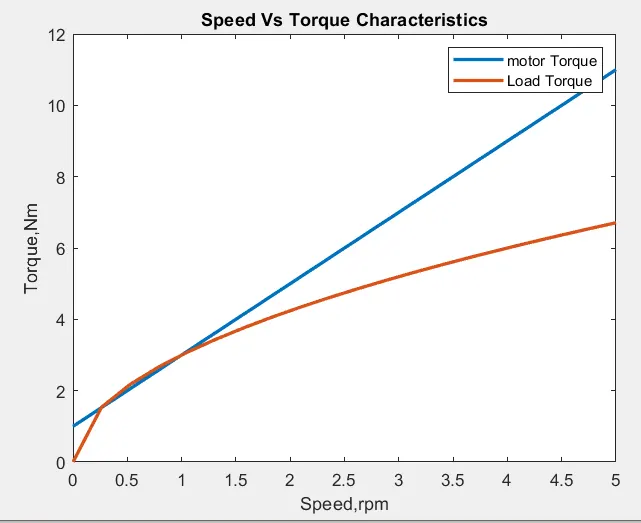
In the above plot the two curves meet at two points, these are the euilibrium points ie) at Wm=0.25 and Wm=1.
To determine the stability,
Stability is a condition at which
(dTl/dWm) - (dTm/dWm) > 0
Tl=3 √Wm
dTl/dWm = 3/(2 √Wm)
Tm=1+2Wm
dTm/dWm = 2
Substituiting in above equation
3/(2 √Wm) - 2 > 0
we have two values, we need check which point satisfies the above condition,
for Wm=1
3/(2 √1) - 2 > 0
1.5-2> 0
-0.5>0 which does not satisfies the above condition
for Wm=0.25
3/(2 √0.25) - 2 > 0
3-2> 0
1>0 which satisfies the above condition
Therefore the drive with above torque equations reaches stability at Wm=0.25 rad/s speed.
4. Make a MATLAB script file which will plot speed-torque characteristics for frequency control method.
The matlab script file created is
clear all
close all
clc

%Voltage per phase
V=230/sqrt(3);
%No of phases
Ph=3;
%No of poles
P=4;
%Stator resistance and Inductance
R1=0.095; X1=0.680;
%Rotor resistance and Inductance
R2=0.23; X2=0.672;
%Magnetizing Inductance
Xm=18.7;
%Calculate stator equivalent equations
Zeq=1i*Xm*(R1+1i*X1)/(R1+1i*(X1+Xm));
Req=real(Zeq);
Ieq=imag(Zeq);
Veq=abs(V*1i*Xm/(R1+1i*(X1+Xm)));
%Frequencies
Vf=linspace(10,50,5);
%loop
for i=1:length(Vf)
%motor speed calculation
Omega=(4*3.14*Vf(i))/P;
Omega_ms=(120*Vf(i))/P;
for n=1:200
    %Slip
    %s = ones(1,length(n));
    s(n)=n/100;
    %motor speed in rpm
    rpm(n) = Omega_ms*(1-s(n));
    %Current in rotor
    I2=abs(Veq/(Zeq+1i*X2+R2/s(n)));
    %Torque Calculation
    %T=ones(1,length(n));
    T(n)= Ph*I2^2*R2 / (s(n)*Omega);
end
% To display maximum speed of motor at different frequencies
Curve =['The maximum speed of motor at',num2str(Vf(i)),'Hz'];
disp (Curve)
disp (rpm(1))
%Plot
plot (rpm,T,'LineWidth',3)
hold on
axis ([0 1500 0 600])
title('Speed Torque Characteristics for frequency controlled Induction Motor');
xlabel('Speed of motor in rpm');
ylabel('Torque of motor in Nm');
end
legend('Fz=10Hz','Fz=20Hz','Fz=30Hz','Fz=40Hz','Fz=50Hz');
The results obtained are
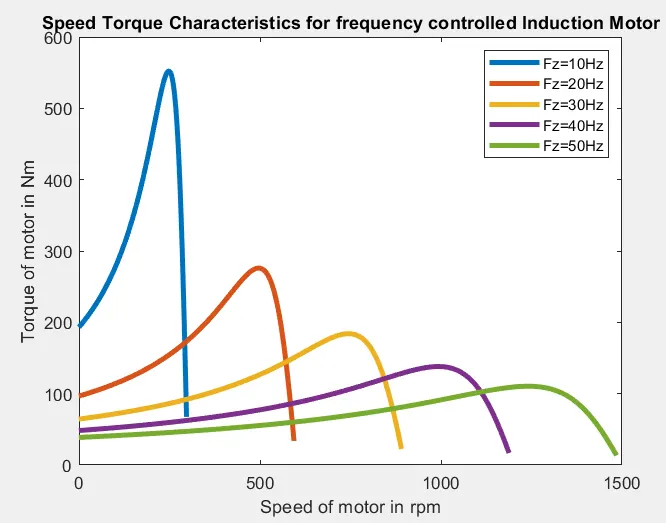
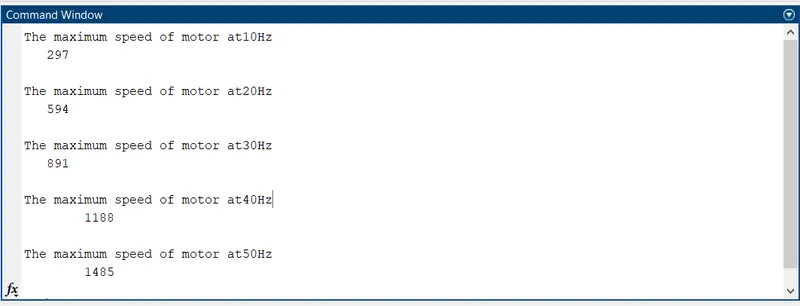
From the plot, it is observed that with the increase in frequency, there is a decrease in peak torque and increase in the speed of motor(rpm).
Your Assets
| Filname | Size | Action |
|---|---|---|
| Equabil…CMotor.m | 316 B | |
| frequen…nmotor.m | 1.23 KB |