#7 State of charge estimation
Question
1.Simulate the 3 test cases from harness dashboard and write a detailed report on the results
2.What is coulomb counting? Refer to the above model and explain how BMS implements coulomb counting for SOC estimation ?
Hint :(Download the file from the link and go to SOC estimation model-ECU block)
Your Answers
Simulate the 3 test cases from harness dashboard and write a detailed report on the results.
The model gives a brief idea about BMS and its function. The harness dashboard consists of different LEDs which will show the status of the battery, if any fault occurs then a red LED will be ON.
The BMS can is modelled to simulate the following defects,
- Overcurrent
- High Temperature
- Low Temperature
- Over voltage
- Under voltage
- charger
- Inverter
- Voltage sensor.
The entire model has a large number of components and system level analysis. A 6cell module is selected as our battery pack for the system.
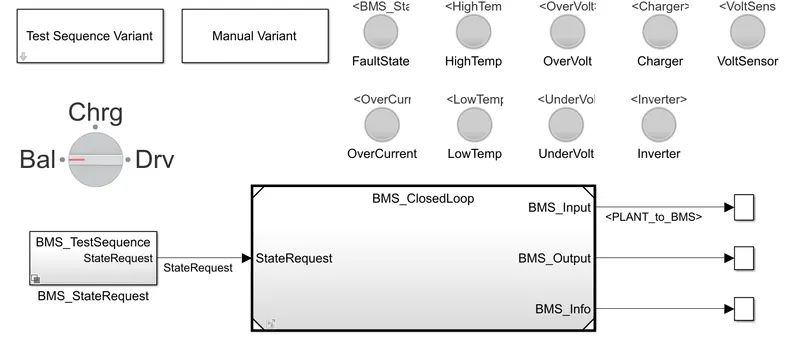
The BMS_Closedloop consists of interlinking of the BMS and the plant(Battery pack).
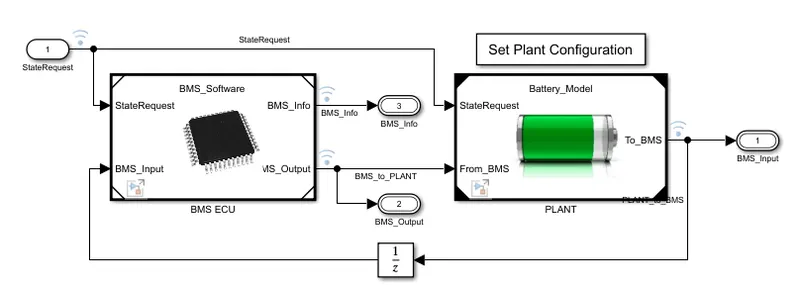
The BMS ECU is the heart of the system which controls all the program, algorithms and logics.
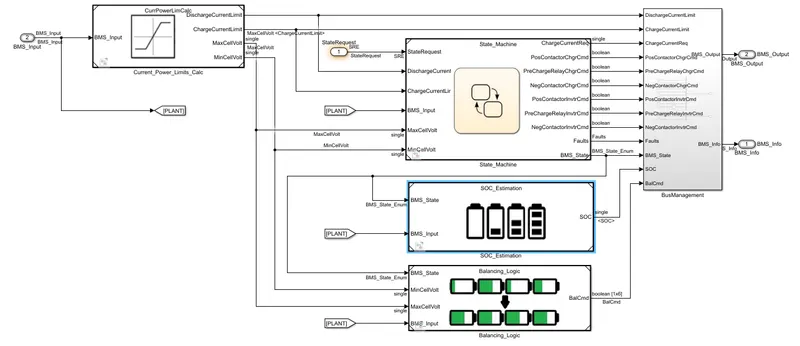
The state machine will implement three logics,
- Driving characteristics tells us the response to the different driving conditions
- Charging: Response to the EV while charging
- Balancing: Respone to the fault options
The SOC-Estimation is also a key important block in the BMS_ECU, which helps to tell the estimate the battery charging condition, whether cells are charging properly or not etc.
The balancing_Logic is responsible for the management of the battery pack while charging so that there is occurance of weak cell into the system, introducing weak cell in the pack comprimses with the SOC and SOH.
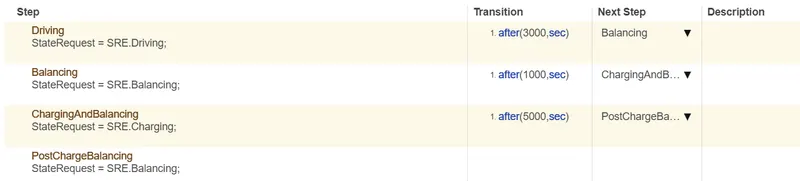
The Test sequence varient has in build 3 models, It has 3 stages of driving condition
- Driving
- Charging and balancing
- standby
When the input is provided to the BMS model, the scope result and dashboard results are
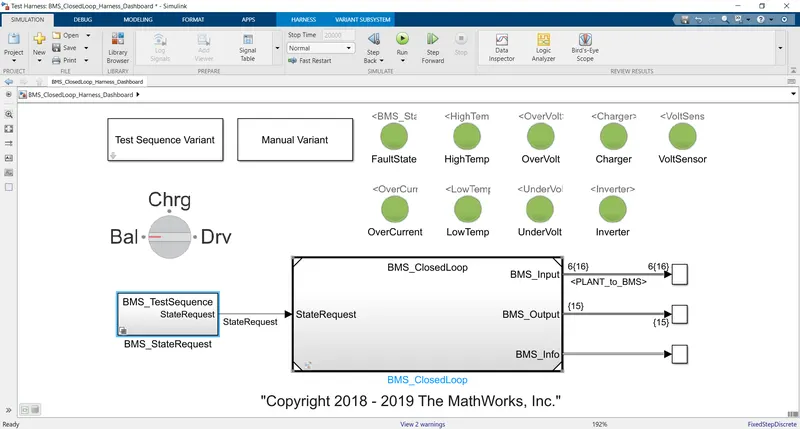
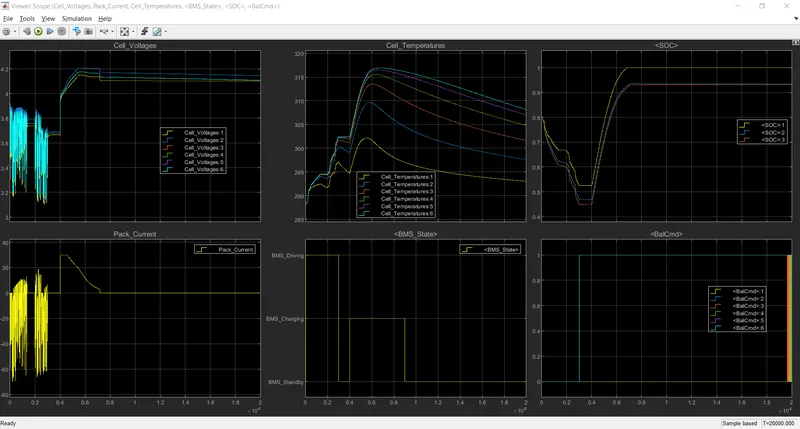
There is no fault in the system which is indicated by the GREEN LED on the dashboard.
Results:
Cell voltage:
The fisrt graph shows the Cell voltage which is varying randomly in the initial stage when the vehicle in driving mode, once the vehicle changes to charging mode the cell voltages increases upto 4.2V and at standby mode the voltages remains constant.
Cell Temperature:
Initially the cell temperatures is increases randomly from 288K to 302K when the vehicle is in driving mode, when the vehicle mode changes to charging we can observe a steep increase in temperature from 302K to 306K and then the temperature falls to around 290K at stand by mode.
State of charge :
While driving the SOC starts decreasing from 80% to around 45% and then at charging mode the SOC reaches upto 100% and remains constant at stand by mode.
The Test sequence varient 2 has 2 phases of the battery
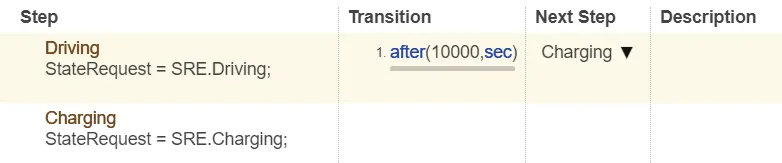
The scope and dashboard results are
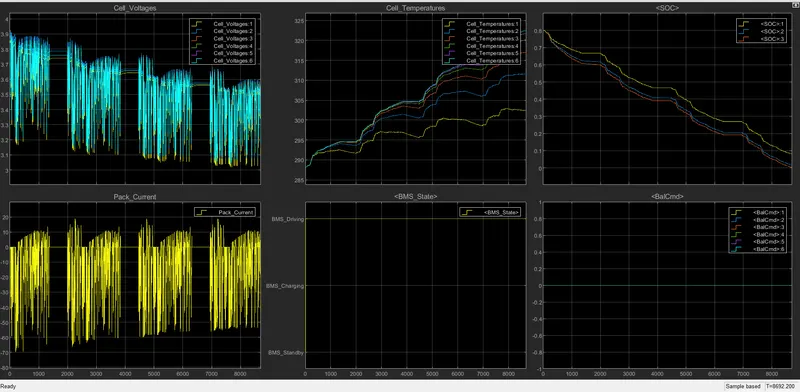
Results:
The cell voltage varies randomly according to the driving conditions of the vehicle. when the vehicle is continuously on driving mode the state of charge of the battery is decreases rapidly and reaches 0% within 10000sec, so the BMS detects that there is no power left in the battery and stops the simulation at around 8000sec.
When the driving duration in second test sequence is changed to 6000s,

The scope and dashboard results are
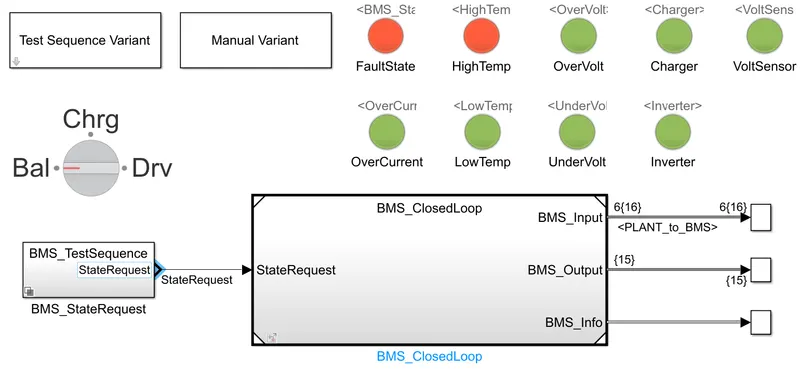
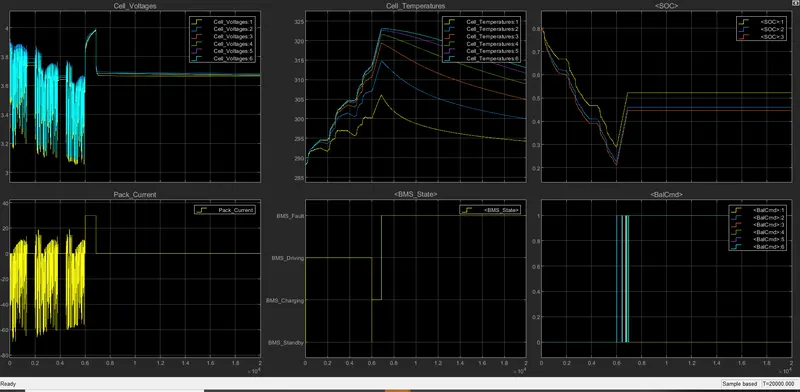
Since the driving state is reduced to 6000s, the vehicle changes to charging mode but the cell temperature increases over 328K so the dashboard shows over temperature fault.
The Test sequence varient 3 has only charging phases of the battery

The scope and dashboard results are
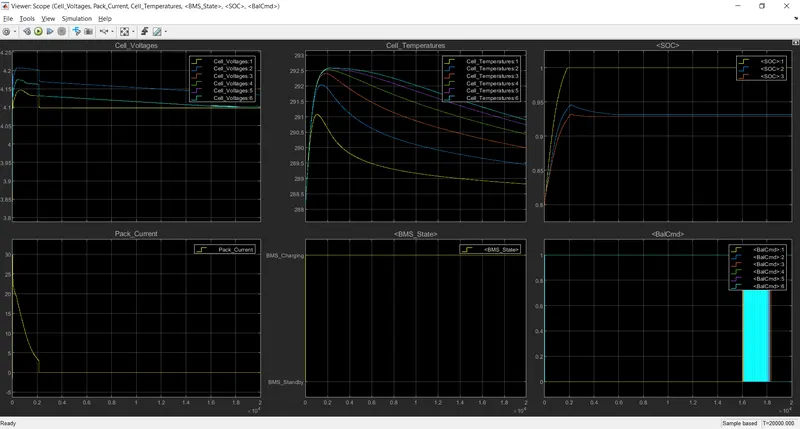
The cell voltage and the temperature increases untill the SOC is increasing. once the SOC is reached 100% then the voltage is reaching steady state and the temperature starts falling.
What is coulomb counting? Refer to the above model and explain how BMS implements coulomb counting for SOC estimation ?
Coulomb counting:
Coulomb counting is a technique used to track the state of charge of a battery pack. It works by integrating the active flowing current (measured in amps) over time to derive the total sum of energy entering or leaving the battery pack. This produces a capacity that is typically measured in Amp-hours.
In BMS, the SOC estimation is implemented using Extended Karman filter and Unscented Karman filter.