#6 EV Drivetrain
Question
1. Which types of power converter circuits are employed in electric and hybrid electric vehicle?
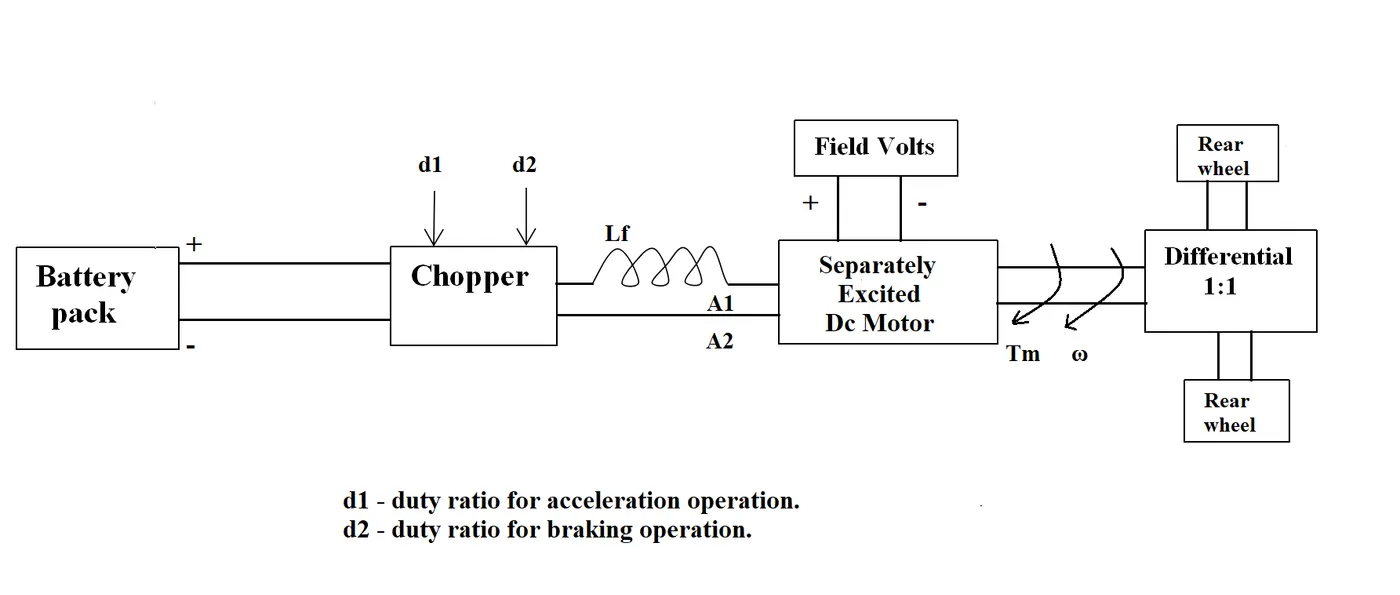
2. An Electric Vehicle's powertrain with 72V battery pack in shown in the diagram below. The duty ratio for acceleration operation is 'd1' and for the braking operation the duty ratio is 'd2'.
The other parameters of the electric vehicle is given below,
Motor and Controller Parameters:
Rated Armature voltage= 72 V
Rated armature current= 400 A
Ra= 0.5Ω, KΦ= 0.7 Volt second
Chopper Switching frequency= 400 Hz
The vehicle speed-torque characteristics are given by the below equation

What is EV steady state speed if duty cycle is 70%?
3. Develop a mathematical model of a DC Motor for the below equation using Simulink.
ωω= V/Kϕϕ -Ra/Kϕϕ^2 .T
4. Refer to the blog on below topic:
Induction Versus DC brushless motors by Wally Rippel, Tesla
Explain in brief about author’s perspective.
Use the "INSERT CODE SAMPLE" option to paste your code.
SUBMISSION RULES
Use the "INSERT CODE SAMPLE" option to paste your code and attach screenshots of the output. 10 points will be reduced for not doing so. Just showing the code and not explaing the results. 20 points will be reduced if this happens.
If your program or model fails to compile then you will score 0, in that particular challenge. This is applicable only for challenges where you are asked to code or submit the model files
Create a zip file with all the necessary .m files model files etc. in google drive and them as a single zip file.
Copying code from others - If you copy code from others, your score will be 0. If you copy from others on more than 1 assignments your challenges will no longer be graded. You can still access the course but your challenges will not be graded.
If you have attached links to images or videos, make sure that they work before you hit submit. At the time of grading broken links will not be taken into account.
Once graded future submissions will not be valid
Make sure you provide open links while attaching Google Sheets file
Make sure you follow the constraints given in the question, violating them will results in 0 marks.
GENERAL INSTRUCTIONS:
The codes, plots, images, GIFs, and videos should be submitted only through the answer box.
Use the Google Drive to share only the cad models or other answers which couldn't be done through the answer box.
NOTE:
Violating the above instructions will lead to ZERO marks.
Link sharing should be enabled while sharing the Google Drive link, else the challenge will be awarded ZERO marks.
Your Answers
1.Which types of power converter circuits are employed in electric and hybrid electric vehicle?
The power electronics deals with power conversion in a very controlled manner. The most important part of power electronics is the power control & the characteristics of the switches that allow this conversion. The function of conversion is performed by static power converters. These converters are divided into six types of circuits or converters used in power electronics.
- AC-DC converters (controlled rectifier)
- AC-AC converters (AC voltage controller)
- DC-DC converters (DC choppers)
- DC-AC converters (Inverters)
AC-DC Converters (Controlled Rectifier)
This type of converters converts the applied AC signal into DC signal using controlled switches (Thyristors). For this reason, the converter is also known as a controlled rectifier. Four natural commutated thyristors are used in this circuit instead of diodes as shown in the figure.
The average output voltage of the converter can be controlled by firing delay or by varying the conduction time. The applied input can be single-phase or three-phase.
AC-AC Converters
These converters convert the fixed AC source into variable AC output voltage. A single-phase AC-AC converter is shown in the figure with a TRIAC. By varying the conduction time of TRIAC, the output voltage of converter can be controlled directly. AC-AC converters are also known as AC voltage controllers.
DC-DC Converters
DC-DC converters convert or change the voltage level of applied DC input into a DC output. These converters are also known as choppers, or a transistor chopper, or switching regulator as shown in the figure.
The average output voltage of the converter circuit can be directly controlled by changing the conduction time of the controlled switch. The conduction time t of the switch is the product of the duty cycle and chopping period.
t = DT
Where D is the duty cycle of the chopper and T is the chopping period.
DC-AC Converter
DC-AC converters convert the input DC power into AC power. These converters are also known as inverters. There are a lot of different types of inverters; however, a typical Inverter uses four switches or thyristors. The four switches make 2 pairs, individually controlled by a switching circuit where each pair is switched on at one interval of time. This alternating switching of the thyristors provides an alternating current through the load. This rhythm of turning the switches changes the DC voltage into AC across the load. The output voltage of the circuit can be directly controlled by changing the conduction time of the switch using the switching circuit.
In Plugin hybrid vehicle the AC to DC converters are used to convert the Ac supply at the charging station to Dc current because battery can be charged only with DC current.
DC-DC converters are used in both Ev and HEV's at various powertrain levels to boost or chop the voltage levels as needed by the elecronic systems.
Normally in EV's, AC motors are used, inorder to convert the available DC current from the battery to the AC current, DC to AC converter are used.
2.An Electric Vehicle's powertrain with 72V battery pack in shown in the diagram below. The duty ratio for acceleration operation is 'd1' and for the braking operation the duty ratio is 'd2'.
The other parameters of the electric vehicle is given below,
Motor and Controller Parameters:
Rated Armature voltage= 72 V
Rated armature current= 400 A
Ra= 0.5Ω, KΦ= 0.7 Volt second
Chopper Switching frequency= 400 Hz
The vehicle speed-torque characteristics are given by the below equation
What is EV steady state speed if duty cycle is 70%?
Vehicle Voltage =Battery voltage * duty cycle
= 72*0.7=50.4V
Vehicle Voltage = 50.4V
The speed-Torque characteristic equation of a DC motor is
                   ω =(V/KΦ)-(RaT/(KΦ)^2)
Where ω is Steady state angular speed of the vehicle.
      V is Voltage of the vehicle (Volts)
      KΦ is Motor Constant
      Ra is armature resistance.
      T is Vehicle Torque.
Applying the known values in the above equation, Then
                   ω  = (50.4/07)- (0.5T/0.7)^2)
                   ω  = 72 - 1.020T
                   T = 70.58-0.980ω
The given torque equation is
                   T = 24.7 + 0.0051 (ω^2)
Sustituting calculated torque equation in above equation,
        70.58-0.980ω = 24.7+0.0051(ω)^2
By solving the above quadratic equation,
We get two values, by taking the positive value
the steady state speed of the vehicle is 38.60 rad/s
3.Develop a mathematical model of a DC Motor for the below equation using Simulink.
ω">ω= V/Kϕ">ϕ -Ra/Kϕ">ϕ^2 .T
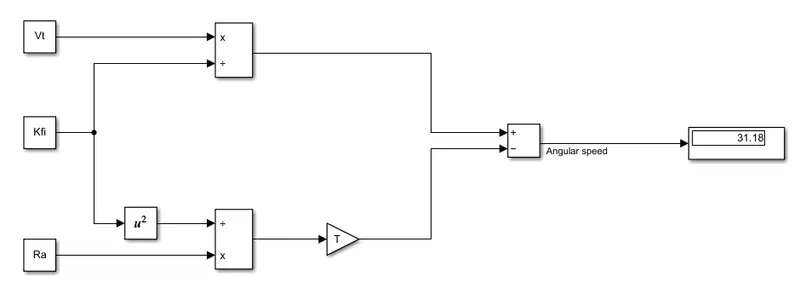
Constant block is used to give the input constant values of vehicle/motor voltage, armature resistance and motor constant(Kfi).
The first term V/Kfi is created using divide block and for the second term Kfi^2 is calculated using square function. The output of the second term is multiplied with Torque and finally subtraction block is used to get the angular speed.
The display block is used to show the obtained result.
4.Refer to the blog on below topic:
Induction Versus DC brushless motors by Wally Rippel, Tesla
Explain in brief about author’s perspective.
In this articel, the author Walley Ripplel shares his view about Induction and DC brushless motors.
Initally he says that no engine is the best engine type, as every type of engine is best according to its requirement, cost and its performance.
Next he explains the working principle of DC brushless motors and induction motors. he says that induction engine has few benefits like it has no permanenant magnets and also can turn over under load. No inverter is required. He also explains the disadvantages of induction motors like they can't work in DC, only an absolute AC source is needed. shaft speed is proportionate to line recurrence. Consequently, when utilized with utility force, they are steady speed machines.
The brushless DC machines also have some benifits like considerably less rotor heat is produced. Few drawbacks of this type engine is that as machine size develops, the attractive misfortune increment proportionality and part load proficiency drops. Prepatual magnets are costly and hard to deal with beacuse of extremely enormous powers that become an integral factor when anything ferromagnetic draws near to them.
Finally he concludes that both the type of engines will have its applications in the growing future of electric and hybrid electric vehicles.
Your Assets
| Filname | Size | Action |
|---|---|---|
| Mathema…link.slx | 25.13 KB |