 Free · 3 lessons · no payment
Control Theory PMSM: 3 free lessons
Three free lessons from Skill-Lync's Control Theory PMSM course. They introduce permanent magnet synchronous motors and why vector control suits them, then build the dq-frame model, the Clarke and Park transformations and the speed and current control loops. The third lesson covers maximum torque per ampere control, field weakening and maximum torque per voltage control.
Last updated 16 Nov 2026 · 3 free lessons (1 h 12 min) · full course: 7 lessons (2 h 15 min), paid · ₹40,000
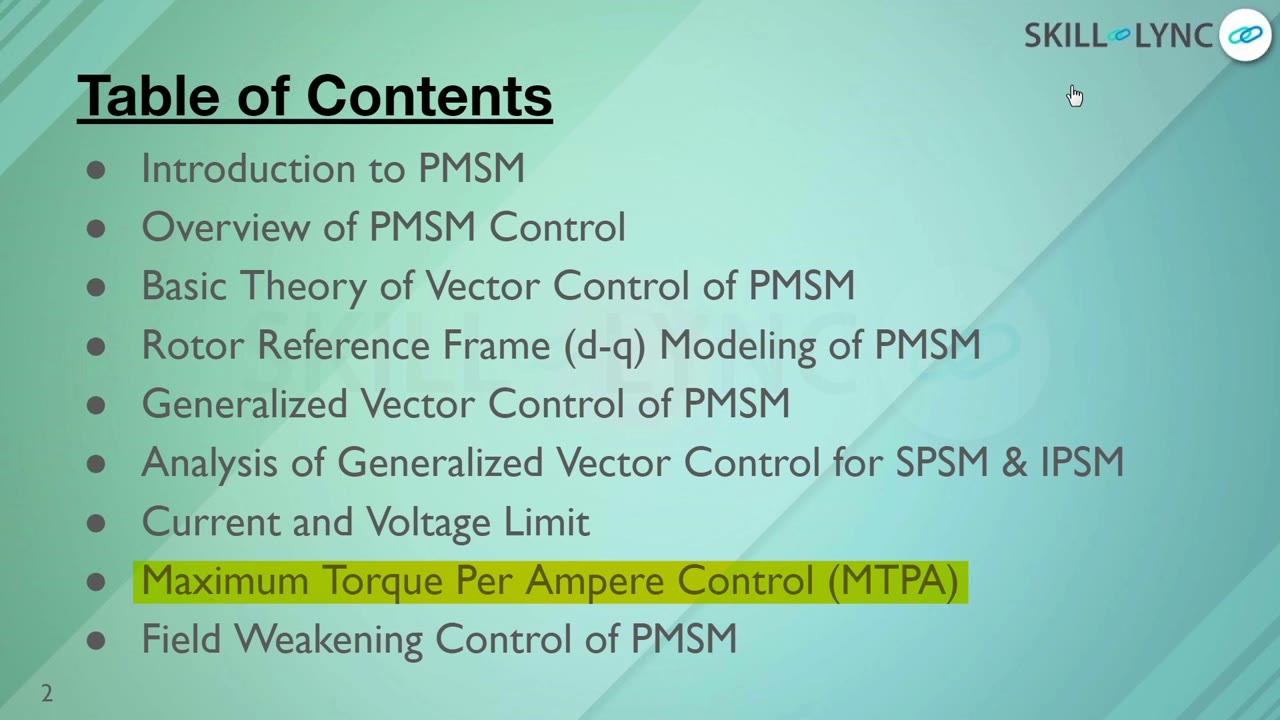 Free lesson 1 · 26 minPMSM Basics and the Idea Behind Vector Control
What will you learn in the free Control Theory PMSM lessons?
- Surface versus interior permanent magnet motors
- Vector control block diagram with PI loops
- Current circle and voltage ellipse limits
- MTPA, field weakening and MTPV control
Free lessons you can watch now
- Lesson 1 · 26 minPMSM Basics and the Idea Behind Vector ControlThe instructor compares surface and interior permanent magnet motors and lists their advantages, including a 5 HP example at 8 kg against 40 kg for an induction motor. The lesson explains why volt by hertz control fails for a PMSM, reviews dq reference frame modelling and shows that setting Id to 0 makes torque proportional to Iq, as in a DC motor.
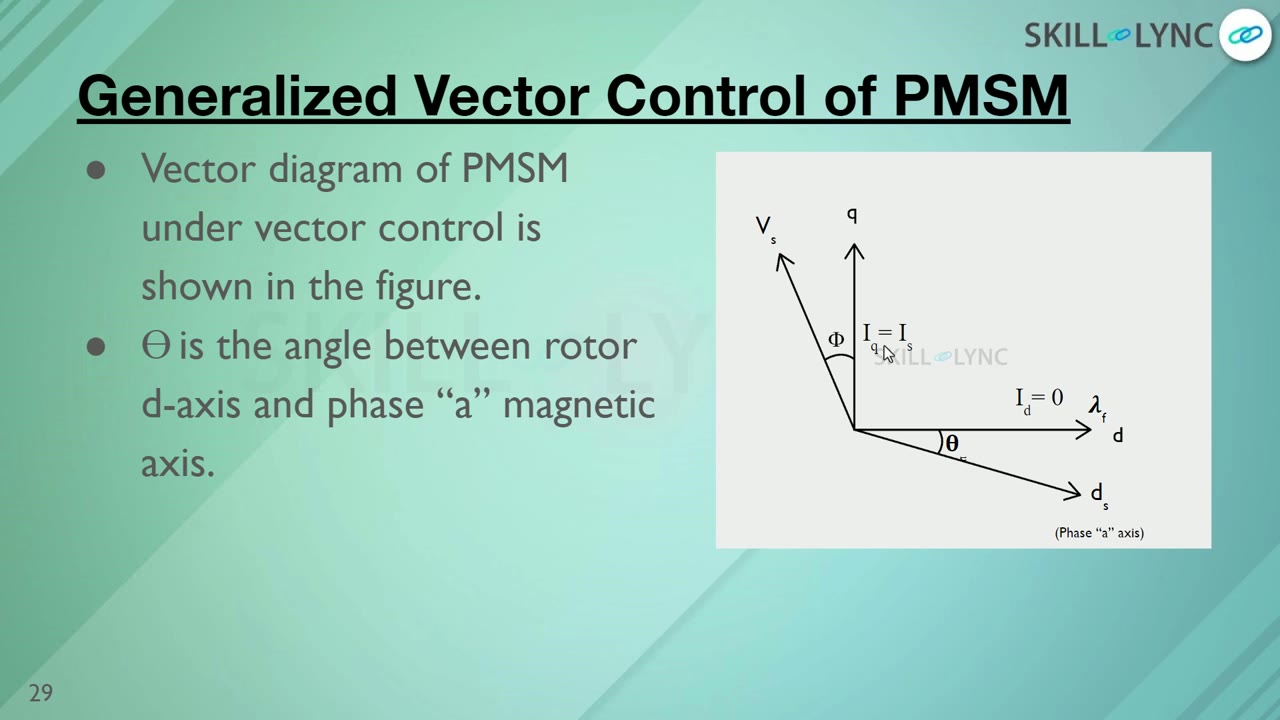 Lesson 2 · 22 minVector Control Loops, Clarke and Park Transforms, Current LimitsThe instructor draws the vector control block diagram: a speed PI controller sets Iq, Id is set to 0, and current PI controllers feed an inverse Park transform and SVPWM. The Clarke, Park and inverse Park equations are listed, SPMSM and IPMSM are compared, and the current circle and voltage ellipse limits are explained.
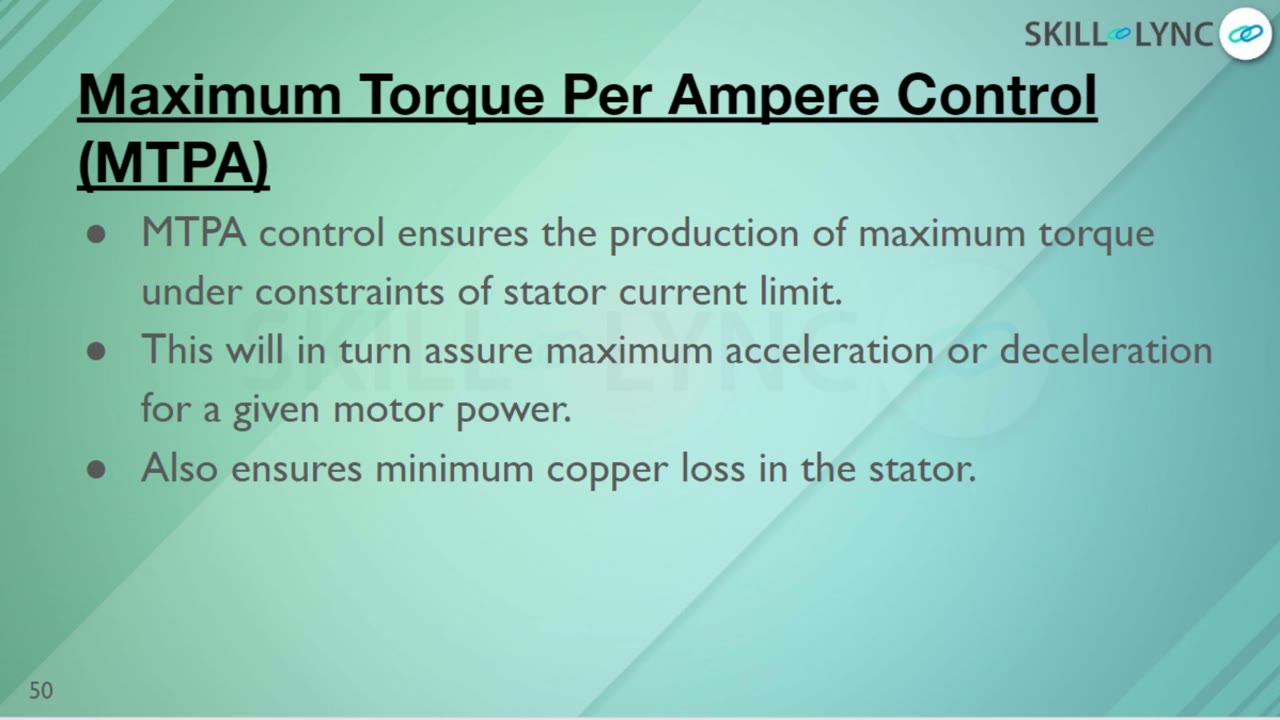 Lesson 3 · 25 minMTPA, Field Weakening and MTPV Control of an IPMSMThe instructor derives the maximum torque per ampere condition for an IPMSM by differentiating torque with respect to Id, and shows the MTPA trajectory against the current circle and voltage ellipse. The lesson then explains field weakening above base speed with negative Id, the maximum torque per voltage condition, and the transition from MTPA to MTPV.
Which lessons of Control Theory PMSM are free?
The first 3 lessons are free on Grow by Skill-Lync: 1 h 12 min of video from Skill-Lync's Control Theory PMSM course that you can watch here at no cost: leave your name and phone number once and they play (as of 16 Nov 2026). The full course is paid (₹40,000); its other 4 lessons are listed in the outline below so you can see what each one covers.
How long is the Control Theory PMSM course?
The full course has 7 lessons and 2 h 15 min of recorded video, plus the projects and assignments that come with enrolment. The free lessons alone take about 1 h 12 min, so you can finish them in an evening and decide whether to continue.
What comes after the free lessons?
Lesson 4 onwards is in the paid Control Theory PMSM course on Skill-Lync, with mentor support and a certificate. For a career in Electric vehicles, the Post Graduate Program in Electric Vehicle Design & Development goes further with industry projects and placement support.