How a Car Backflips on Compressed Air: The Control System Behind the Tesla Roadster Thruster Stunts
Tesla's new Roadster backflipped off a 21 m ramp and kickflipped over a Tesla Semi on compressed air. We measured the footage, rebuilt both stunts in a physics simulator and worked through the engineering: cold-gas thrust, a suicide-burn landing, a 200 Hz attitude loop, thrust allocation and valve limits.
A two-seat sports car drives up a curved wall, leaves the top upside down, finishes a backflip in mid-air and lands on its wheels. In a second clip it kickflips over a Tesla Semi. There are no wings, no rotors and no combustion. Just compressed air leaving ten nozzles.
It looks like a special effect. It is really a control problem: guidance, attitude control, thrust allocation and valve timing, the building blocks of a rocket's reaction-control system, squeezed into a car.
We measured Tesla's two official clips frame by frame, then rebuilt both stunts in our own physics simulation: a rigid car, a draining air tank, nozzle physics, valve delays and a 200 Hz flight computer. Every simulation number below is the model's estimate under stated assumptions, not Tesla data. Skill-Lync has no affiliation with Tesla.
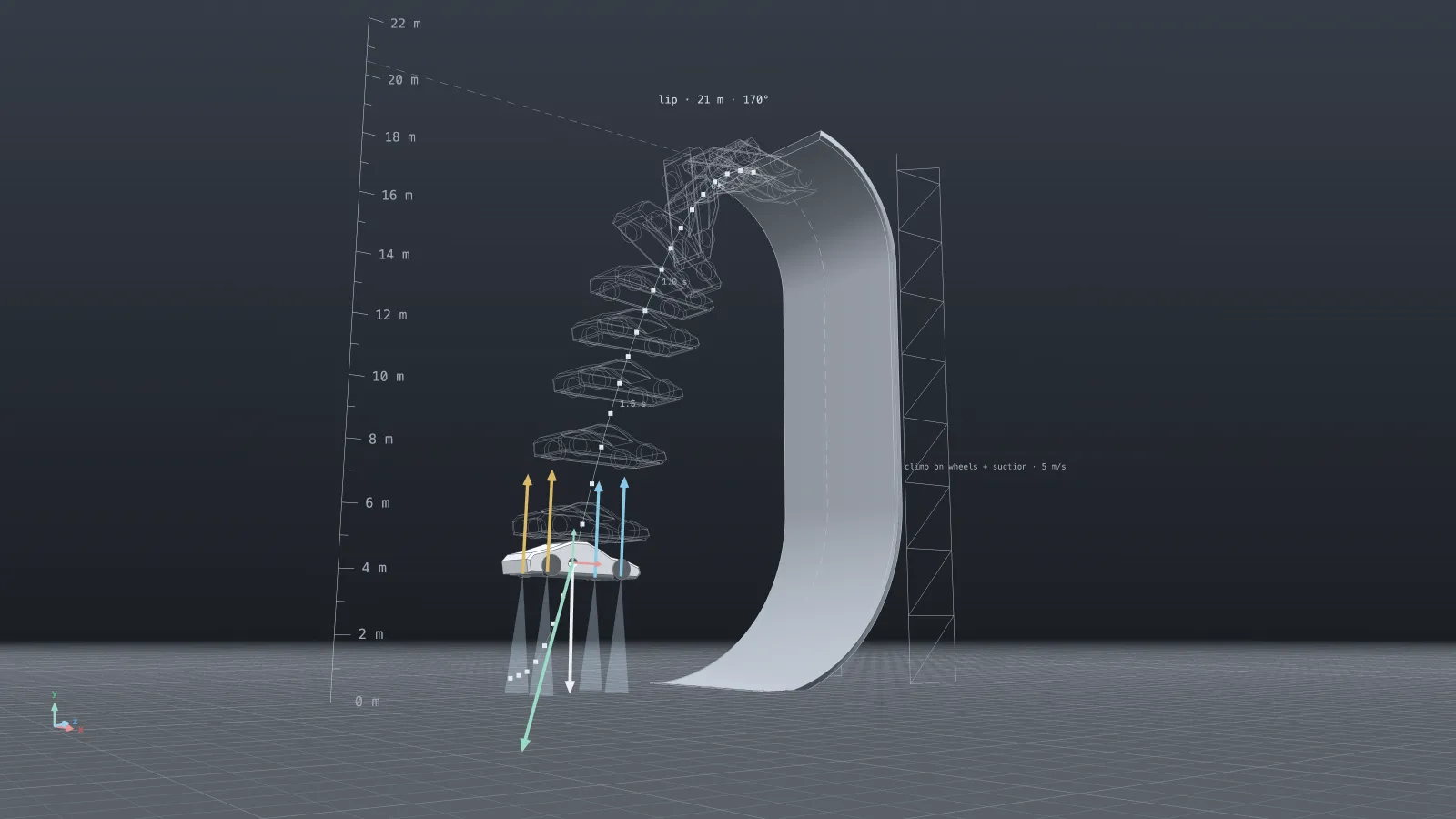
The ramp backflip in our simulation, real time. Arrows show thrust from each jet group, weight (white) and velocity (green). The wire-frame "ghosts" mark the car every 0.2 s.
What the car actually did
Start with what Tesla said at the launch, as reported by Paul Tan, TechCrunch and Electrek. Treat these as claims, not measurements.
- The air supply. Two carbon-overwrapped pressure vessels (COPVs) hold 600 litres, about 250 kg of air, according to Tesla engineering VP Lars Moravy. A "Thruster" readout in Tesla's interior photos shows 5,500 psi, about 379 bar.
- Ten nozzles on the Rocket trim. Four rear mains (Tesla quotes 80 kN of thrust), four corner jets firing downward and two front jets for yaw.
- The ramp. The car leaves the wall about 21 m up at a pitch of 170°, almost upside down. The on-screen G-meter peaks at 3.3 G at about 6.5 m as the jets brake the fall.
- Who was driving. Elon Musk said the car was "technically autonomous for this demo".
Then we measured the footage ourselves. In "The Ramp", the car climbs the wall at a steady 5 m/s on its wheels plus a suction fan. It does not stop at the top. It drives off the lip at about 170°, already rotating backwards at about 1.1 rad/s. From the lip to touchdown takes about 2.1 s.
That changes how you think about the stunt. The wall does the first 170° of the backflip. The thrusters only have to do the last 190°, and then land.
In "The Kickflip", the camera is locked off and the Semi (about 4.0 m tall) gives a scale of roughly 44 pixels per metre. The car's centre peaks at 8.7 m, it crosses the ground at 13.1 m/s (29 mph), and it rolls a full 360° in about 1.7 s, starting about 0.65 s after liftoff.
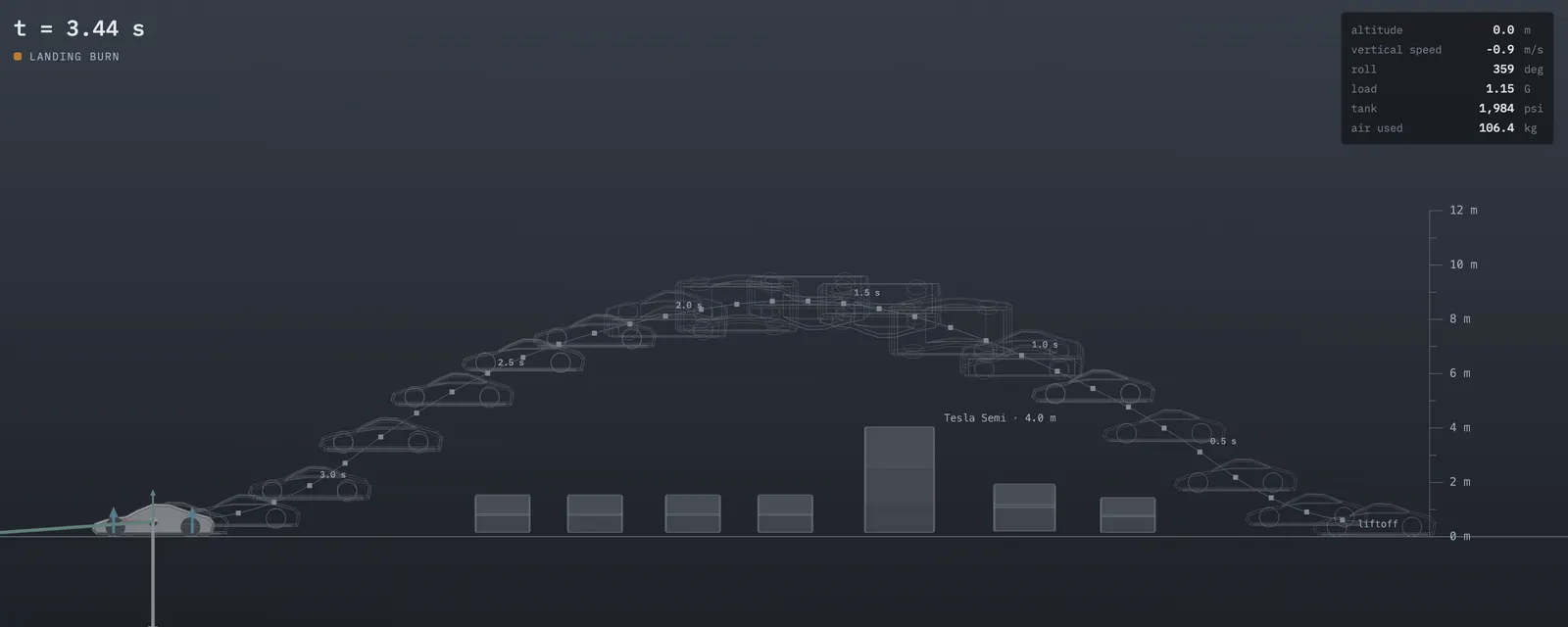
The simulated kickflip, side view, with a ghost frame every 0.2 s. The car lifts off on the right, peaks over the Semi-sized block and lands on the left.
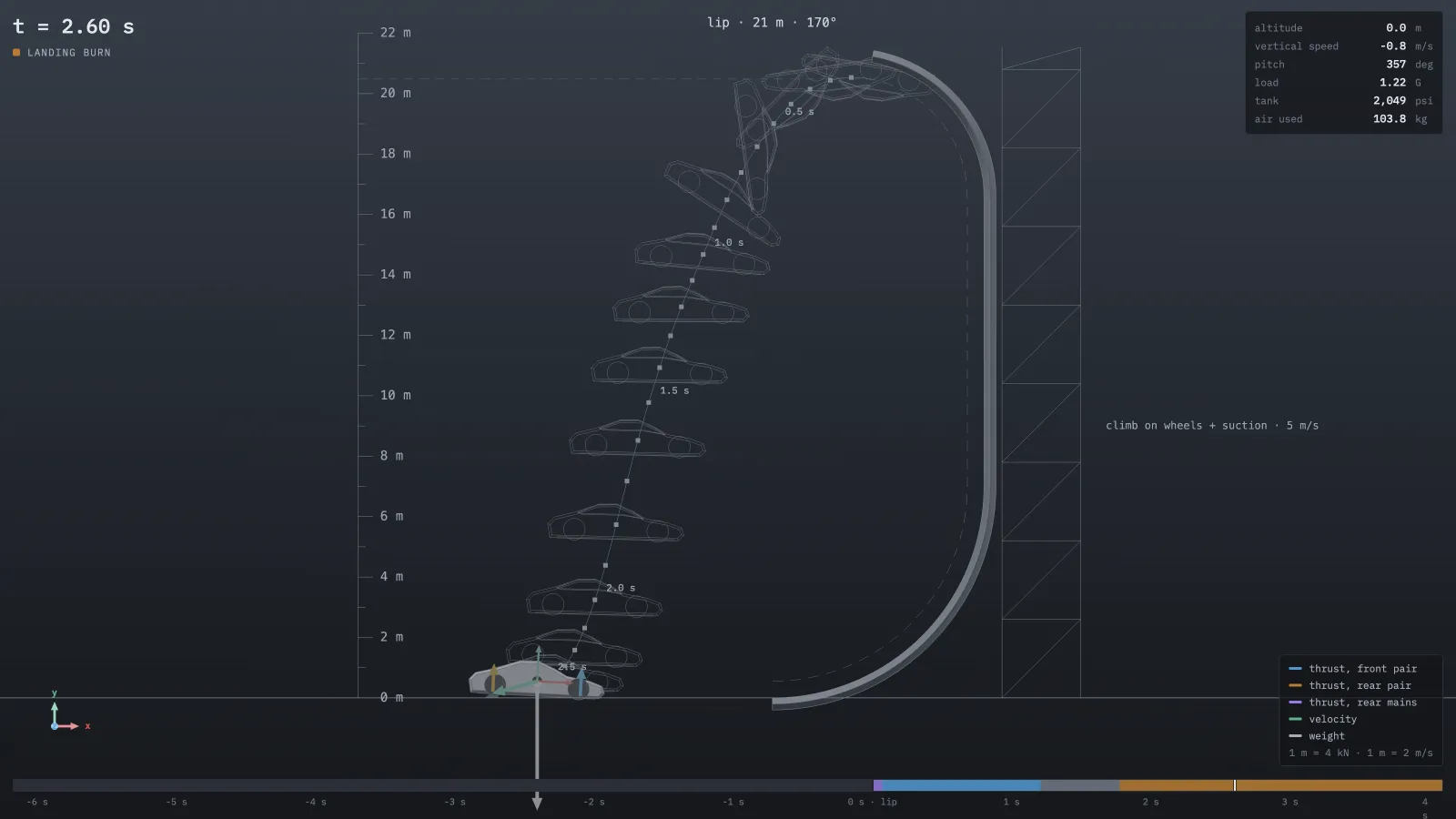
Side view of the whole simulated backflip, with a ghost frame every 0.2 s. The car leaves the lip at 21 m and 170°, rotates upright within about a second, then falls almost level until the landing burn.
The physics: how much push is in a tank of air?
A cold-gas thruster is the simplest rocket there is. High-pressure gas expands through a converging-diverging nozzle and leaves fast. Nothing burns. The thrust is the momentum the gas carries away, plus a small pressure term at the nozzle exit:
F   = ṁ·vₑ + (pₑ − pₐ)·Aₑ
Isp = vₑ / g₀
Our model gives an exhaust speed of about 585 m/s, so Isp ≈ 585 / 9.81 ≈ 60 s. That is roughly a fifth of a kerosene rocket engine's exhaust speed.
There is a hard ceiling: the only energy in the jet is the heat already in the gas. Room-temperature air expanding perfectly into vacuum reaches vₘₐₓ = √(2γ/(γ−1) · R · T₀) = √(7 × 287 × 293) ≈ 770 m/s, however clever the nozzle.
Low exhaust speed means high mass flow. Rearranging, ṁ = F / vₑ. Our model assumes 15 kN per corner jet, so four of them give 60 kN, and 60,000 / 585 ≈ 103 kg of air per second. That is half the tank in about a second of full braking, which is why every burn in these stunts is short and late.
How much air is there? An ideal-gas estimate for 600 L at 379 bar and 20 °C gives m = pV/RT = (379 × 10⁵ × 0.6) / (287 × 293) ≈ 270 kg. Real air at that pressure is about 21% less compressible than an ideal gas (a compressibility factor Z ≈ 1.21), which brings it down to about 224 kg in our model. Tesla says about 250 kg.
The tank also changes during the stunt. As air leaves, the gas inside expands and cools, the way a spray can gets cold in your hand. This blowdown drops pressure and temperature, so one valve opening gives different thrust at the start and the end. A regulator holds the nozzle feed at 100 bar in the model, but the controller still flies a plant that drifts.
Here is what one stunt costs in the simulation, starting at 1,850 kg:
| Simulation estimate | Ramp backflip | Kickflip |
|---|---|---|
| Air used | 104 kg (46% of the tank) | 107 kg (48%) |
| Landing burn | lit at 5.6 m, peak 3.3 G | lit at about 2.7 m, peak about 3.3 G |
| Touchdown | 0.8 m/s, 2.6 s after the lip | about 0.9 m/s, 3.4 s after liftoff |
| Peak jet power | 29 MW (about 26 Bugatti Chirons) | 18 MW (about 16 Chirons) |
| Work done on the car | 488 kJ (about 2.2 Oreos) | 321 kJ (about 1.4 Oreos) |
| Electricity to refill | 26 kWh (about a day for a US home) | 27 kWh |
| Wall-plug efficiency | about 0.5% | about 0.3% |
The efficiency is simple arithmetic: 26 kWh is 93.6 MJ, and 0.488 / 93.6 ≈ 0.5%. Most of the energy becomes heat in the compressor; most of the rest leaves in the exhaust. Jet power is P = ½ · F · vₑ, so the 80 kN rear mains alone make ½ × 80,000 × 585 ≈ 23 MW during the push-off that clears the foot of the wall. A full tank is good for about two stunts.
Guidance: deciding what the car should do
Guidance turns "do a backflip and land" into a reference the controller can follow. Our model uses a plan worked out before the stunt, in three parts.
1. A minimum-jerk attitude reference
The target angle follows a quintic (fifth-order) polynomial:
θ_ref = θ₀ + Δθ·(10s³ − 15s⁴ + 6s⁵)
where s = t / T
It starts and ends with zero rate and zero angular acceleration: the smoothest way to get from one angle to another, so the torque demand ramps gently and the valves never see a step. The peak angular acceleration is about 5.77 · Δθ / T². For the kickflip, a full turn in 1.7 s needs 5.77 × 2π / 1.7² ≈ 12.5 rad/s².
For the ramp, the same idea is fitted to the car's state at the lip. It starts at 170° and at the 1.1 rad/s the wall already gave it, and reaches 360° in about 1.2 s.
2. A predicted boost cut-off for the kickflip
The corner jets fire together to throw the car up. The model predicts the apex as z + v²/2g and cuts the boost when the prediction reaches 8.7 m, with a lead for the thrust the valves still deliver after the cut.
3. A suicide-burn landing, like Falcon 9
Hovering is expensive. Holding 1,850 kg up at 1 G takes 1,850 × 9.81 / 585 ≈ 31 kg of air every second. So the model does what a Falcon 9 booster does: it waits until the last safe moment and then brakes hard in one go. The burn lights when
h ≤ v² / (2·(a_max·margin − g))
Plug in the numbers. 60 kN / 1,850 kg ≈ 32.4 m/s², which is 3.3 g. With the model's 88% margin, the net braking is 0.88 × 32.4 − 9.81 ≈ 18.7 m/s². A car falling at 14 m/s needs 14² / (2 × 18.7) ≈ 5.2 m to stop. The simulated backflip lights its burn at 5.6 m and peaks at 3.3 G. Tesla's G-meter shows 3.3 G at about 6.5 m.
The simulated landing burn at half speed. The car falls level until about 1.8 s after the lip, then all four corner jets light together and brake it at about 3 G. The green velocity arrow still points forward at touchdown: the car lands rolling, as in the footage.
Attitude control: a PD loop with feed-forward at 200 Hz
The controller's job is to make the car's angle follow the reference. Our model uses a proportional-derivative (PD) law with feed-forward:
τ  = I·(α_ref + Kp·e + Kd·ė)
e  = θ_ref − θ
Kp = ωₙ² = 64 s⁻²
Kd = 2ζωₙ = 12.8 s⁻¹
(ωₙ = 8 rad/s, ζ = 0.8)
The feed-forward term, I · α_ref, does most of the work: it is the torque the reference needs if everything goes to plan. The PD terms correct what doesn't: sensor noise, valve rounding, falling tank pressure. That is why the actual angle sits on top of the target in the plots below.
With ζ = 0.8, a step would overshoot by only about 1.5%. The loop runs every 5 ms (200 Hz), roughly 150 times faster than the 8 rad/s (1.3 Hz) closed loop. The computer is not the bottleneck. The valves are.
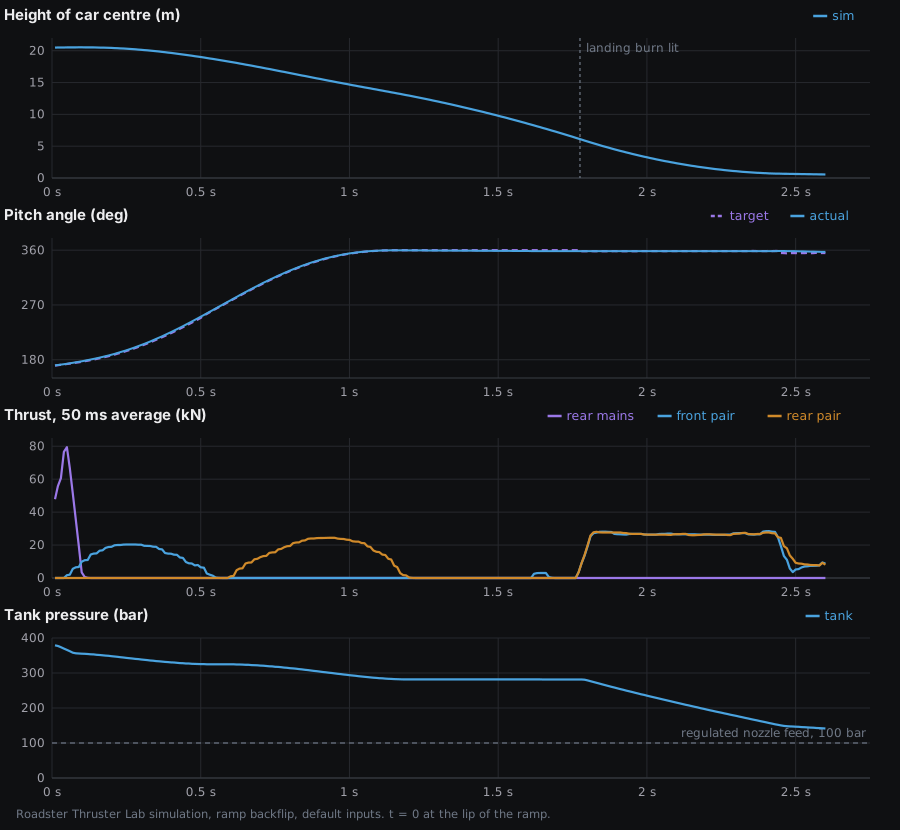
Simulated ramp backflip telemetry, t = 0 at the lip. The rear mains fire an 80 kN push-off, the front pair spins the car up, the rear pair slows it down, and both pairs share the landing burn. Tank pressure falls the whole way.
Thrust allocation: jets only push
The controller asks for a torque τ and a net force F. Allocation turns that into commands for individual jets. With two groups of corner jets a lever arm d either side of the rotation axis:
T₊ = F/2 + τ/(2d)
T₋ = F/2 − τ/(2d)
with T₊ ≥ 0 and T₋ ≥ 0
The catch is the last condition. A jet can push but never pull, so every torque costs at least F = |τ| / d of push along the car's "up" direction. Our model allocates torque first: it clamps τ to what the jets can deliver, then fits F into the room left. Attitude wins over height, because landing hard beats landing on the roof.
The side effect is easy to miss. Upside down, the car's "up" points at the ground, so the jets that spin it also push it down and sideways. In the backflip plot the front pair fires about 20 kN while the car is inverted, and that shove shows up in the drop from the ramp.
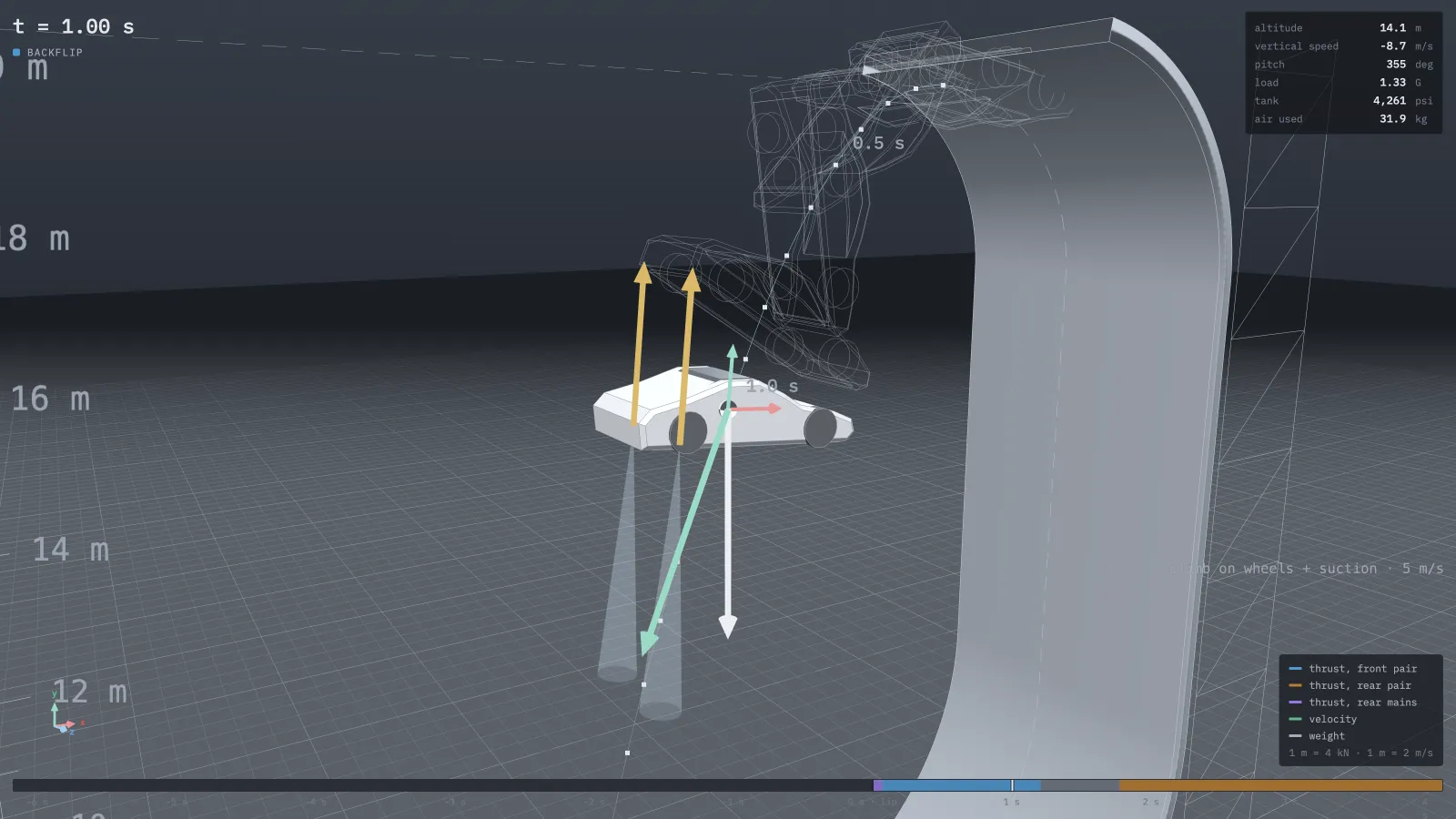
One second after the lip. The car is nearly level and the rear pair (amber) is firing to stop the rotation. Weight (white) and velocity (green) both point down.
The kickflip shows the same pattern from the side. Both pairs fire together to throw the car up, then the left pair starts the roll and the right pair stops it.
The simulated kickflip from a chase camera, real time: boost, a 360° roll in 1.7 s, then the landing burn.
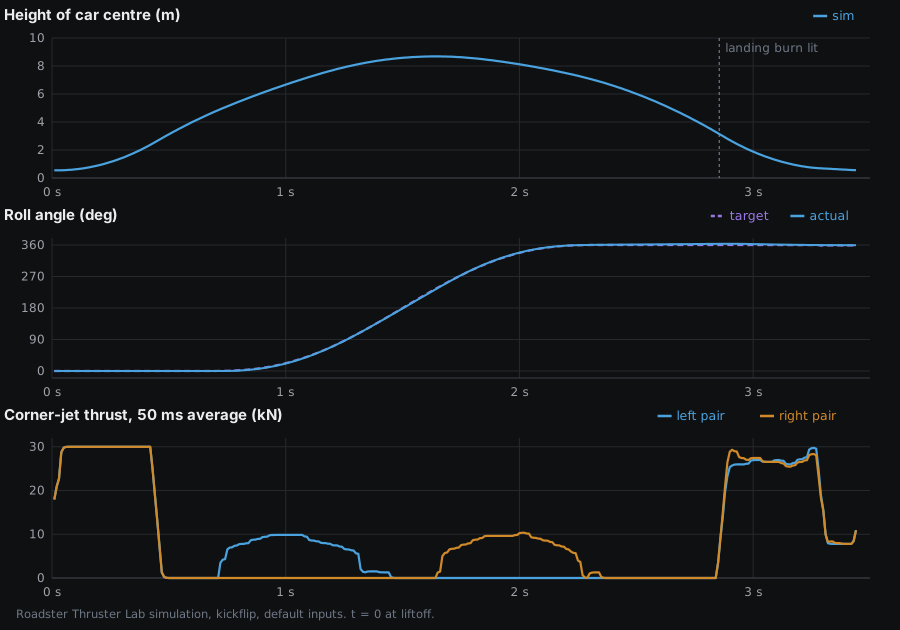
Simulated kickflip telemetry, t = 0 at liftoff. A 0.45 s boost at full corner thrust, then about 10 kN on the left pair to start the roll and about 10 kN on the right pair to stop it.
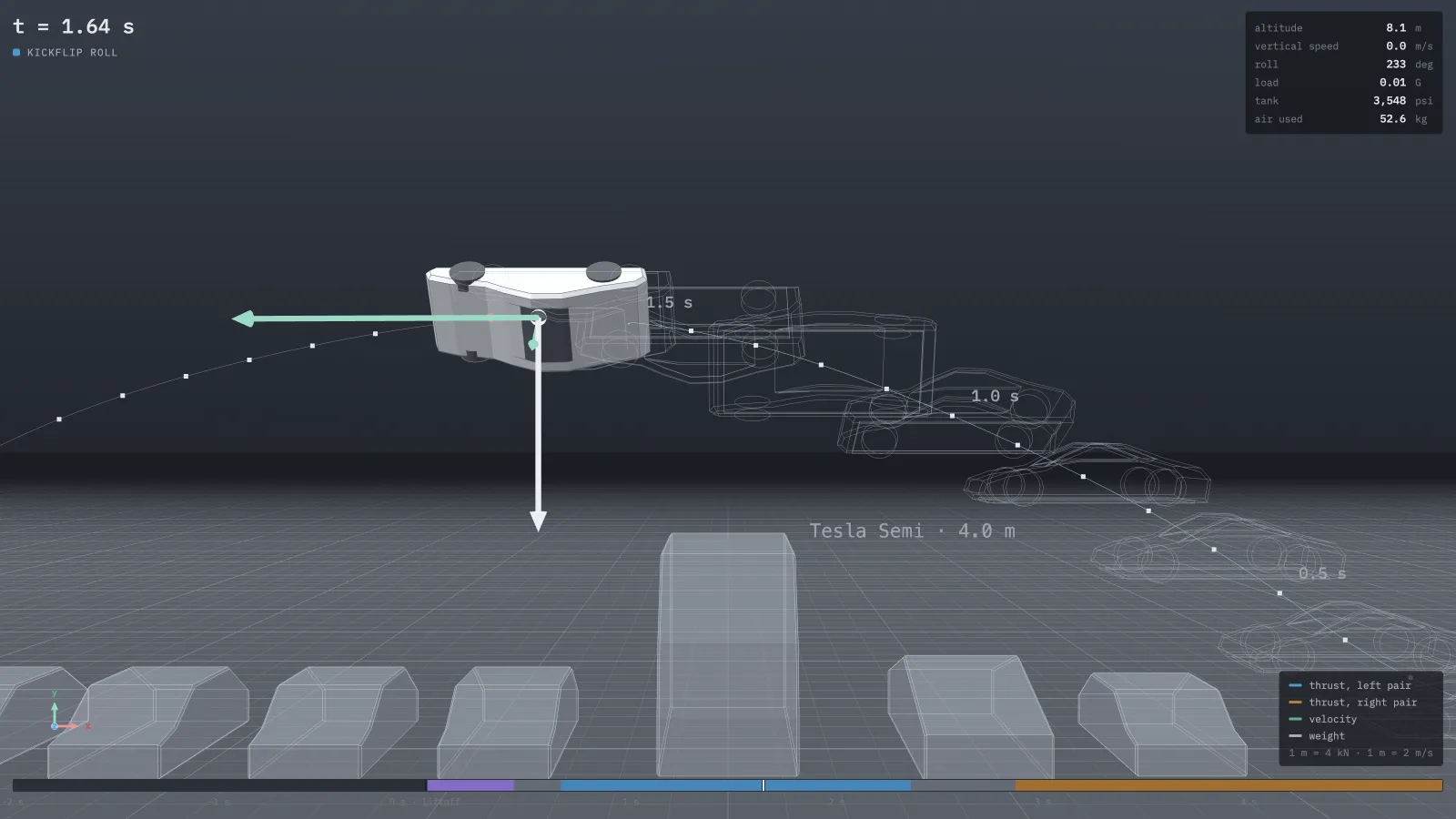
Apex of the simulated kickflip: upside down, with zero vertical speed. The box below is a Tesla Semi-sized block, about 4 m tall, used for scale.
Valves: on, off, and late
Our model uses on/off solenoid valves, not proportional ones. To get "40% thrust" out of a valve that is either open or shut, the controller uses pulse-width modulation (PWM). It opens the valve for 40% of each cycle. The model runs 40 Hz PWM, a 25 ms cycle, with three real-world limits:
- 10 ms dead time. Nothing happens for 10 ms after the command. At the loop's 8 rad/s that is 8 × 0.01 = 0.08 rad, about 4.6° of phase lag: small, but it is why the kickflip cut-off needs a lead.
- 4 ms minimum pulse. Shorter pulses are dropped. 4 ms out of 25 ms is 16%, so any command below about 16% of a jet's full thrust becomes zero.
- Opening lag. A short pulse barely opens the valve before it closes again. Real thrust comes out lower than commanded, especially for the small corrections the PD loop makes.
None of this appears if you model the valve as a perfect gain. All of it appears in hardware.
The catch: what this model can and can't tell you
The simulation reproduces the 3.3 G peak, a workable air budget and a soft touchdown. It is still a model, and it gets some things wrong.
The timing is off. The simulated car touches down 2.6 s after the lip, still rolling at 3 m/s. The footage shows about 2.1 s. Something is different: the mass, the thrust, the push-off or Tesla's flight plan.
The mass is a guess. We assumed 1,850 kg at launch. The 3.3 G reading fixes thrust-to-weight at about 32 N/kg, not the weight itself. A heavier car with bigger nozzles would look identical on camera.
The "lightweight shell" theory doesn't need to be true. One theory going around is that the stunt car was a light shell. Electrek noted that the underbody in some frames doesn't look like Tesla's usual flat battery floor. In the kickflip clip, around 0:14.6, we also see what looks like an open frame rather than a flat floor. The simulation says a 1,000 kg shell would need about 55 kg of air per stunt, about half as much. But the full-weight car still closes on air. With these jets, the landing only starts to fail above about 2,400 kg.
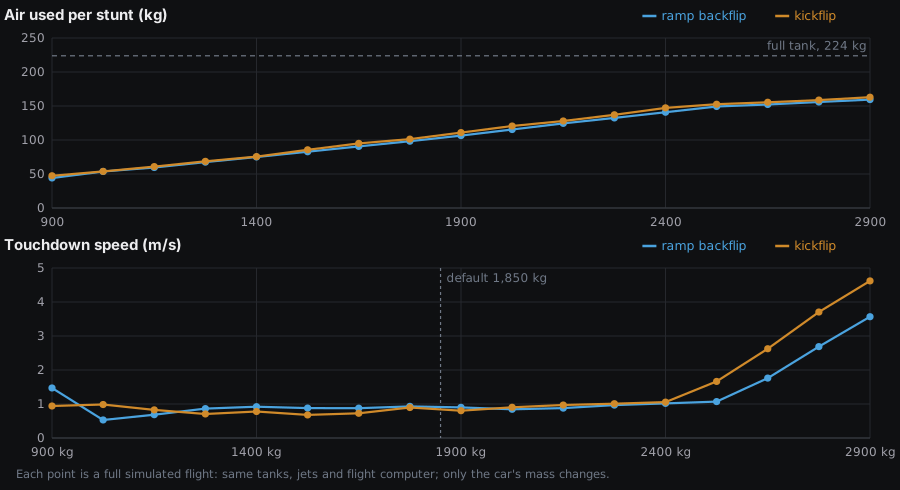
Every point is a full simulated flight with the same tanks, jets and flight computer. Only the mass changes. Air use grows with weight, but both stunts stay inside one tank. Touchdown speed stays around 1 m/s across the range until about 2,400 kg, then climbs fast.
It is a flat, simplified world. The model is planar (two translations, one rotation), so no yaw and no cross-axis coupling. No drag, no jet–ground interaction, no suspension, no structural flex, Gaussian sensor noise and no real state estimator. The 15 kN per corner jet and the 100 bar regulator are our assumptions; Tesla has only stated the 80 kN rear figure.
We don't know Tesla's flight computer. "Technically autonomous" says there is one, not how it works. Ours is one plausible design that fits the numbers we can measure.
Takeaways for engineers
- Feed-forward does the heavy lifting. A smooth reference plus I · α_ref gets you most of the way; feedback cleans up. That is the core of any motion controller, including the ones you build in an automotive controls course in MATLAB and Simulink.
- Actuator limits shape the architecture. Jets that only push force allocation with priorities. Brakes that only decelerate and tyres with a friction limit do the same on the ground, which is what vehicle dynamics is all about.
- Model the actuator, not just the plant. Dead time, minimum pulse and PWM decide whether a controller works on hardware. Physical modelling in Simulink and Simscape exists for exactly this.
- Sanity-check before you code. ṁ = F / vₑ ≈ 100 kg/s at full brake explains the whole flight plan.
- Say what your data can't prove. A G-meter gives thrust-to-weight, video gives position and timing, and neither gives mass. Keep measured, claimed and assumed apart.
Get the physics first. Model the hardware honestly. Then trust the plots.
Sources
- Tesla, "The Ramp | Roadster" and "The Kickflip | Roadster" (YouTube). Timings, apex height and ground speed above are our measurements from these clips.
- Paul Tan, Tesla Roadster revealed (16 Oct 2026): 600 L and about 250 kg of air, ten nozzles, the 5,500 psi readout, 21 m / 170° / 3.3 G at 6.5 m, Musk's "technically autonomous" remark.
- TechCrunch, Tesla reveals SpaceX-powered Roadster (15 Oct 2026): ten thrusters, 600 L, COPVs.
- Electrek, An updated technical look at Tesla's next-gen Roadster (15 Oct 2026): 80 kN rear thrust, the nozzle layout, the underbody frames.
- All renders, animations and plots on this page come from our own simulation. None of them use Tesla footage.