ETABS vs STAAD.Pro: Versions, Indian Codes and an IS 1893 Worked Example
ETABS is built for buildings; STAAD.Pro handles any frame, truss or plate structure. Here are the current versions (ETABS v23, STAAD.Pro 2026), how each models a structure, which Indian codes each vendor documents, licensing, and a worked IS 1893 base shear and storey drift example that shows what both programs compute.
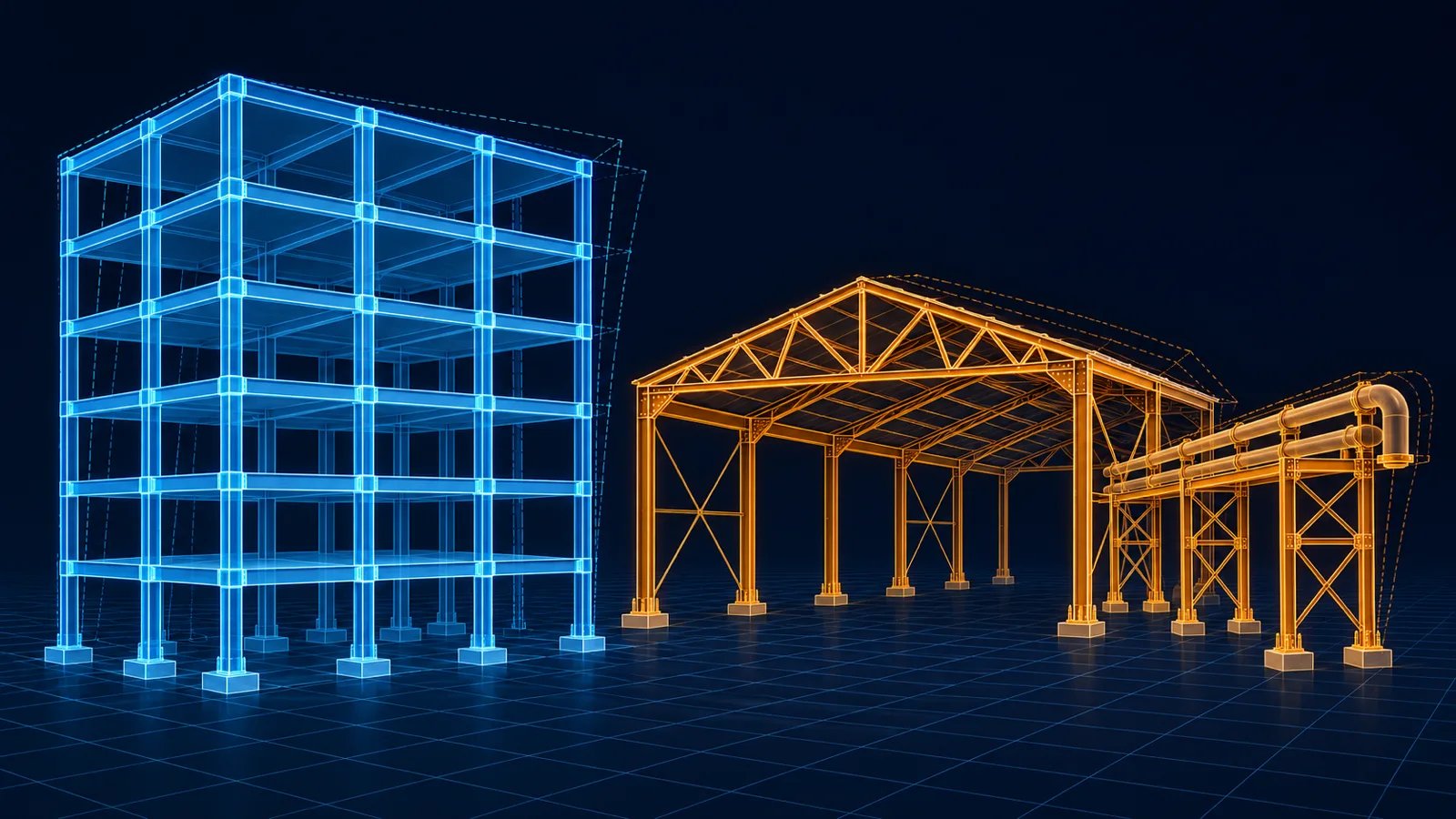
In short
- ETABS (Computers and Structures, Inc.) is built only for buildings. You model storeys, grids, floor slabs and walls, and it designs the whole building to codes such as IS 456 and IS 800. The latest release we found is v23.3.2, dated 21 September 2026.
- STAAD.Pro (Bentley Systems) is a general-purpose frame and finite-element program. You model nodes, members and plates of any shape, which suits industrial sheds, pipe racks, towers, bridges and plant structures. The latest version is STAAD.Pro 2026.
- Both programs compute IS 1893 (Part 1):2016 seismic loads, IS 875 (Part 3):2015 wind loads and IS 456 / IS 13920 concrete design. STAAD.Pro also covers IS 1893 (Part 4) for industrial structures and IS 802 for transmission towers.
- Under the hood, both solve the same stiffness equations. Our worked example computes, by hand and in a short program, the 571 kN design base shear and 5.1 mm maximum storey drift that either tool would report for a G+4 RC frame in Zone III.
The main difference between ETABS and STAAD.Pro is what each program assumes about your structure. ETABS assumes a building: it organises everything by storey, treats each floor as a diaphragm and is fastest for RC and steel buildings, from G+4 apartments to high-rises. STAAD.Pro assumes nothing: it works with any arrangement of nodes and members, so it is the natural choice for industrial structures, pipe racks, towers and bridge components. Both are used in India, and both support the main Indian codes.
Courses: compare every Skill-Lync STAAD.Pro course and ETABS course, with fees, duration and projects, and which tool fits the structures you want to design. For RCC, steel and bridge design beyond one tool, see all 28 structural design courses.
This guide, refreshed in November 2026, covers the current versions, how each tool models a structure, Indian code support as each vendor documents it, analysis types, the design workflow and licensing. It then works through an IS 1893 seismic base shear and storey drift calculation, so you can see exactly what both programs compute.
What is the difference between ETABS and STAAD.Pro?
CSI describes ETABS as an integrated package for the structural analysis and design of buildings. Bentley describes STAAD as software to model, analyse and design steel, concrete or timber structures, with no restriction to buildings. That positioning, which has held for years, explains most of the practical differences in the table below.
| Aspect | ETABS | STAAD.Pro |
|---|---|---|
| Developer | Computers and Structures, Inc. (CSI) | Bentley Systems (originally Research Engineers International, acquired by Bentley in 2005) |
| Latest version (Nov 2026) | v23 (v23.3.2, 21 Sep 2026) | STAAD.Pro 2026 (26.00.01) |
| Built for | Buildings | Any frame, truss, plate or shell structure |
| Model unit | Storeys, grids, objects (beams, columns, slabs, walls) | Joints, members, plates, supports |
| Floor behaviour | Rigid, semi-rigid or flexible diaphragms assigned per floor | Modelled explicitly (plates or diaphragm definitions) |
| Typical Indian use | Residential and commercial buildings, high-rises | Industrial sheds, pipe racks, plant structures, towers, bridge parts, also buildings |
| Companion tools | SAFE (slabs and foundations), CSiXRevit, CSiXCAD | STAAD Foundation Advanced, RAM Connection, ADINA, OpenSTAAD |
| Licensing | Cloud sign-in licences only from v23; perpetual prices listed on csiamerica.com | Virtuoso subscriptions with prices listed on bentley.com |
So the old rule of thumb still holds, with one refinement: STAAD.Pro can design buildings well, but ETABS cannot easily model a structure that is not a building.
What are the latest versions of ETABS and STAAD.Pro?
ETABS v23
CSI released ETABS v23.0.0 on 13 October 2025. It was a major release. It added FEM-based buckling analysis, which converts steel members into detailed shell models to capture both global and local buckling (Ultimate licence level only). It also added the option to import a SAFE model into ETABS at a chosen storey. Minor releases followed through 2026: v23.3.0 on 24 June, v23.3.1 on 2 July and v23.3.2, whose release notes are dated 21 September 2026. The v23.3 notes include several fixes to IS 456:2000 concrete frame and shear wall design, a sign that the Indian code modules are actively maintained.
The biggest practical change in v23 is licensing. CSI removed standalone, network and cloud-key licences, and all licences now use cloud sign-in. Remote checkout is available for machines with no internet access.
STAAD.Pro 2025 and 2026
STAAD.Pro versions are now named by year. STAAD.Pro 2025, announced with Structural WorkSuite 2025 on 1 October 2025, added a Eurocode 3 update, ASCE 7-22 wind loads, cloud analysis through Bentley's Simulation Hub and a GPT-based assistant for the documentation. STAAD.Pro 2026 (26.00.01) is the newest. Its readme lists several India-specific additions:
- Steel members can now be checked to IS 800:2007 together with IS 18168:2023 (earthquake-resistant design and detailing of steel buildings), with capacity-design and seismic performance checks. IS 18168 takes over the seismic provisions that used to sit in Section 12 of IS 800.
- Composite column design to IS 11384:2022, including concrete-filled tubes.
- IS 2062:2025 and IS 2062:2011 steel grades, plus updated IS 808:2021 and IS 4923:2017 section databases.
- A built-in MCP server, so an AI assistant (Bentley Copilot) can drive STAAD models through OpenSTAAD's Python interface, which arrived in the 2025 release.
How does each tool model a structure?
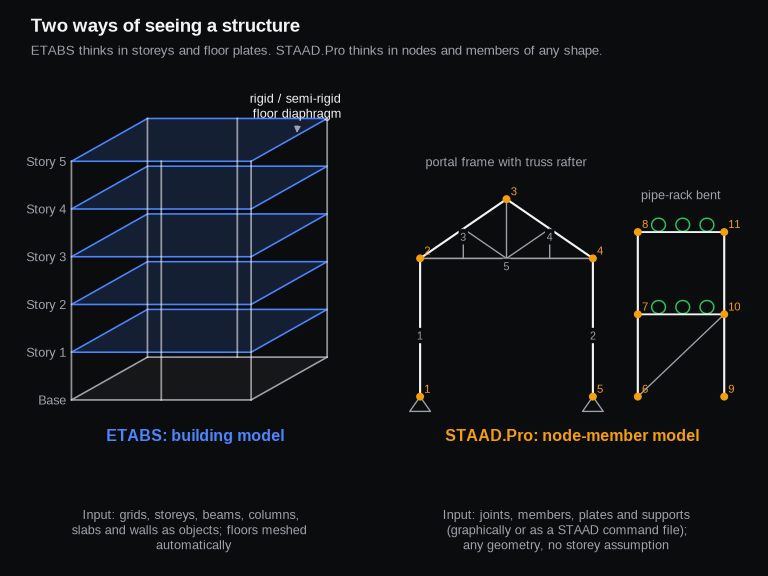
ETABS is storey-first. You start from a template or a grid, give the number and height of storeys, and draw beams, columns, slabs and walls as objects. The program recognises storey levels, so building data goes in floor by floor. Each floor can be a rigid, semi-rigid or flexible diaphragm. Slabs and walls are meshed automatically into finite elements for analysis, while you keep working with the physical objects. Because the model already knows its storeys, the storey-by-storey checks that IS 1893 asks for, such as storey drift, follow naturally.
STAAD.Pro is geometry-first. A STAAD model is a set of joints, the members and plates that connect them, and supports. You declare it as a PLANE, SPACE, TRUSS or FLOOR structure. You can build it in the graphical interface or write it as a plain-text STAAD command file. Many engineers like the command file, because a model can be read, edited and generated by script. Nothing assumes that the structure has floors. That is why a sloping truss rafter, a pipe-rack bent, a transmission tower or a bridge pier is as natural in STAAD.Pro as a building frame.
Think of it like this: ETABS is a building-shaped spreadsheet with structural engineering built in, and STAAD.Pro is a general structural calculator that you can shape into anything.
Which Indian codes do ETABS and STAAD.Pro support?
The table lists what each vendor documents. A blank does not prove the feature is missing. It means we did not find it in the vendor's own pages. Always check the code list in the version you have installed.
| Indian Standard | What it covers | ETABS | STAAD.Pro |
|---|---|---|---|
| IS 1893 (Part 1):2016 | Seismic loads on buildings | Auto seismic loads and response spectrum (since v17) | Equivalent static load generation |
| IS 1893 (Part 4):2015 | Seismic loads on industrial structures | Not documented | Yes (industrial structures, not stack-like) |
| IS 875 (Part 3):2015 | Wind loads | Auto wind loads (since v16.1) | Wind load generator |
| IS 456:2000 | RC design | Concrete frames, slabs, shear walls | Concrete design |
| IS 13920:2016 | Ductile detailing of RC | Built into IS 456 frame design (since v17) | Yes (2016 and 1993 editions) |
| IS 800:2007 | Steel design | Steel frame design | Yes (plus the 1984 edition) |
| IS 18168:2023 | Seismic design and detailing of steel buildings | Not documented | With IS 800:2007 (STAAD.Pro 2026) |
| IS 11384:2022 | Composite steel-concrete | Composite beams and columns | Composite columns (STAAD.Pro 2026) |
| IS 801 / IS 802 | Cold-formed steel / transmission towers | Not documented | Yes |
IS 875 Parts 1 and 2 (dead and imposed loads) give unit weights and floor loads. You enter those values yourself in both programs.
Which edition of IS 1893 should you use in 2026?
The Bureau of Indian Standards (BIS) released a revised earthquake code in late November 2025, with a new Zone VI covering almost the whole Himalayan arc. In March 2026, BIS was reported to have withdrawn that 2025 code after the Ministry of Housing and Urban Affairs raised concerns about cost and consultation, and IS 1893 (Part 1):2016 is back in effect. We could not locate the gazette notification itself, so confirm the applicable edition with the approving authority on your project. The worked example below uses the 2016 code, which is also what both programs implement.
What analysis types can each run?
For everyday Indian practice, the two are close. Both run linear static, P-delta, modal, response spectrum and time history analysis, and both offer nonlinear analysis in their higher tiers. The differences are in packaging and in specialist features:
- ETABS lists pushover analysis (FEMA 356 procedures), nonlinear hinges, linear buckling, staged construction and, since v23, FEM buckling. It is sold in three levels (Plus, Nonlinear and Ultimate), and some features, such as FEM buckling, need the Ultimate level.
- STAAD.Pro covers static, dynamic, wind, earthquake and moving-load analysis, with first-order elastic and P-delta options. STAAD.Pro Advanced adds nonlinear geometric and cable analysis, plus floor spectrum generation from time history results. Models can be exported to ADINA for harder nonlinear and blast problems.
If your work is performance-based seismic design of tall buildings, ETABS's nonlinear tools are the ones built for it. If your work includes moving loads, cables or odd geometry, STAAD.Pro is the more natural fit.
How does the design workflow differ?
An ETABS building job usually runs like this:
- Set up grids and storeys.
- Draw the frame, slabs and walls.
- Assign loads and the mass source.
- Generate IS 1893 and IS 875 load patterns automatically.
- Analyse, then check storey drift, torsional irregularity and modal participation.
- Design beams, columns and shear walls to IS 456 / IS 13920 (or IS 800 for steel).
Slabs and foundations then often move to SAFE, CSI's slab and foundation program. ETABS v23 can also pull a SAFE model back in at a chosen storey. CSiXRevit links the model to Revit in both directions.
A STAAD.Pro industrial job runs member by member:
- Build the geometry.
- Assign sections, releases and supports.
- Define primary load cases and generate seismic and wind loads.
- Build load combinations.
- Run steel or concrete design with parameters such as effective lengths and deflection limits.
Foundations go to STAAD Foundation Advanced. Steel connections go to RAM Connection. Because the input is a text file, and now also accessible from Python through OpenSTAAD, repetitive structures such as pipe-rack bents are easy to generate by script.
Worked example: IS 1893 base shear and storey drift
Here is what both programs do when you click "run" on a simple building. We compute it step by step, then check drift with a 2D frame model solved by the direct stiffness method, the same matrix method both programs use. The Python script is kept with this article's working files, and every number below comes from it.
The building (assumptions)
- G+4 RC special moment resisting frame (SMRF), five floors of 3.0 m (height h = 15 m), plan 20 m × 15 m with 5 m bays.
- Zone III (Z = 0.16), medium soil (Type II), residential with not more than 200 occupants (I = 1.0), SMRF (R = 5.0).
- Floors: 10 kN/m² dead load (slab, finishes, beams, columns and walls spread over the floor) and 2 kN/m² imposed load. Roof: 8 kN/m² dead load.
- Columns 450 × 450 mm, beams 300 × 500 mm, M25 concrete.
Step 1: Seismic weight
IS 1893 Table 10 takes 25% of an imposed load up to 3 kN/m². Clause 7.3.2 ignores imposed load on the roof. Each floor is 300 m² × (10 + 0.25 × 2) = 3,150 kN, and the roof is 300 × 8 = 2,400 kN. Total seismic weight W = 4 × 3,150 + 2,400 = 15,000 kN. In ETABS this is the "mass source". In STAAD.Pro it is the weight data inside the IS 1893 definition.
Step 2: Approximate period
For a bare RC moment frame, clause 7.6.2(a) gives Ta = 0.075 h0.75 = 0.075 × 150.75 = 0.572 s. If the frame had masonry infill walls, clause 7.6.2(c) would apply instead: Ta = 0.09 h / √d = 0.09 × 15 / √20 = 0.302 s along the 20 m side.
Step 3: Design acceleration coefficient
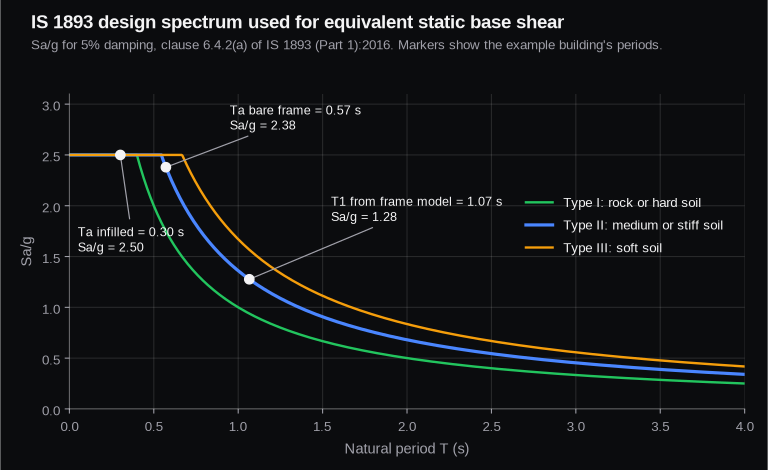
For medium soil, Sa/g = 1.36 / T when T is between 0.55 and 4.0 s, so Sa/g = 1.36 / 0.572 = 2.379. Clause 6.4.2 then gives:
Ah = (Z/2) × (Sa/g) / (R/I) = (0.16/2) × 2.379 / (5/1) = 0.0381
Step 4: Base shear
VB = Ah × W = 0.0381 × 15,000 = 571 kN. This is well above the Table 7 minimum for Zone III (1.1% of W = 165 kN). With the infilled-frame period, Sa/g would sit on the 2.5 plateau and VB would be 600 kN, 5% more.
Step 5: Distribute over height
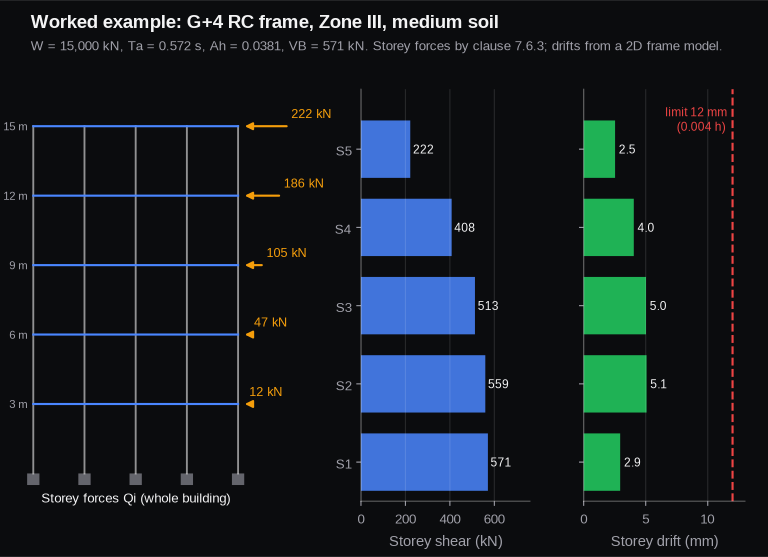
Clause 7.6.3 distributes the base shear in proportion to Wihi²:
| Level | hi (m) | Wi (kN) | Qi (kN) | Storey shear (kN) | Drift (mm) |
|---|---|---|---|---|---|
| Roof | 15 | 2,400 | 221.7 | 221.7 | 2.5 |
| 4 | 12 | 3,150 | 186.3 | 408.0 | 4.0 |
| 3 | 9 | 3,150 | 104.8 | 512.8 | 5.0 |
| 2 | 6 | 3,150 | 46.6 | 559.3 | 5.1 |
| 1 | 3 | 3,150 | 11.6 | 571.0 | 2.9 |
Step 6: Storey drift
Four identical frames resist shaking along X, so each carries a quarter of these forces. Accidental torsion is ignored here, although both programs add it. We modelled one frame (four 5 m bays, fixed bases) with E = 5,000√fck = 25,000 MPa from IS 456. Following IS 1893 clause 6.4.3.1, we used cracked stiffness: 70% of gross inertia for columns and 35% for beams. Clause 7.11.1.1 limits drift to 0.004 × storey height = 12 mm, under unfactored seismic load. The largest drift is 5.1 mm in storey 2, which is 42% of the limit. Roof displacement is 19.6 mm.
Step 7: Compare with the computed period
A modal analysis of the same frame gives a fundamental period of 1.07 s, almost twice the 0.572 s code formula. That is normal for a bare-frame model, because the masonry walls that stiffen a real building are not in it. If you used 1.07 s, Sa/g would fall to 1.28 and the base shear to 306 kN. IS 1893 does not allow that shortcut. Clause 7.7.3 says that when a dynamic analysis gives a base shear below the value from Ta, the results must be scaled up to match it. Both ETABS and STAAD.Pro report modal periods. Neither one stops you from forgetting this scaling, so it is a classic interview and checking question.
How you would set this up in each tool
In ETABS: define five 3 m storeys and a 4 × 3 bay grid at 5 m. Draw the frame and slabs, and set the mass source to dead load plus 0.25 × imposed load. Add a seismic load pattern using the IS 1893:2016 auto-lateral load with Z = 0.16, soil type II, I = 1 and R = 5. Choose how the period is taken, then run and read the storey drift table.
In STAAD.Pro, the same seismic definition is a few lines in the command file. The fragment below is illustrative only; check the syntax against your version's technical reference:
DEFINE IS1893 2016 LOAD
ZONE 0.16 RF 5 I 1 SS 2 ST 1 DM 0.05
JOINT WEIGHT
21 TO 80 WEIGHT 157.5
81 TO 100 WEIGHT 120
LOAD 1 LOADTYPE SEISMIC TITLE EQ +X
1893 LOAD X 1
Here SS 2 is medium soil and ST 1 is an RC moment frame, which makes STAAD use the 0.075 h0.75 period formula. The joint weights are each floor's seismic weight shared over its 20 column joints (3,150 / 20 = 157.5 kN, and 2,400 / 20 = 120 kN at the roof). The joint numbers depend on how you built the model.
Done correctly, both programs should land close to 571 kN. If yours does not, the usual culprits are the mass source, the period option, or loads counted twice in the seismic weight.
How are ETABS and STAAD.Pro licensed and priced?
ETABS: CSI lists perpetual licence prices in US dollars on its sales page: Plus $7,439, Nonlinear $11,903 and Ultimate $17,855, plus annual maintenance of $1,301, $2,081 and $3,128 (checked 17 Nov 2026). Since v23, every licence is a cloud sign-in licence; the older standalone and network licences are no longer supported. For a rupee quote, ask CSI or its authorised Indian reseller.
STAAD.Pro: Bentley sells 12-month Virtuoso subscriptions and lists "starting at" prices on its STAAD page. When we checked on 15 November 2026, the page showed these prices in rupees:
- STAAD.Pro from ₹97,887.
- STAAD.Pro Advanced from ₹1,73,563.
- Structural WorkSuite from ₹1,84,684. It bundles STAAD.Pro Advanced, STAAD Foundation Advanced and RAM Structural System.
Prices vary by region and change, so treat these as a snapshot. Bentley also offers a free trial and free access for students and educators.
Which one do Indian employers use?
We could not find any published survey that measures ETABS against STAAD.Pro use among Indian employers, so we will not give you a percentage. What the vendors' own material does show is where each tool is aimed:
- Building design (residential, commercial, high-rise): ETABS is the tool built for this job. CSI positions it as the industry standard for building design, its storey-based model matches the storey-wise checks in IS 1893, and SAFE handles the slabs and rafts.
- Industrial, plant and infrastructure work (steel sheds, pipe racks, process and power plants, transmission towers, metro and rail structures): STAAD.Pro's general geometry, together with its IS 1893 Part 4, IS 800, IS 801 and IS 802 support, is aimed at this work. One documented Indian example: Delhi Metro Rail Corporation used STAAD.Pro to analyse and design the 242 m steel skywalk at New Delhi railway station, according to Bentley's November 2025 project profile.
- Your own market: before choosing, read 20 or 30 current job listings for the city and sector you want and note which tool each asks for. That will tell you more than any general rule.
Should you learn ETABS or STAAD.Pro first?
Pick by the work you want, not by which tool is "better":
- Aiming for building design (apartments, offices, high-rises): learn ETABS first, with SAFE, along with IS 456, IS 13920 and IS 1893. Skill-Lync's high-rise building design course with ETABS and SAFE follows this path.
- Aiming for industrial or plant structures: learn STAAD.Pro first, along with IS 800 and IS 875. The industrial structures course using STAAD.Pro and the pipe-rack design course are built around exactly those structures.
- Not sure yet: learn the theory both tools hide. That means stiffness, load paths, cracked sections and the IS 1893 steps above. Once you understand what the software computes, switching between programs takes days, not months.
If you are preparing for interviews, our ETABS interview questions and STAAD.Pro interview questions posts are a good next read. The post on stiffness modifiers in ETABS explains the cracked-section factors used in Step 6.
Frequently asked questions
Is ETABS better than STAAD.Pro?
Neither is better in general. ETABS is faster and more specialised for buildings because it works in storeys and diaphragms. STAAD.Pro is more flexible because it handles any geometry, which makes it the usual choice for industrial structures, towers and bridge components.
Can STAAD.Pro be used for high-rise buildings?
Yes. STAAD.Pro can model and design buildings, including IS 1893 seismic and IS 875 wind loads. For tall buildings, though, ETABS's storey-based modelling, diaphragm handling and storey-wise results usually make the work quicker.
Do ETABS and STAAD.Pro support IS 1893:2016?
Yes. CSI added IS 1893:2016 auto seismic loads and response spectrum functions in ETABS v17. Bentley documents IS 1893 (Part 1):2016 load generation in STAAD.Pro, plus IS 1893 (Part 4):2015 for industrial structures.
Why does the software's period differ from the IS 1893 formula?
The formula is empirical and reflects real buildings, infill walls included. A computer model of a bare frame is usually more flexible, so its period comes out longer (1.07 s against 0.572 s in our example). IS 1893 clause 7.7.3 requires dynamic results to be scaled up to the base shear from the formula period.
Is there a free version of ETABS or STAAD.Pro for students?
Bentley offers free access to STAAD for students and educators, and a free trial for others. CSI lists a trial for ETABS on its website. Check each vendor's current terms, since they change.
Sources and further reading
- ETABS v23.3.2 release notes, Computers and Structures, Inc., 21 Sep 2026.
- ETABS v23.0.0 release notes (licensing change, FEM buckling), CSI, 13 Oct 2025.
- ETABS v23.3.1 and v23.3.0 release notes, CSI, 1 Jul 2026.
- ETABS enhancements by version (IS 1893:2016, IS 13920:2016, IS 875 Part 3 history), CSI, accessed 15 Nov 2026.
- CSI international design codes, CSI, accessed 15 Nov 2026.
- ETABS features and ETABS levels, CSI, accessed 15 Nov 2026.
- STAAD.Pro 2026 (26.00.01) readme, Bentley Systems, accessed 15 Nov 2026.
- Structural WorkSuite 2025 announcement, Bentley Systems, 1 Oct 2025.
- STAAD product and pricing page, Bentley Systems, accessed 15 Nov 2026.
- STAAD.Pro help: Indian design codes, Bentley Systems.
- STAAD.Pro help: IS 1893 (Part 1) 2016 lateral seismic load and IS 1893 Part 4 2015, Bentley Systems.
- STAAD.Pro help: wind load generation to IS 875 (Part 3):2015, Bentley Systems.
- STAAD.Pro help: structure type specification, Bentley Systems.
- IS 1893 (Part 1):2016, Criteria for Earthquake Resistant Design of Structures, with Amendments 1 (2017) and 2 (2020), Bureau of Indian Standards (public copy).
- IS 456:2000, Plain and Reinforced Concrete: Code of Practice, Bureau of Indian Standards (public copy).
- 61% of India now at moderate to high earthquake risk: decoding new seismic map, ThePrint, 2 Dec 2025.
- Rollback of Seismic Code of 2025 (summarising The Economic Times), Drishti IAS, 13 Mar 2026.
- Skywalk at New Delhi Railway Station, DMRC: project profile, Bentley Systems, 7 Nov 2025.
- STAAD, Wikipedia (history of Research Engineers International and Bentley).