Week 9 - Project_1 - Door Trim Lower with Engineering Features
OBJECTIVE:
Create the Door Trim Lower Plastic component through the given Class-A surface.
To create the tooling axis for the plastic component
To perform draft analysis over the plastic component.
Create the Heat Stakes and the locators considering the design rules.
OVERVIEW:
Initially, we need to offset the given Door Trim class A surface in the inner direction to the required thickness (here the thickness is 2.5mm). After that, we need to close the patches on the offset surface of the door, the patches are formed due to the fillets on the Class A surface. Once all the patches are closed properly join them together to make a proper class B surface and now sweep the boundary of the class A surface to trim with the class B surface to make a closed body. By using the closed body command in the Prat workbench we can get the solid body from the closed surface of the Door Trim.
TOOLING AXIS:
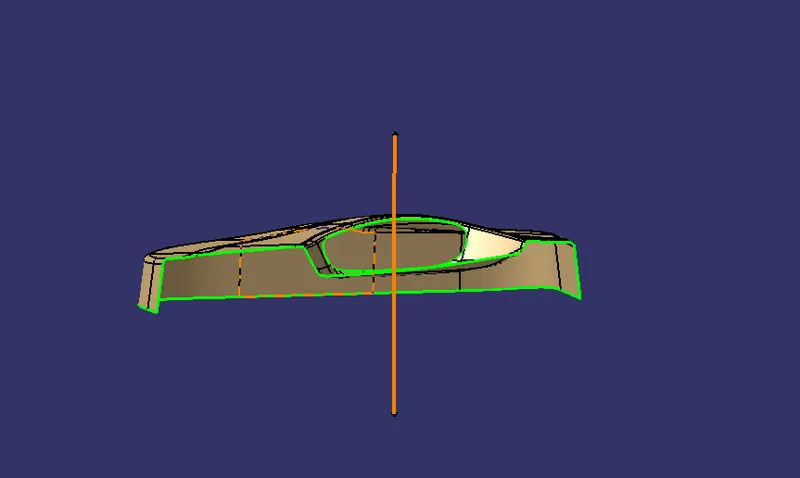
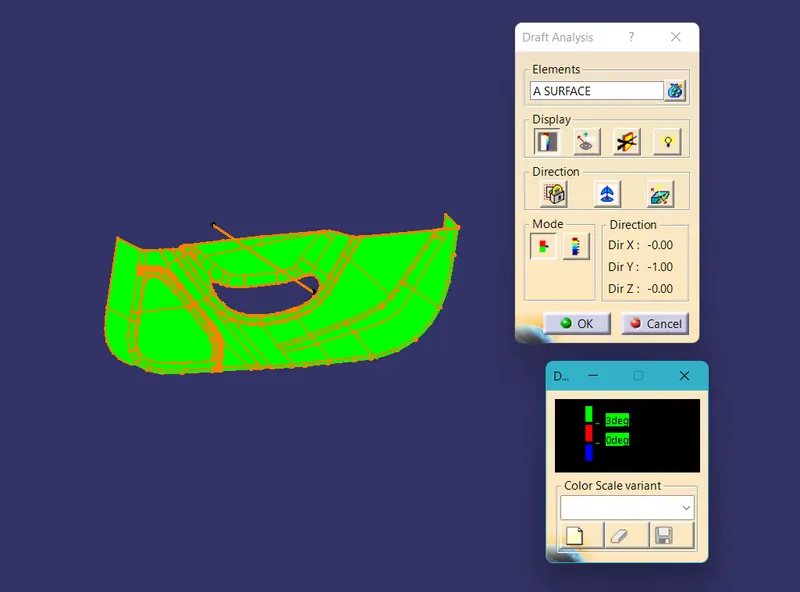
To create the tooling axis, I extracted a surface from class A and created a point in the middle of the surface by using the point command and created a line at that point through the x-axis. Now, I performed a draft analysis check from that line whether the created tooling axis is in the correct position or not. If in the draft, analysis check the surface highlighted with green colour on both sides of the surface the tooling axis is in the correct position and direction.
DRAFT ANALYSIS:
- First the class - A surface is checked before creating the class B&C surface and finally the solid body must be analysis. Both can be done by following procedures.
- By changing the view mode to custom view parameters material mode then the feature draft analysis is enabled.
- Then the compass was activated and placed with the tooling axis by dragging the red pointer and then locked it.
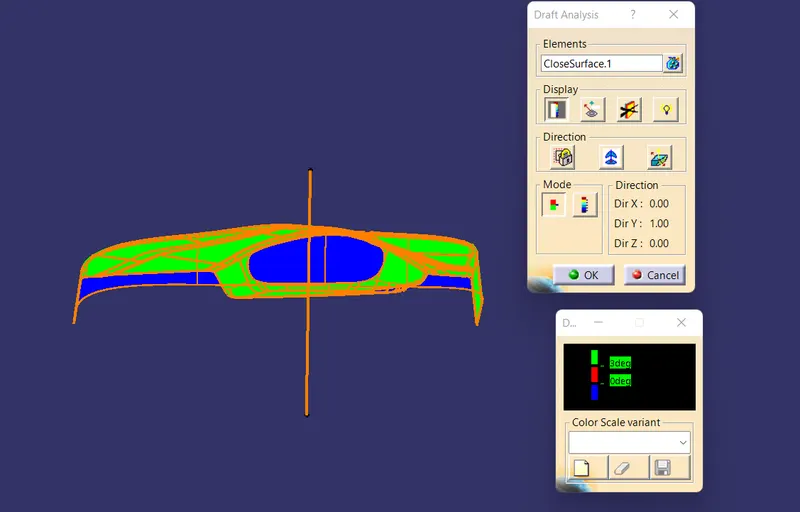
- Then, by selecting the quick analysis mode, the nominal value will be 3 degree and checked for the component's draft angle.
- The green colour area shows thast it satisfies the 3- degree draft angle. if not satisfied then by using running point tool the area is measured and then altered to get a successful draft for the created tooling direction.
DRAFT ANALYSIS FOR CLASS A:
DRAFT ANALYSIS FOR DOOR TRIM LOWER:
GIVEN REQUIREMENT:
LOCATOR AND HEAT STAKES:
The locators restrict all the other degrees of freedom except the translation along the direction of tooling axis along y-axis. For restricting that degree of freedom we will be using the heat stakes.
In heat staking, we use local heating and cooling to raise the temperature of plastic components and allow plastic reforming to be carried out.
These heat stakes will enter the mating component and using a heat staking machine these heat stakes are melted and cooled. When cooled this will get hardened and the two components will stick together. Thus all degrees of freedom are arrested
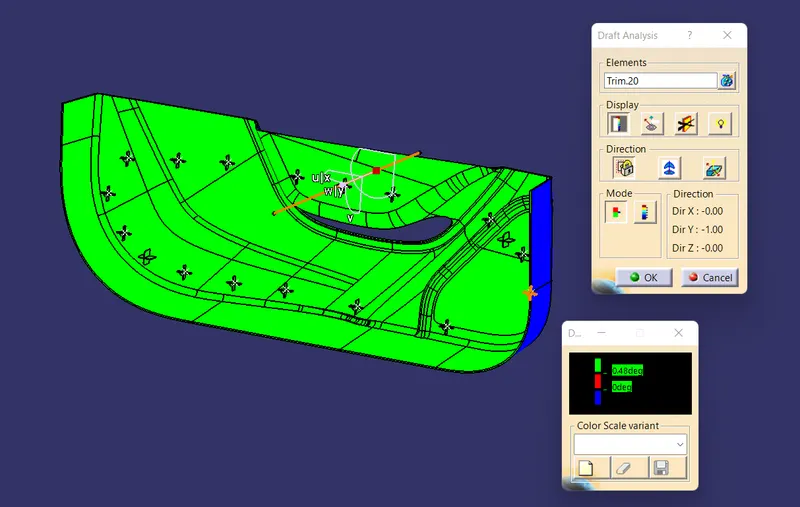
DRAFT ANALYSIS FOR DOOR TRIM WITH HEAT STAKES AND LOCATORS:
The green colour area shows in 0.48degree of draft angle.
RIGHT SIDE VIEW:
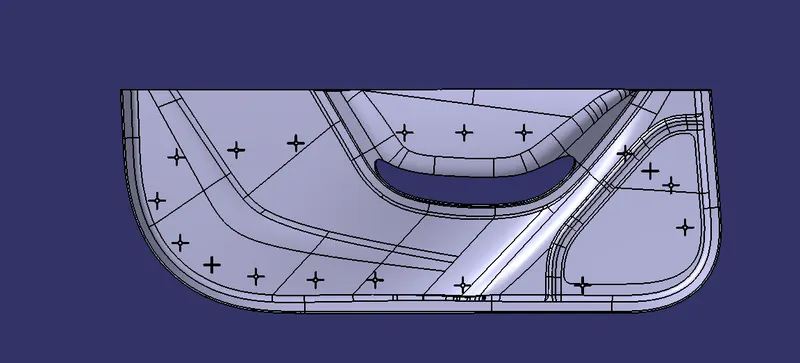
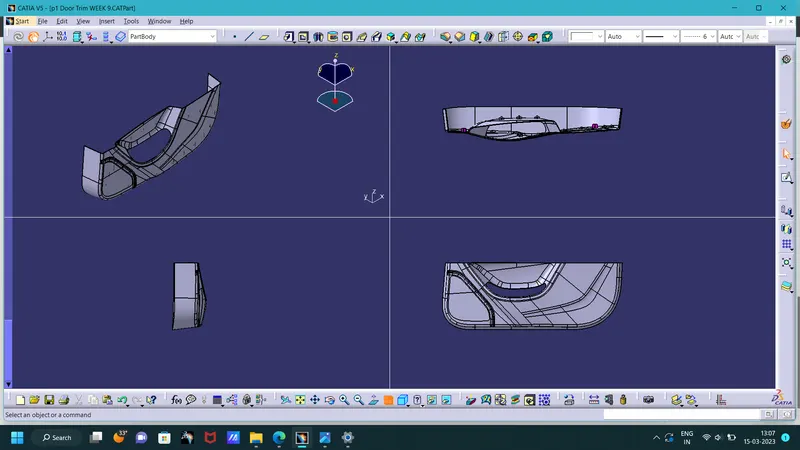
Isometric, Front, Side, and Top View:
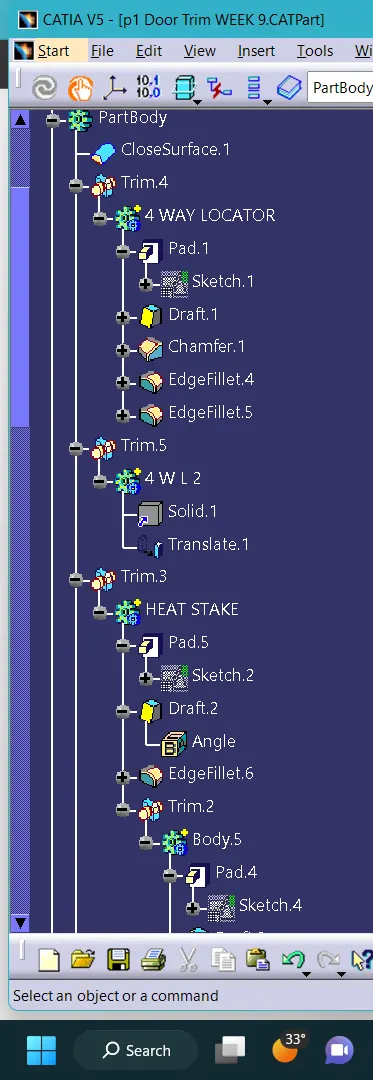
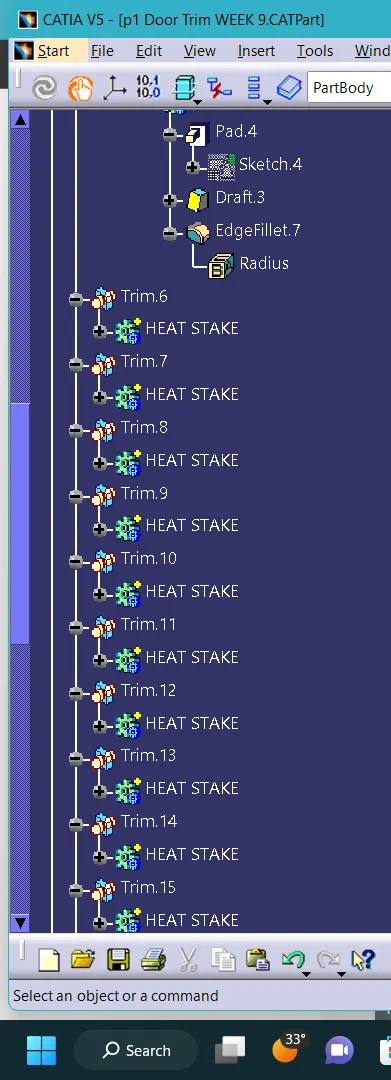
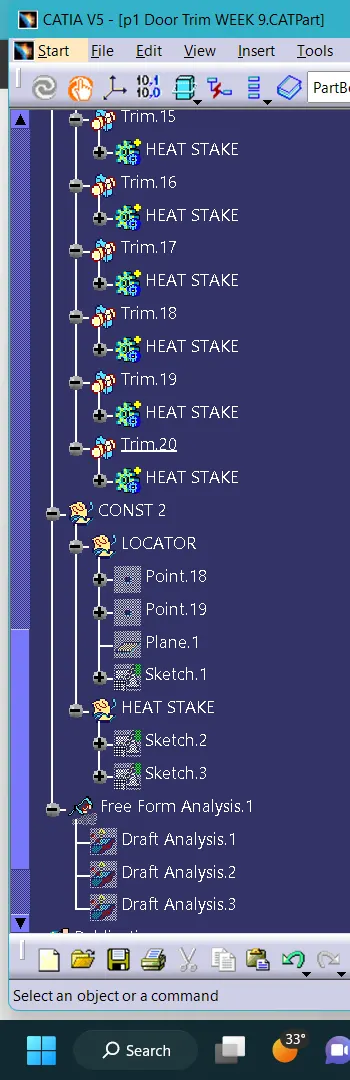
TREE STRUCTURE: