Week 9 - Project 1 - Door Trim Lower with Engineering Features
AIM
Create the Door Trim Lower Plastic component through the given Class-A surface. To begin with, the tooling axis for the given Class-A Surface should be created meeting the requirements of the draft angle and at the end perform the Draft analysis on the model.
Create the Heat Stakes and the locators considering the design rules mentioned in the video for the door applique.
TOOLING AXIS FOR GIVEN CLASS A SURFACE
First create a tooling axis for the given class A surface .In this direction the mold opens and closes .
For the given class A surface Y direction is consider as the tooling direction.Then create tooling direction clearing X and Y direction.finally bisecting this two lines to get the main tooling axis.
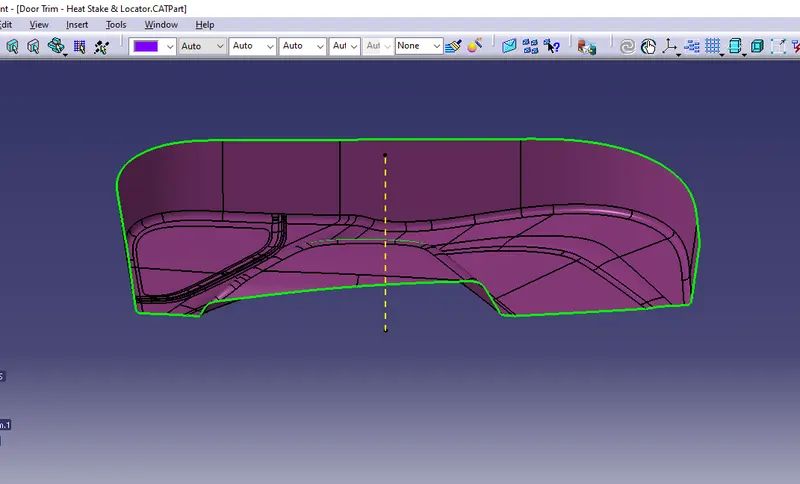
figure.1. shows main tooling axis
DRAFT ANALYSIS OF CLASS A SURFACE
Check the draft analysis of the given class A surface along the tooling direction to ensure the part has minimum draft angle (3 degree) in all faces.Draft analysis shown in fig 2 .The class A surface clearing the draft .
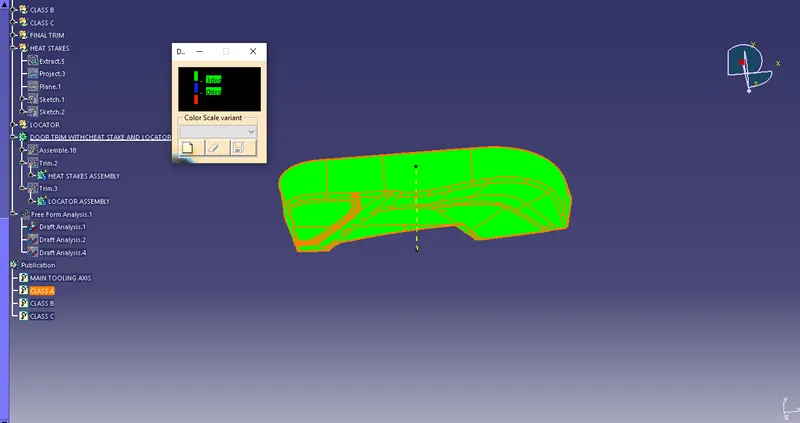
Fig.2. draft analysis of class A surface
CLASS B SURFACE
Class b surface created from the class A surface .offset class A surface in required thickness.Extract,extrapolate, trim operations used to create the class B surface .
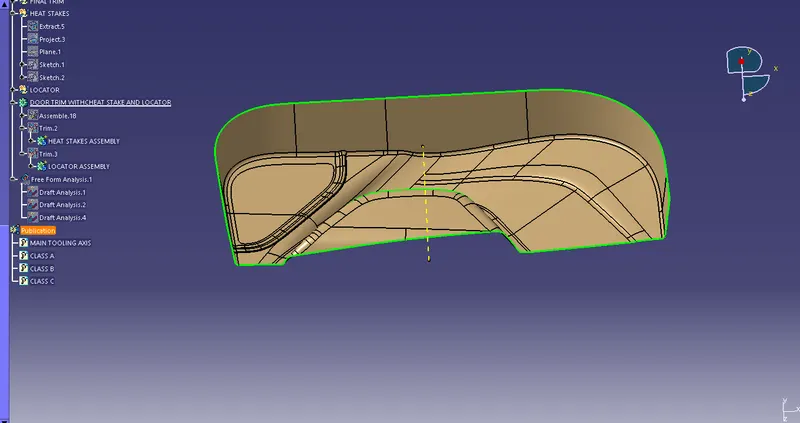
Fig.3. Class B surface
CLASS C SURFACE
Class C surface connecting the class A and B surfaces.Create the boundary of class A surface and using the swept with reference surface to generate the class C surface.
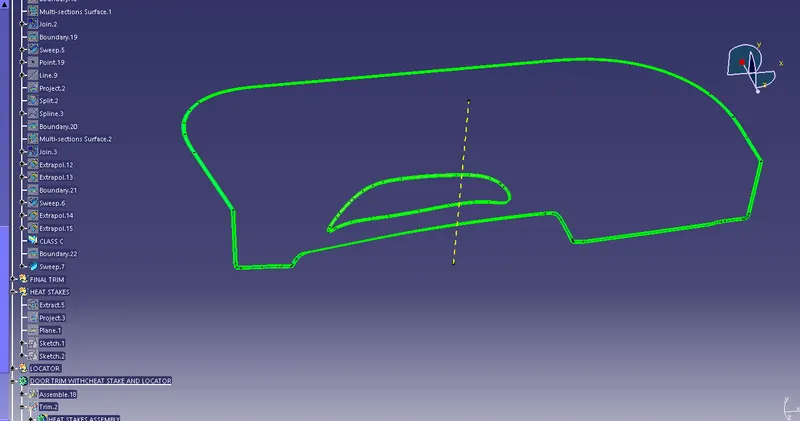
Fig.4. Class C surface
- Then join the class A surface with class C surface
- Finally trim with class B to get the close surface of door lower trim.
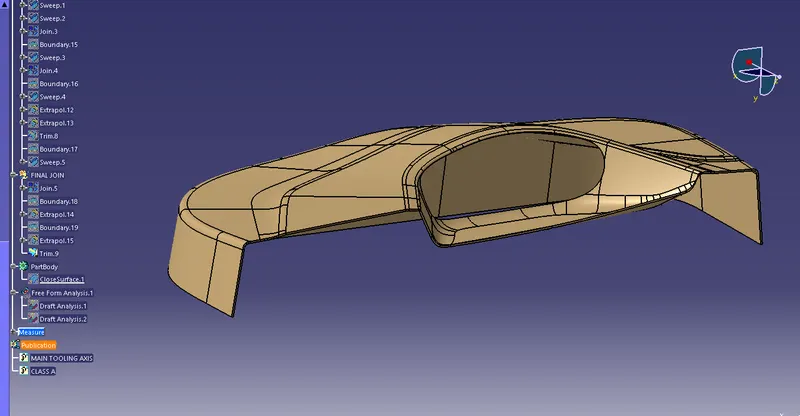
Fig.5. closed surface of door lower trim.
DRAFT ANALYSIS OF CLOSE BODY
Use the draft analysis to check the final product has minimum draft angle.
here some areas in C surface not clearing the draft angle due to some errors in class A surface .(class C surface genetated using class A surface as a reference) (shown in fig 6.).
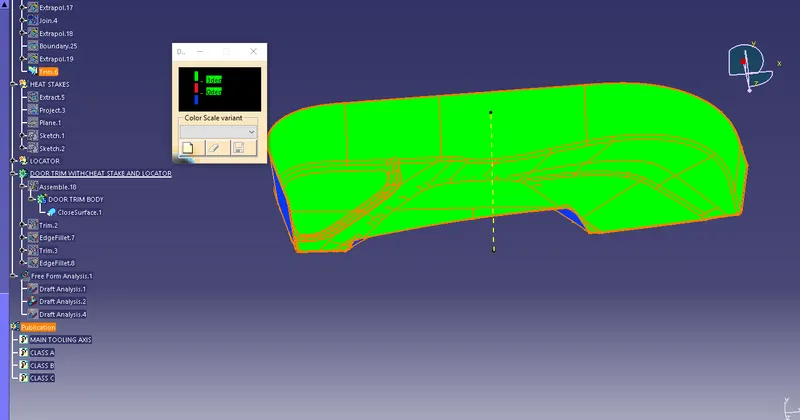
Fig.6.Draft analysis of close body
DESIGN OF HEAT STAKES AND LOCATOR
HEAT STAKE
Heat staking also known as thermoplastic staking is the process of joining two dissimilar materials together. In heat staking we use local heating and cooling to raise the temperature of plastic components and allow plastic reforming to be carried out. This reforming can be used in a wide variety of applications.
Thermal staking should be considered when the parts to be assembled are still in the design stage. Several configurations for boss/cavity design are available, each with specific features and advantages. Their selection is determined by such factors as type of plastic, part geometry, assembly requirements, machining and molding capabilities, and cosmetic appearance. Heat staking can be performed using wide range of thermoplastic materials including polypropylene, ABS, polycarbonate and many others.
The integrity of a thermal staked assembly depends greatly upon the geometric relationship between the boss and the thermal tip. Proper design will produce optimum strength with minimum flash.
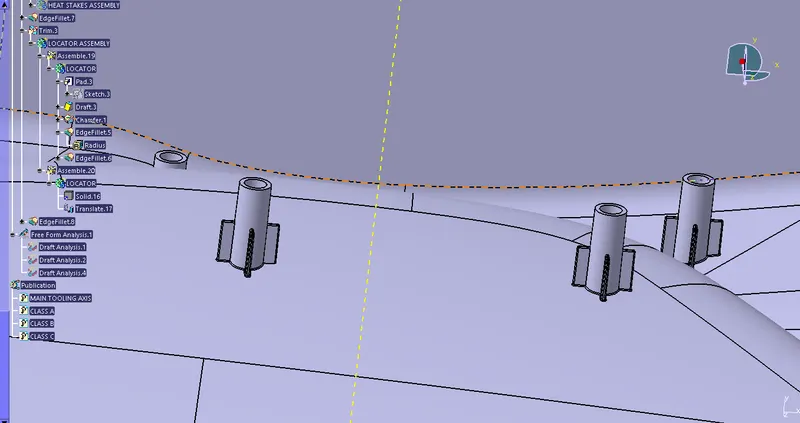
fig.7. heat stakes
Here heat stakes created with draft 0.5 degree, fillet radius is 0.25mm and wall thickness is 1.5mm (0.6*2.5) .heat stakes designed by following the design rules.
LOCATORS
Typically, locating pins are used for controlled, fine tolerance positioning of a work piece.
A 2-way locating pin restricts motion along 1 axis (or 2 degrees of Freedom), like a round pin in a slot. Likewise, a 4-way pin restricts 4 degrees of freedom along 2 axes. A round locating pin located concentrically in a hole is a common application of a 4-way pin, and helps to further secure the piece
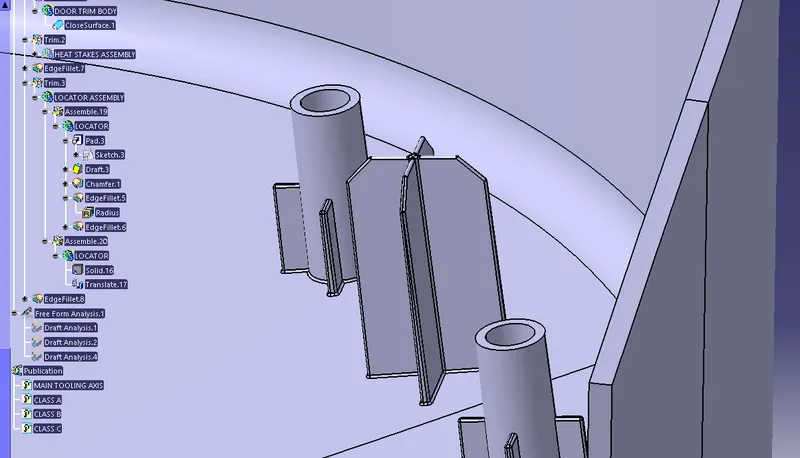
Fig.8. locator
Here 4-way locator created with thickness 1mm ,draft 0.5 degree and the fillet value is 0.25 mm .
DRAFT ANALYSIS OF HEAT STAKES AND LOCATOR
Draft analysis performed on the final body to check all the part has minimum draft along the tooling direction .here the locator and heat stakes has minimum draft 0.5 degree.
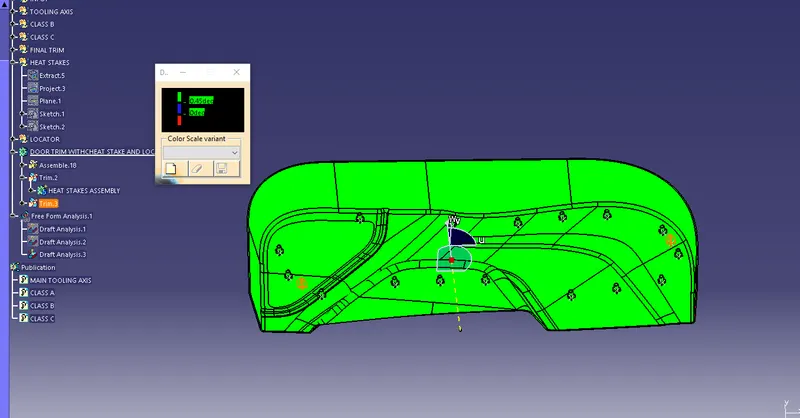
Fig.9.draft analysis heat stakes and locator
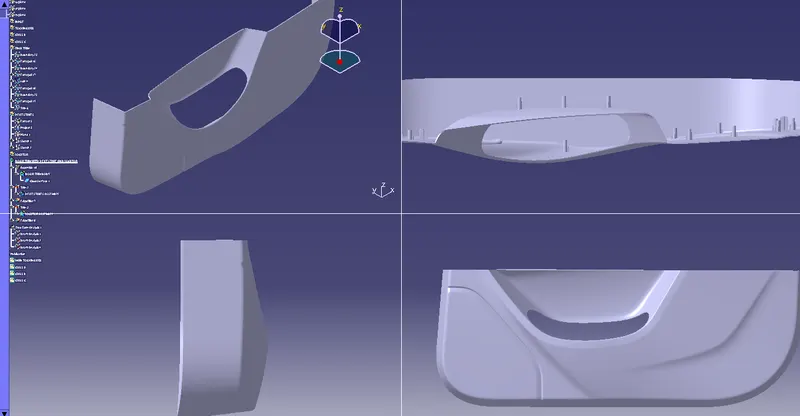
Fig.10.different views
CONCLUSION
The Heat Stakes and the locators created by considering the design rules.