Section Modulus calculation and optimization
AIM :Use the Section from your Hood design and calculate the Section Modulus using the formula
INTRODUCTION
Section modulus is a geometric property of the cross section used for designing beams and flexural members . A beam that has a larger section modulus than another will be stronger and capable of supporting greater loads. The section modulus is classified into two types:-
1] Elastic section modulus:- The elastic section modulus is applicable up to the yield point of material. It is used in most engineering applications.
2] Plastic section modulus:- The plastic section modulus is generally used for material in which plastic behaviour is observed.
2.SECTION MODULUS
Section modulus is defined as the ratio of total moment resisted by the section to the stress in the extreme fibre.which is equal to the yeild strength.
2.1 SECTION MODULUS EQUATION :-
The formula of elastic section modulus is given by,
S=I/Y
Where,
I = Moment of inertia (mm^4).
- Moment of inertia is nothing but offering resistance against of moment, bending or twisting, i.e if we applied any external load on the body, how much resistance its offering to tend to deform.
Y = Distance between neutral axis and outermost fiber (mm)
- It represents the strength of the section.
- Greater the value of S, greater will be the strength of the section.
- It is also often used to determine the yield moment (My) such that My = S × σy, where σy is the yield strength of the material.
2.2 STEP TO CALCULATE SECTION MODULUS :-
- Step 1:- Find moment of inertia about neutral axis (I)
- Step 2:- Find Y from neutral axis.
- Step 3:- Find section modulus using the formula provided above.
2.3 CALCULATING SECTION MODULUS OF HOOD USING THE FORMULA
1 .Find the moment of inertia of the section
it is possible to find out the moment of inertia of the section using NX cad tool "section inertia analysis ".before that create a cross-section of hood design.
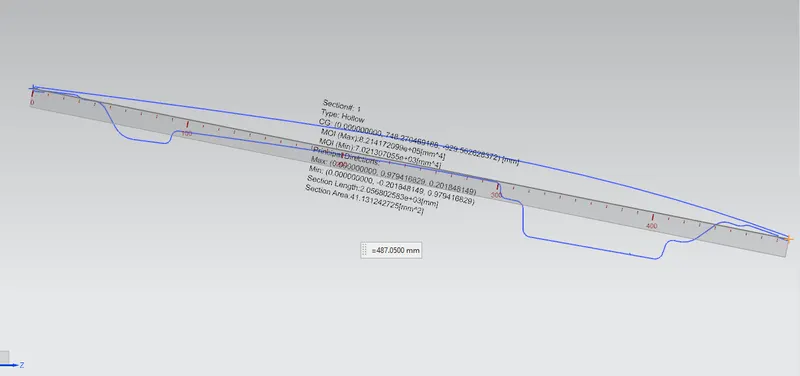
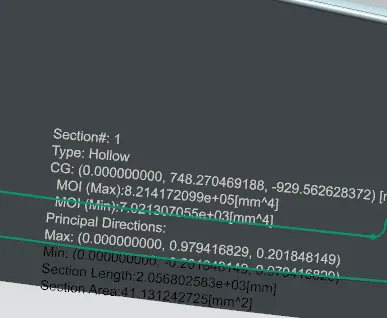
fig 2.3.a. Section inertia analysis of hood cross section
MOI (max) =8.214172099e+05[mm^4]
MOI (min) =7.021307055e+03[mm^4]
2.find Y (distance from neutral axis to one of the extreme end of an object)
with the help of NX we get total length of the section = 487.0500mm
Y= 487.0500/2=243.525 mm
3.Find the section modulus using the above formula
Section modulus S =I (max)/Y
=8.214172099e+05[mm^4]/243.525 mm
=3.37303033*10^3 mm^3
S =I (min)/Y
=7.021307055e+03 mm^4/243.525 mm
= 0.02883197*10^3 mm^3
Increasing the cross sectional area of section by changing the depth of inner panel up to 3 mm {create an offset 3mm to inner panel}
Find the moment of inertia of new section following above steps.
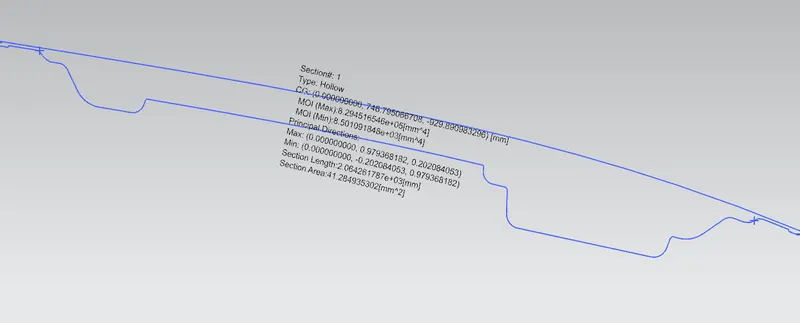
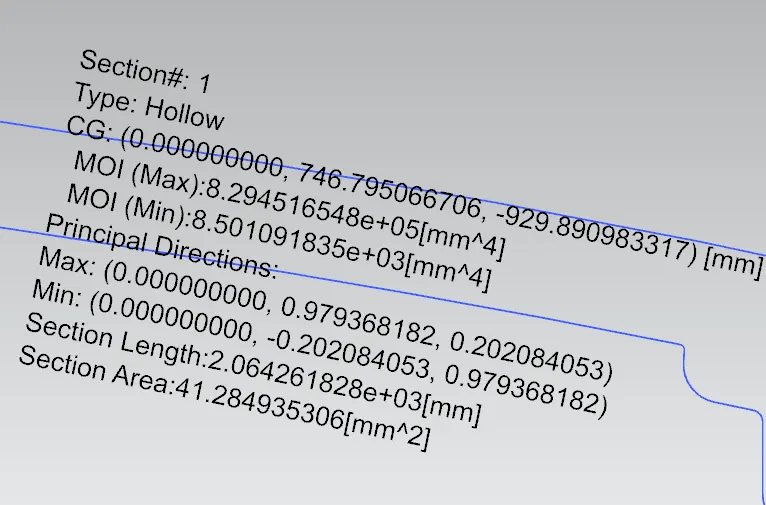
fig 2.3.b. Section inertia analysis hood section after changing the area of section
MOI (max) =8.294516546e+05[mm^4]
MOI (min) =8.501091848e+03[mm^4]
find Y = 487.0500/2=243.525 mm ^3
Section modulus S =I (max)/Y
=8.294516546e+05[mm^4]/243.525 mm
=3.4060226*10^3 mm
S =I (min)/Y
=8.501091848e+03mm^4/243.525 mm
=0.0349084975*10^3 mm^3
3. CONCLUSION
Section modulus of hood design is S at(Imax) =3.37303033*10^3 mm^3 & S (Imin) =0.02883197*10^3 mm^3
Comparing the above two case it conclude that increasing in section modulus after increasing the cross sectional area of the hood design.
Increasing crossection area improve the strength of the model.
- The section modulus depends upon the moment of inertia which again depends not only on the total area of the cross-section but also on the disposition of the area with respect to neutral axis.