Week 9 - Project 1 - Door Trim Lower with Engineering Features
Aim: To create a closed solid, Tooling Axis, Heat stakes,Dog House and locators for the given the given component.
Input : CLASS-A Surface Door Trim Lower.
TOOLING AXIS:
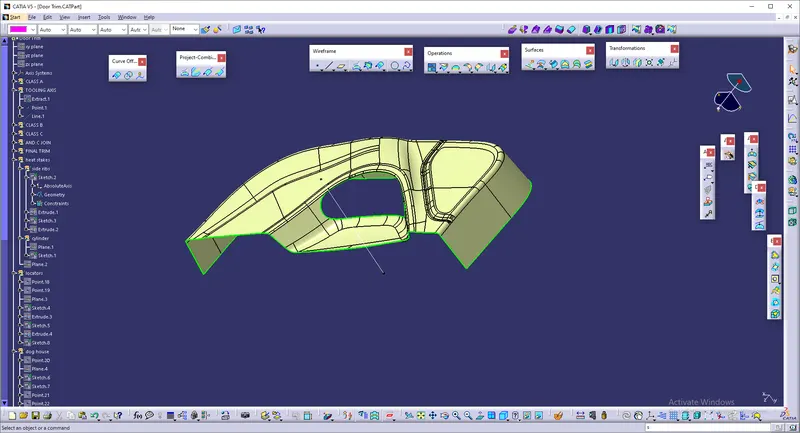
The Tooling Axis is the direction in which the mould travels. The mold is built in two separate piece named core and cavity.
Three methods for creation of a tooling axis:
- Tooling axis based on x,y,z direction.
- bisecting method.
- normal to the surface.
CLASS-A SURFACE:
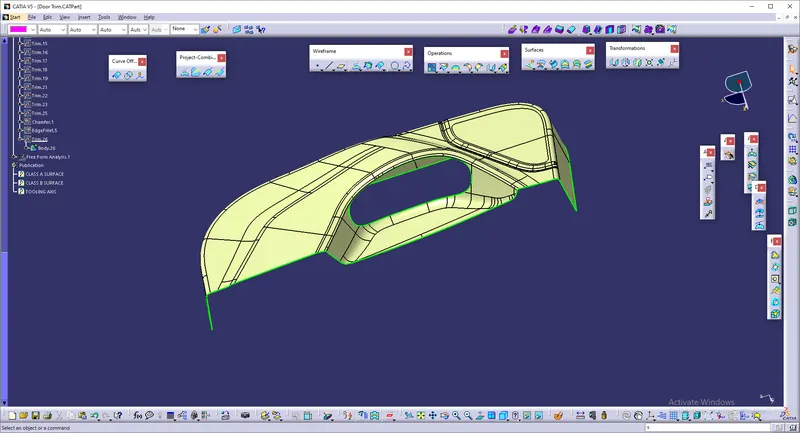
It is aesthetic surface and the outer most surface which is visible to the cutomers.
CLASS-B SURFACE:
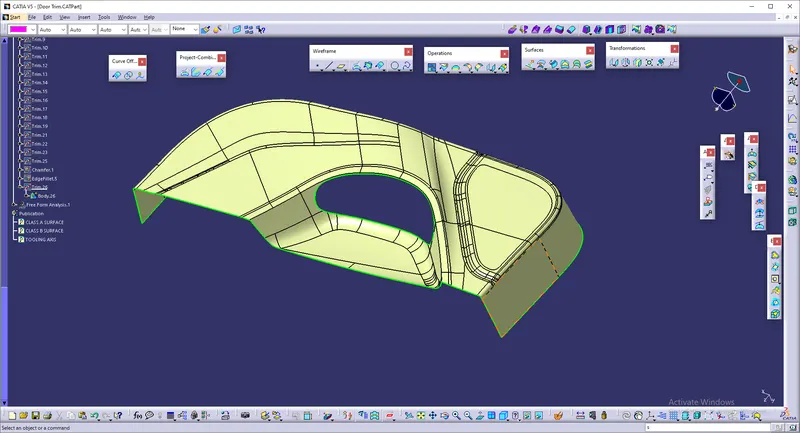
It is simply off-set of Class A surface and inner most part which is not visible to the customers.
CLASS-C SURFACE:
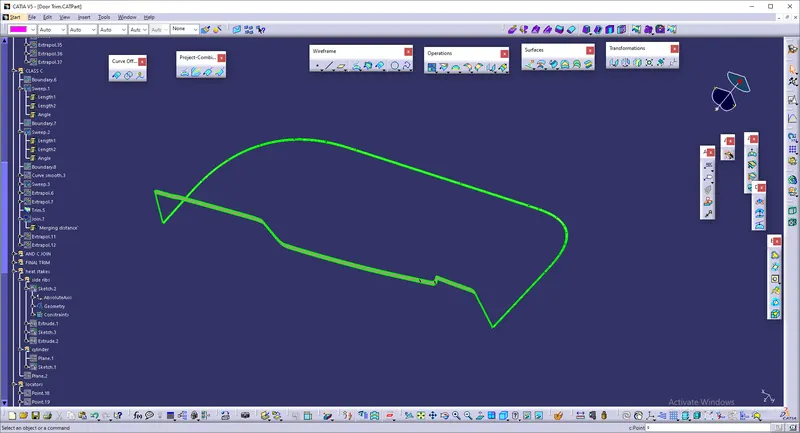
A surface that joins class-A and class-B surfaces is class-C surface(thickness).
Draft analysis:
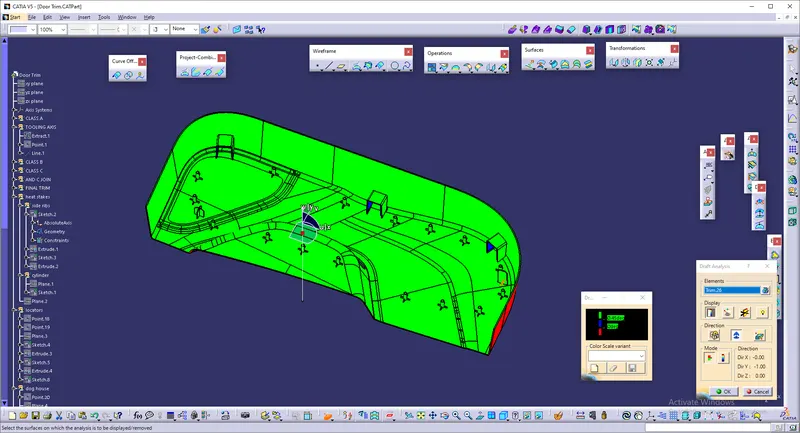
The draft analysis technique is used to analyze whether our part model created in CAD is manufacturable based on the draft condition applied. Here the part should get easily removed from the Mold. No parts can be ejected from the tool if it is having a straight 90-degree profile from its base surface. A small draft angle is provided to each and every area of the component in order to get easy removal of the component from the tool.
MATERIAL USED IN DOOR TRIM AND WHY?
Acrylonitrile Butadiene Styrene(ABS) has a low melting point, which enables Door trim its easy use in the injection moulding. It also has high tensile strength and is very resistant to physical impacts and chemical corrosion, which allow the finished plastic to withstand heavy use and adverse environmental conditions.
Heat staking:
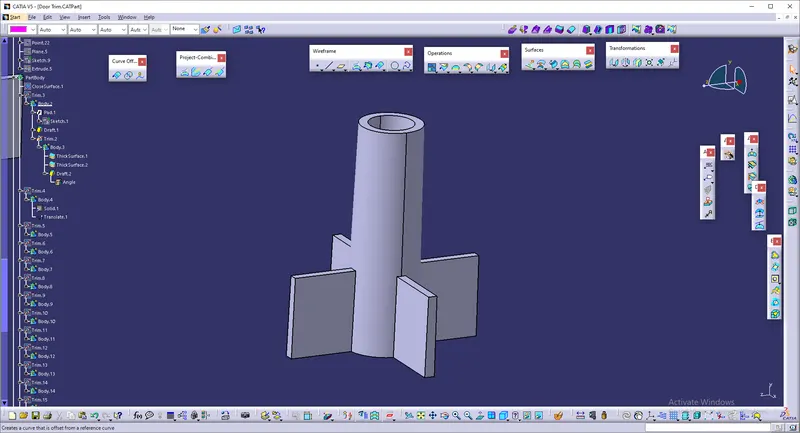
Heat Staking is a pulsed-heat process to join two or more parts out of which one at least is made of plastic. The process is to deform the plastic Material using heat and force at a set process time. The bond is made by partially de-forming the plastic part in order to fix the other. Heat Staking makes it easy to bond metal to plastic and is commonly used in high volume/low cost applications such as automotive, IT and consumer appliances.
Shaping Plastic Using Heat and Pressure:
The plastic is deformed by heating it to a temperature above the glass transition temperature. Super-heated air or a thermode is used for this. Pressure is then applied to create the stake. After the stake has been formed, the plastic should be cooled down again below the glass transition temperature. Cooling is performed under constant pressure to ensure good fixation of the parts. Compressed air can be applied for cooling when a thermode is used. Heat is used to facilitate the creation of the stake. Heat control is critical, especially for glass-filled plastics which often have a process window of less than 10 degrees Celsius. When the temperature is too high, the glass fibres come out of the plastic which leads to a rough surface and adhesion to the thermode. If the temperature is too low, the plastic will crack due to cold deformation.
Heat staking Benefits:
- Similar and dissimilar materials may be joined: metal to metal, plastic to plastic, metal to plastic
- Accurate control operating within a small process window
- Local heating resulting in no damage to surrounding materials
- Processing of glass-filled materials
- No mechanical vibration
- Many heat-stake shapes possible through custom designed tools.
2-WAY AND 4-WAY LOCATORS:
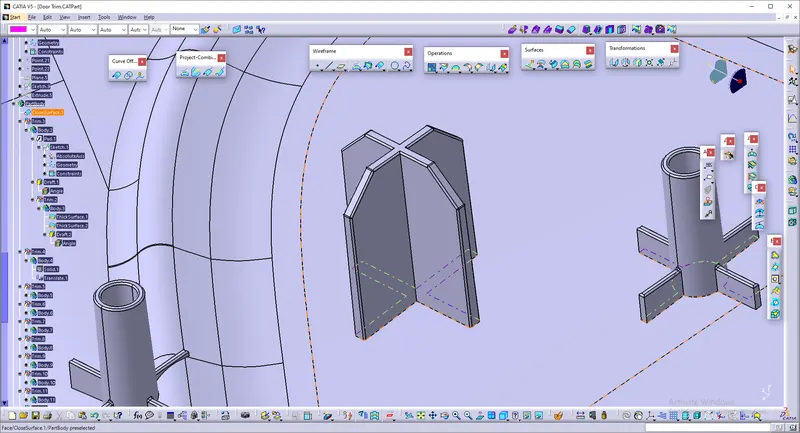
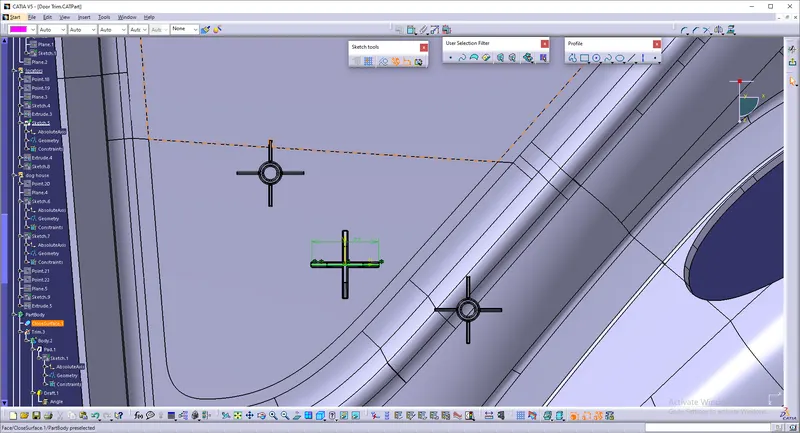
A 2-way locating pin restricts motion along 1 axis (or 2 degrees of Freedom), like a round pin in a slot. Likewise, a 4-way pin restricts 4 degrees of freedom along 2 axes. A round locating pin located concentrically in a hole is a common application of a 4-way pin and helps to further secure the piece. For restricting that degree of freedom we will be using the locators According to the requirements of the fixation we place locators on the component.
321 Principle:
Locators are based on 321 principle.This principle is used for contrainting all the Degrees of Freedom of an object.Consider three perpendicular planes if we place a object in it , it will have 3 linear motions in x,y,z and 3 rotational motions in x,y,z in it.First place the object in between the mutually perpendicular planes after giving the 3 pin support in the datum plane the then will move along the y axis , x axis and rotational along z axis there 3 motions were arrested ( along z axis , rotational along x and y).Next we have to give 2 pin support next plane the object will move along y axis alone there the another two motions were arrested . Then we have to give 1 pin support in the next plane, there all the degrees of
Freedom were arrested .There the object is fuuly constrain.
DOG HOUSE
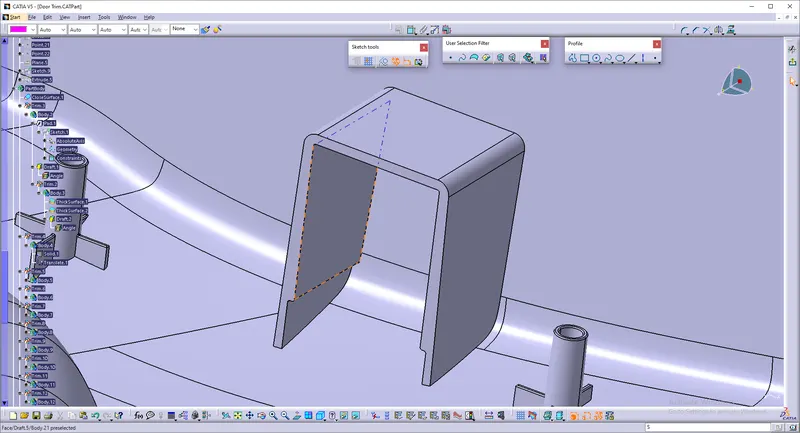
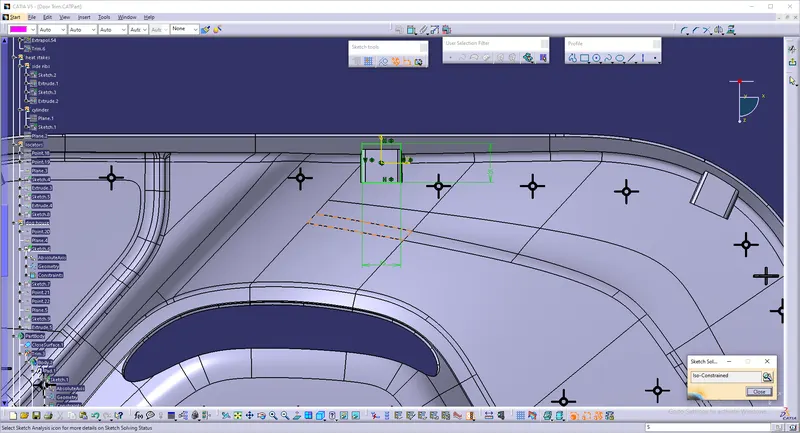
Dog house is an engineering feature used in plastic trim design. Dog houses are used as supporting feature. Sometimes other engineering features like snaps; locators etc. are mounded on them to increase their strength. Dog houses are subjected to draft analysis to prevent breakage of the component during ejection from mould cavity. Dog house and other engineering components are built on B-surface.
CLASS-A SURFACE:
TOOLING AXIS:
CLASS B SURFACE:
CLASS C SURFACE:
JOIN CLASS A AND C:
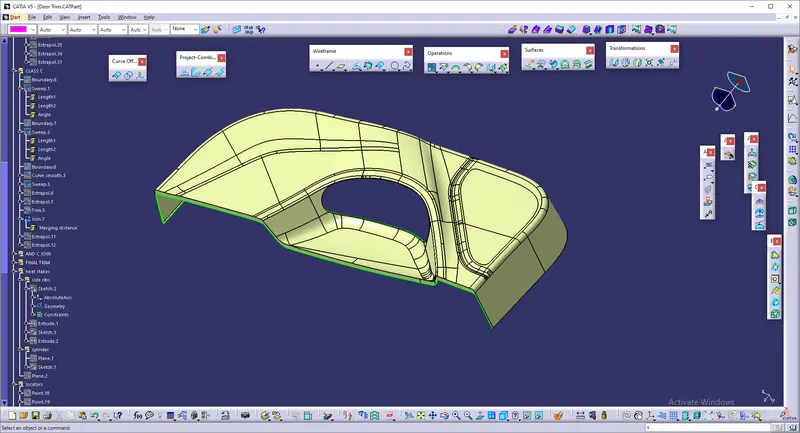
CLOSED SURFACE:
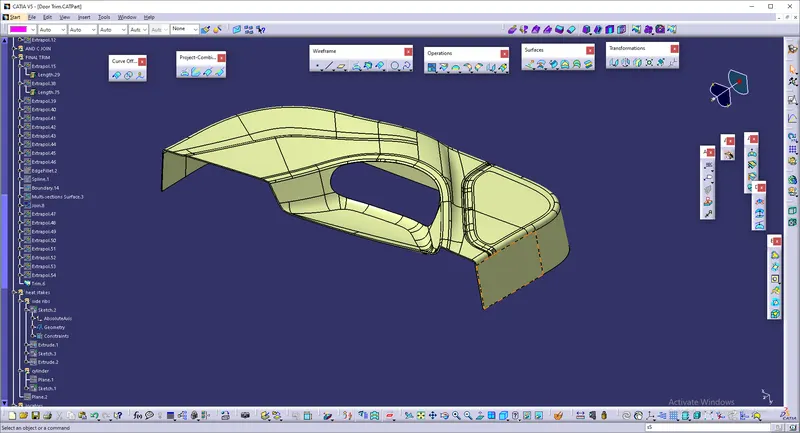
DRAFT ANALYSIS ON CLOSED SURFACE:
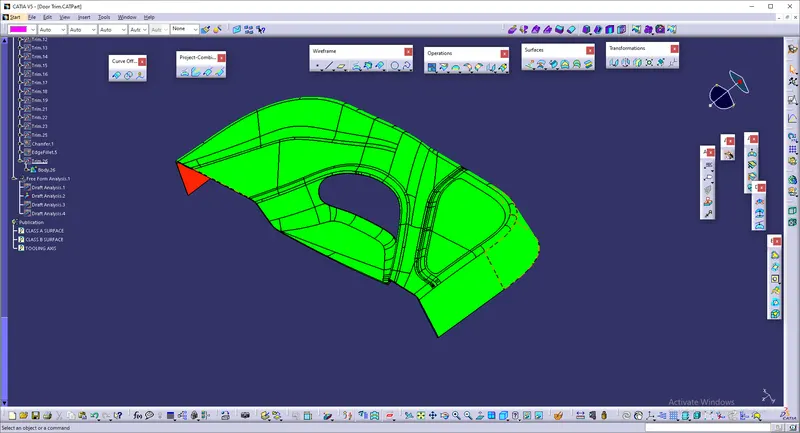
COVERSION OF SOLID SURFACE:
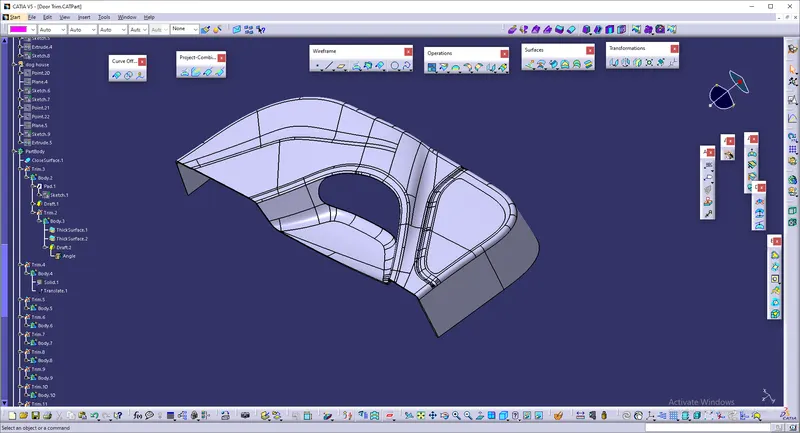
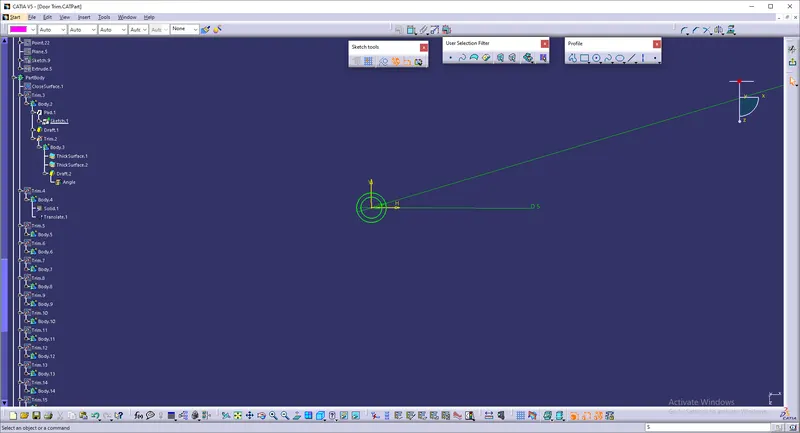
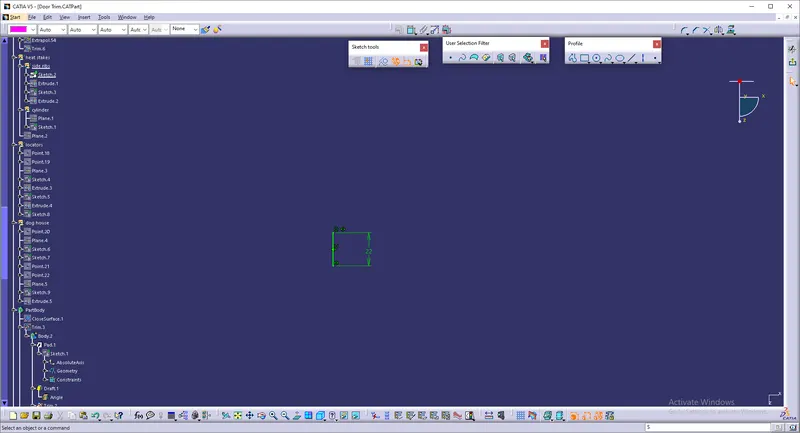
HEAT STAKES:
DOG HOUSES:
LOCATORS:
FOURWAY:
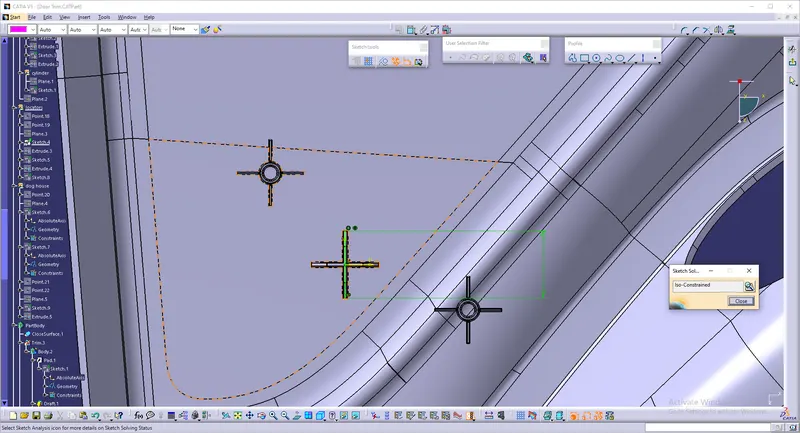
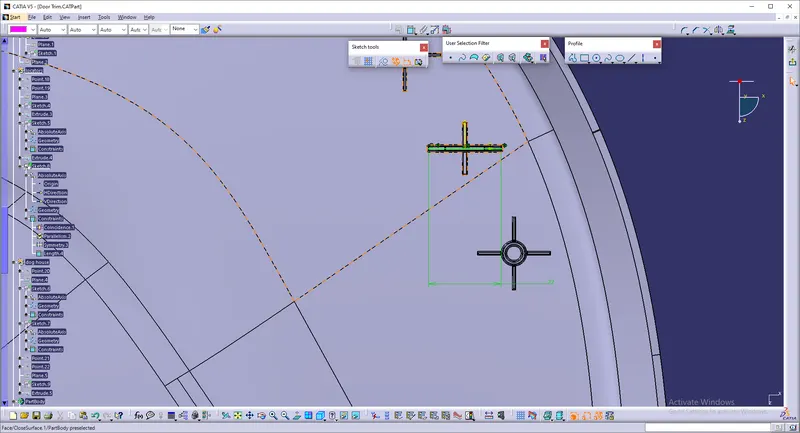
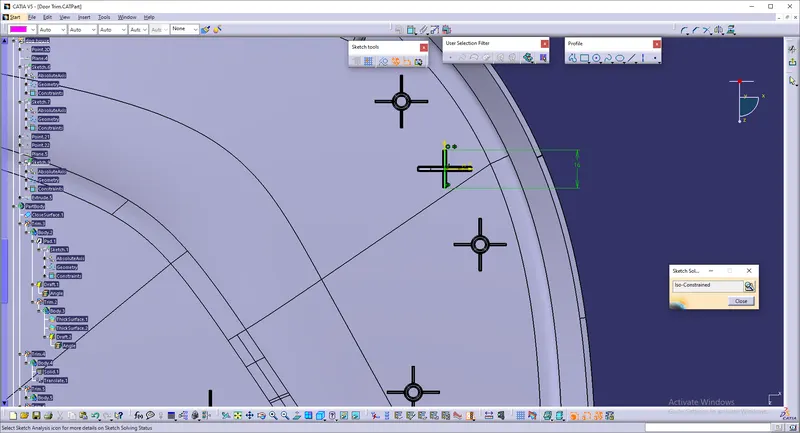
DRAFT ANALYSIS:
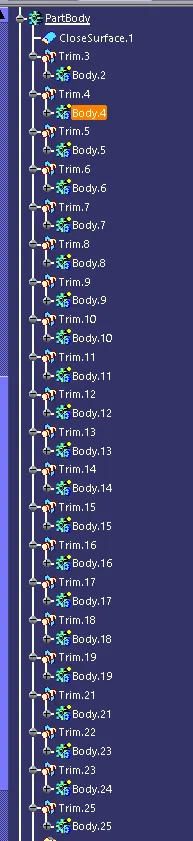
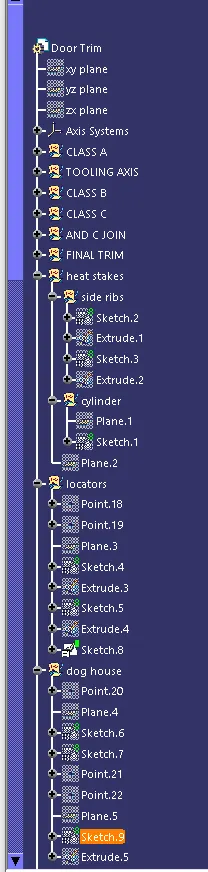
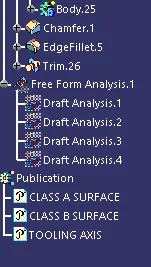
TREE STRUCTURE:
CONCLUSION:
Create the Door Trim Lower Plastic component through the given Class-A surface. To begin with, the tooling axis for the given Class-A Surface should be created meeting the requirements of the draft angle and at the end perform the Draft analysis on the model.
Create the Heat Stakes and the locators considering the design rules mentioned in the video for the door applique is done.