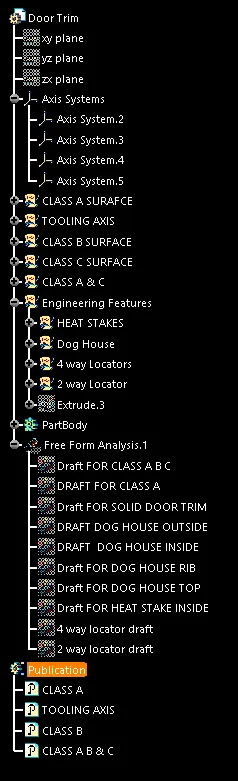
Week 9 - Project 1 - Door Trim Lower with Engineering Features
Aim:
To Create the door trim component through the given Class-A surface. To begin with, the tooling axis for the given Class-A Surface should be created meeting the requirements of the draft angle and at the end perform the Draft analysis on the model.
Objective :
- To design door trim as per automotive OEM Standard.
- Create B Class and C Class and tooling axis.
- Converting close surface into the solid inside part workbench and provide the thickness of 2.5mm.
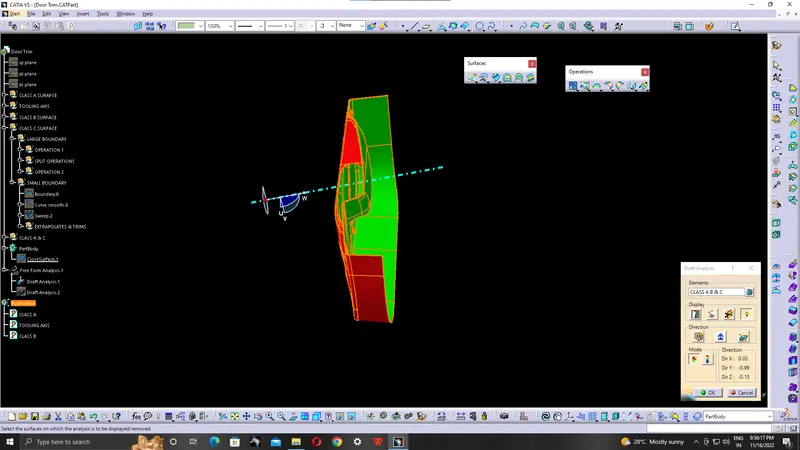
- Performing draft analysis to verify the creation of the Tooling axis and C Class surface.
- Creating Engineering Features.
Operations :
- Creating tooling axis.
- Create draft analysis
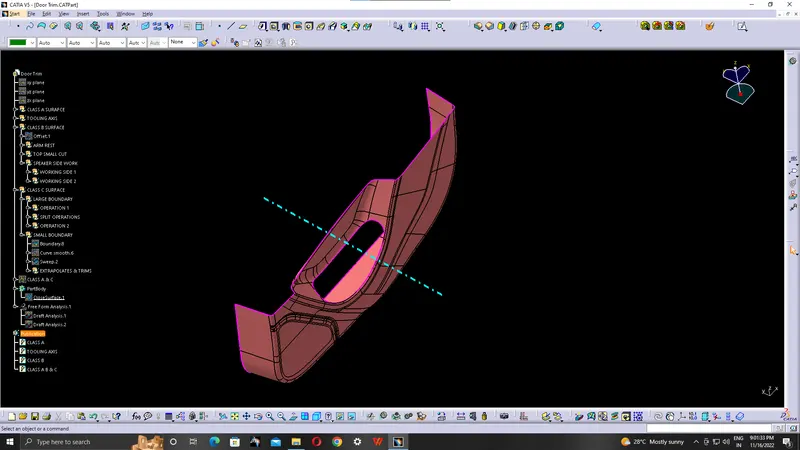
- Creating Class B surface.
- Creating Class C surface.
- Final product using closed surface.
- To create heat stakes, locators and dog house.
MATERIAL USED :
Acrylonitrile butadiene styrene(ABS)
Door trim is manufactured in plastic materials such as ABS. ABS plastic remains hard, rigid and tough even at low temperatures. It is available in fire-retardant, heat-resistant and platable grades. It is found inside the car.
Tooling Axis:
Tooling Axis is created on the surface along which a point is created on the centre of the surface and a line is extruded along the y is which is normal to the surface. The tooling axis determines the direction of the core and cavity moves.
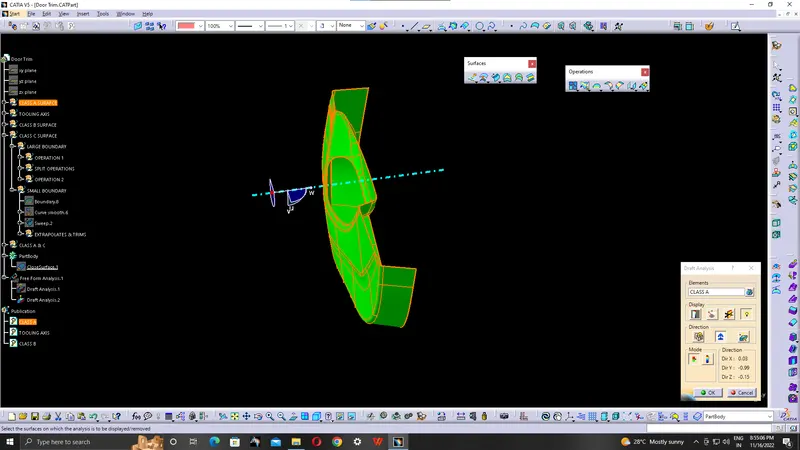
Draft analysis:
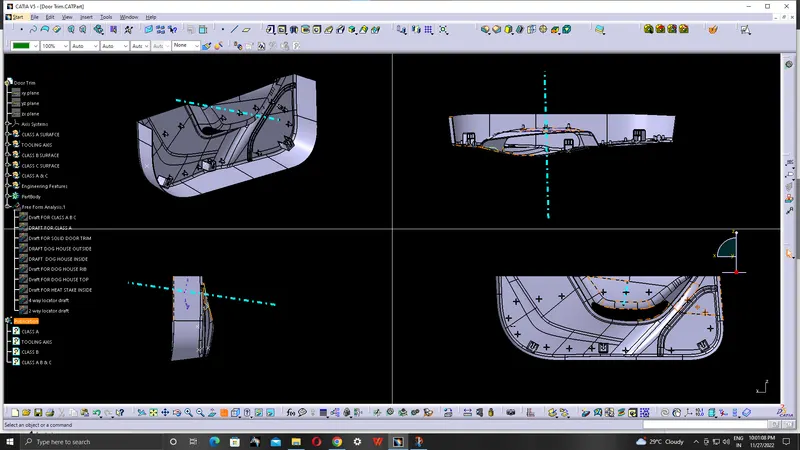
Draft analysis is a angular tapering given at the design stage to every plastic component that has to be manufactured. For this design we have given the draft angle of 2.9degee which is widely accepted for cost saving purpose.
Final Draft:
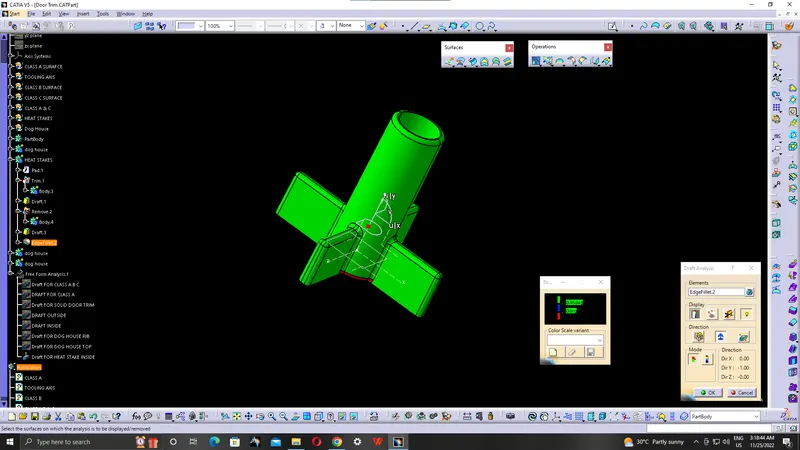
Draft analysis for Heat stakes:
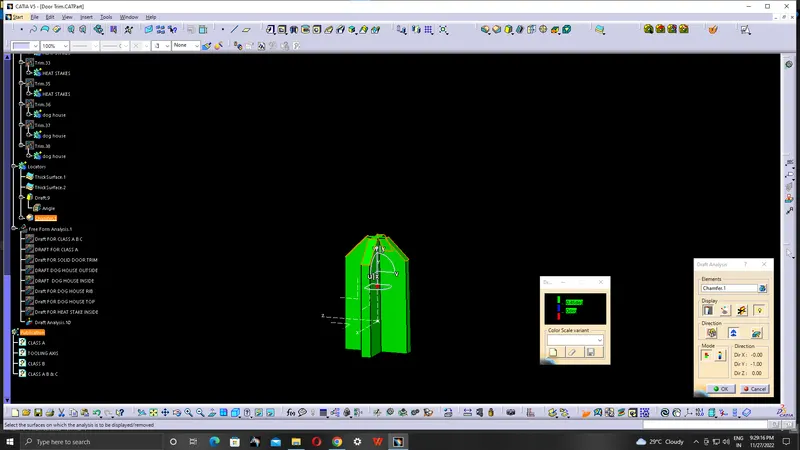
Draft Analysis for Locators:
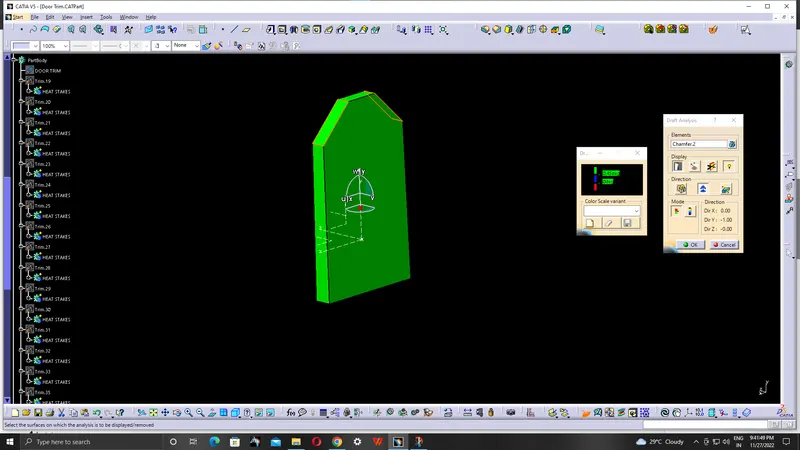
4 way locator
2 way locator
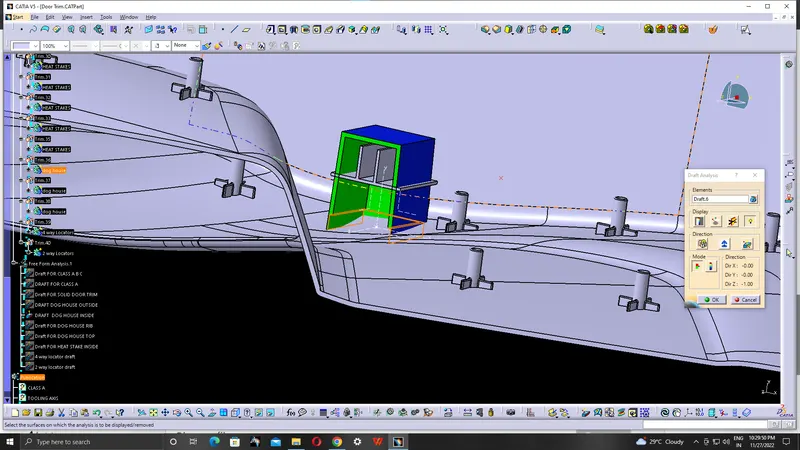
Draft analysis for dog house:
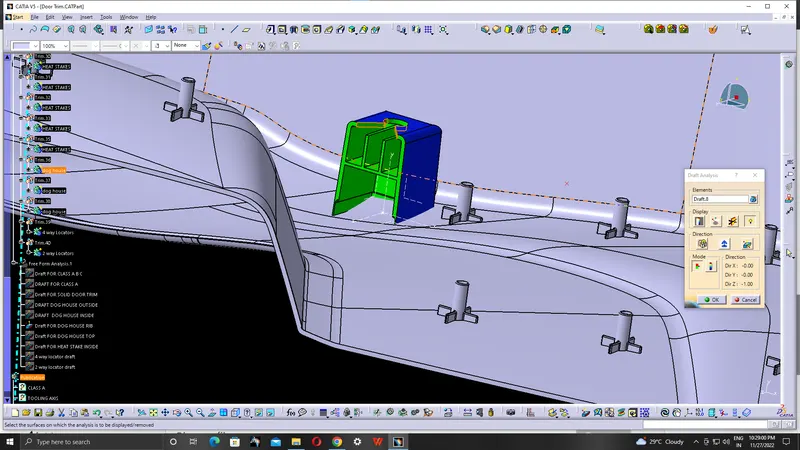
Class A surface:
Class A surface is a any set of freefrom surface of high efficiency and quality. It is the aesthetic surface pf any automotive component. class A surface is visible to eye .It is given as input to design the Class B&C surfaces.
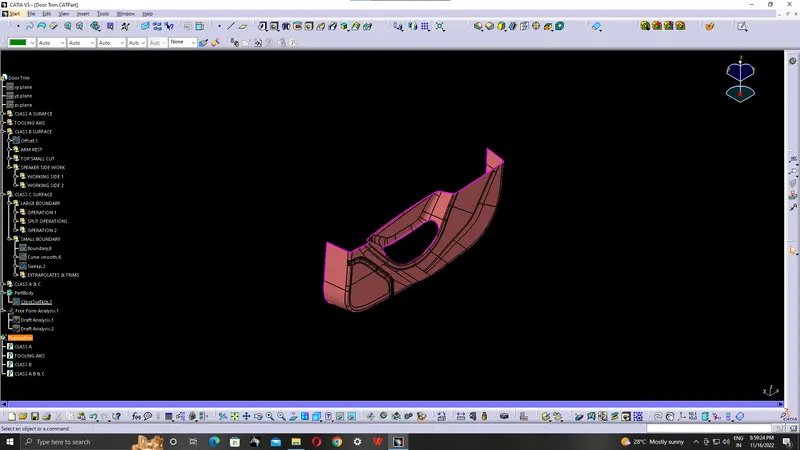
Class B surface:
Class B surface is invisible to the eyes or it is often found in back side of the Class A surface. It is mainley the thickness of the component and the thickness of the component is 2.5mm thickness.
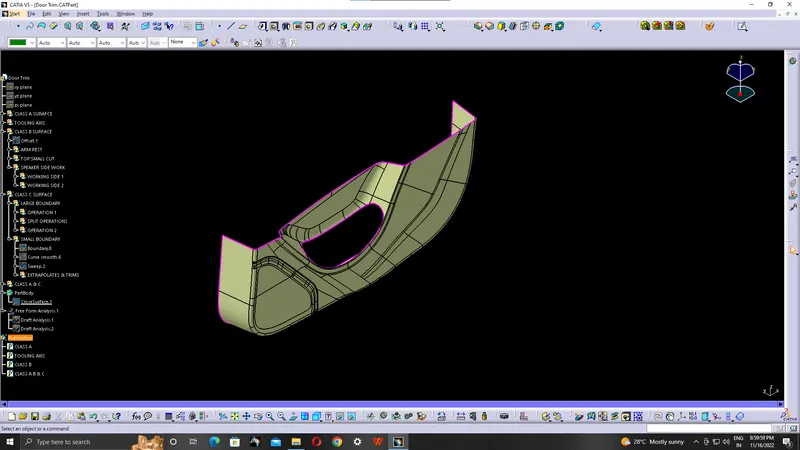
Class C surface:
Class C surface connects the surface between Class A and B surface. This surface connects both A & B surfaces along the tooling axis. It is the thickness of the Class A&B surface.
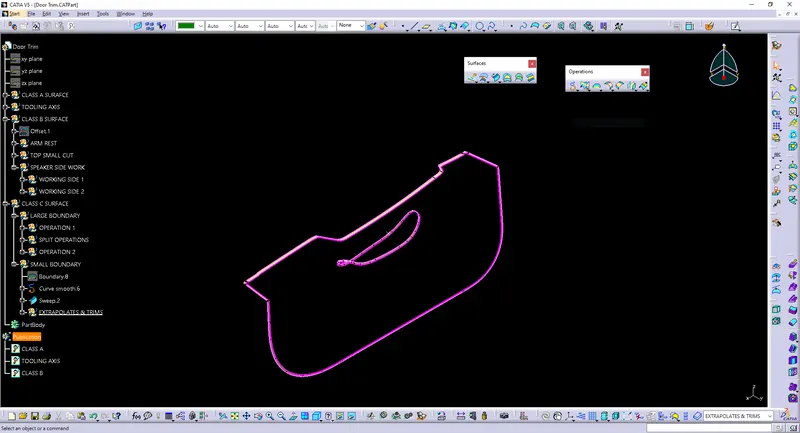
Final Product:
Final Product includes the finished surface of class A & B and C.
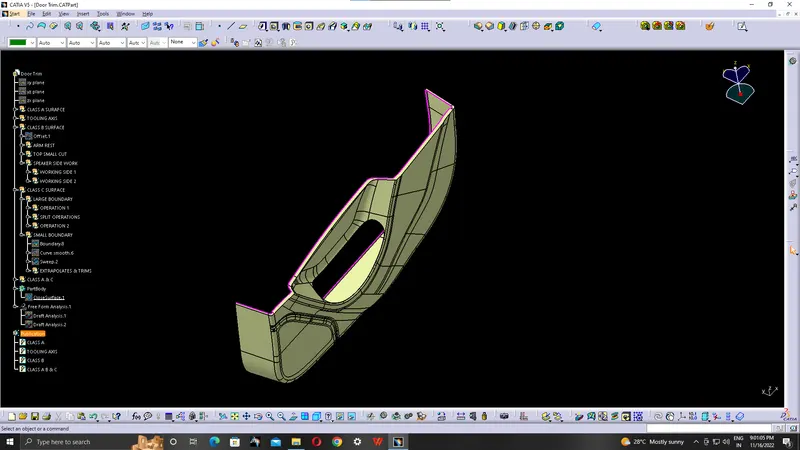
Engineering Features
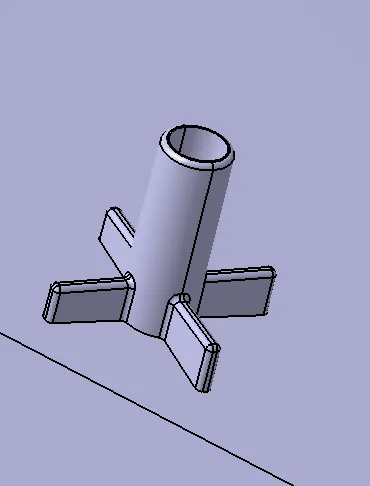
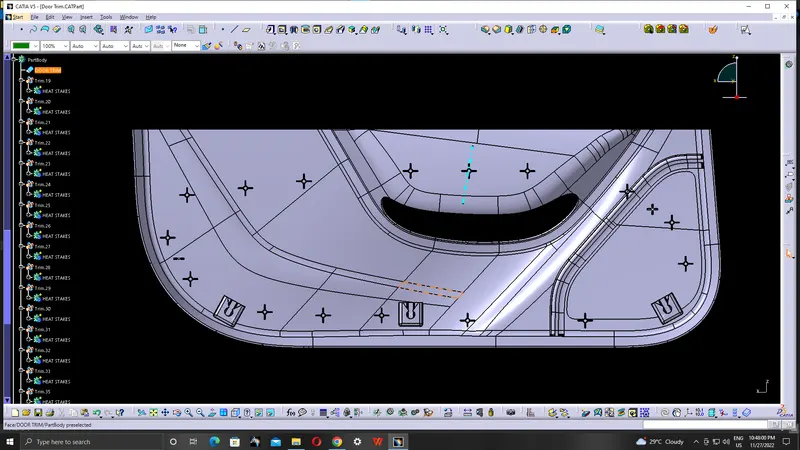
Heat Stakes:
Heat staking also known as thermoplastic staking is the process of joining two dissimilar materials together. In heat staking we use local heating and cooling to raise the temperature of plastic components and allow plastic reforming to be carried out.
Heat staking Benefits:
- Similar and dissimilar materials may be joined: metal to metal, plastic to plastic, metal to plastic
- Accurate control operating within a small process window
- Local heating resulting in no damage to surrounding materials
- Processing of glass-filled materials
- No mechanical vibration
- Many heat-stake shapes possible through custom designed tools
3-2-1 Principle:
Locating Process: In order to completely specify the position in space of a three-dimensional object (such as the cube that’s shown), we refer to six coordinates with total 12 degrees of freedom.
- Translational position along the X-axis
- Translational position along the Y-axis
- Translational position along the Z-axis
- Rotational position about the X-axis
- Rotational position about the Y-axis
- Rotational position about the Z-axis
These six coordinates are known as the six degrees of freedom of a three-dimensional object. As the double-headed arrows indicate, the translational and rotational positions can vary in either direction with respect to each of the three axes. To completely prevent movement, all six degrees of freedom must be restricted.
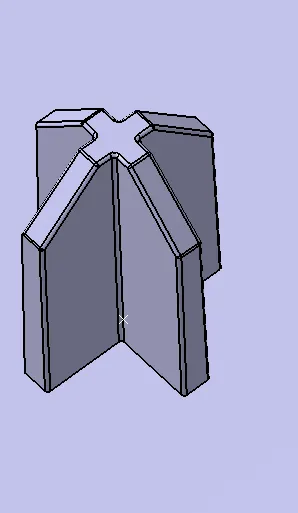
4-Way Locators:
These are the locators which arrests the 4 degrees of freedom by four ribs junctional together. These are of following type especially used for mold designs.
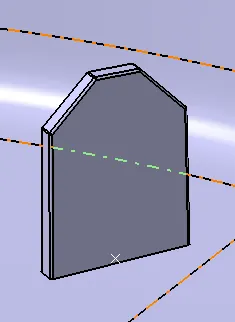
2-Way Locators:
These are the locators which arrests 2 degrees of freedom by a single rib.
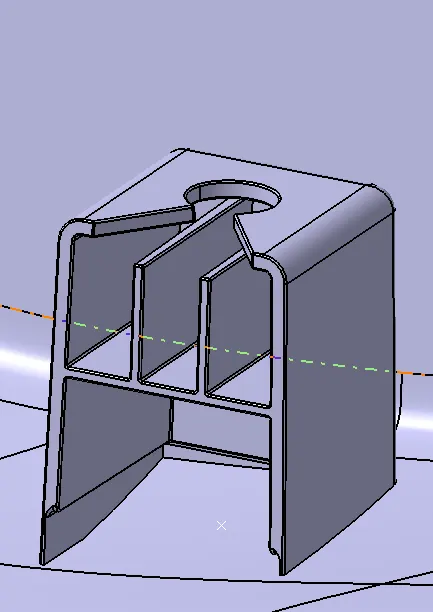
Dog House:
Dog house is a feature used as supporting featrue in the plastic trim.It is used to avoid sink mark.
Guidelines to create dog house:
- width of the dog house -(25-35mm).
- height of the dog house -(45-60mm).
- outer draft -(>0.3 deg), nominal =1.5 deg.
- inner draft -(>0.1 deg), nominal =0.5 deg.
- Thickness -Nominal wall thickness.
- Height of the sink mark cut-(3-6mm).
- Fillet can be according to then drawing.
- Length of one dog house to anotherdog house is (w x 3).
Closed surface:
Closed surface is the finished product using part body design with closed body surface command.
Tree Structure: