Week 8 - Challenge 4 - Bumper
Aim:
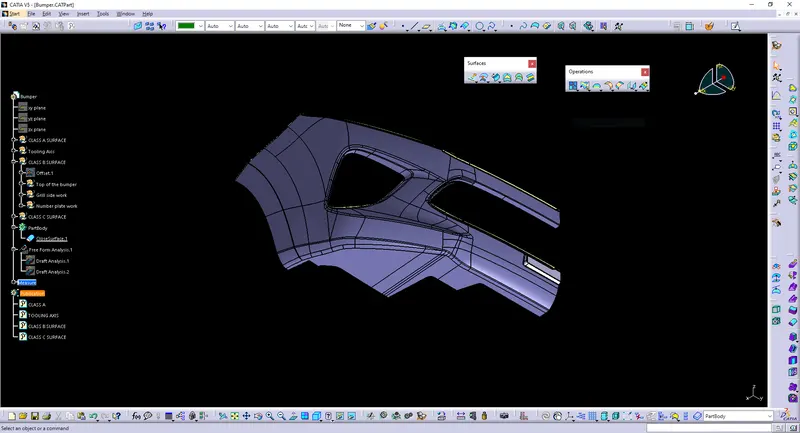
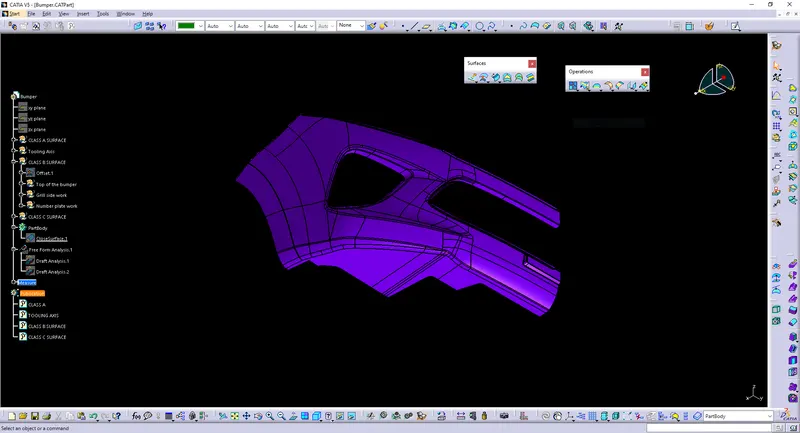
Create the bumper component through the given Class-A surface. To begin with, the tooling axis for the given Class-A Surface should be created meeting the requirements of the draft angle and at the end perform the Draft analysis on the model.
Objective :
- To design switch bezel as per automotive OEM Standard.
- Create B Class and C Class and tooling axis.
- Converting close surface into the solid inside part workbench and provide the thickness of 3mm.
- Performing draft analysis to verify the creation of the Tooling axis and C Class surface.
Operations :
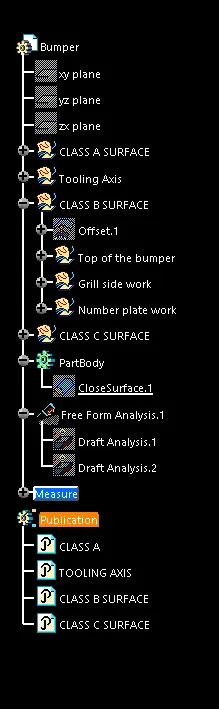
- Creating tooling axis.
- Create draft analysis
- Creating Class B surface.
- Creating Class C surface.
- Final product using closed surface.
MATERIAL USED :
Acrylonitrile butadiene styrene(ABS)
Bumper is manufactured in plastic materials such as ABS. ABS plastic remains hard, rigid and tough even at low temperatures. It is available in fire-retardant, heat-resistant and platable grades. It is founf in the front of the car.
Tooling Axis:
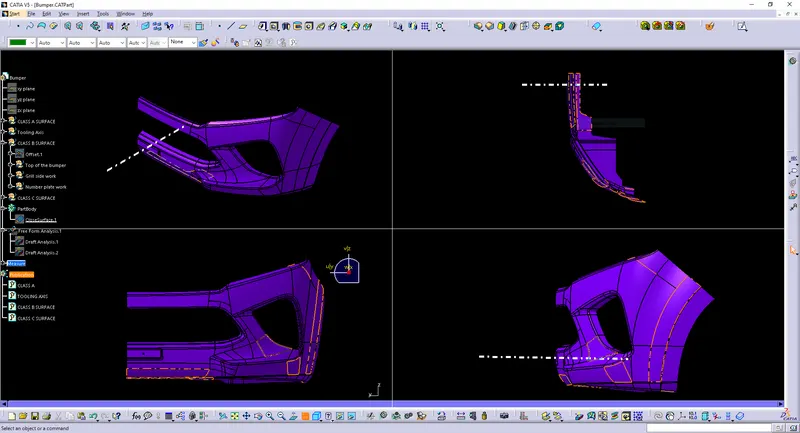
Tooling Axis is created on the surface along which a point is created on the centre of the surface and a line is extruded along the z is which is normal to the surface. The tooling axis determines the direction of the core and cavity moves.
Draft analysis:
Draft analysis is a angular tapering given at the design stage to every plastic component that has to be manufactured. For this design we have given the draft angle of 2.9degee which is widely accepted for cost saving purpose.
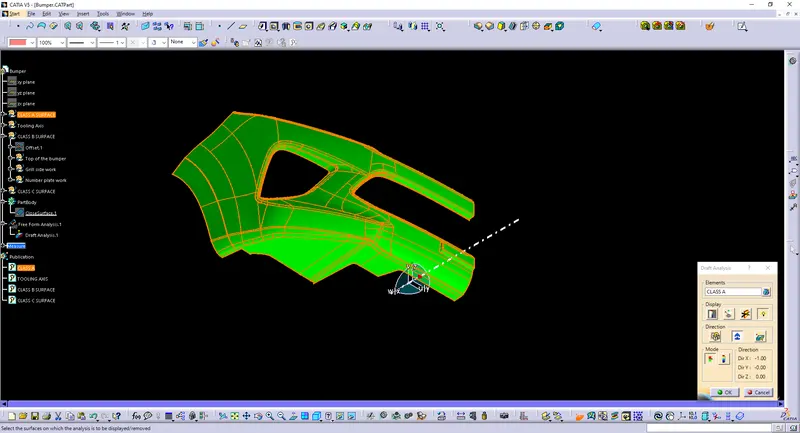
Final Draft:
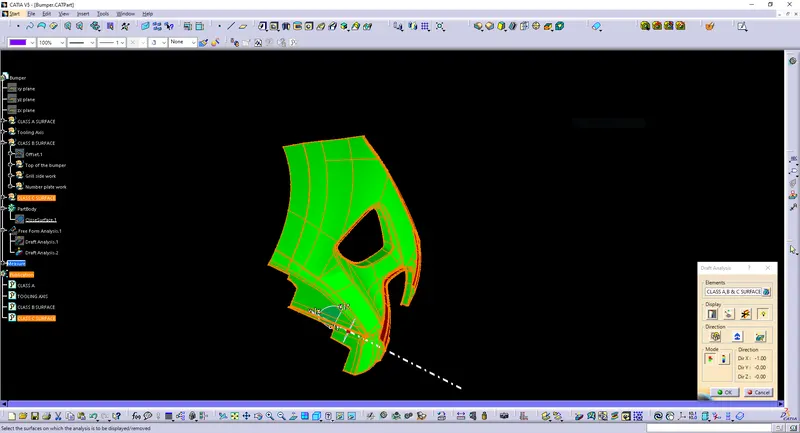
Class A surface:
Class A surface is a any set of freefrom surface of high efficiency and quality. It is the aesthetic surface pf any automotive component. class A surface is visible to eye .It is given as input to design the Class B&C surfaces.
Class B surface:
Class B surface is invisible to the eyes or it is often found in back side of the Class A surface. It is mainley the thickness of the component and the thickness of the component is 3mm thickness.
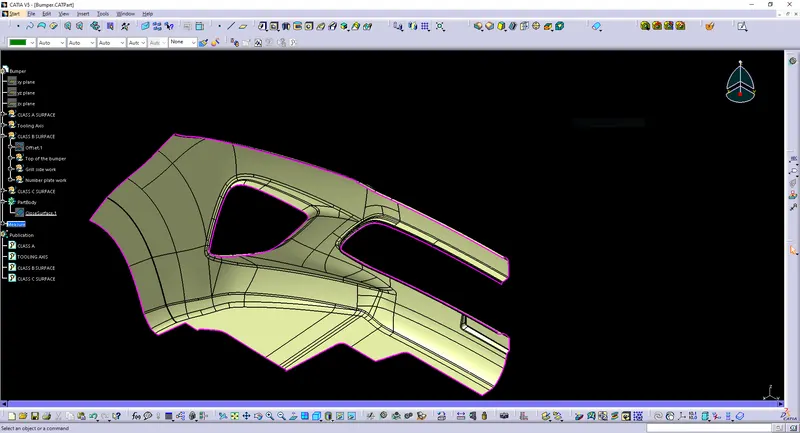
Class C surface:
Class C surface connects the surface between Class A and B surface. This surface connects both A & B surfaces along the tooling axis. It is the thickness of the Class A&B surface.
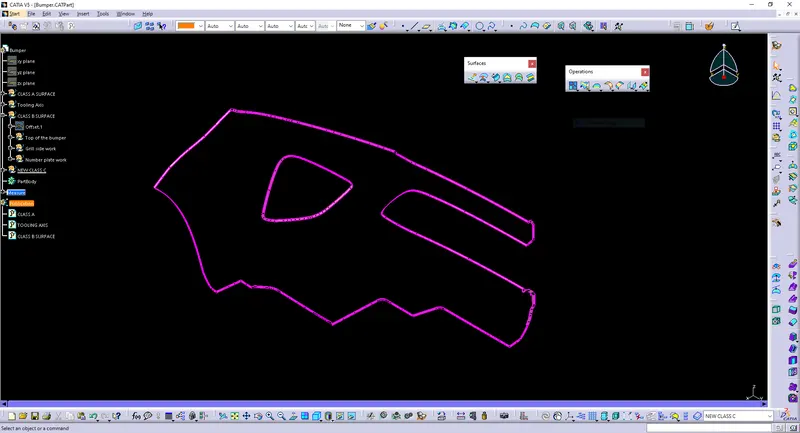
Final Product:
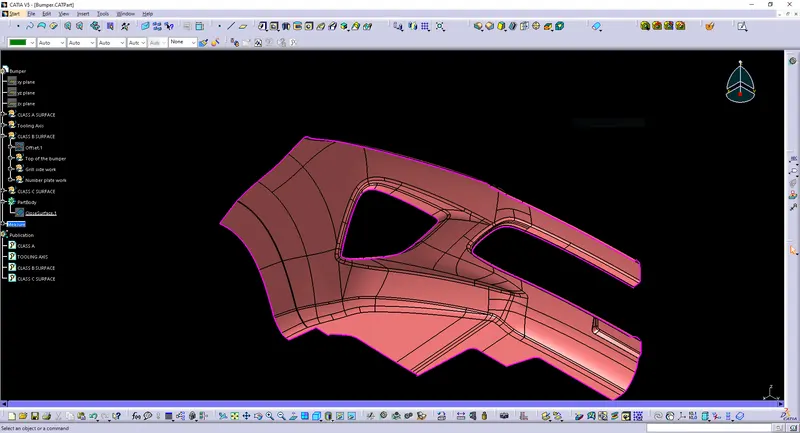
Final Product includes the finished surface of class A & B and C.
Closed surface:
Closed surface is the finished product using part body design with closed body surface command.