Week 9 - FVM Literature Review
Aim: our aim is to describe the fallowing methods
- What is Finite Volume Method(FVM)
- write down the major differences between FDM & FVM
- describe the need for interpolation schemes and flux limiters in FVM
- we have to solve this by using 1D linear heat conduction equation as an example.
Answer:
1) in cfd we have 3 deffrening methods to sove the governing equation of navier stoke equations
they are:
- finate diffrencing method
- finate valume method
- finate elemental method
Finate deffrencing method:Finite volume method (FVM), like FEM, is based on an unstructured (e.g. triangular) mesh. Therefore, it is suitable for irregular and complex geometries.
steps invalving in solving the finate diffrence methode are:
- once we have the integral part of the quation
- we can apply guass divergence theorem on it to solve
- then after apply guass divergence theorem we will get the discritized form of the equation then we can solve it by using the computer code
consider an 1D heat conduction equation as shown below
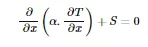
where S is the source term
t is the tempreture and
alpha is the thermal diffuser
the above shown governing equation is valid on each and very point of the domain
as the above equation is same on every point in the given domain so we are considering bthe small elemental area in the domain and integrating the above equation for that point so we will get the solution for our whole domain.
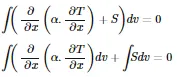
in above equation we have multiplyed the equation by dv and dv is nothing but the area of the domain
i.e dv=a*dx
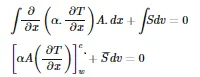
i the above equation we have taken S as Sbar which is nothing but the source term
now we have to solve the above equation by using the taylers series


in above equation we can say that
heat flux(in)- heat flux(out)+source term = 0
hence we call the finate valume method as conserved method.
Finate deffrencing method: this is method where we can apply it on the grid ponts which are assigned in straight line
Finate elemental method :The finite element method (FEM) is a numerical technique used to perform finite element analysis of any given physical phenomenon.
2) majar diffrence between finate diffrence method and finate valume method
- finate valume method can be applaid on the complex structure and moving parts where finate valume method is applaid only on grids points arrenged on straight line
- finate valume method give more flexibility then finate deffrencing method
- In the FVM, the discretization process is carried out directly in the physical domain without any transformation between the computational and physical coordinate systems
- FDM use partial differential equations, FVM is discretization Technique.
3) Interpoletion scheme:Interpolation is a method of deriving a simple function from the given discrete data set such that the function passes through the provided data points. This helps to determine the data points in between the given data ones. This method is always needed to compute the value of a function for an intermediate value of the independent function. In short, interpolation is a process of determining the unknown values that lie in between the known data points. It is mostly used to predict the unknown values for any geographical related data points such as noise level, rainfall, elevation, and so on.
-
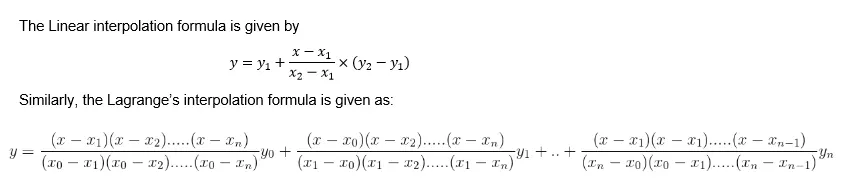
Interpolation Formula
The unknown value on the data points can be found using the linear interpolation and Lagrange’s interpolation formula.
-
Interpolation Methods
There are different types of interpolation methods. They are:
Linear Interpolation Method – This method applies a distinct linear polynomial between each pair of data points for curves, or within the sets of three points for surfaces.
Nearest Neighbour Method – This method inserts the value of an interpolated point to the value of the most adjacent data point. Therefore, this method does not produce any new data points.
Cubic Spline Interpolation Method – This method fits a different cubic polynomial between each pair of data points for curves, or between sets of three points for surfaces.
Shape-Preservation Method – This method is also known as Piecewise Cubic Hermite Interpolation (PCHIP). It preserves the monotonicity and the shape of the data. It is for curves only.
Thin-plate Spline Method – This method consists of smooth surfaces that also extrapolate well. It is only for surfaces only
Biharmonic Interpolation Method – This method is applied to the surfaces only.
Flux limiters:Flux limiters are used in numerical schemes used to solve problems in science and engineering, particularly fluid dynamics, described by partial differential equations (PDEs). They are used in high resolution schemes, such as the MUSCL scheme, to avoid the spurious oscillations (wiggles) that would otherwise occur with high order spatial discretization schemes due to shocks, discontinuities or sharp changes in the solution domain. Use of flux limiters, together with an appropriate high resolution scheme, make the solutions total variation diminishing (TVD).