Week 9 - FVM Literature Review
Week 9 - FVM Literature Review
Question: What is Finite Volume Method(FVM), write down the major differences between FDM & FVM. Also, describe the need for interpolation schemes and flux limiters in FVM. You can use the 1D linear heat conduction equation as an example.
Answer:
What is FVM ?
FVM which is commonly known as Finite Volume method is an discritization method used to approximate a single or a system of partial differential equations. It is based on an intergral form of the PDE to be solved.
In this method, the domain is discritized into finite volume.
Then the governing equation is solved for each volume.
The resuliting system of equations usually involve fluxes of the conserved variable, and thus the calculation of fluxes is very important in FVM.
| Finite Difference Method | Finite Volume Method |
| It is easy to code. | Coding is relatively difficult |
| It is very hard to discritize a complex geometry. | It is relatively easier to discritize. |
| In FDM, the dependant variable value are stored in the nodes. | In FVM, the dependant variable value is stored in the center of Finite Volume. |
| Not true in this method. | Conservation of mass, energy & momuntum on every finite volume. |
Steps:
1. Get the governing eauation in intergral form
2. Apply Gauss divergence therorem
3. A discretized form which can be solved to find the flux terms.
As mentioned in the questions, let's take a 1D steady state heat conduction equation.
`(del)/(del x)(alpha.(delt)/(delx)) +S = 0`
This governing equation is valid in every point in the control volume.
alpha = thermal diffusivity
S= Source term
`(delt)/(delx)` = temperature gradient along x-axis.
What are interpolation schemes ?
Interpolation schemes are used to transform cell - centre quantites to face centres.The interpolation schemes are specified in the fvSchemes file under the interpolationSchemes directory.
`phi N` - Neighbouring cell centroid
`phi O` - Owner cell centroid
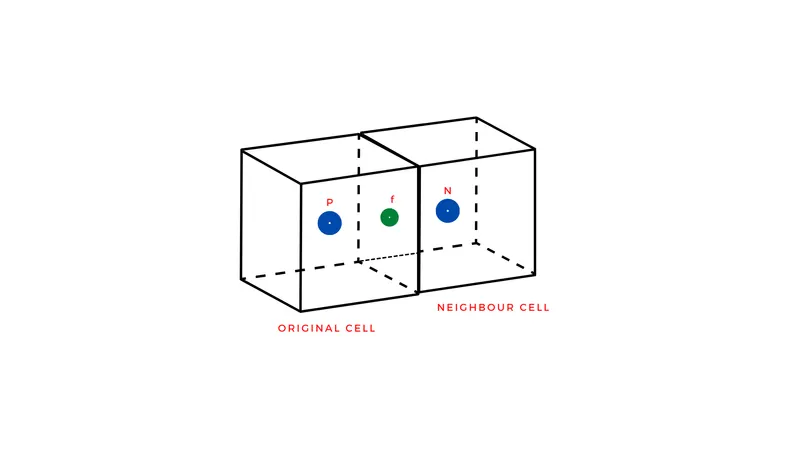
1. Upwind interpolation scheme:
Upwind differencing depends on the mass flux.
The value of `phi` on the cell face is given by :
`phi`= `{(underset(p)(phi) if underset(f)(F) >0 ),(underset(phi)(n) if underset(f)(F)<0 ):}`
It is mostly used when the velocity is high & when the diffusion is low.
2. Linear/central differencing interpolation scheme:
This scheme says that the `phi P` & `phi O` are linearly related and it linearly interpolates in order to find the face point.
It is mostly used when the diffusion is high.
3. Quadratic upwind interpolation scheme:
It is third order accurate, but is prone to ossicillations and is derived from polynomial fittings.
What are flux limiters ?
They operate functionally as a switch and tune the numerical fluxes obtained from lower order schenems and higher order schemes such that a lower order scheme is employes near the discontinuity and a higer order(accurate) scheme away from it.