Week 5.1 - Mid term project - Solving the steady and unsteady 2D heat conduction problem
Solving the steady and unsteady 2D heat conduction problem
Objective:
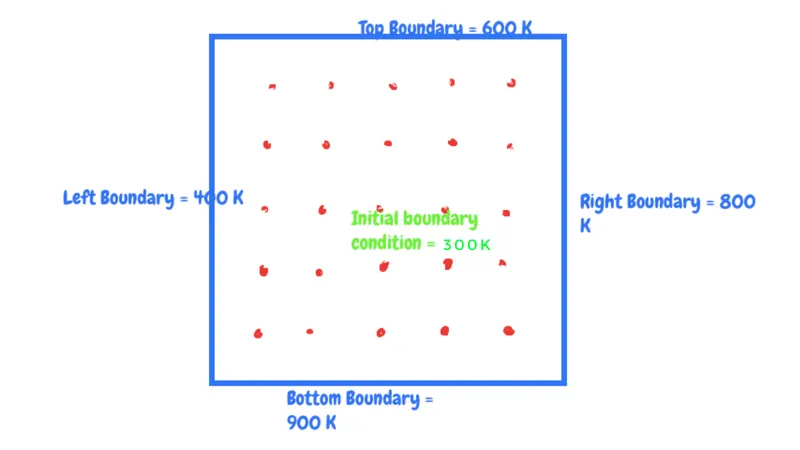
Solve the 2D heat conduction equation by using the point iterative techniques that were taught in the class. The Boundary conditions for the problem are as follows;
Top Boundary = 600 K
Bottom Boundary = 900 K
Left Boundary = 400 K
Right Boundary = 800 K
1. Jacobi
2. Gauss-seidel
3. Successive over-relaxation
Your absolute error criteria is 1e-4
Explaination:
Steady state analysis:
`(delx^2)/(delt^2)+(dely^2)/(delt^2)`
Unsteady state/ Transient State Analysis:
Initial value for inbetween nodes
Initial value for inbetween nodes= 675K
Inputs:
Top Boundary = 600 K
Bottom Boundary = 900 K
Left Boundary = 400 K
Right Boundary = 800 K
Source code:
Steady state:
`(del^2T)/(del x^2) +(del^2T)/(del y^2) = 0`
% Code to solve a second order 2 D PDE
% d^u/dx^2 = 0

% boundary conditions:
% x=0 u=5
%y=0 u=8

clear all
close all
clc

% inputs

nx = 10 % number of grid points along x axis
ny = 10 % number of grid points along y axis

t=ones(nx)*300
t(:,1) = 400; % Boundary condition - Left
t(:,ny) = 800; % Boundary condition - Right
t(1,:) = 600; % Boundary condition - Top
t(nx,:) = 900; % Boundary condition - Bottom

t(1,1)= 500
t(1,ny)= 650
t(nx,1)= 700
t(nx,ny)= 850

error= 9e+9 % random value higher than the tolerance
tol=1e-4; % Tolerance limit
omega = 1.2; %SOR omega value
iterative_solver = 1;

% Creating a copy
told=t;
t_initial= t;

x=linspace(0,1,nx);
y=linspace(0,1,ny);

dx= x(2)-x(1);
dy= y(2)-y(1);

k=0.25
%-----------------------------------------------------------------------
% Jacobi method
if iterative_solver==1
    jacobi_counter =1;
    while(error> tol)
        for i= 2:nx-1 % Space loop along x axis
            for j= 2:ny-1 % Space loop along y axis

            t(i,j)=k*(told(i-1,j)+told(i+1,j)+told(i,j-1)+told(i,j+1));

            end
        end
        error = max(max(abs(told-t)));
        told=t; % Updating values
        jacobi_counter =jacobi_counter+1;
    end

    contourf(t)
        xlabel('X axis')
        ylabel('U')
        colorbar
        title_text = sprintf('Iteration number = %d',jacobi_counter);
        title(title_text)
        pause(0.03)
end

%-----------------------------------------------------------------------

% GS method

if iterative_solver==2
    gs_counter =1;
    while(error> tol)
        for i= 2:nx-1 % Space loop along x axis
            for j= 2:ny-1 % Space loop along y axis

            t(i,j)=k*(t(i-1,j)+told(i+1,j)+t(i,j-1)+told(i,j+1));

            end
        end
        error = max(max(abs(told-t)));
        told=t; % Updating values
        gs_counter =gs_counter+1;
    end

    contourf(t)
        xlabel('X axis')
        ylabel('U')
        title_text = sprintf('Iteration number = %d',gs_counter);
        title(title_text)
        pause(0.03)
end

%-----------------------------------------------------------------------
% SOR-GS method
if iterative_solver==3
    sor_counter =1;
    while(error> tol)
        for i= 2:nx-1 % Space loop along x axis
            for j= 2:ny-1 % Space loop along y axis

            t_gs=k*(t(i-1,j)+told(i+1,j)+t(i,j-1)+told(i,j+1));

            t(i,j)=omega*t_gs+(1-omega)*told(i,j);

            end
        end
        error = max(max(abs(told-t)));
        told=t; % Updating values
        sor_counter =sor_counter+1;
    end

    contourf(t)
        xlabel('X axis')
        ylabel('U')
        title_text = sprintf('Iteration number = %d',sor_counter);
        title(title_text)
        pause(0.03)
end

%-----------------------------------------------------------------------
Changing the iterative_solver value will change the method.
1 - Jacobi
2 - Gauss Seidal
3 - SOR - Gauss Seidal
Output:
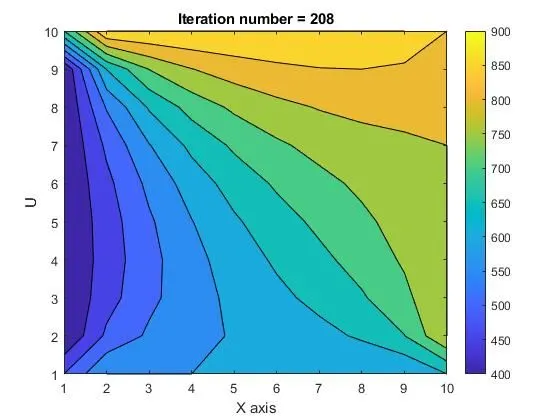
Jacobi
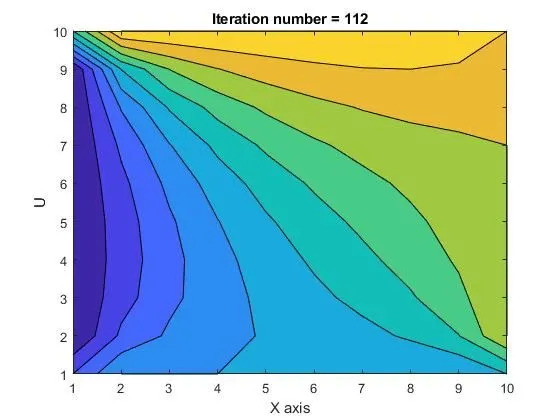
Gauss Seidal:
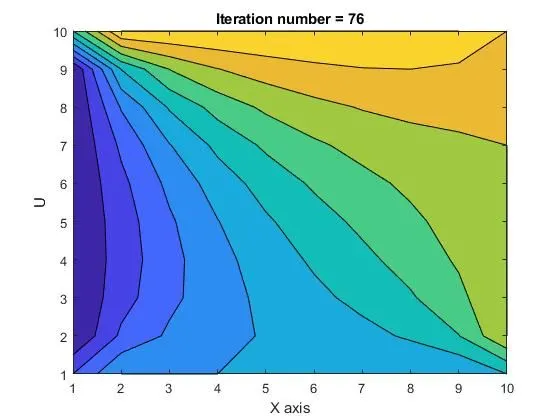
SOR - Gauss Seidal:
Transient State:
`(del^2T)/(del t^2)= alpha((del^2T)/(del x^2) +(del^2T)/(del y^2) )`
`(T^(n+1) -T^(n))/(del t) = alpha((T - 2`(T^(n+1) ) = T^(n)+(del t)*alpha((T - 2T+T)/(deltax^2)+(T-2T+T)/(deltay^2))`T+T)/(deltax^2)+(T-2T+T)/(deltay^2))`
`(T^(n+1) ) = T^(n)+K1((T - 2T+T))+K2((T-2T+T))`
`K1= (alpha*delta t)/(deltax^2)`
`K2= (alpha*delta t)/(deltay^2)`
Source code:
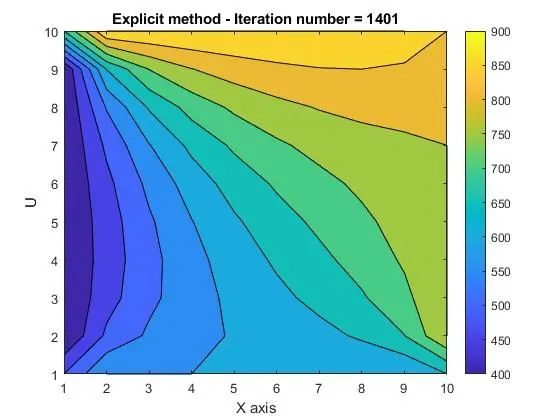
Explicit method:
% Code to solve a second order 2 D PDE - Explicit method
% d^u/dx^2 = 0

% boundary conditions:
% x=0 u=5
%y=0 u=8

clear all
close all
clc

% inputs
nx = 10 % number of grid points along x axis
ny = 10 % number of grid points along y axis

T=ones(nx)*300
T(:,1) = 400; % Boundary condition - Left
T(:,ny) = 800; % Boundary condition - Right
T(1,:) = 600; % Boundary condition - Top
T(nx,:) = 900; % Boundary condition - Bottom

T(1,1)= 500
T(1,ny)= 650
T(nx,1)= 700
T(nx,ny)= 850

error= 9e+9 % random value higher than the tolerance
dt=1e-3

nt=1400
alpha = 1.4;
iterative_solver = 1;
% If iterative_solver = 1 ,then Explicit method
% If iterative_solver = 2,then Implicit Gauss Seidal method
% If iterative_solver = 3,then Implicit Jacobi method
% If iterative_solver = 4,then Implicit SOR

% Creating a copy
Told=T;
T_initial= T;

x=linspace(0,1,nx);
y=linspace(0,1,ny);

dx= x(2)-x(1);
dy= y(2)-y(1);

K1= (alpha*dt)/(dx^2)
K2= (alpha*dt)/(dy^2)
cfl = K1+K2;
%--------------------------------------------------------------------------

%Explicit method
if iterative_solver==1
    counter =1;
    for v=1:nt
        for i=2:(nx-1)
            for j=2:ny-1
                term1=Told(i,j);
                term2=K1*(Told(i+1,j)-2*Told(i,j)+Told(i-1,j));
                term3=K2*(Told(i,j+1)-2*Told(i,j)+Told(i,j-1));
                T(i,j)=term1+term2+term3;
            end
        end
        error = max(max(abs(Told-T)));
        Told=T; % Updating values
        counter =counter+1;
    end
    contourf(T)
    xlabel('X axis')
    ylabel('U')
    colorbar
    title_text = sprintf('Explicit method - Iteration number = %d',counter);
    title(title_text)
    pause(0.03)
end

%-----------------------------------------------------------------------
Implicit method:
% Code to solve a second order 2 D PDE
% d^u/dx^2 = 0

% boundary conditions:
% x=0 u=5
%y=0 u=8

clear all
close all
clc

% inputs
nx = 10 % number of grid points along x axis
ny = 10 % number of grid points along y axis

T=ones(nx)*300
T(:,1) = 400; % Boundary condition - Left
T(:,ny) = 800; % Boundary condition - Right
T(1,:) = 600; % Boundary condition - Top
T(nx,:) = 900; % Boundary condition - Bottom

T(1,1)= 500
T(1,ny)= 650
T(nx,1)= 700
T(nx,ny)= 850

error= 9e+9 % random value higher than the tolerance
dt=1/50

nt=800
tol=1e-4; % Tolerance limit
alpha = 1.4;
omega = 1.4 % SOR
iterative_solver = 4;
% If iterative_solver = 2,then Implicit Gauss Seidal method
% If iterative_solver = 3,then Implicit Jacobi method
% If iterative_solver = 4,then Implicit SOR

% Creating a copy
Told=T;
T_initial= T;

x=linspace(0,1,nx);
y=linspace(0,1,ny);

dx= x(2)-x(1);
dy= y(2)-y(1);

K1= (alpha*dt)/(dx^2)
K2= (alpha*dt)/(dy^2)
cfl = K1+K2;

%-----------------------------------------------------------------------

%Implicit GS method

if iterative_solver==2

    term1= (1+2*K1+2*K2)^(-1)
    term2= K1*term1;
    term3= K2*term1;

    counter =1;

    for v=1:nt
        error = 10;
        while(error> tol)
            for i= 2:nx-1 % Space loop along x axis
                for j= 2:ny-1 % Space loop along y axis

                    Hor=(T(i-1,j)+Told(i+1,j));
                    Ver=(T(i,j-1)+Told(i,j+1));
                    T(i,j)= (T_initial(i,j)*term1)+(Hor*term2)+(Ver*term3);

                end
            end
            error = max(max(abs(Told-T)));
            Told=T; % Updating values
            counter =counter+1;
        end
        T_initial=T;
    end
    contourf(T)
    xlabel('X axis')
    ylabel('U')
    title_text = sprintf('GS method - Iteration number = %d',counter);
    title(title_text)
    pause(0.03)
end

%-----------------------------------------------------------------------

%Implicit Jacobi method

if iterative_solver==3

    term1= (1+2*K1+2*K2)^(-1)
    term2= K1*term1;
    term3= K2*term1;

    counter =1;

    for v=1:nt
        error = 10;
        while(error> tol)
            for i= 2:nx-1 % Space loop along x axis
                for j= 2:ny-1 % Space loop along y axis

                    Hor=(Told(i-1,j)+Told(i+1,j));
                    Ver=(Told(i,j-1)+Told(i,j+1));
                    T(i,j)= (T_initial(i,j)*term1)+(Hor*term2)+(Ver*term3);

                end
            end
            error = max(max(abs(Told-T)));
            Told=T; % Updating values
            counter =counter+1;
        end
        T_initial=T;
    end
    contourf(T)
    xlabel('X axis')
    ylabel('U')
    title_text = sprintf('Jacobi method - Iteration number = %d',counter);
    title(title_text)
    pause(0.03)
end


%-----------------------------------------------------------------------

%Implicit SOR
if iterative_solver==4

    counter =1;

    for v=1:nt
        error=10;
        while(error> tol)
            for i= 2:nx-1 % Space loop along x axis
                for j= 2:ny-1 % Space loop along y axis


                    term1= (1+2*K1+2*K2)^(-1)
                    term2= K1*term1;
                    term3= K2*term1;

                    Hor=T(i-1,j)+Told(i+1,j);
                    Ver=T(i,j-1)+Told(i,j+1);

                    T(i,j)=(1-omega)*Told(i,j) + omega*(T_initial(i,j)*term1 +(Hor*term2)+(Ver*term3));

                end
            end
            error = max(max(abs(Told-T)));
            Told=T; % Updating values
            counter =counter+1;
        end
        T_initial=T
    end
    contourf(T);
    xlabel('X axis')
    ylabel('U')
    title_text = sprintf('Iteration number = %d',counter);
    title(title_text)
    pause(0.03)
end

%-----------------------------------------------------------------------
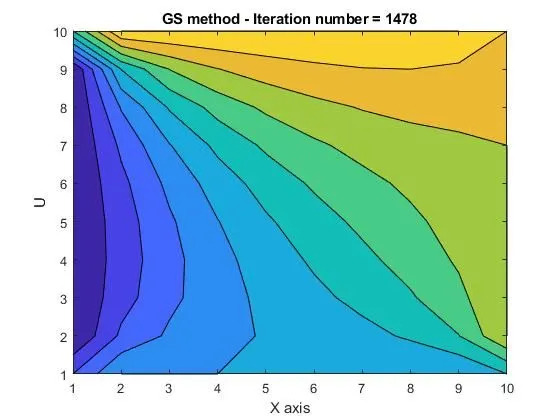
Gauss-Seidel Method:
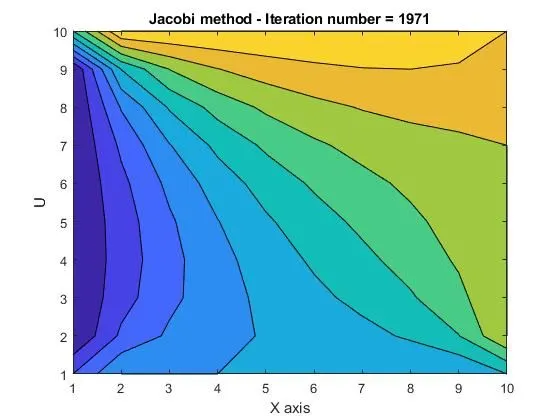
Jacobi method:
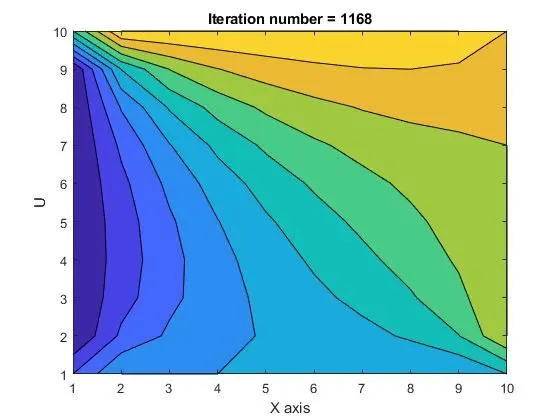
SOR:
Observations:
As we can see that the explicit method is much faster than the implicit method.
But from the results we can see that the implicit method is much accurate compared to the explicit method.
Reason:
In the implicit method, for each time step we make multiple iterations to get a the error lesser than the tolerance limit because the the RHS term values are not fully known.
In the explicit method, for each time step, it makes only one iteration because the RHS term values are already known.