Week 9 - FVM Literature Review
FINITE VOLUME METHOD:
It is a method for evaluating partial differential equations by representing them in the form of algebraic equations. In this method, divergence theorem is used to convert volume integrals in a partial difference equations that contain divergence term into surface integrals. These terms are evaluated as fluxes at the surface of each finite volume, as the flux entering the given volume is equal to the volume leaving the adjacent volume.
Finite volume refers to a small volume surrounding each node point on a mesh. Another added advantage of this method is, it is easily formulated to allow for unstructured meshes.
Example:
Considering 1D convection problem;
`(del rho )/( del t)+(del f)/(del x)=0`, where t≥0 ---Eqn (1)
`rho =rho(x,t)`Is the state variable
`f=f(rho(x,t))`Is the flux variable
For sign convention, +f represents the flow to the right, while –f represents the flow to the left, assuming the flowing medium through a constant area, we can sub divide the spatial domain into finite volumes or cells with centres (Say i), then the volume average value can be defined as in functions of x,t at time t1, and the same can be done for time t2, in which upstream and downstream faces are used in terms of x.
Equation 1 is integrated with time.
To obtain volume average at time t2, integration is done over the cell volume and the result is divided by `Delta x` (Differences between two faces of x)
We assume that f stays the same even if the order of integration is reversed, and also the flow is normal to the unit area of the cell.
Now divergence theorem can be applied by replacing the volume integrals with the surface integrals of the finite volume. Thus a semi-discrete numerical scheme with cell centres and edge fluxes is obtained by differentiating with time.
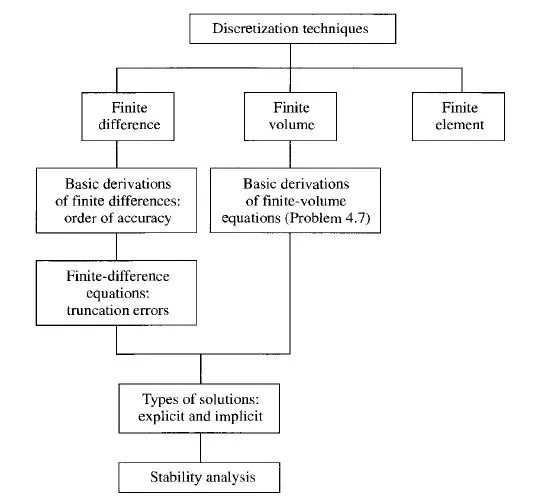
FINITE DIFFERENCE vs FINITE VOLUME METHODS:
Finite volume method evaluates exact expressions for the average value of the solution over some volume and uses this data to construct approximations of the solutions within the cells; whereas Finite Difference method approximates derivatives using nodal values.
Discretization of the partial differential equations is the finite differences while discretization of the integral form is called the finite volumes
FLUX LIMITERS:
Flux limiters are used in high resolution schemes to avoid spurious oscillations that would otherwise occur in high order spatial discretization schemes due to shocks, discontinues or sharp changes in the solution. Flux limiters along with high resolution schemes are used to make the solutions total variation diminishing (TVD)
In other words to take a higher order scheme and make it TVD is to multiply the selected elements of the difference equation involving flux terms with non-linear function and then find appropriate forms of these functions by forcing the difference equation to satisfy the TVD condition, these non-linear terms intend to limit the gradients by modifying the flux terms and is therefore known as flux limiters.
NEED FOR INTERPOLATION:
It is needed to compute the value of a function for an intermediate value of the independent variable. Simply, interpolation is used to estimate data points in between the given points, as in computation we often use discrete data points. It is also used to simplify complicated data functions by sampling data points and interpolating them using a simpler function.