Week 9 - FVM Literature Review
FINITE VOLUME METHOD:
It is one of the methods of solving partial differential equations by converting them into algebraic equations and then solving them using iterative solvers or the matrix inversion method, Volume integration of the partial differential equation is converted into surface integral using the gauss divergence theorem.
The resulting equations are solved for the flux terms. The flux entering through control volume is equal to the flux leaving the control volume. Hence the resulting solution is always conserved, Another advantage is that this method can be applied to an unstructred mesh.
For example, Solving for 1D linear heat conduction equation using Central Difference Scheme.
Governing equation for 1D linear heat conduction equation
d/dx(k dt/dx)=0
The volume considered is divided into 5 control volumes as shown in the figure
The Major difference between FVM and FDM are:
- Since the governing equations are conservative in nature, FVM solves the governing partial differential equations over the control volume using the gauss divergence theorem which results in conservative equations.
- Major advantage of the FVM is that it only needs to calculate the flux variables at the volume boundaries. This can be applied to all non-linear conservative governing equations. Hence this method is widely used in CFD applications.
- The accuracy of the finite volume method for the area of interest can be increased by using finer mesh in that area.
- It is difficult to obtain higher-order schemes in the finite volume method when compared to the finite difference method.
- The accuracy and stability of the solution in the finite difference method depend on the initial and boundary conditions.
Most of the flow problems in CFD consist of convection and diffusion terms in which a linear interpolation scheme that is a CDS cannot be used as it may give errors because of the presence of large oscillations if a finer mesh is not used. Because of this, there was a need to use other interpolation schemes. Irrespective of the differencing methods used numerical results obtained are close to the exact solution of the governing equation when the number of cells in large but are results of the discretization scheme will be physically realistic when it has certain fundamental properties, They are:
1.Conservativeness
The integration of the convection-diffusion equation over a finite number of control volumes results in discretized conservative equations involving fluxes. For the equations to be conserved the flux leaving the control volume face should be equal to flux entering the control volume face.
2.Boundedness
This property means that an increase in the flow variable at one node will result in an increase of the flow variables in the neighbouring nodes. If the discretization scheme not satisify the conditions for boundedness then the solution does not converge it contains wiggles.
The conditions for boundedness are:
a) All coefficients of the discretized equations should have the same sign(+ve)
b) The resulting matrix from the discretized should be diagonally dominant.
3.Transportiveness
It defines the relationship between the directionally of the influencing and the flow direction and magnitude of the peclet number.
Different differencing schemes:
1.Central Differencing Scheme(CDS):
The CDS uses consistent expressions to evaluate convective and diffusive fluxed at the control volume faces. Hence this is conserved. This scheme is not bounded as it voilates the boundedness conditions and leads to physically impossible solutions. Since the scheme uses neighbouring points to calculate the convective diffusive fluxes it does not recognize the direction of the flow.It does not possess the transportiveness.
2.Upwind Differencung Scheme:
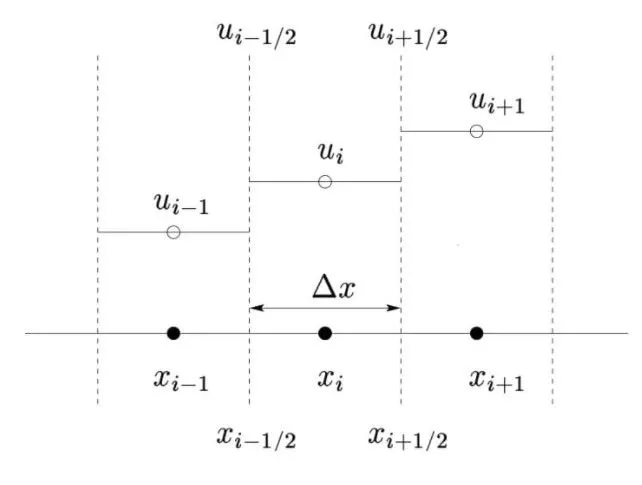
This scheme uses consistent expressions to calculate the fluxes through cell faces therefore it is conserved. The coefficients of the discretized equation are always positive and satisify the requirements for boundedness. This scheme accounts for the direction of the flow so it possesses transportiveness property.
3.Hybrid Differencing Scheme:
The hybrid differencing scheme is a mix of the upwind and CDS schemes. It switches to the upwind differencing schemes when the CDS produces inaccurate results. The scheme is fully conservative ans since the coefficient are always positive it is unconditionally bounded. It also satisifies the transportiveness by using an upwind differencing scheme.
FLUX LIMITERS:
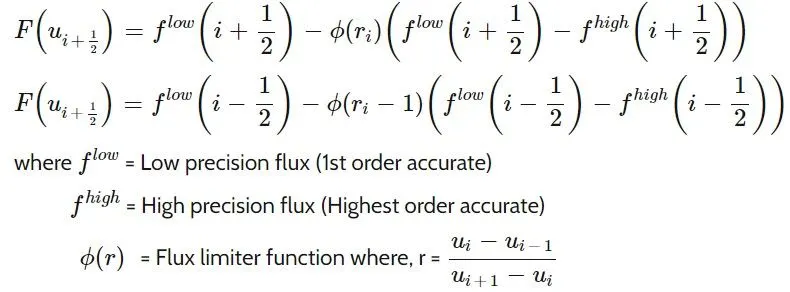
We have seen the behaviour of numerical schemes in order to caputre shocks and discontinuity that araises in hyperbolic equations. It has been observed that low-order schemes are usually stable but quite dissipative in nature around the points of discontinuity/shocks. On the other hand higher-order numerucal schemes are unstable in nature and show oscillations in the vicinity of discontinuity.
However, We cannot have higher order accuracy without oscillations. The objective is to have accurate and stable oscillation free schemes. This kind of schemes are known as high resolution schemes. To obtain such a scheme, the idea is to tune the numerical flux of high order and low order schemes using the flux limiter function in such a way that the resulting schemes gives a high order accuracy in the smooth region of flow and sticks with first order of accuracy in the vicinity of socks/discontinuities.
They operate functionally as a switch and tune the numerical fluxes obtained from lower order scheme and high order scheme such that near the discontinuity lower order scheme is employed and away fromit high order scheme is employed.
In order to prevent solution from unwanted oscillations and to preserve the accuracy, flux limiters are used.