Week 9 - Attachment Feature Creation (Ribs & Screw Boss) - Challenge 1
Design and Draft Analysis of Ribs & Screw boss
Introduction:
- The main goal of this project is to produce a plastic material for door trim components that complies with OEM standards utilizing the provided class A surface.
- Class A-surface Confirm the Correct Tree Structure.
- The name of a geometric set should be based on proper Standards.
- Door Trim in the car is parts that contain switches and controls for different functions like Window control, Door lock/Unlock, Media, and Temperature controls.
Aim:
- This design aims to create Ribs & Screws & Plastic components using the given class A surface following the OEM standard.
- perform the draft analysis and join Class A, Class B & Class C surfaces.
Class A Design:
- The automobile design sector employs creates the class-A surface.
- It describes the aesthetic Surface final it requires final production surface data.
Class B Design:
- The class-B surface is the second surface from the class-A surface reference that has a specific thickness.
- This surface includes Plastic design engineering components.
- These must also be "error-free" and smooth but are not bound to the same requirements as class A surfaces.
Class C Design:
- Compared to Class A or B, the Class C finish allows greater flaws.
- Class C specifications are frequently used for interior surfaces that are difficult to see, surfaces that will be hidden by another part when it is completed, or surfaces.
Design Methodology:
- Add the Door Trim class A surface design to the CATIA program.
-
Choosing the tooling axis of the Door Trim design.
-
Then Creating a class B surface.
-
The surface of class C creation.
-
Joining the change Verify that the class A, class B, and class c surfaces on the Ribs & Screws are all closed surfaces.
-
Create a solid body from the surface by using the Close Surface function.
-
Finally, Perform the Draft analysis on the Ribs & Screws and finalize the plastic component.
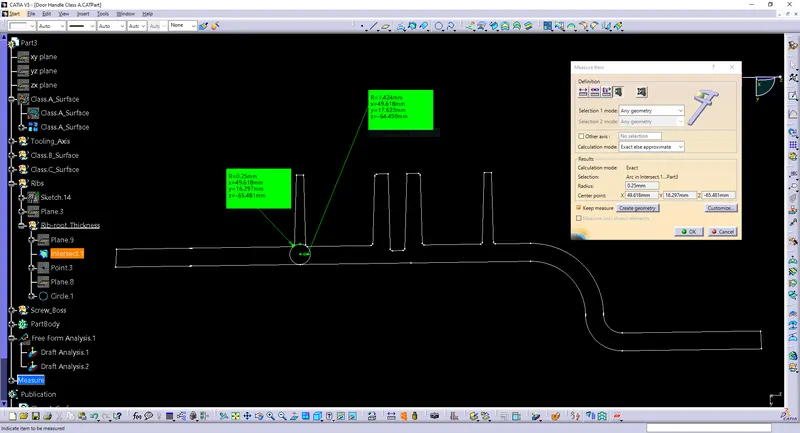
Class A Surface:
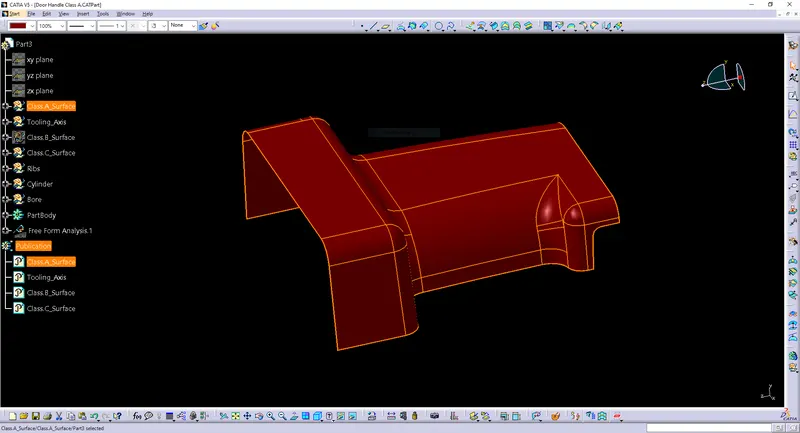
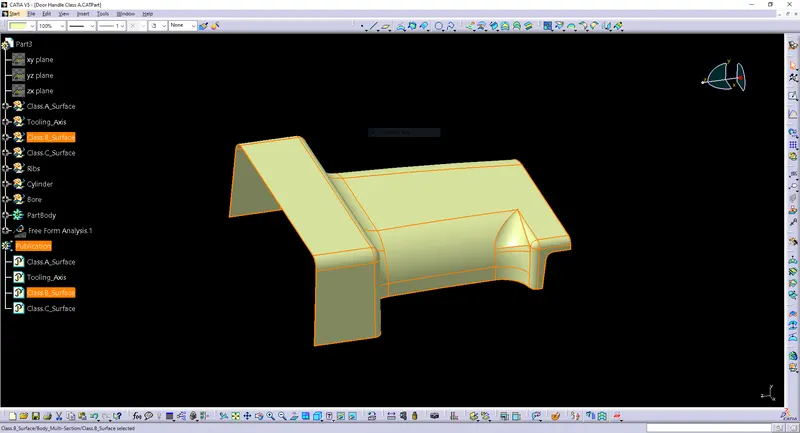
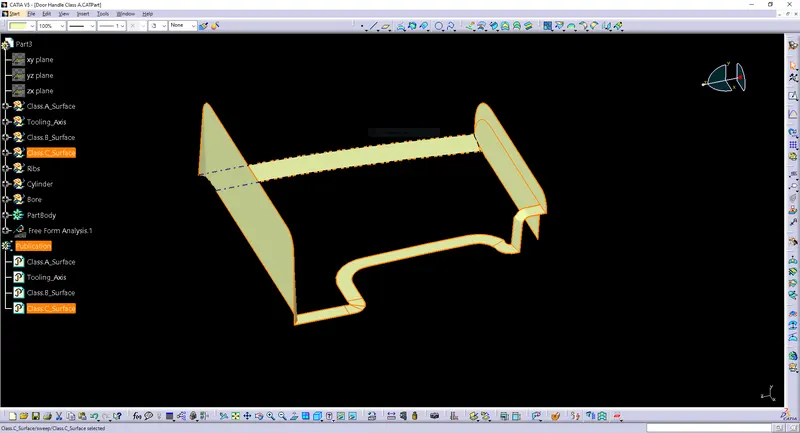
Class A Joining_Method:
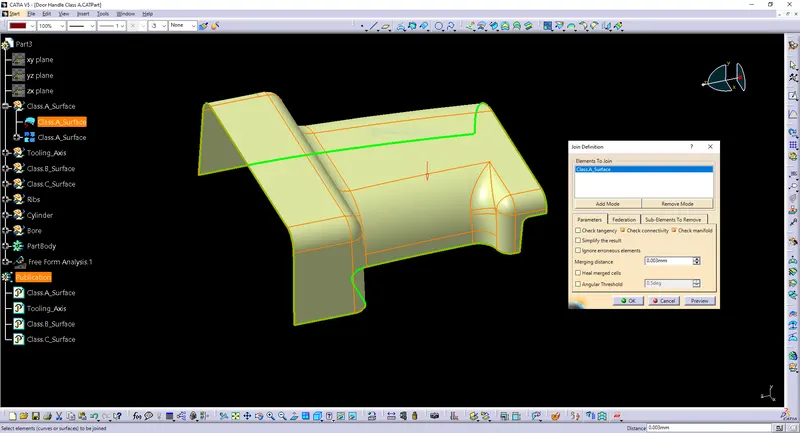
- In Class A surface, must be closed.
- If it is not closed or any invalid features are noticed the part will not going to generate.
- The part is fully constrained, use the join method and give distance propagation and join it all.
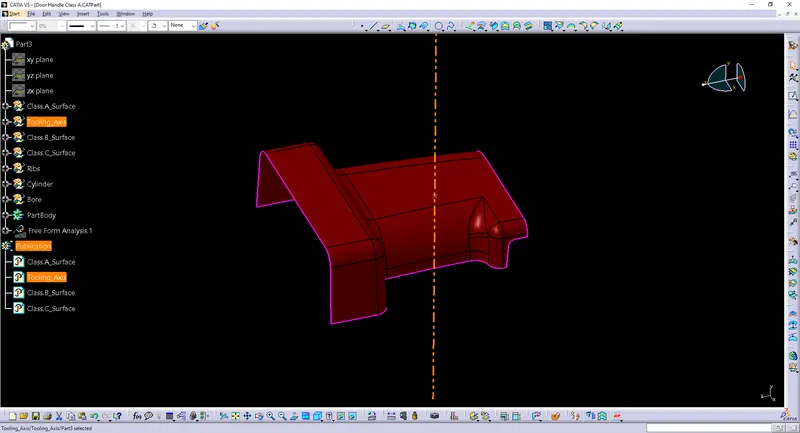
Creating of Tooling Axis:
- Select Insert > Axis System from the menu bar or click Axis System . ...
- Select the point as shown to position the origin of the axis system you wish to create. ...
- If you are not satisfied with the x-axis, for instance, click the X-Axis field and select a line to define a new direction for the x-axis.
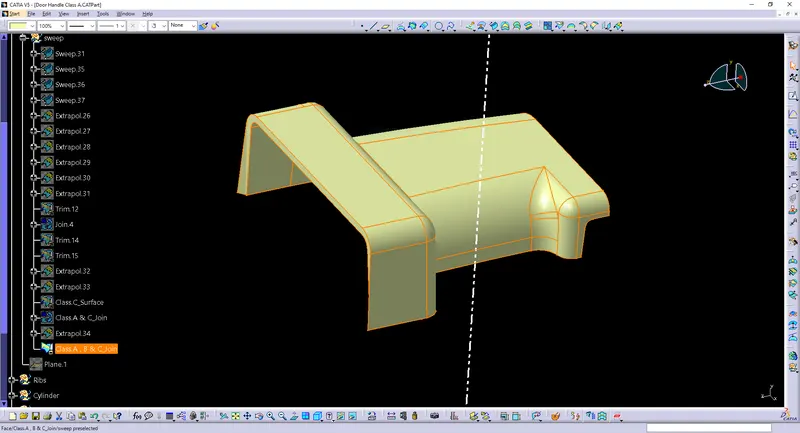
Class.A & Class.C_Joining:
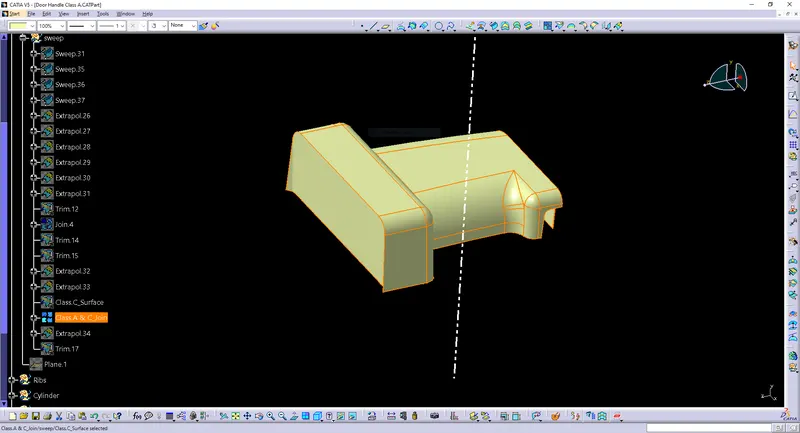
- In a process of joining A & C, it should be a closed surface.
Class.A & Class.B & Class C_Joining:
Draft Analysis:
- The draught analysis approach is used to determine whether our CAD-created part model is capable of being manufactured given the draught condition employed.
- Here, the component should be simple to remove from the panel dies (for sheet metal parts) or Mold (in the case of plastic).
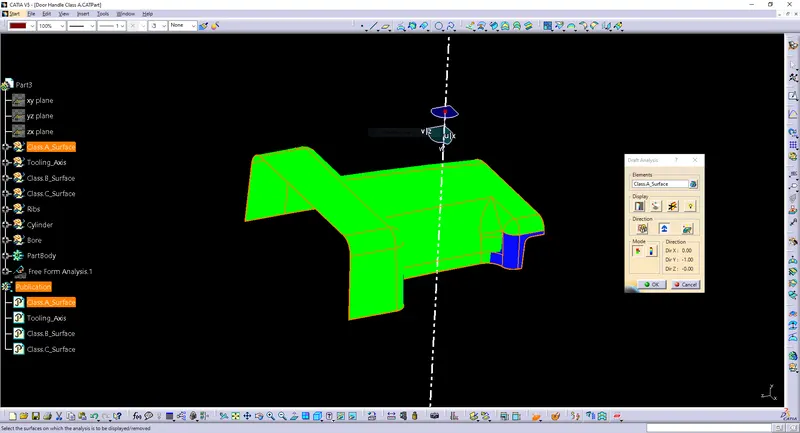
Draft Analysis on Class-A Surface:
- Enter analysis, feature draught analysis, and insert.
- Align the compass and the tooling axis.
- Click the surface to verify that it is within the draught values' permitted range.
- The surface should be green, and the nominal input value for the column should be 3 degrees.
- As a result, the draught analysis on the class-A surface was completed satisfactorily.
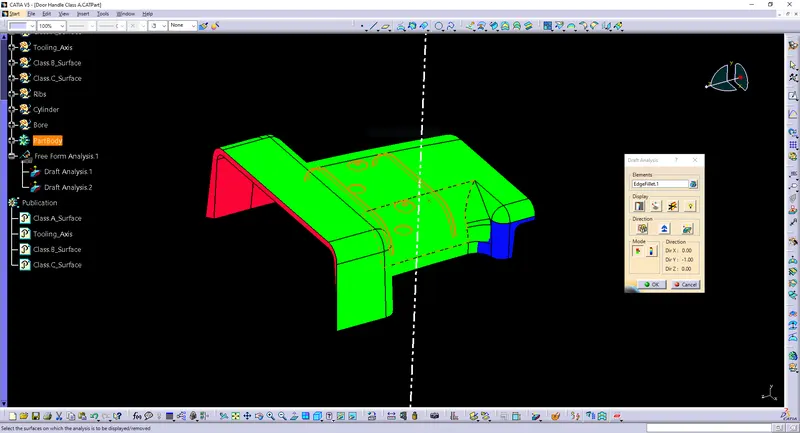
Draft Analysis on Final Part:
- You can determine whether the part you drafted will be simple to remove using the draught analysis command.
- In this kind of analysis, zones on the investigated element are identified by color ranges where the deviation from the draught direction at any given place corresponds to predetermined values.
Orientation of Class A, B, & C, Surfaces:
Front View:
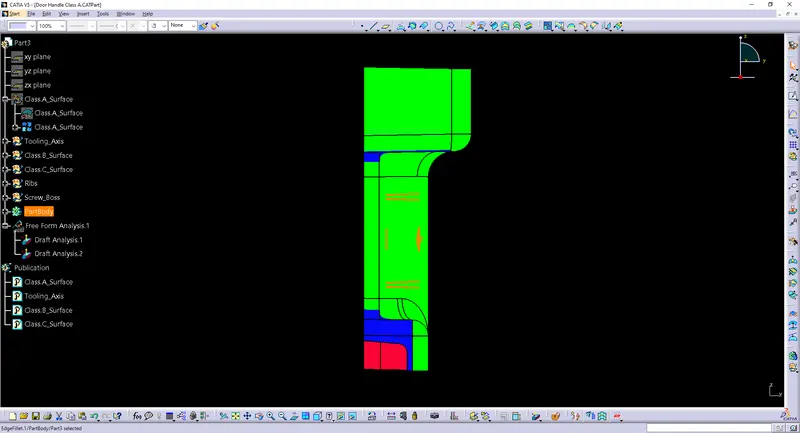
Top View:
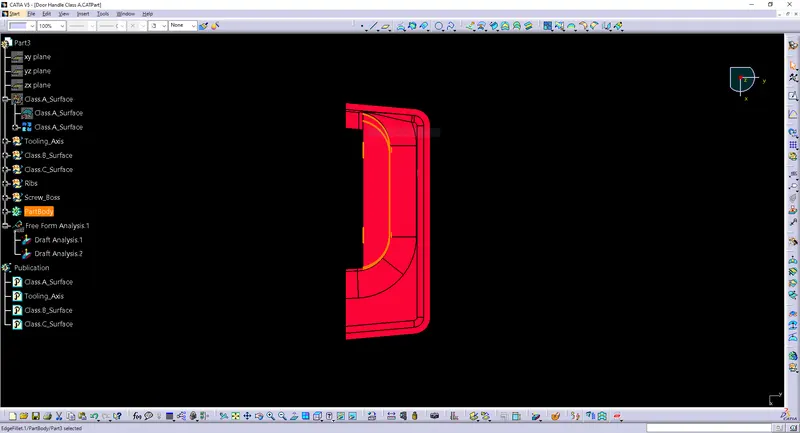
Left View:
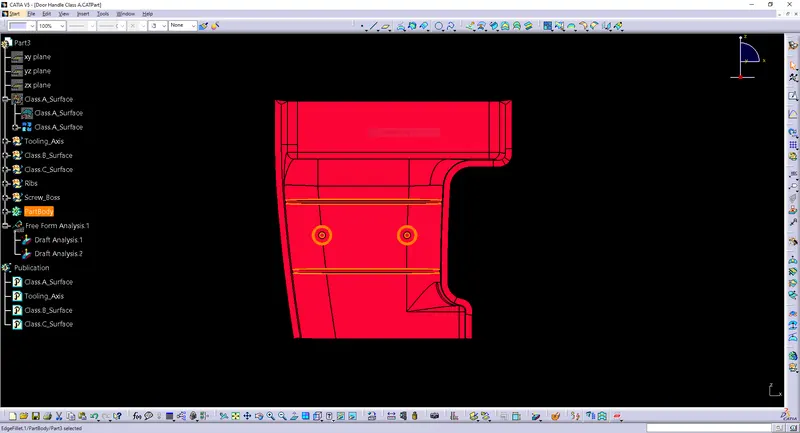
Isometric View:
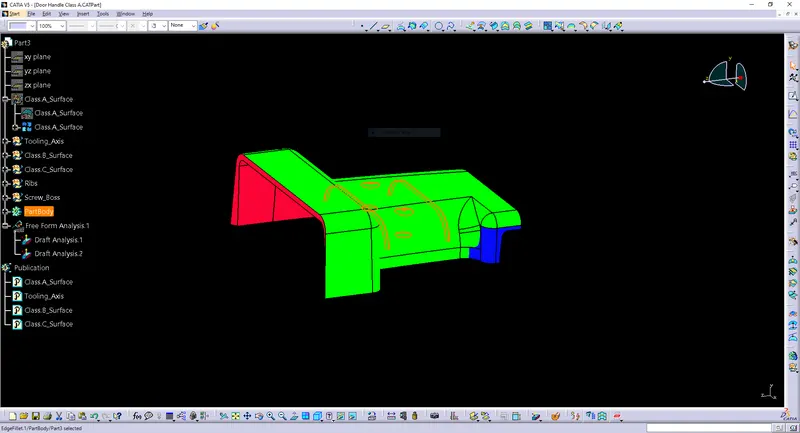
Results:
- Successful creation and draught analysis of the class-A surface and finished Ribs & Screws of Plastic components employing class-A surface.