Week 8 - Universal Joint
Objective
To perform a transient structural analysis on a double universal joint with a spring using three different materials and to compare the Equivalent stress and total deformation for all the three cases.
Procedure
Preprocessing
A transient structural analysis is done onto the universal joint for three different materials and the results are to be compared between them. The geometry file is imported into the software and it is checked for any irregularities in the spaceclaim. If not, the spaceclaim is closed and the geometry is updated in the model section. The materials that are chosen for analysis are Structural Steel, Stainless Steel and Titanium alloy.
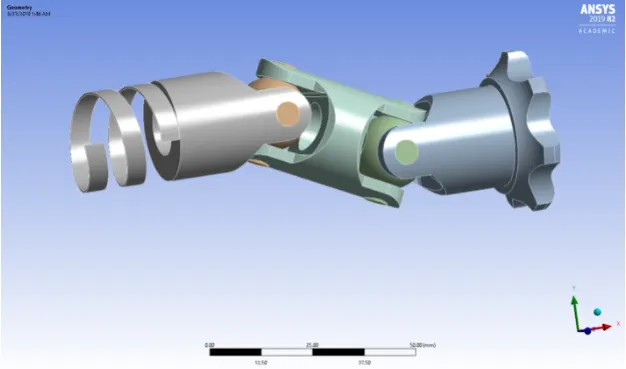
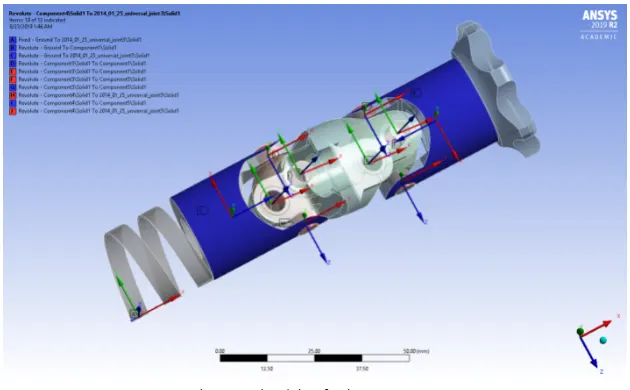
The inbuilt contacts are deleted and only the joints are established for the model. The initial fixed joint is given to the body with the spring as the primary objective is to simulate for spring and get to know the stresses on the spring. Here, the entire model is given rotation and no stresses or strains are checked in any other parts of the model. A revolute joint is given to all the interfaces that connects the 3 components. The revolute joint is given so that the rotation gets tranmitted through all the assembled components.
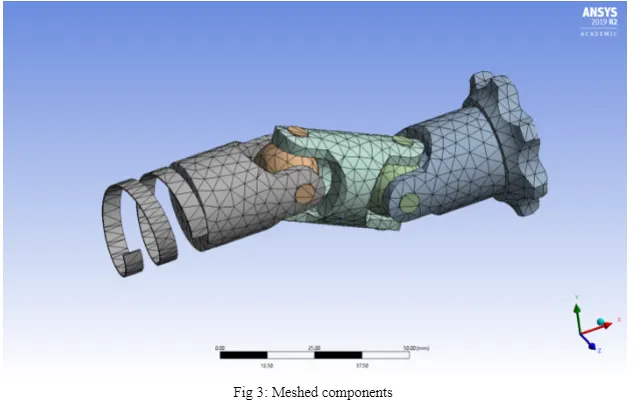
The meshing is done having an element size of 4.0 mm with the medium smoothing. The elements and nodes created were 11663 and 6003 respectively.
The rotation of the joint is given in 5 steps with 30 degree increments at each step. The other analysis settings were selected as given below
Step Controls
Number Of Steps 5.
Current Step Number 1.
Step End Time 1. S
Auto Time Stepping On
Define By Time
Initial Time Step 0.1 s
Minimum Time Step 0.1 s
Maximum Time Step 0.1 s
Time Integration On
Solver Controls
Solver Type Program Controlled
Weak Springs Program Controlled
Large Deflection On
Restart Controls Generate Restart Points Program Controlled
Nonlinear Controls
Stabilization Program Controlled
--Method Energy
--Energy Dissipation Ratio 1.e-004
--Activation For First Substep No
--Stabilization Force Limit 0.2
Output Controls
Stress Yes
Surface Stress Yes
Back Stress Yes
Strain Yes
Contact Data Yes
Nonlinear Data Yes
Nodal Forces Yes
Damping Controls
Stiffness Coefficient Define By Direct Input
Stiffness Coefficient 0.
Mass Coefficient 0.
Numerical Damping Program Controlled
Numerical Damping Value 0.1
Solution
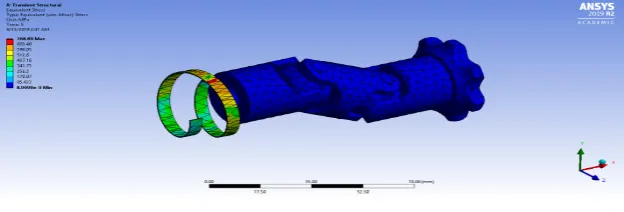
After setting up the analysis settings, the problem is solved and the results are obtained for the spring component of three different materials
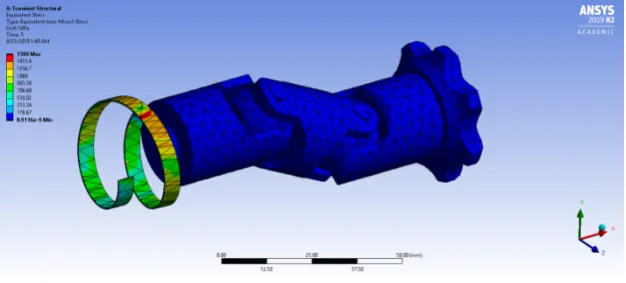
Structural steel
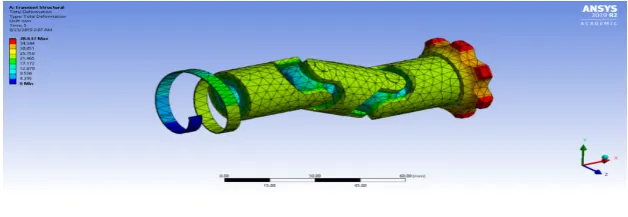
Total deformation: 38.537 mm Max
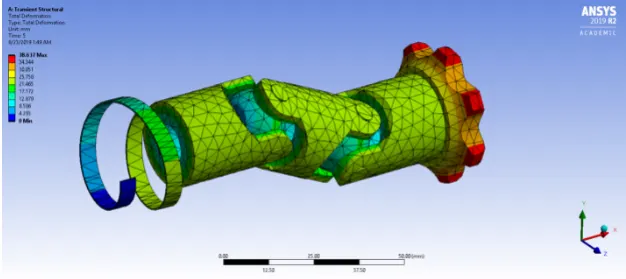
Equivalent Stress: 1590 MPa Max
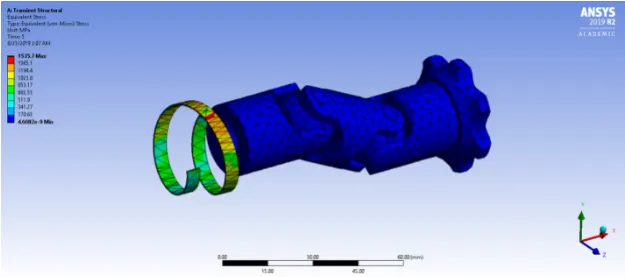
Stainless steel: Total deformation: 38.637 mm Max
Equivalent Stress: 1535.7 MPa Max
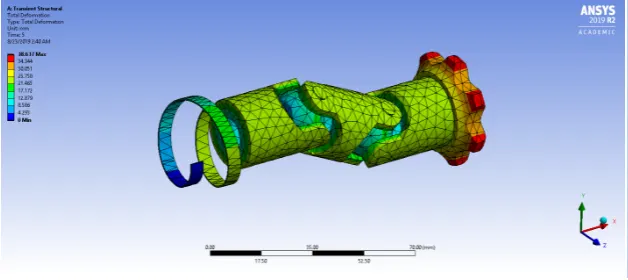
Titanium alloy:
Total deformation: 38.637 mm Max
Equivalent Stress: 768.89 MPa Max
Conclusion
The transient structural analysis for the universal joint for structural steel, stainless steel and titanium alloy was found and the results are tabulated below
|
Materials |
Total Deformation, mm |
Equivalent Stress, MPa |
|
Structural steel |
38.537 |
1590 |
|
Stainless steel |
38.637 |
1535.7 |
|
Titatium alloy |
38.637 |
768.89 |
From the above results, we can infer that other than titanium alloy all the other materials fail if this amount of stress acts on it. Titanium alloy has a stress of 768.89 MPa which is very much safe for this kind of loading as the ultimate strength of titanium alloy is 1070 MPa. the other two materials have an ultimate tensile strength of only about 600 MPa, hence it is not advisable to employ the structural steel and stainless steel materials for this kind of application.