Week 8 - Universal Joint
Universal Joint Assignment –
Objective –
The objective of this assignment is to simulate a double universal joint with spring and performing transient structural analysis.
The analysis is performed on 3 different materials and behaviour of each is studied under the same loading condition.
Model and Analysis Set up
- Model Geometry and Component Labels
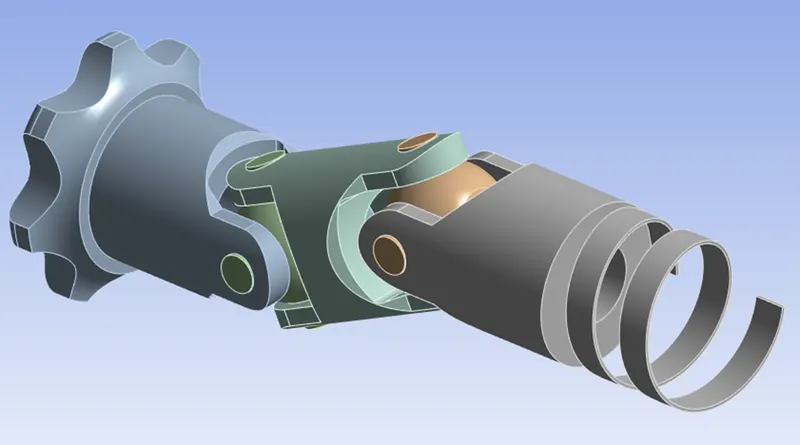
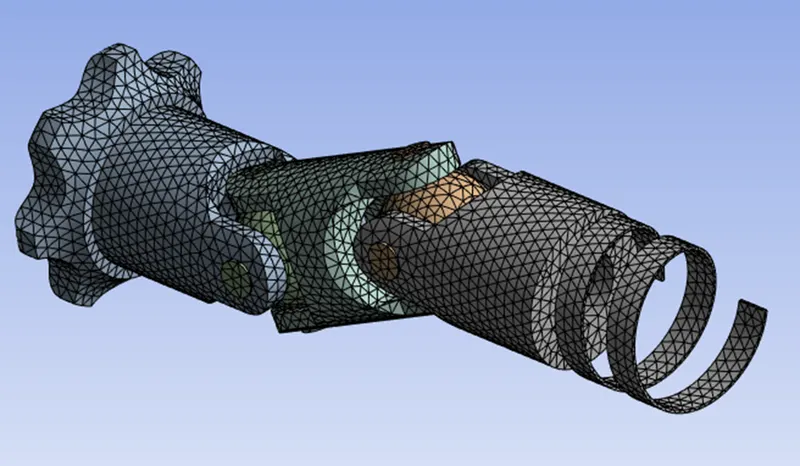
The model is created in a CAD software and imported in ANSYS, initially checked in Space claim
See below model snapshot.
- Materials
All the materials to be Structural Steel for all the parts except the joint spring which is variable for different simulation cases.
- Contacts and Joints
No Contacts are defined for this simulation case
Joints are defined as below –
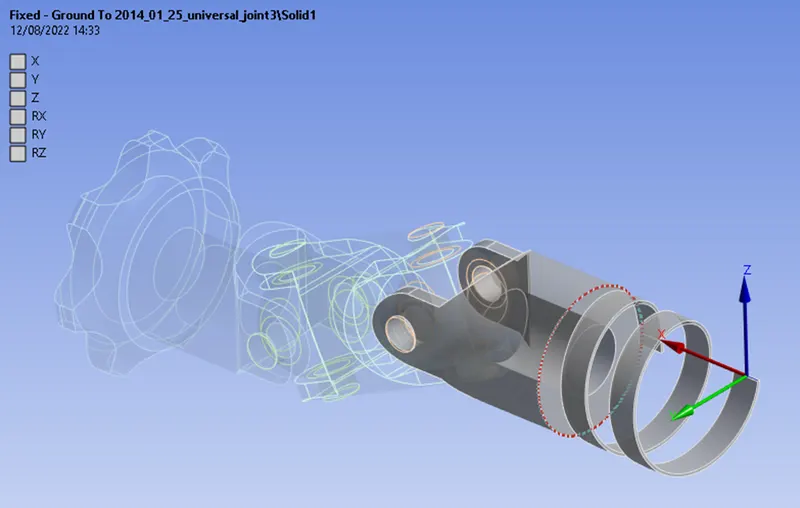
- Fixed Joint at the Spring End
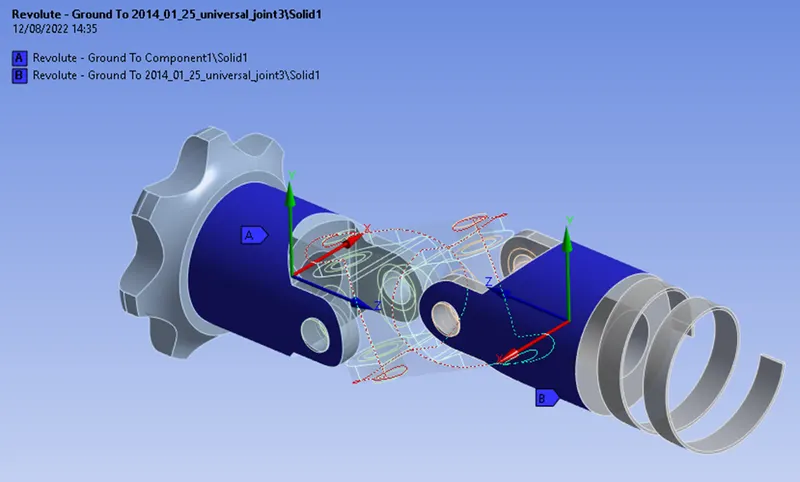
- Body to Ground Revolute joints for the spring joint and gear joint – so that it can rotate about the Z axis
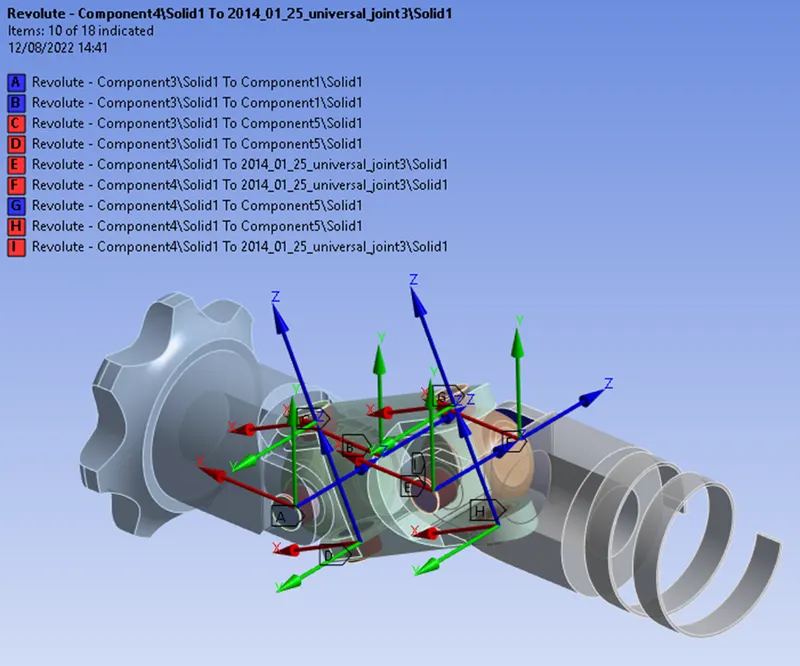
- Body to Body Revolute joints between the intermediate rotational spherical ball connections – so that complete assembly can rotate about the Z axis
- Meshing
The model is meshed with the element size of 2mm throughout
- Analysis Settings
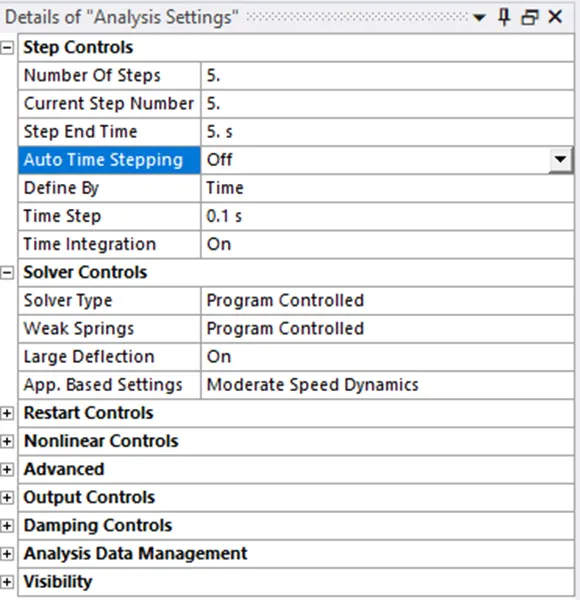
The analysis is performed in 5 steps and the analysis settings as below
- Joint Loads
Joint Rotation is applied on the revolute joint of the gear joint, and is applied in 30, 60, 90, 120, 150 degree steps.
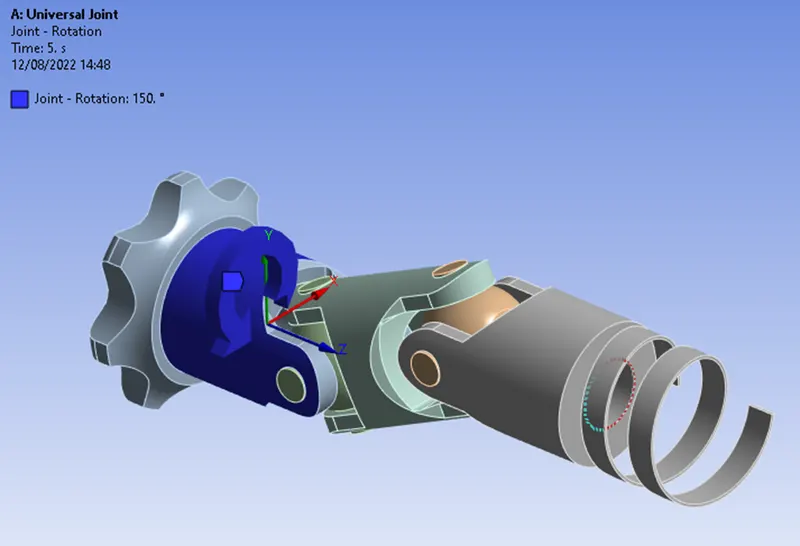
The model is solved for the results, and the required results are plotted as below
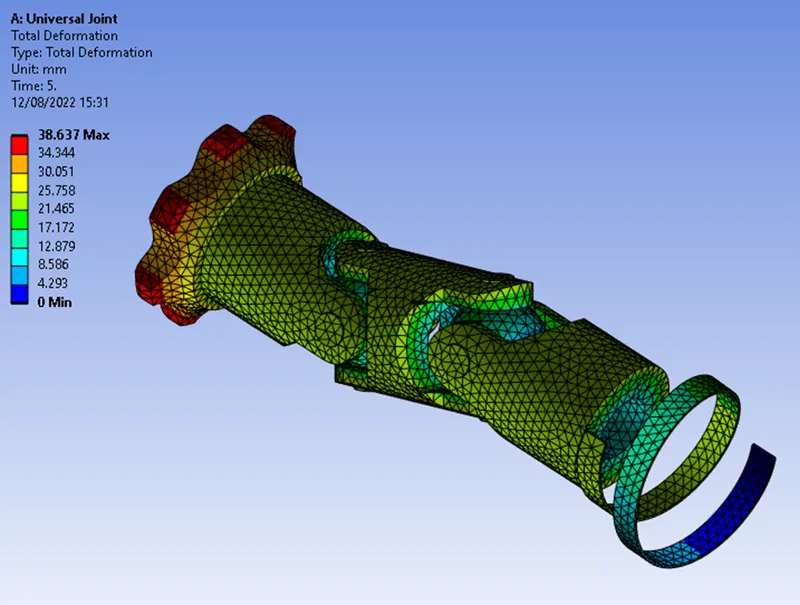
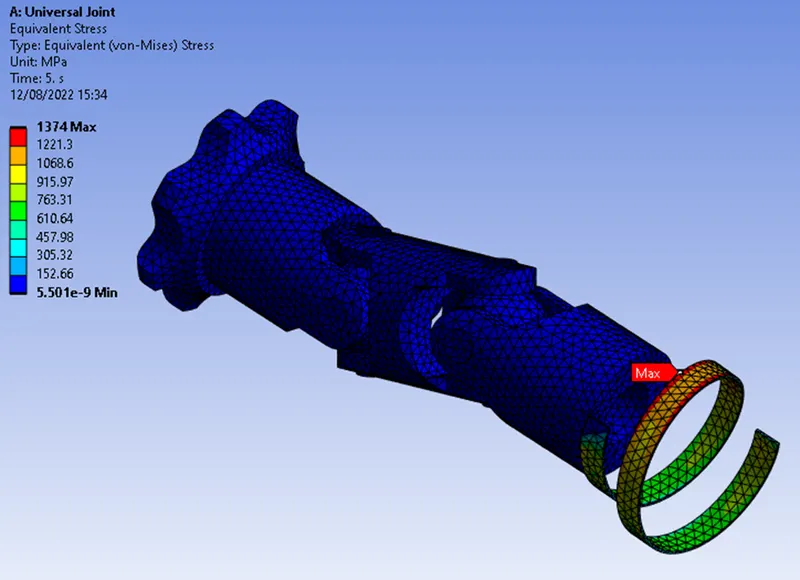
Case 1 – Joint Spring Material – Structural Steel
- Total Deformation
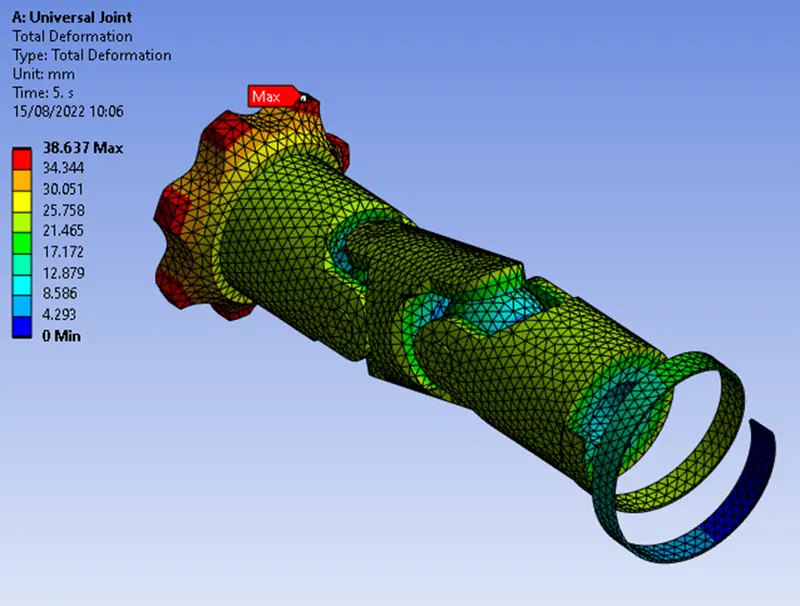
The total deformation = 38.637 mm on the rotating joint
- Equivalent Stress
The maximum stress in the spring – 1374 MPa
Case 2 – Joint Spring Material – Stainless Steel
- Total Deformation
The total deformation = 38.637 mm on the rotating joint
- Equivalent Stress
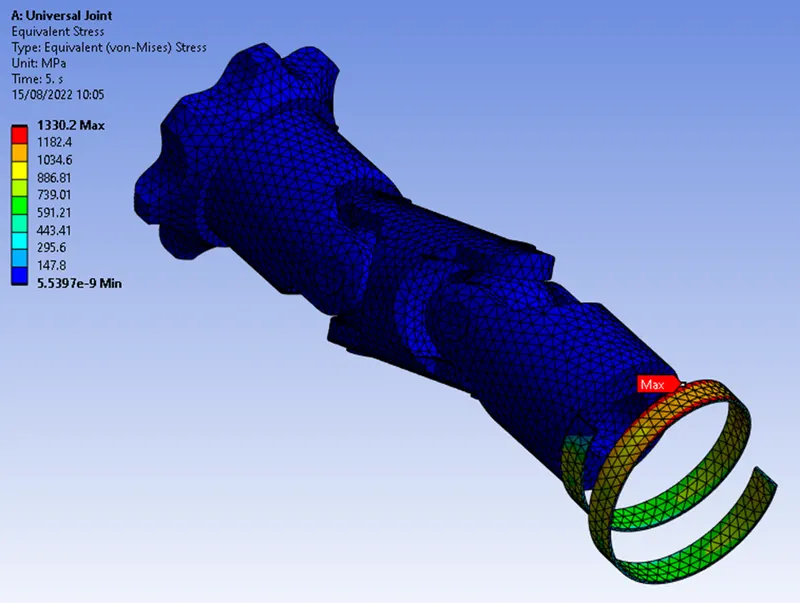
The maximum stress in the spring – 1330.2 MPa
Case 3 – Joint Spring Material – Titanium Alloy
- Total Deformation
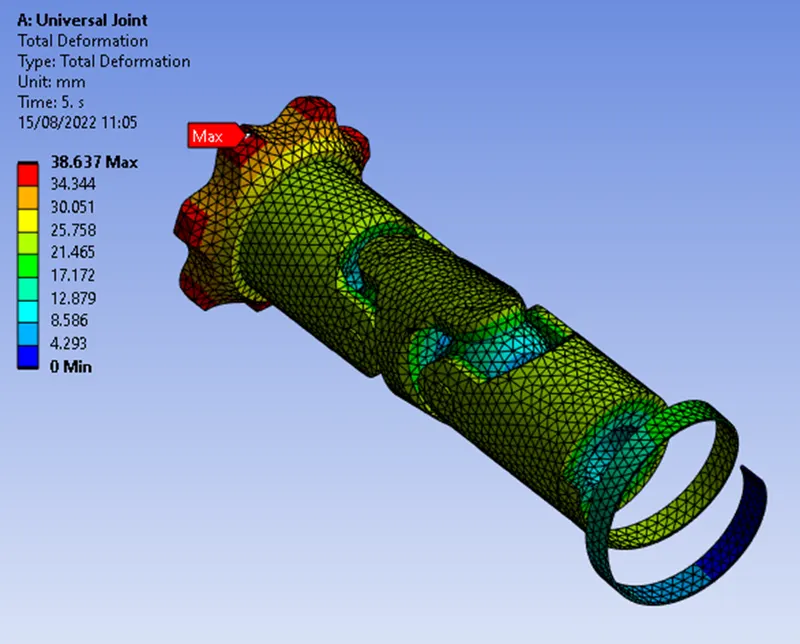
The total deformation = 38.637 mm on the rotating joint
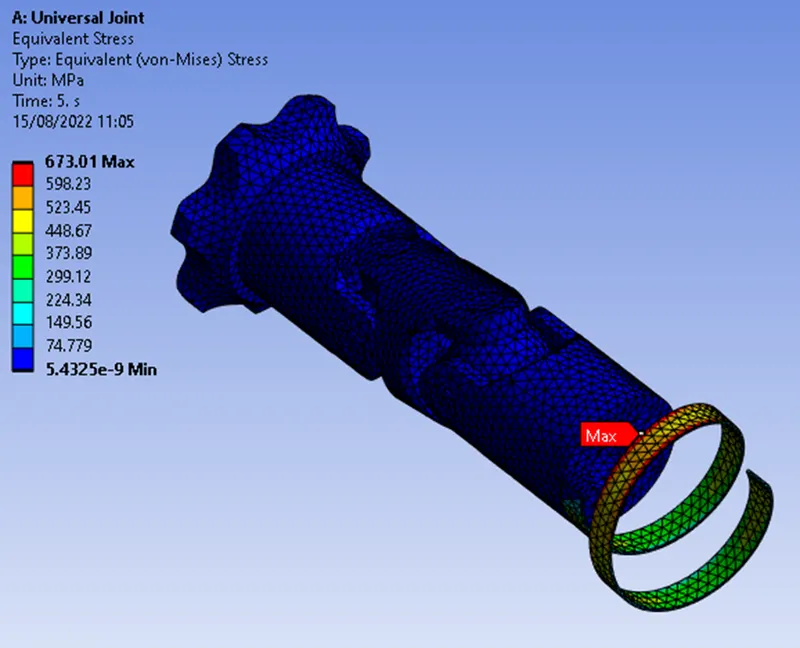
- Equivalent Stress
The maximum stress in the spring – 673.01 MPa
- Results and Conclusion
The comparison of the results for all the 3 cases are tabulated as below –
|
Design Case |
Deformation (mm) |
Maximum Stress (MPa) |
|
Case 1 – Joint Spring Material – Structural Steel |
38.637 |
1374 |
|
Case 2 – Joint Spring Material – Stainless Steel |
38.637 |
1330.2 |
|
Case 3 – Joint Spring Material – Titanium Alloy |
38.637 |
673.01 |
- The deformation is constant for all the 3 cases as the joint is rotated with a constant rotation keeping the spring end constant.
- Titanium Alloy develops least stress amongst all the 3 materials proving it is the most flexible material
- Structural Steel develops highest stress amongst all the 3 materials proving it is the most rigid material
- Point no. 2 and 3 are proven by comparison of the Young’s Modulii for the 3 materials, Titanium Alloy having lowest Young’s Modulus is stressed lowest and Structural Steel having highest Young’s Modulus is stressed highest.
- Titanium Alloy is the best material for this application as the stress developed is within the yield strength limit of 960 MPa, whereas Structural Steel and Stainless Steel are overstressed exceeding the yield strength limits.