Week 8 - Simulating Cyclone separator with Discrete Phase Modelling
Aim:- To perform analysis on cyclone separator and calculate the separation efficiency and pressure drop.
Objective:-
- To write a few words about any four empirical models used to calculate the cyclone separator efficiency.
- To perform an analysis on a given cyclone separator model by varying the particle diameter from 1 μm to 5 μm and calculate the separation efficiency in each case. Discuss the results. [Use both the velocity's as 3m/sec.]
- To perform an analysis on a given cyclone separator model by varying the particle velocity from 1 m/sec to 5 m/sec and calculate the separation efficiency and pressure drop in each case. Discuss the results. [Use particle diameter size as 5 μm for all cases & keep flow velocity same as particle velocity]
Boundary Conditions:-
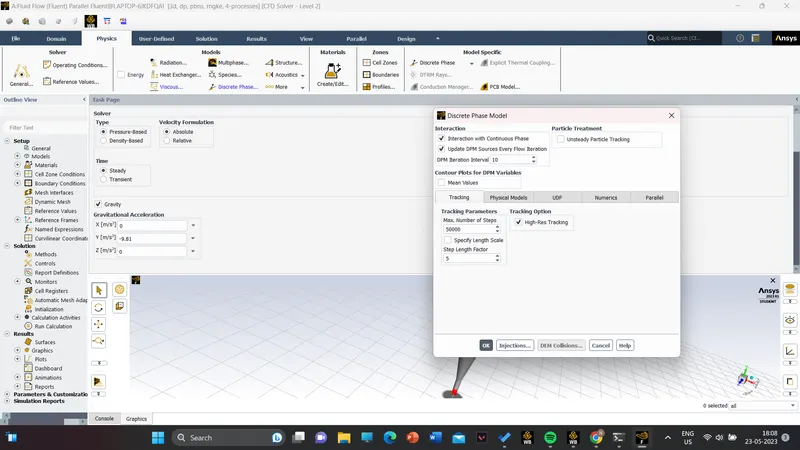
Inlet and wall:- Reflect
Outlet(Top):- Escape
Outlet(Bottom/dustbin) - Trap
Cyclone separators are widely used in various industries to separate particulate matter from gas or liquid streams. Several empirical models have been developed to estimate the efficiency of cyclone separators based on various parameters. Here are four commonly used empirical models:
-
Lapple Model: The Lapple model is one of the earliest empirical models for cyclone separator efficiency. It predicts the overall collection efficiency of a cyclone based on the inlet particle size distribution, particle density, and cyclone dimensions. This model assumes that the collection efficiency is primarily influenced by the cyclone's geometric dimensions.
-
Barth Model: The Barth model is an empirical model that takes into account the particle size distribution, particle density, and gas flow properties. It incorporates the effect of particle inertia and gravitational settling on the collection efficiency. The model considers the effect of both the cyclone's geometric dimensions and the particle characteristics.
-
Stairmand Model: The Stairmand model is widely used for predicting the cyclone efficiency based on the cyclone dimensions and gas flow parameters. It assumes that the separation efficiency is determined by the tangential velocity, radial velocity, and inlet particle size distribution. This model provides a good estimate of cyclone efficiency for a wide range of operating conditions.
-
Leith-Licht Model: The Leith-Licht model is an empirical model that takes into account the particle size distribution, particle density, and cyclone dimensions. It considers the effect of both the centrifugal force and the drag force on the collection efficiency. This model provides a more accurate prediction of cyclone efficiency by incorporating additional factors such as particle density and cyclone dimensions.
It is important to note that these empirical models provide approximate estimates of cyclone separator efficiency and may have limitations based on specific operating conditions and variations in particle characteristics. Therefore, it is always advisable to validate the model predictions with experimental data for accurate results.
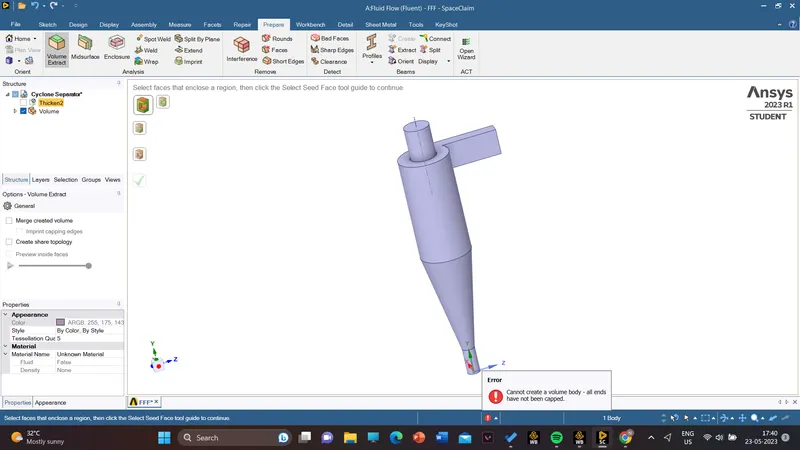
Geomerty preparation
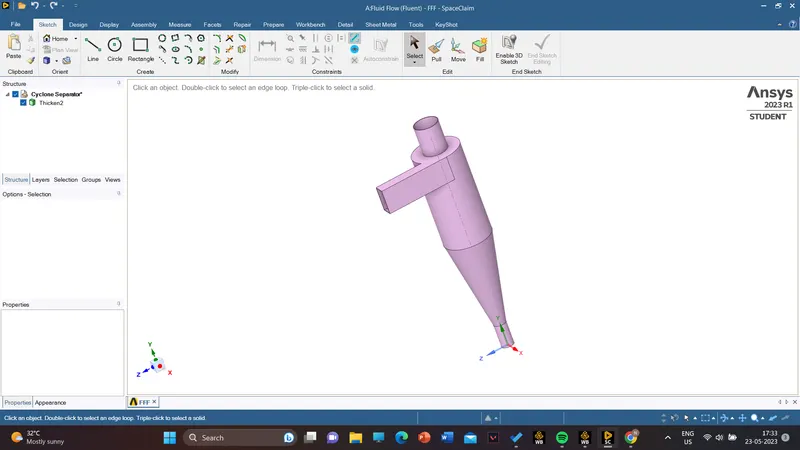
Extracted volume
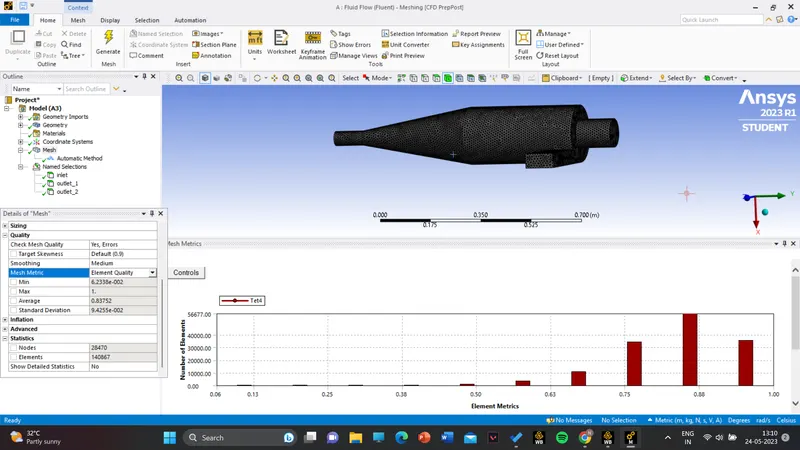
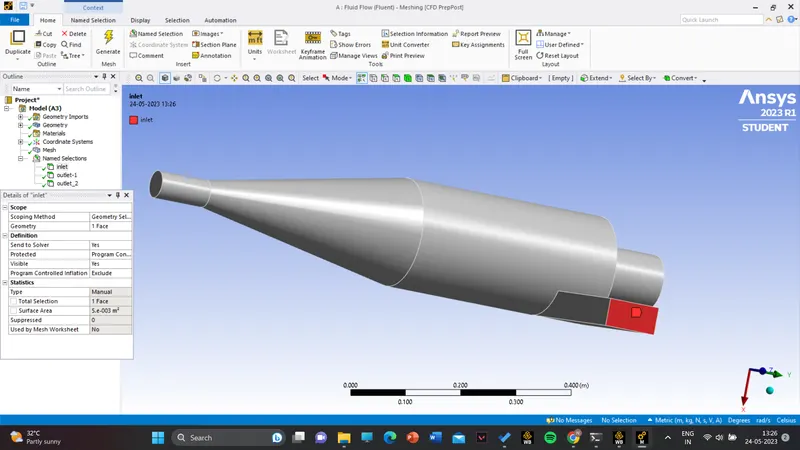
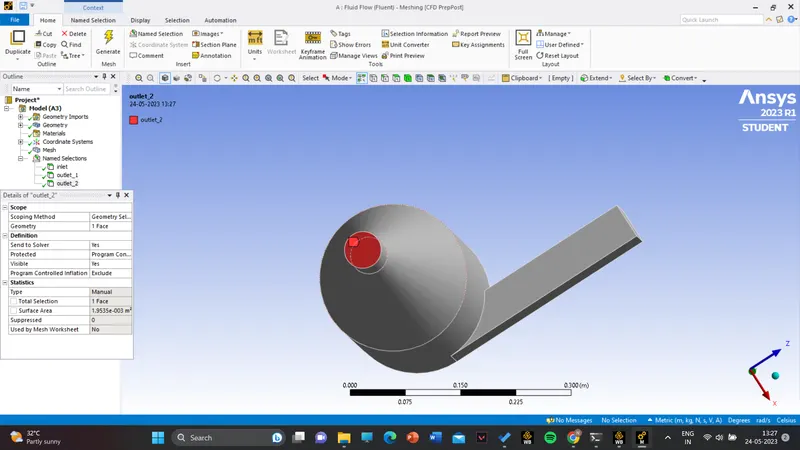
inlet
outlet 1
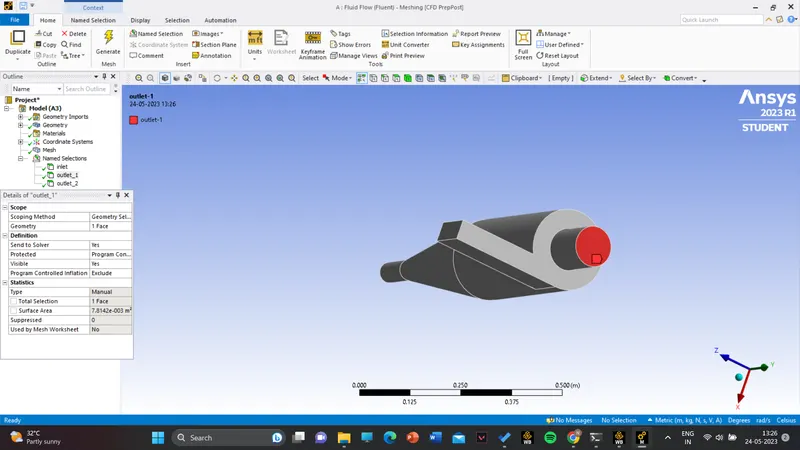
outlet 2
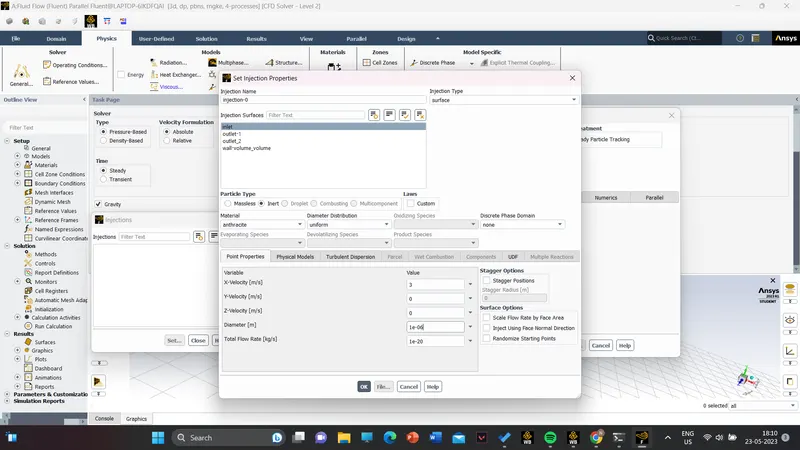
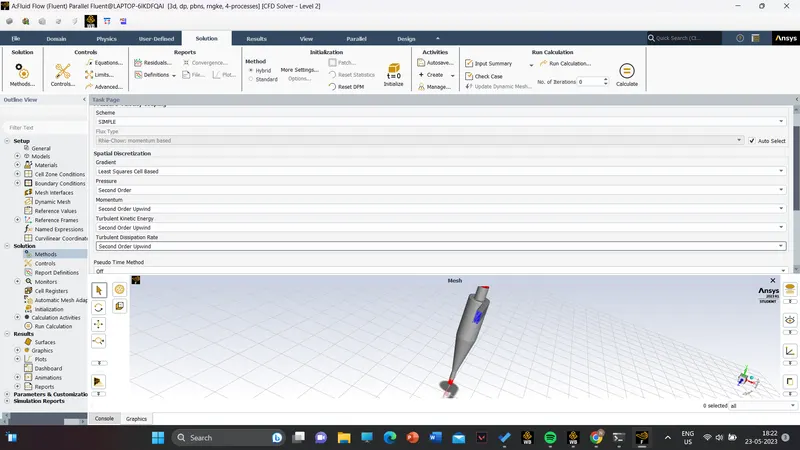
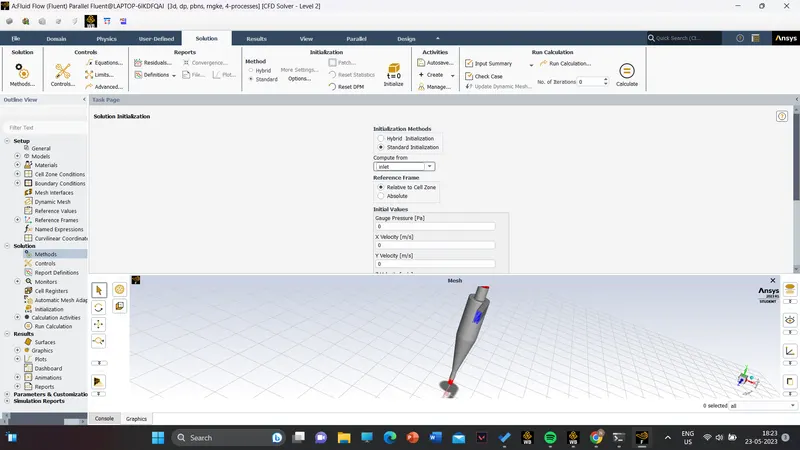
result for 3mm inlett velocity and 5 micrometer particle size
number tracked = 142, escaped = 3, trapped = 139
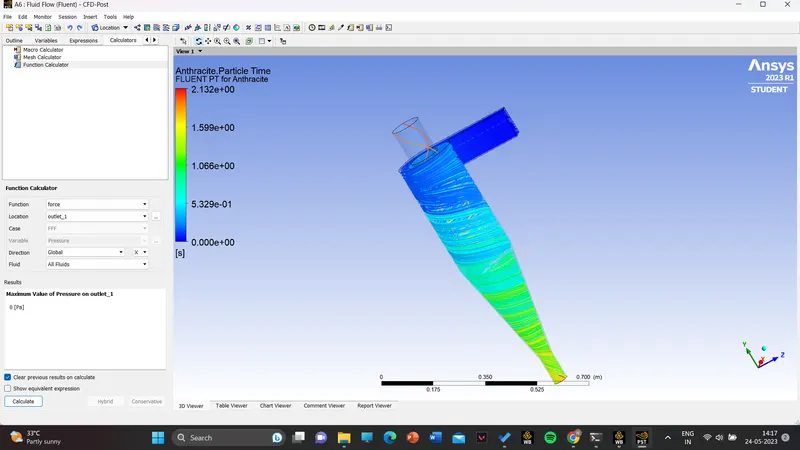
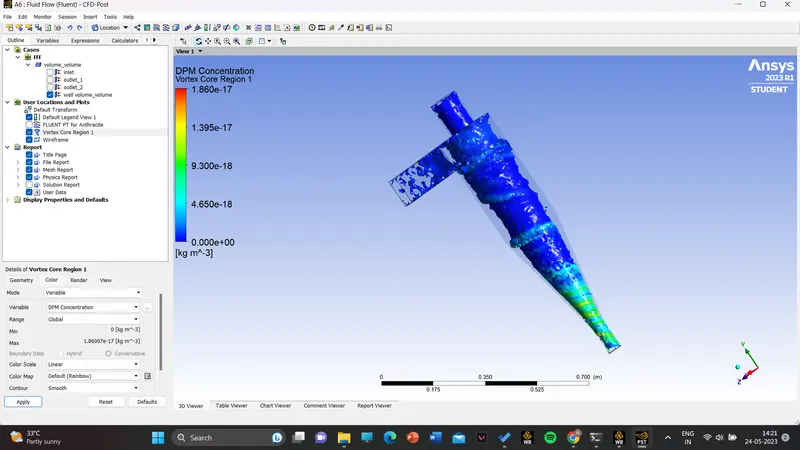
result for 3mm inlett velocity and 4micrometer particle size
number tracked = 142, escaped = 1, trapped = 136, incomplete = 5
result for 3 mm inlet and 3 micrometer particle size
number tracked = 142, escaped = 6, trapped = 129, incomplete = 7
result for 3mm inlet velocity and 2 micrometer particle size
number tracked = 142, escaped = 14, trapped = 125, incomplete = 3
result for 3mm inlet velocity and 1 micrometer particle size
number tracked = 142, escaped = 20, trapped = 84, incomplete = 38
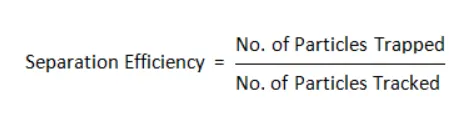
Separation efficiency: It is defined as the fraction of particles of a given size collected in the cyclone, compared to those of that size going into the cyclone. Experience shows that the separation efficiency of cyclone separator increases with increasing particle mean diameter and density; increasing gas tangential velocity; decreasing cyclone diameter; increasing cyclone length; extraction of gas along with solids through the cyclone legs. In this case, depending upon the particle history data - Separation Efficiency is defined as the ratio of concentration that has been removed from the feed stream to the initial concentration in the feed stream. For this case ratio of the number of trapped particles to the total number of particles tracked.
- Pressure Drop:
Pressure drop across the cyclone is of much importance in a cyclone separator. The pressure drop significantly affects the performance parameters of a cyclone. The total pressure drop in a cyclone will be due to the entry and exit losses, and friction and kinetic energy losses in the cyclone. Normally the most significant pressure drop occurs in the body due to swirl and energy dissipation.
Pressure drop is defined as the difference in total pressure between two points of a fluid carrying network.
Pressure drop, ΔPΔ = Total inlet pressure - Total Outlet Pressure (escape)
As the escape DPM condition is given to the outlet-top in this case, so outlet-top is considered in pressure drop calculation.
| sl.no | velocity (m/s) | particle size(m) | tracked | trapped | separation efficiency |
| 1 | 3 | 5e-6 | 142 | 139 | 97.88% |
| 2 | 3 | 4e-6 | 142 | 136 | 95.7% |
| 3 | 3 | 3e-6 | 142 | 129 | 90.8% |
| 4 | 3 | 2e-6 | 142 | 125 | 88% |
| 5 | 3 | 1e-6 | 142 | 84 | 59.1% |
case 2
result of particle size 5 micrometer and velocity of both particle and inlet is 1m/s .
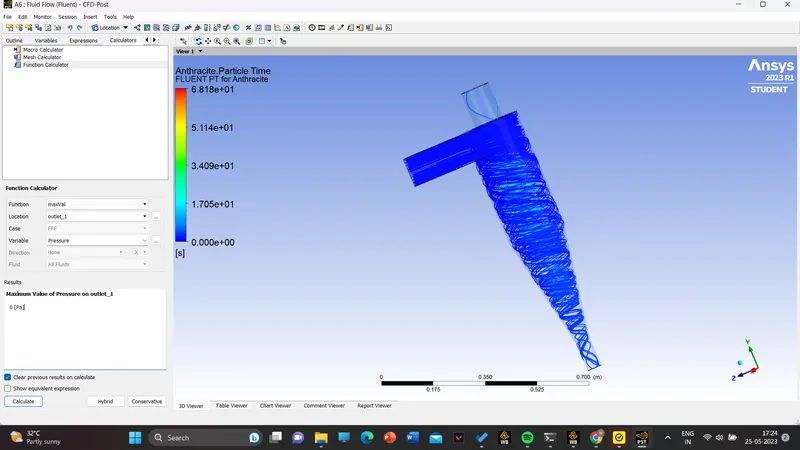
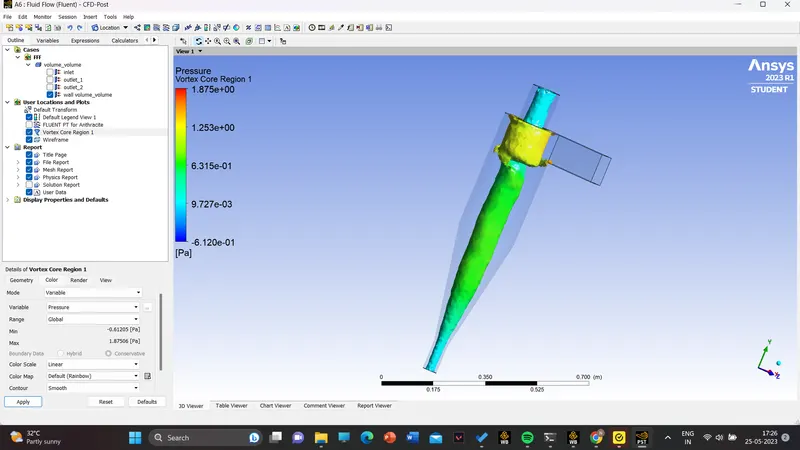
result of particle size 5 micrometer with velocity of 2m/s for both inlet and particle
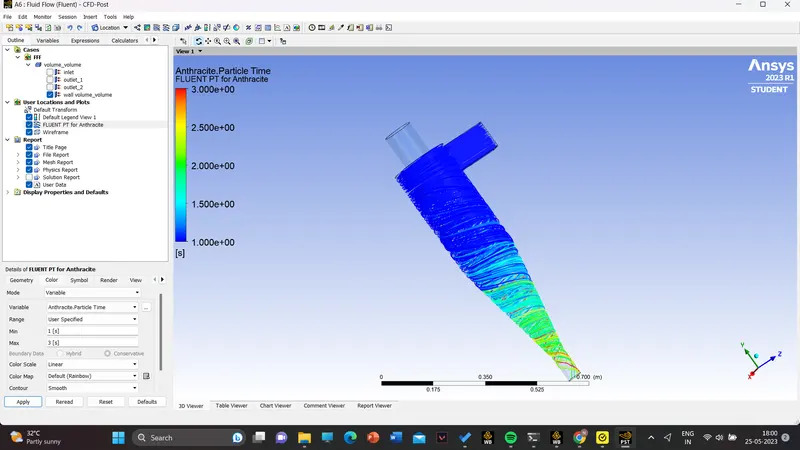
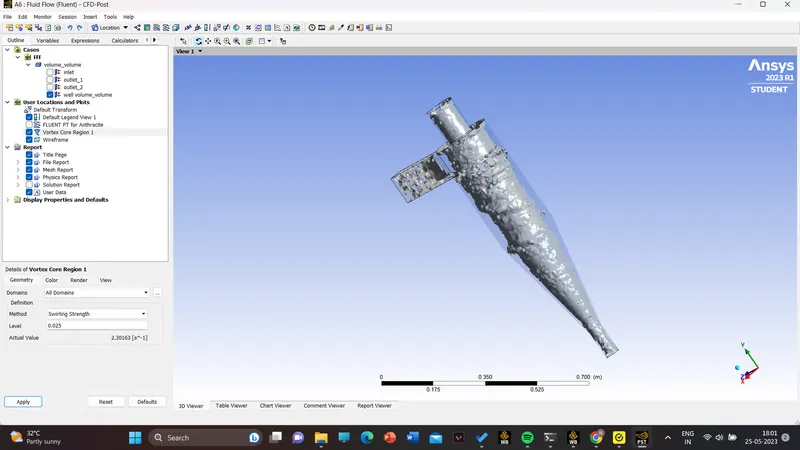
result of 5 micrometer with velocity 3mm
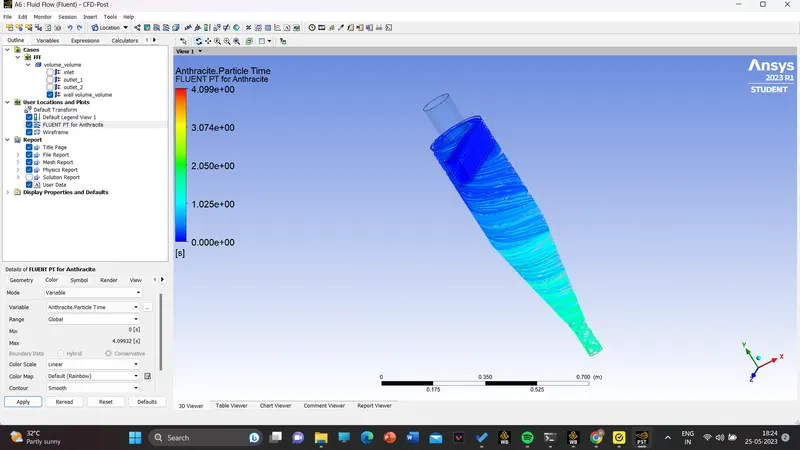
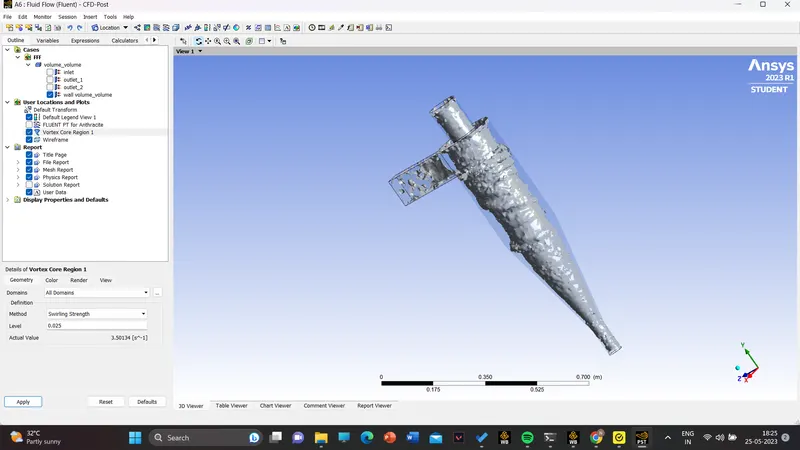
result of 5 micrometer particle size with 4 m/s velocity
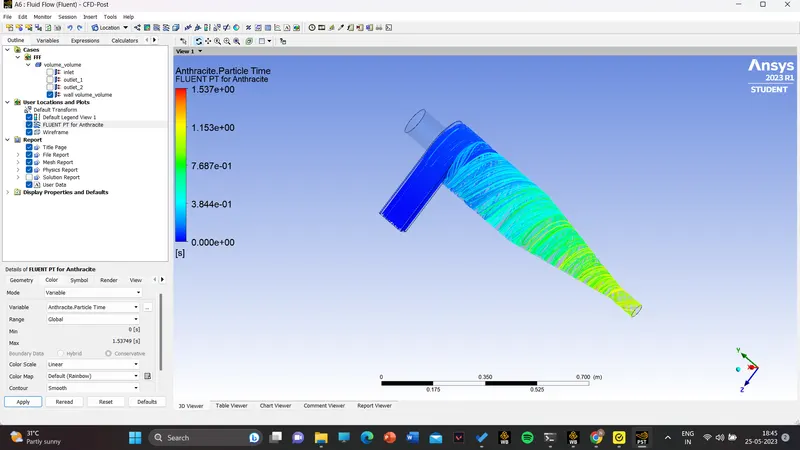
result of 5 micrometer particle with 5 m/s velocity
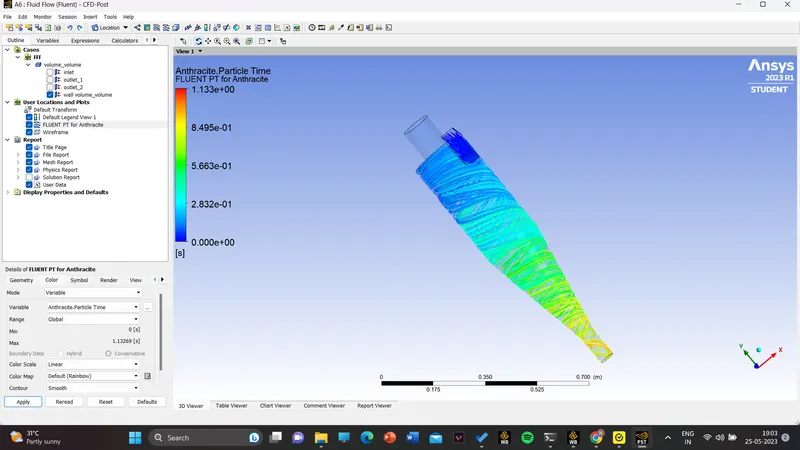
| sl.no | particle size(micrometer) | velocity of particle and inlet(m/s) | pressure at inlet | pressure at outlet 1 | pressure drop |
separation efficiency tracked trapped efficiency |
| 1 | 5 | 1 |
1.85836 [Pa] |
0 [Pa] |
1.858 pa | 142 15 10.5% |
| 2 | 5 | 2 |
8.62125 [Pa] |
0 [Pa] |
8.6215 pa | 142 7 4.9% |
| 3 | 5 | 3 |
19.9475 [Pa] |
0 [pa] | 19.9475 pa | 142 136 95.7% |
| 4 | 5 | 4 |
35.333 [Pa] |
0 pa | 35.33 pa | 142 142 100% |
| 5 | 5 | 5 |
55.3701 [Pa] |
0 pa | 55.37 pa | 142 142 100% |
Conclusion:
- Both the parts simulated above show that Separation efficiency depends on both the diameter and velocity of the particles. As increased diameter and velocity gives increased separation efficiency.
- Velocity has a greater impact as compared to the diameter of the particle.
- Pressure drop is dependant on velocity. For constant velocity with varying diameter sizes, the pressure drop remains almost constant.
- Increased velocity causes a higher pressure drop.