Week 4 - CHT Analysis on Exhaust port
EXHAUST PORT SIMULATION
Aim
To analyse Conjugate Heat Tranfer through an Exhaust Manifold
Inroduction
The term conjugate heat transfer (CHT) is used to describe processes which involve variations of temperature within solids and fluids. The exchange of thermal energy between the two physical bodies is called study of Heat Transfer, the rate of transferred heat is directly proportional to the temperature difference between the bodies.From this experiment we are ought to find the wall/surface heat transfer coefficient on the internal solid surface and visualise the velocity and temperature contours
Theory
Conjugate heat transfer corresponds with the combination of heat transfer in solids and heat transfer in fluids. In solids, conduction often dominates whereas in fluids, convection usually dominates. Efficiently combining heat transfer in fluids and solids is the key to designing effective coolers, heaters, or heat exchangers. Forced convection is the most common way to achieve high heat transfer rate. In some applications, the performances are further improved by combining convection with phase change (for example liquid water to vapor phase change).
Heat transfer in solids and heat transfer in fluids are combined in the majority of applications. This is because fluids flow around solids or between solid walls, and because solids are usually immersed in a fluid.
Solving and Modelling approach
The Modelling approach is divided into 2 cases first the base line mesh and the coarse mesh.
First we need to Repair the model then Use volume Extract to extract the Volume of the exhaust,taking to two different volumes called fluid volume and solid volume.
Meshing should be Non conformal mesh as solid and fluid volume are two parts
Geometry:
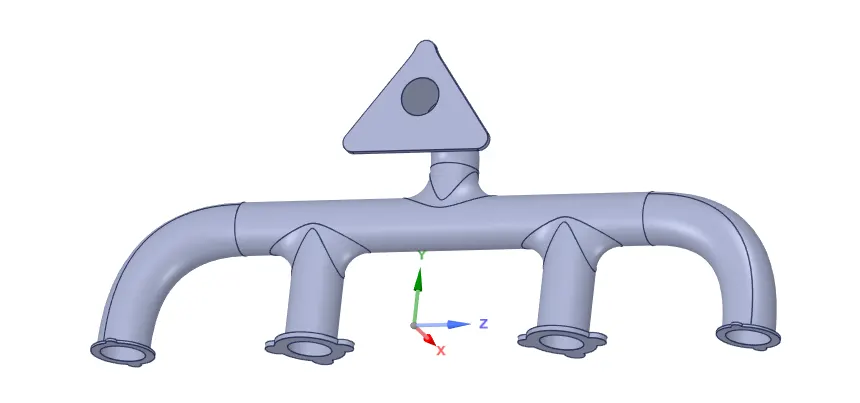
set up
Generate finer mesh in the solid volume of element size 10mm by Inserting body sizing in the solid volume.
To capture wall effects accurately at the interface, generate inflation layers. The thickness of the inflation layer depends on the turbulence model.
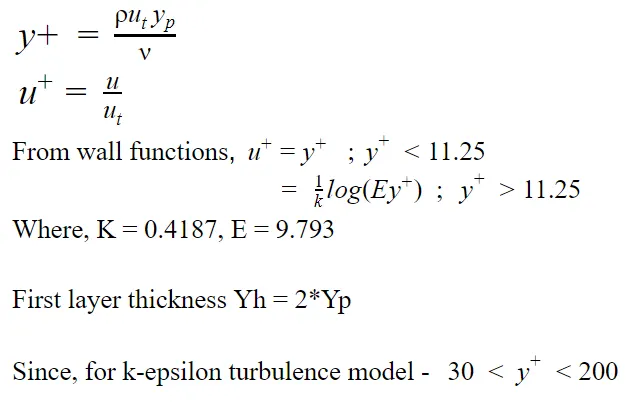
In this report, the k-epsilon turbulence model is considered for analysis, consider y+ as 30.
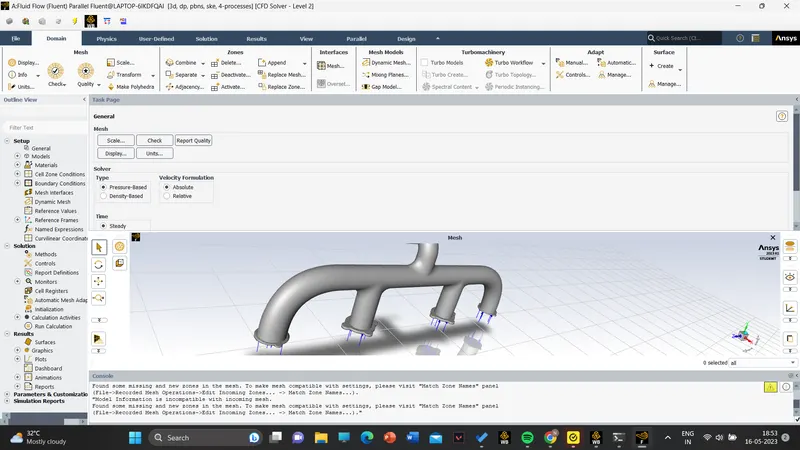
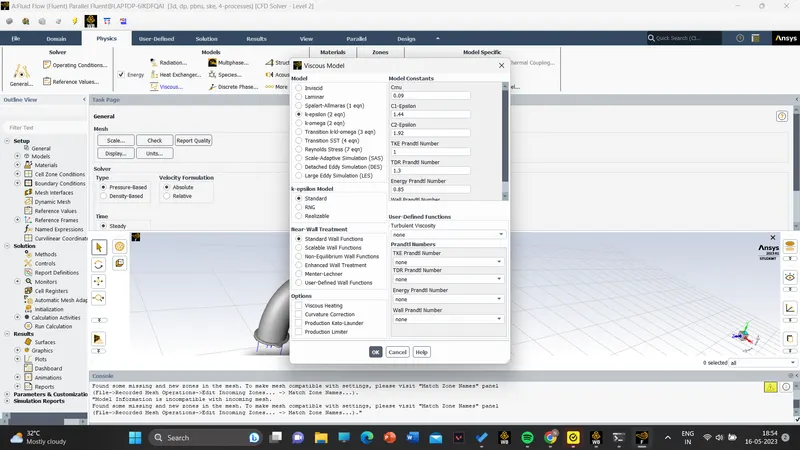
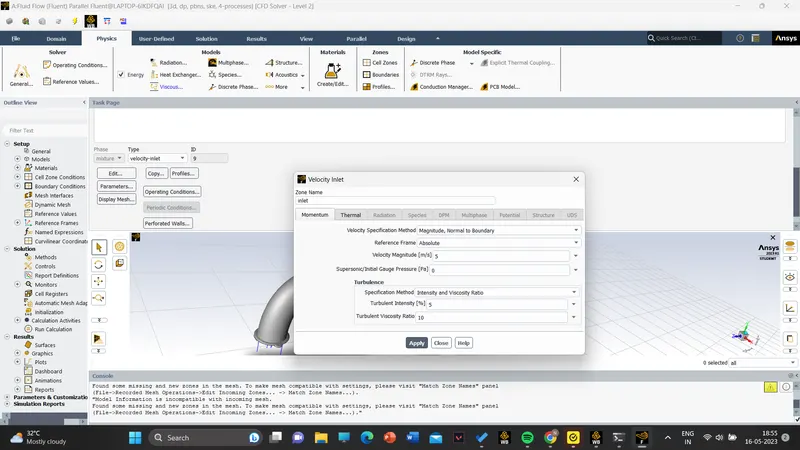
inlet
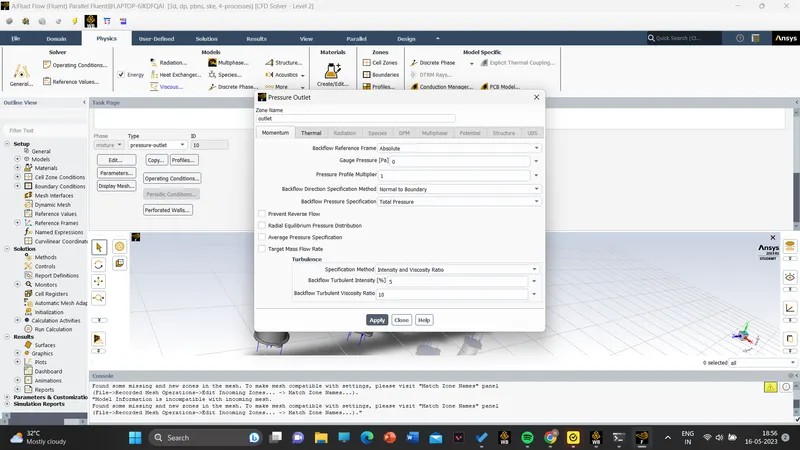
outlet
outer wall

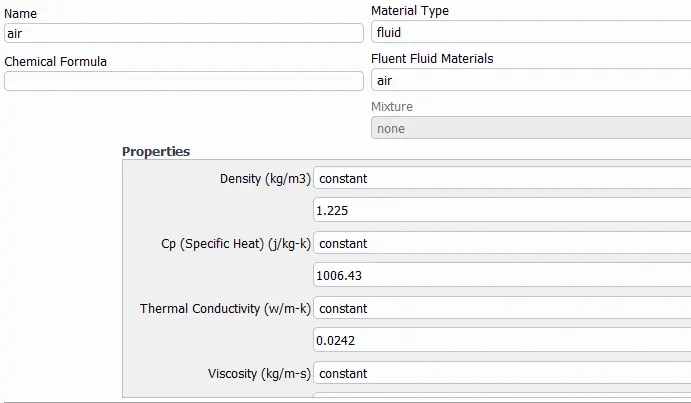
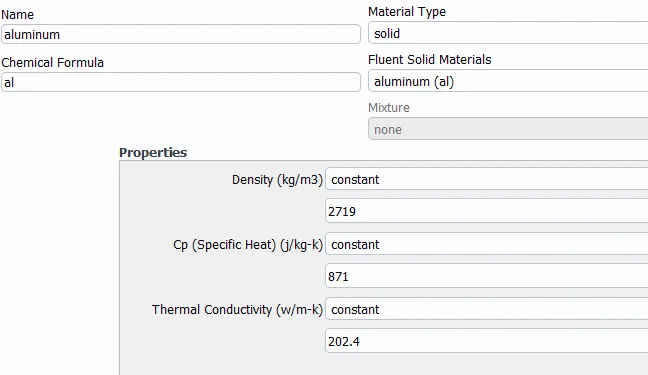
Material properties:
Fluid as Air and Solid part as Aluminium
Refined mesh with Inflation layer
elememt size= 10 mm for outer part
inflation layer of 5 mm
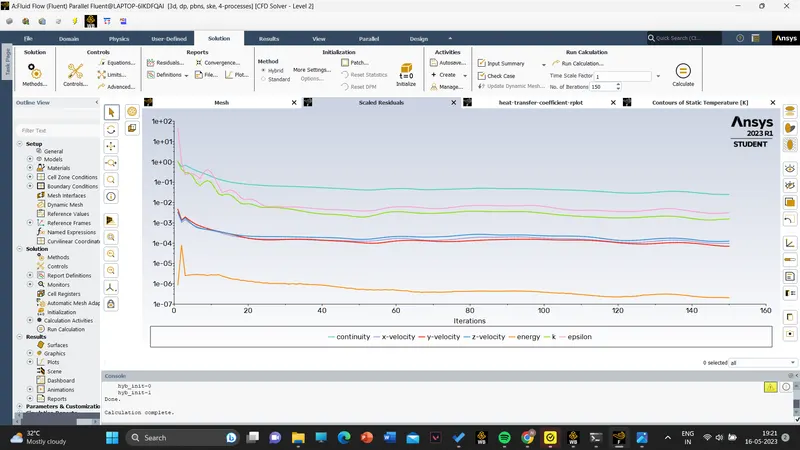
residual
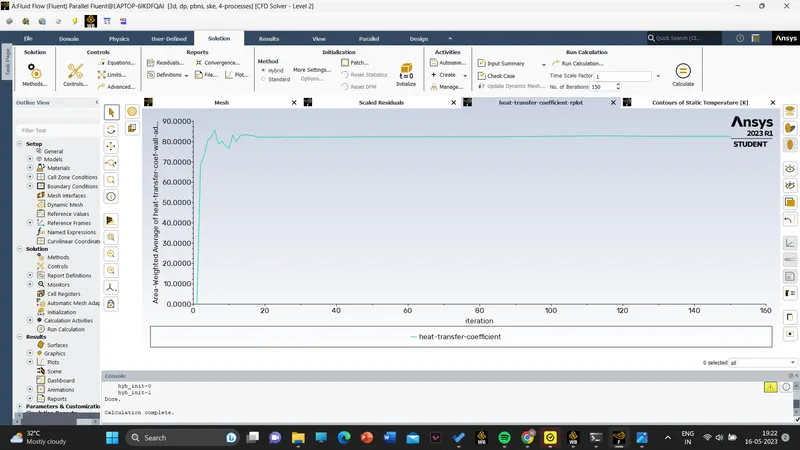
heat transfer coefficient
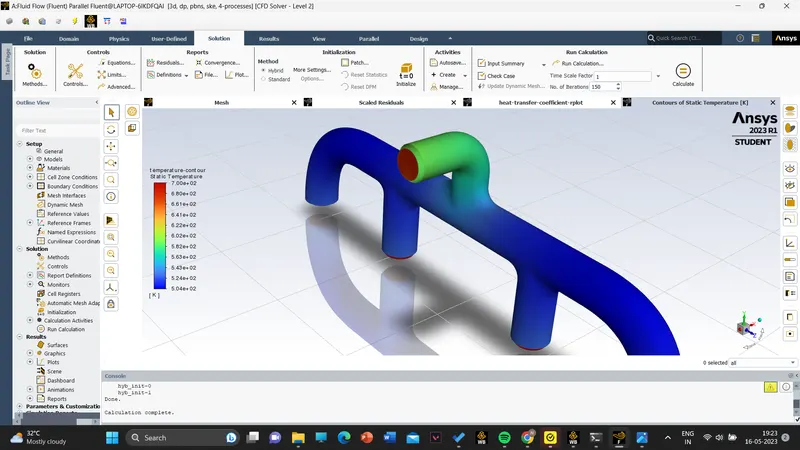
temperature contour
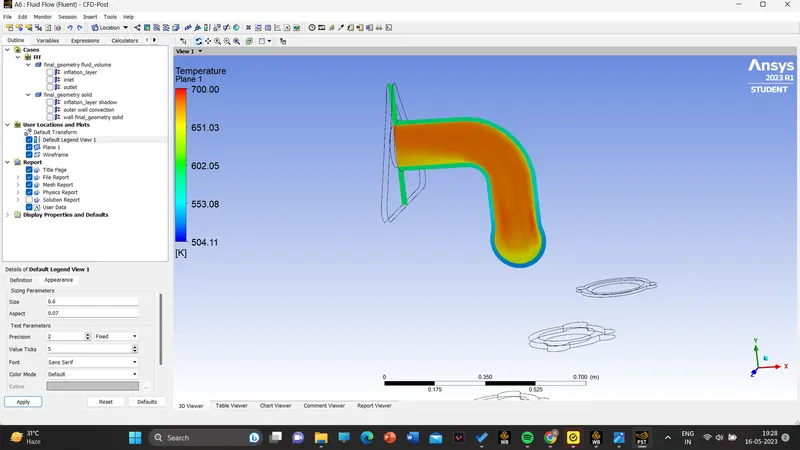
wall temperature plot
velocity plot
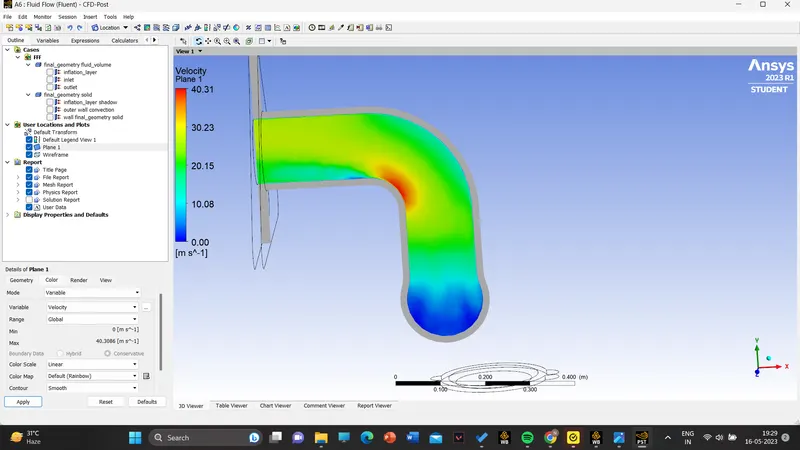
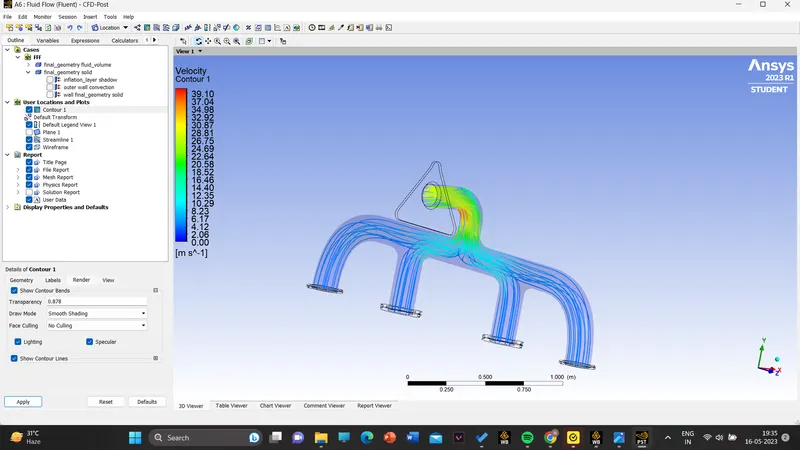
streamline velocity plot
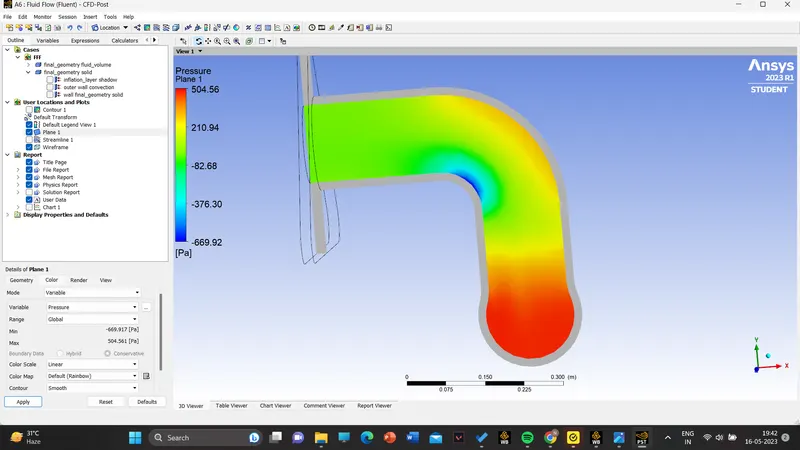
pressure plot
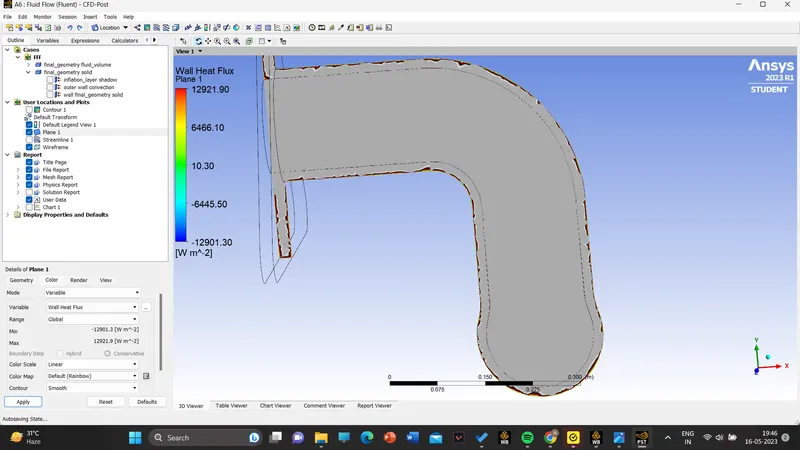
wall heat flux
Analytical solution -
The local heat transfer coefficient is analytically calculated by using Dittus - Boelter equation.
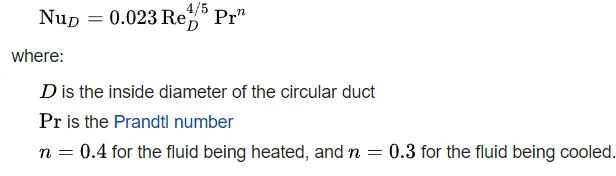
In this model, since working fluid is being cooled in the exhaust manifold, n is taken as 0.3
The characteristic length for the exhaust port is 150mm(Diameter)
Properties of working fluid(air) -
Density = 1.225 kg/m3, Thermal conductivity = 0.0242 W/m-K, Dynamic viscosit = 1.789e-5 Pa-s, Specific heat at constant pressure = 1006.43 J/Kg-K
From the above equation, we get
(hD/k) = 0.023*(V*D/ν)^0.8*(ν/α)^0.3
h = 19.92 W/m2-k
| S.NO | Variable | Analytical solution | Numerical solution |
| 1 | Heat transfer coefficient | 19.92 W/m2-K | 21.36 W/m2-K |
Since, Dittus - Boelter equation is less accurate, the obtained analytical solution is of 7% error.
CONCLUSION:
From the results, it is concluded that since continuity equation is valid throughout the domain, the velocity is maximum at the exhaust port due to which the local heat transfer coefficient is maximum at the exhaust port. Since local heat transfer coefficent value is maximum at the exhaust port, maximum heat is convected from fluid to the solid which makes exterior surface hotter. The heat transfer coefficient at the fluid-solid interface obtained from weigthed average method is of magnitude 21.36 W/m2-K.
The k-omega SST model captures wall effects accurately compared to k-epsilon model. Since in k-omega SST model, y+ < 5 which generates total cell count greater than 6 lakhs which is not possible to perform simulation in Ansys student version. So, the simulation is performed using k-epsilon model.