Week 8 - Simulating Cyclone separator with Discrete Phase Modelling
Simulating Cyclone separator with Discrete Phase Modelling
Aim: To perform analysis on cyclone separator and calculate the separation efficiency and pressure drop.
1. To write a few words about any four empirical models used to calculate the cyclone separator efficiency.
There are several empirical models that have been proposed in the literature to calculate the separation efficiency of a cyclone separator. Here are four examples:
Stairmand Model: The Stairmand model is a widely used empirical model that relates the collection efficiency of a cyclone separator to the particle diameter and the cyclone geometry. The model assumes that the flow inside the cyclone is fully developed and that the centrifugal force is the dominant mechanism for particle separation.
Lapple Model: The Lapple model is another commonly used empirical model that relates the separation efficiency of a cyclone separator to the particle size and the inlet velocity. The model assumes that the particles follow a streamline path and that the separation efficiency is determined by the balance between the centrifugal force and the drag force.
Barth Model: The Barth model is an empirical model that considers the effect of particle size distribution on the separation efficiency of a cyclone separator. The model assumes that the particle size distribution follows a log-normal distribution and that the separation efficiency is determined by the cut size of the cyclone.
Plitt Model: The Plitt model is an empirical model that relates the separation efficiency of a cyclone separator to the inlet velocity and the particle size. The model assumes that the separation efficiency is determined by the ratio of the centrifugal force to the drag force acting on the particles.
It is important to note that empirical models are based on simplified assumptions and may not accurately predict the separation efficiency of a cyclone separator under all operating conditions. Therefore, experimental validation is necessary to confirm the actual separation efficiency of a cyclone separator.
2. To perform an analysis on a given cyclone separator model by varying the particle diameter from 1 μm to 5 μm and calculate the separation efficiency in each case.
Discuss the results. [Use both the velocity's as 3m/sec.]
3. To perform an analysis on a given cyclone separator model by varying the particle velocity from 1 m/sec to 5 m/sec and calculate the separation efficiency and pressure drop in each case. Discuss the results. [Use particle diameter size as 5 μm for all cases & keep flow velocity same as particle velocity]
GOEMETRY CHECK AND METHOD.
1. IMPORT 3D MODEL OF CYCLONE SEPERATOR AND EXTRACT THE VOLUME INSIDE TO USE IN CALCULATION AND SIMULATION. SUPPRESS THE OUTER BODY MODEL.
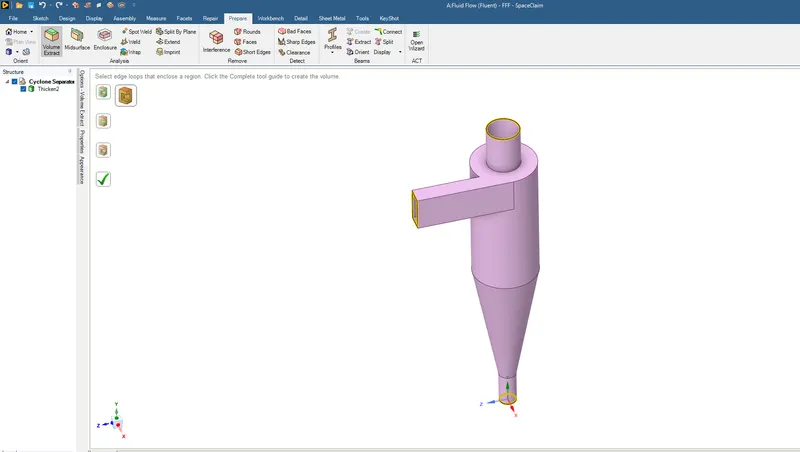
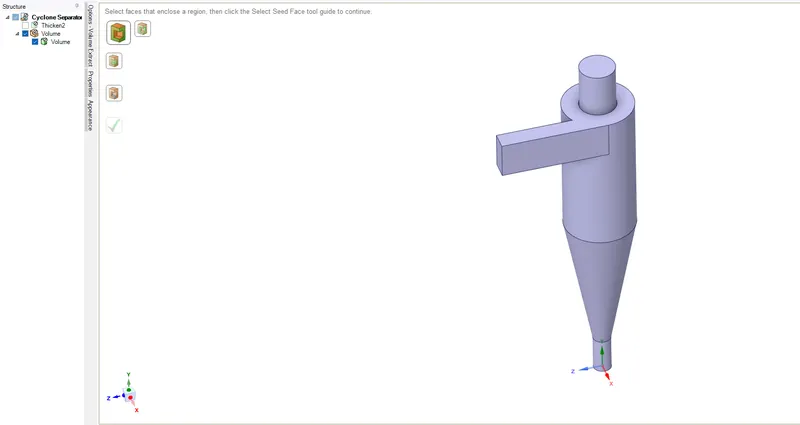
FOR MESHING:
DETAILS OF MESH TYPE AND ELEMENT SIZE.
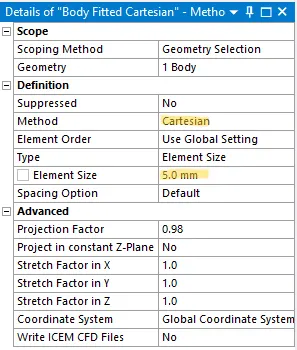
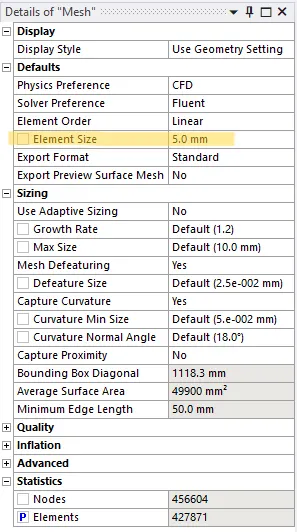
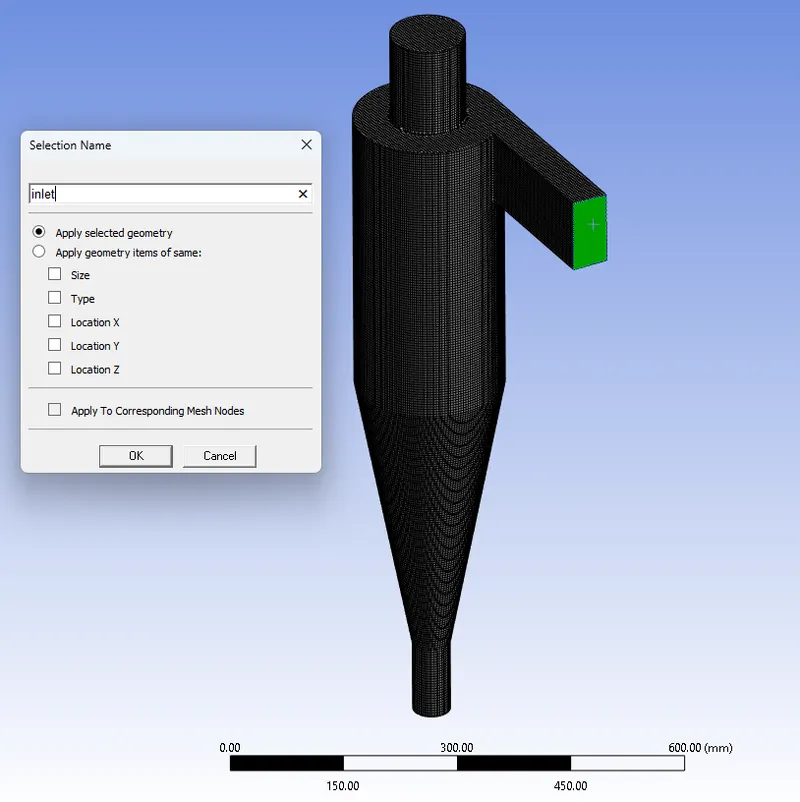
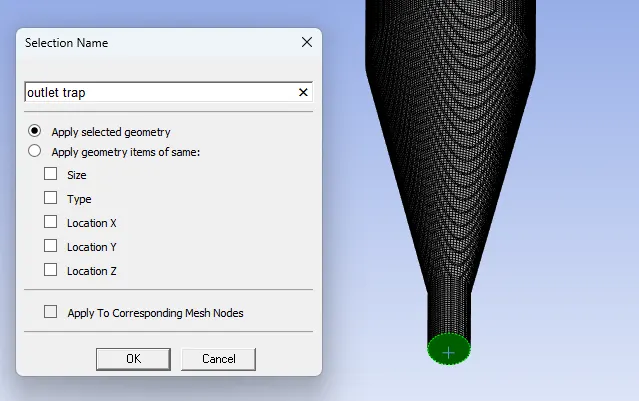
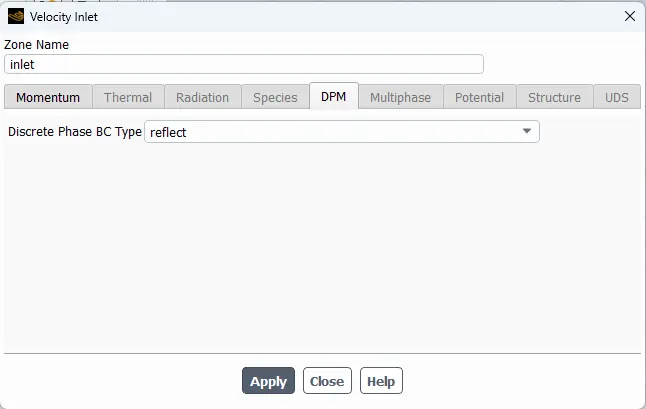
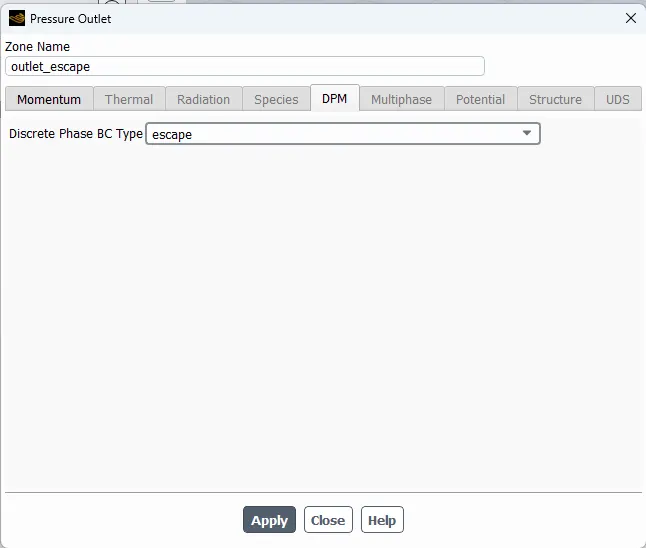
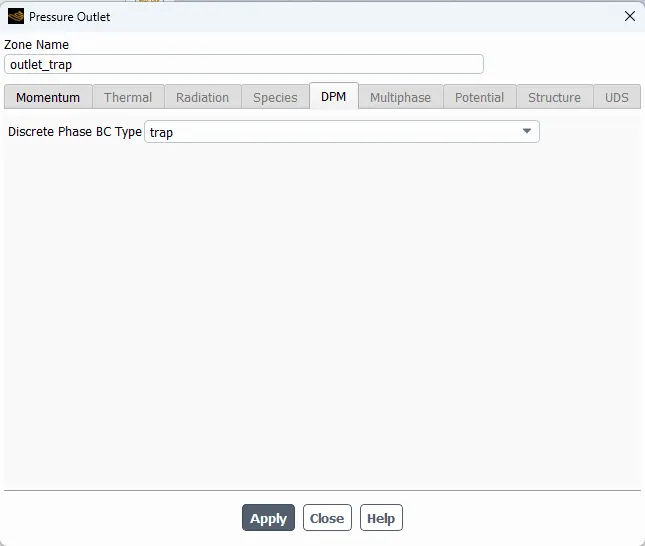
THEN NAMED THE SURFACES AS INLET, TRAP AND ESCAPE.
SOLUTION AND SETUP:
| SETUP - ANSYS FLUENT | |
| SOLVER TYPE | PRESSURE BASED |
| SOLVER TIME | STEADY STATE |
| GRAVITY | ENABLED (Y=-9.81m/s^2) |
| VISCOUS MODEL | K-EPSILON |
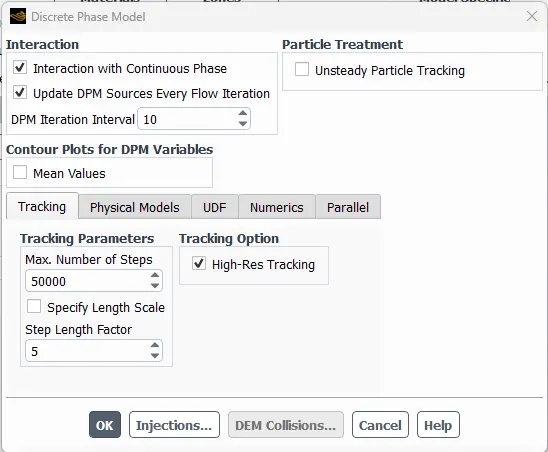
| DPM | ENABLED |
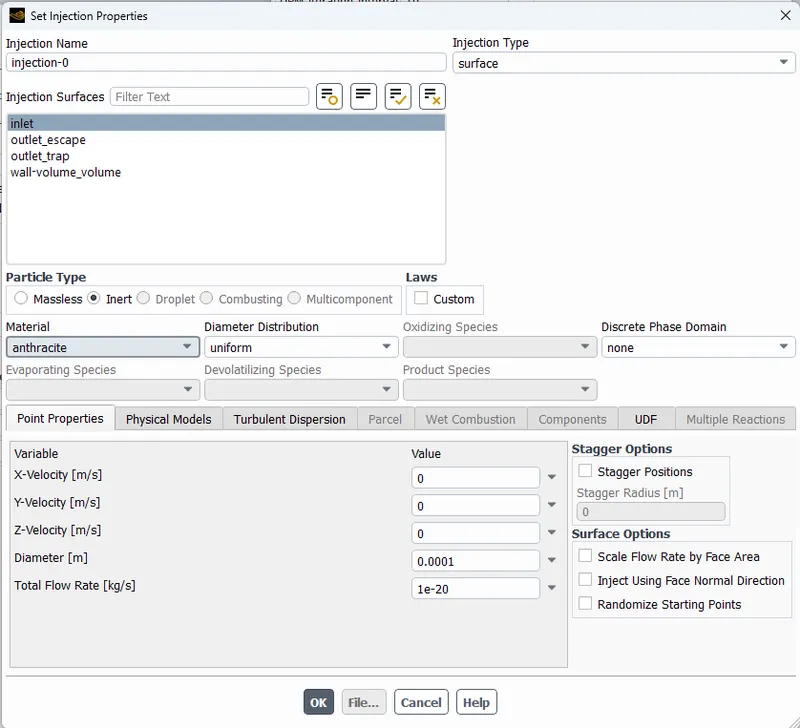
| INJECTION (ANTHRACITE PARTICLES) | SURFACE INJECTION |
| PARTICLE DIAMETER | 1 µm - 5 µm |
| PARTICLE VELOCITY | 1 m/s - 5 m/s |
| MATERIAL (FLUID) | AIR |
| INLET (VELOCITY) | 1 m/s - 5 m/s |
| OUTLET - ESCAPE | DPM - ESCAPE |
| OUTLET -TRAP | DPM - TRAP |
ANIMATION:
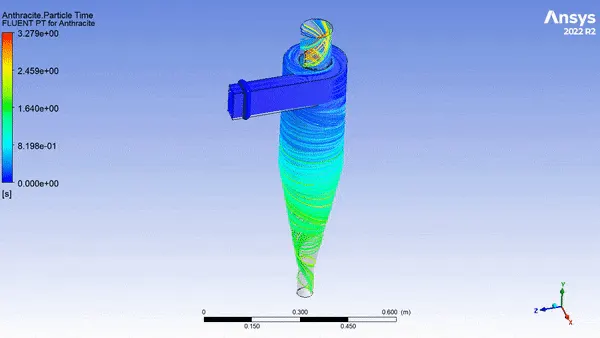
CALCULATION OF SEPERATION EFFICIENCY:
N=PARTICLES TRAP/PARTICLES TRACKED X 100%
RESULTS:
SEPERATION EFFICIENCY AT RESULTS:
| Size of particles | velocity input | no. particles tracked | no. of particles trapped | No. of particles escaped | Cyclone Seperator Efficiency |
| 5 µm | 1 m/s | 378 | 245 | 133 | 65% |
| 3 m/s | 378 | 307 | 71 | 81% | |
| 5 m/s | 378 | 299 | 79 | 79% | |
| 3 µm | 3 m/s | 378 | 270 | 108 | 71% |
| 1 µm | 3 m/s | 378 | 250 | 128 | 66% |
PRESSURE DROP AT RESULTS:
| Size of particles | velocity input | pressure (pa) | |||
| pressure at tracked | pressure at escape | pressure trapped | pressure drop | ||
| 5 µm | 1 m/s | 5.524 | 4.1 | 2 | 0.576 |
| 3 m/s | 5.5 | 4.207 | 2.33 | 1.037 | |
| 5 m/s | 5.506 | 4.207 | 2.1 | 2.107 | |
CONCLUSION:
The simulation of cyclone separator separation efficiency can be useful for predicting the performance of the device under different operating conditions and for optimizing the design parameters. The accuracy of the simulation results depends on several factors, including the quality of the computational model, the accuracy of the input parameters, and the appropriateness of the separation model used.
Empirical models can provide a quick estimate of the separation efficiency, but they are based on simplified assumptions and may not accurately predict the performance of the device under all operating conditions. Therefore, it is important to validate the simulation results with experimental data to ensure their accuracy.
In general, the separation efficiency of a cyclone separator can be improved by increasing the diameter of the cyclone and reducing the size of the particles being separated. Other design parameters, such as the inlet shape and the length of the cyclone, can also affect the separation efficiency.
Overall, simulation of cyclone separator separation efficiency can be a valuable tool for optimizing the design and operation of the device to achieve the desired separation performance.
In the result for in first case,I observed that as the particle diameter increases, the centrifugal force required to separate the particles from the gas stream also increases. This means that larger particles are more difficult to separate than smaller particles, and the separation efficiency of the cyclone separator will decrease as the particle diameter increases. For the second case with a constant of particle size and varry the velocity from 1 to 5 m/s, increasing the inlet velocity can increase the centrifugal force acting on the particles, which improve the separation efficiency of the cyclone separator.