Week 8 - Simulating Cyclone separator with Discrete Phase Modelling
REPORT FOR CHALLENGE-8
Aim : To Perform analysis on cyclone separator using Ansys Fluent software by varying the particle diameter from 1 μm to 5 μm and calculate the separation efficiency in each case. Discuss the results. [Use the velocity as 3m/sec.]
Software Required : Ansys Workbench – Fluid Flow vR2-2022
Hardware Required : Desktop, Keyboard, Mouse, CPU.
Theory:
Cyclone separators or simply cyclones are separation devices that use the principle of inertia to remove particulate mattee from flue gases. Cyclone separators is one of many air pollution devices known as precleaners since they generally remove larger pieces of particulate matter. This prevents finer filtration methods from having to deal with large, more abrasive particles.
How It Works:
Cyclone separators work much like a centrifuge, but with a continuous feed of dirty air. In a cyclone separator, dirty flue gas is fed into a chamber. The inside of the chamber creates a spiral vortex, similar to a tornado. This spiral formation and the separation is shown in Figure 2. The lighter components of this gas have less inertia, so it is easier for them to be influenced by the vortex and travel up it. Contrarily, larger components of particulate matter have more inertia and are not as easily influenced by the vortex.Since these larger particles have difficulty following the high-speed spiral motion of the gas and the vortex, the particles hit the inside walls of the container and drop down into a collection hopper. These chambers are shaped like an upside-down cone to promote the collection of these particles at the bottom of the container. The cleaned flue gas escapes out the top of the chamber.
Effectiveness:
Cyclone separators are generally able to remove somewhere between 50-99% of all particulate matter in flue gas.How well the cyclone separators are actually able to remove this matter depends largely on particle size. If there is a large amount of lighter particulate matter, less of these par0ticles are able to be separated out. Because of this, cyclone separators work best on flue gases that contain large amounts of big particulate matter.
Discrete Phase Model:
A division of multiphase flows is the discrete phase model. When attempting to analyze the behavior of the particles from both a Lagrangian and discrete perspective, a discrete phase model (DPM) is often employed via Ansys Software. The difference between the Lagrangian and Eulerian views is that the Eulerian perspective assumes a finite volume element in the fluid flow route while the Lagrangian view bases its analysis of fluid behavior on particle tracking of a particulate flow.
Navier-Stokes equations are used in the discrete phase model to solve the continuous phase. Countless particles, bubbles, or droplets are tracked at once to approximate the discrete phase. Specifically, those that cross the predicted continuous flow field.
Procedure :
Geometry:
- Open this page claim and important geometry.
- Now extract the volume by selecting all the edges in Edge selection mode.
- Then surprise the body for physics.
Meshing:
- Open the meshing.
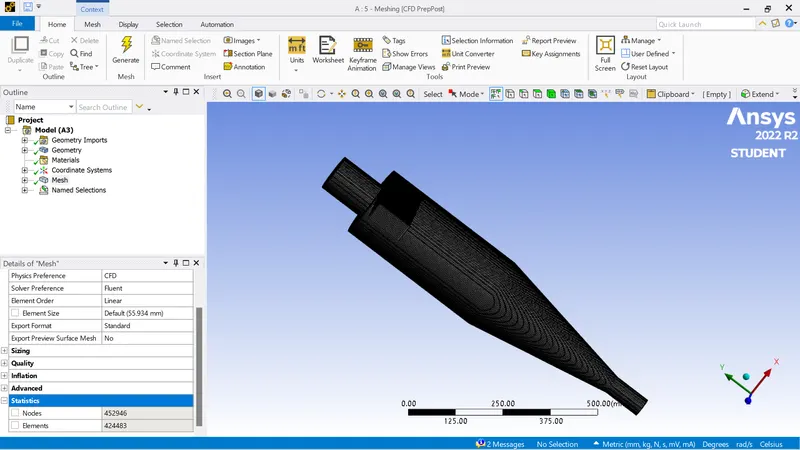
- Now generate the refined mesh for more particle injection, for that sake we need to generate the cartesian mesh.
- Now select the method and convert to cartesian and update.
- Then assign names to all the faces and close.
Set-up and solving:
- Open the setup by choosing the requirements of your laptop for this solving process.
- Set the gravity invoire direction with 9.81.
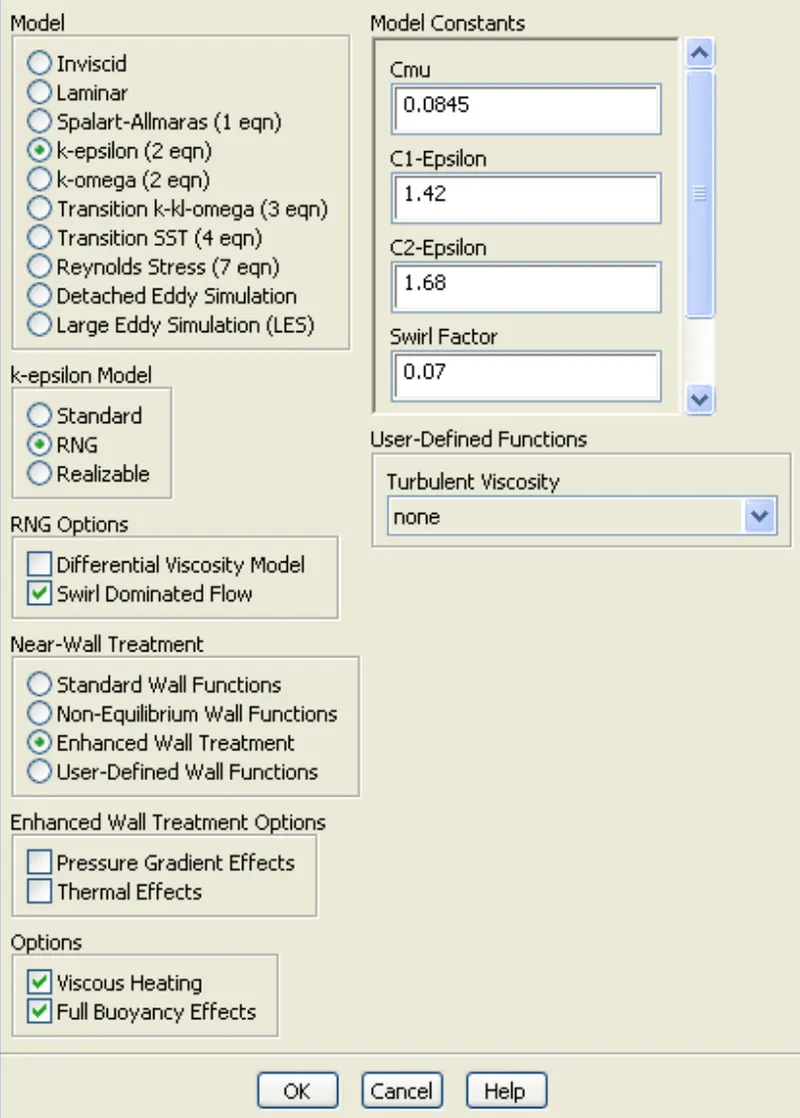
- Open the physics tab and choose the K-Epsilon turbulence model.
- Then change it to RNG swirl dominant wall enhanced.
- Open the boundary conditions and give the inlet velocity as 3 m/s.
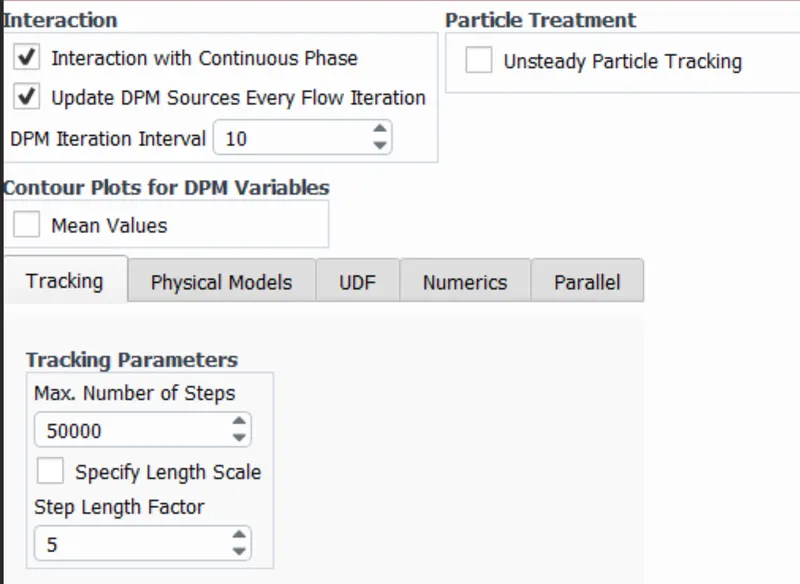
- Now open the discrete face model and activate the iteration with continuous phase and also update dpm and set it to default.
- Now open the injections, then click create and set surfaces inlet then choose the option of injecting the particle normal to the surface.
- Then give the particle size as per the given case and velocity is 3 m/s.
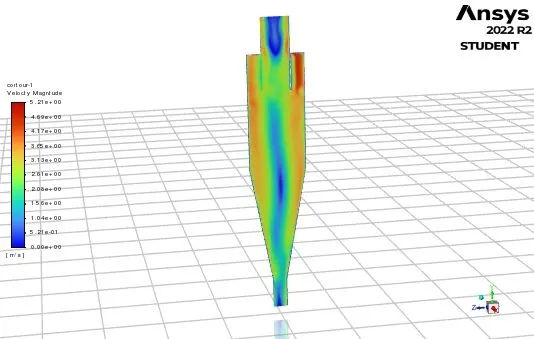
- Now create the contours for the velocity and pressure after initialisation in standard mode from the inlet.
- Then give the number of iterations and calculate.
Observations :
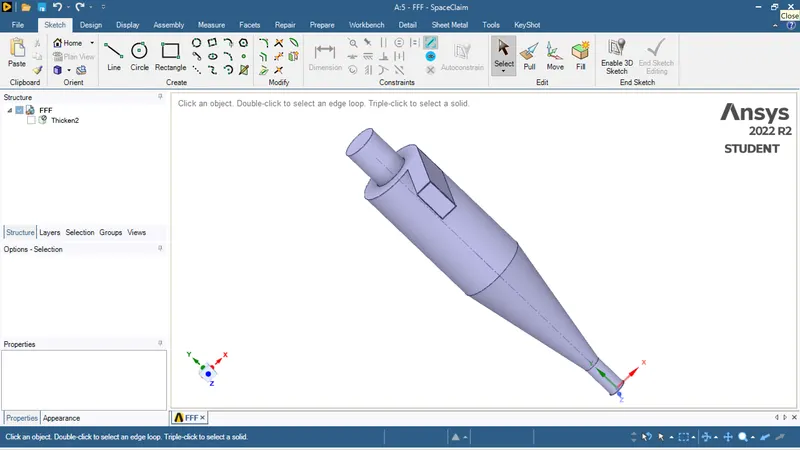
Geometry:
-Model to be Analize after Cad clean-up.
Mesh Details:
Viscous Model Deatils:
Discrete Phase Model:
Boundary Conditions:
Inlet- V=3m/s
Solution Status:
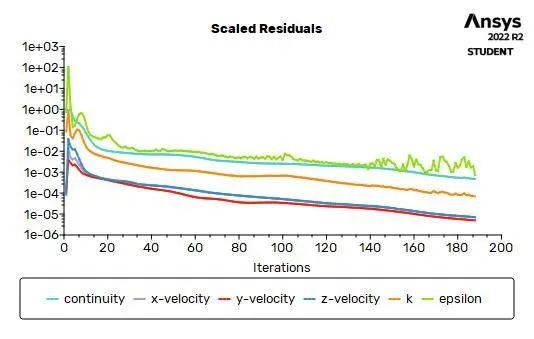
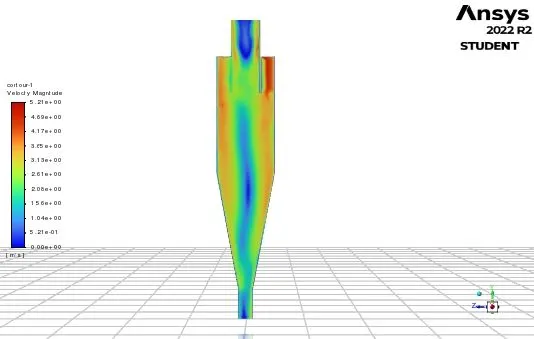
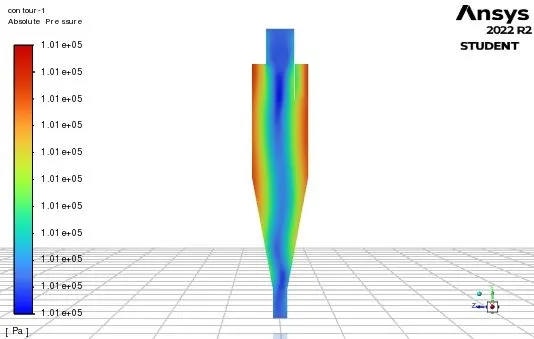
Case-1:
Plots and Contours:
Case-2:
Plots and Contours:
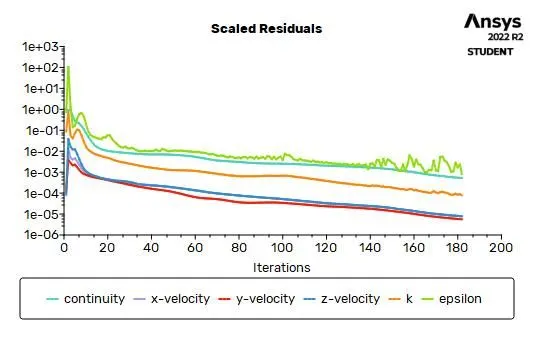
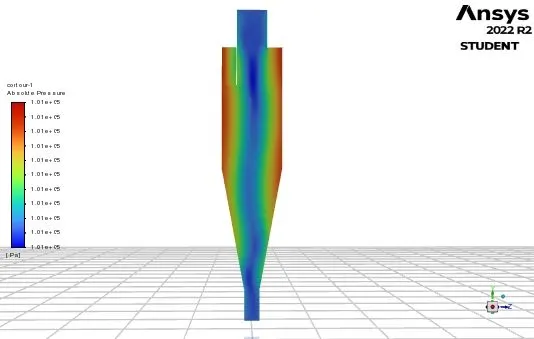
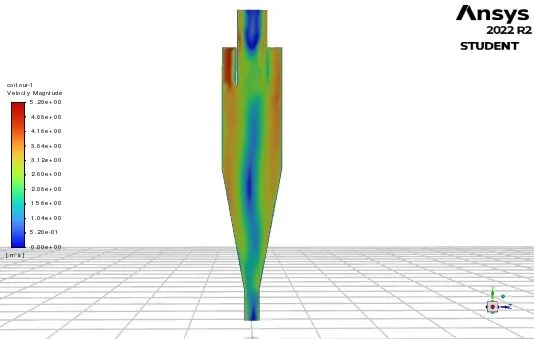
Case-3:
Plots and Contours:
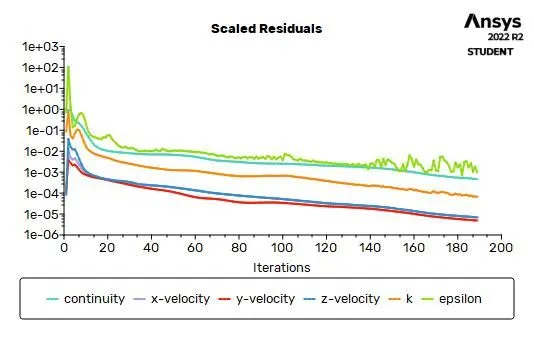
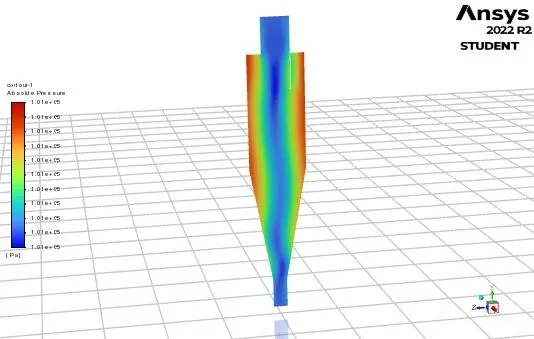
Precautions :
1.Carefully solve the problem.
2.Choose the suitable methods carefully for to get the desired results.
3.Note the coordinates carefully.
Result:
| Case | Element Size | Cyclone seperator data | Inlet | Outlet | Efficiency | Efficiency in % | |||||
| Tracked | Traped | Escaped | Incomplete | Pressure | Velocity | Pressure | Velocity | ||||
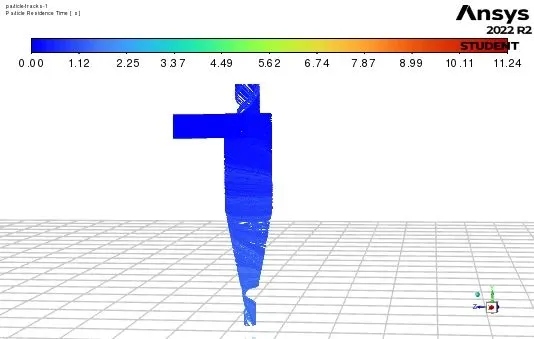
| 1 | 1e-6 | 378 | 266 | 99 | 13 | 27.02 | 3 | 3.907 | 2.151 | 0.703 | 70.3 |
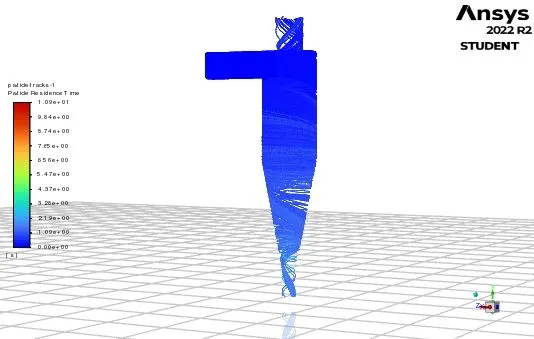
| 2 | 3e-6 | 378 | 271 | 94 | 13 | 26.955 | 3 | 3.899 | 2.150 | 0.717 | 71.7 |
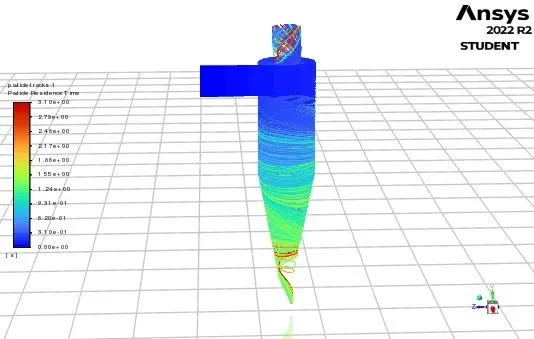
| 3 | 5e-6 | 378 | 269 | 109 | - | 27.032 | 3 | 3.908 | 2.152 | 0.703 | 70.3 |
case-1:For particle size of 1e-6
case-2:For particle size of 3e-6
case-3:For particle size of 5e-6
Conclusion:
After the analysis, we can say that the particle diameter influence is higher in the capturing process inside the cyclone seperator.Time Residence inside the particle diameter is higher if the particle diameter is high vice-versa.
After entering the particle in to the cyclone seperator, it undergoes the rotational motion due to the vortexes and eddys inside the seperator. Because of the rotational flow centrifugal force is acts on the particle, ultimately particle pushed to the wall, then because of the pressure difference heavier particle falls doen and lighter particles gets escapes.
The density of an object is its mass per unit volume. Objects float when their density is less than the fluid. It is because the downward pressure of the object's weight is less than the upward pressure of the fluid at that depth.
We can ssy that the efficiency of the cyclone seperator is higher when the trapped particles are almost equal to the tracked particles.