Week 8 Multi cell Battery Pack
AIM : To explain how weakest cell limits the usable capacity of the battery pack and give a solution.
SOLUTION :
A cell refers to anode and cathode separated by electrolye which is used to produce voltage and current. A battery may be made up of one or more cells.
When a battery pack is designed using multiple number of cells it is important to design the electronic features to contiuously balance cell voltages.
When we use multiple cells , there may be differences in their electronic features such as in level of voltage and current.
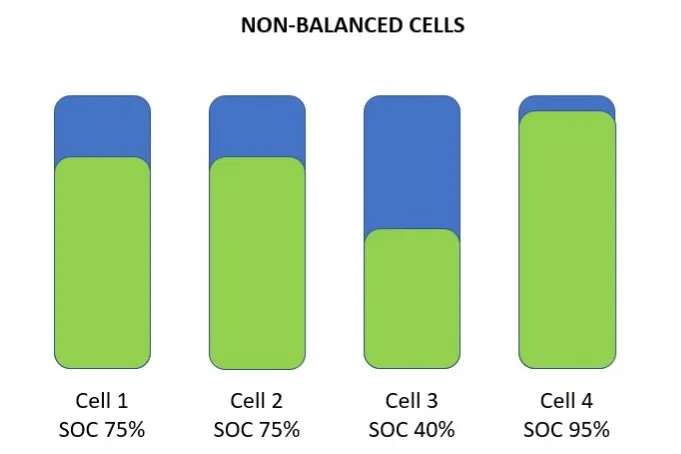
The imbalance in the levels occur due to coulombic efficiency(ratio of charge extracted from battery to charge put),different discharge rate,capacity,impedence and leakages.
Manufacturers will sort cells by similar voltage to match as close as possible, but there are still slight variations in the individual cells impedance, capacity, and self-discharge rate that can eventually lead to a divergence in voltage over time.
Example, If a lithium cells are overheated or over charged they are prone to accelerated degradation. They can catch fire or explode even if cell voltage exceeds 4.2 voltage by millivolts.
So the use of cell balancing enables us to design a battery with larger capacity for an application because balancing allows the battery to achieve a higher state of charge(SOC). SOC is related to the available charges left in a battery.
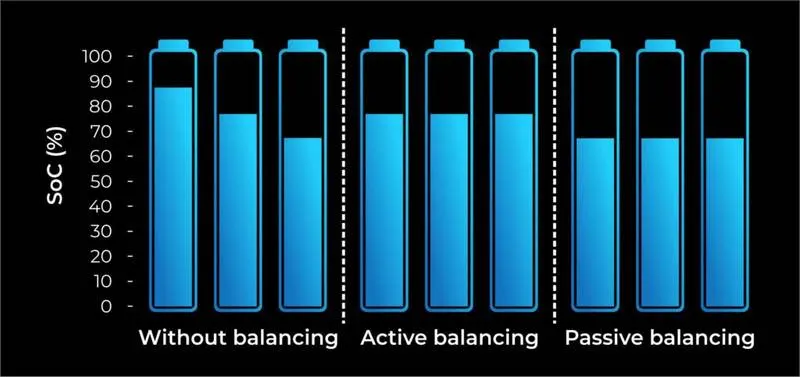
Cell balancing a technique which is used equalize voltages and state of charge among cells.
How weakest cell limits the usable capacity of the battery pack ?
Weaker cells are the ones which have lower capacity or impedence compared to their counter parts.
They exhibit higher voltage than the rest of the series cells at full charge termination. These cells are then weakened further by continuous overcharge cycles. The higher voltage of the weaker cells at charge completion causes accelerated capacity degradation.
During discharge , the weak cells tend to have lower voltage than the other cells, due to either higher internal resistance, or a faster rate of discharge that results from the lower capacity. This means that if any of the weak cells hits the cell under voltage protection limit while the pack voltage is still sufficient to power the system, the full capacity of the battery will never be used as the pack protector will prevent over discharge (which would damage the cell) by stopping the discharge of the whole pack.
Thus we deploy cell balancing techniques. Cell balancing not only improves performance and life cycles, but also provides safety to the battery as well as the users.
There are two methods which can be used to balance the cells with respect to SOC.
*Passive cell balancing
*Active cell balancing
PASSIVE CELL BALANCING : Here cells are discharged through a dssipative bypass route. The bypass is eoither integrated or external to integrated circuit.
The excess energy is dissipated as heat. This becomes a drawback for passive mathod.
ACTIVE CELL BALANCING : This method uses capacitance or inductance which stores the excess charges transferring power between battery lines whenever it is needed. Active method is more efficient than passive cell balancing.