Week - 8 Mass Scaling
Aim:
The Objective of this Challenge is to understand the Mass-Scaling Parameters in Explicit Analysis.
Description:
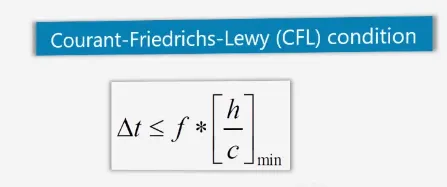
Mass Scaling is a technique to increase the Timestep of Explicit Dynamic Analysis. The Important Concern in the Explicit analysis is the smaller Time step. The Minimum Timestep required for Explicit analysis is defined by Courant-Friedrich's-Lewy Condition. Where h is the Characteristic Length of Finite Element and c is the Velocity of Longitudinal Sound Wave in the Material. The Implicit Analysis is the Timestep dependant and the minimum timestep largly depends upon the Element's Characteristic length. It is not possible to maintain the uniform mesh size in all areas of mesh, smaller features in the Design require lower mesh size. Implicit simulation will look for the smaller element in mesh & calculate the minimum time step accordingly.
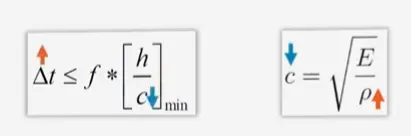
Mass scaling is a method used in implicit method to reduce the timestep. In the Mass scaling the mass is added to element which are found to be less than the Average mesh size. The mass increase is accomplished by locally increasing the density of the element. If the density is increased, the velocity of wave propagation is decreased, and thereby the Time step of the Element can be increased.
It is important to note that mass scaling should not be used globally, it should be only used for group of elements(locally) which are less than the Average mesh size. If the mass scaling is used for all elements in the mesh, then the accuracy of the simulation will be lost.
Unit-1 Influence of dt2ms on Mass Scaling:
The Mass-scaling Model.K is provided and the Estimated Time taken to solve the problem will be compared by changing the mass scaling parameter like "dt2ms" and "tssfac".
Case-1: In Case-1 the dt2ms is specified as 3.5e-5. The Estimated time to Complete the simulation is 21 Hours & 40 Minutes.
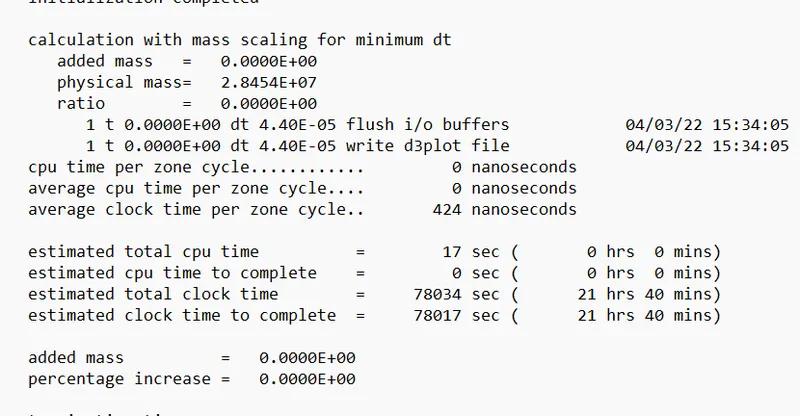
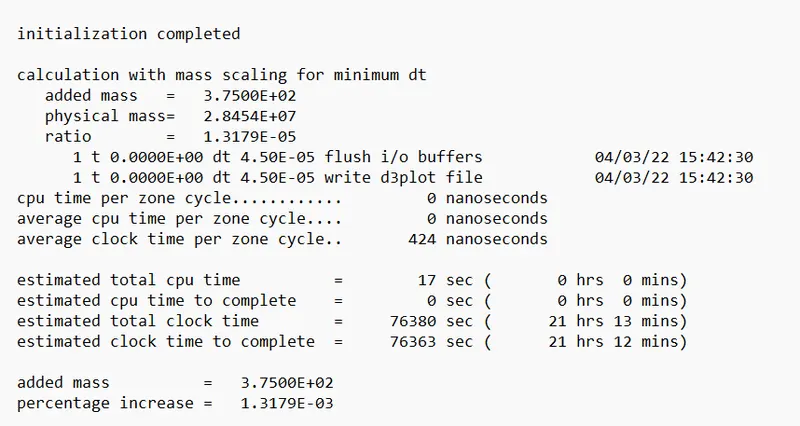
Case-2 The dt2ms is specified as -5e-5, The Estimated time to Complete the simulation is 22Hrs & 12mins. The Percentage of Extra mass Added = 0.13%. Since the Mass addition upto 8% is allowed, the Maximum limit for mass addition is computed as 2.276e6. The Non physical mass added with dt2ms value of -5.00e-5 is less than the maximum limit.
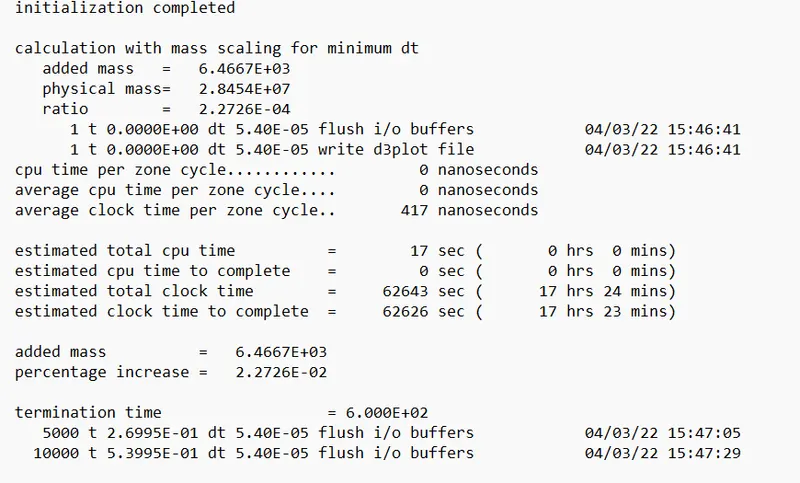
Case-3 The dt2ms is specified as -6e-5, The Estimated time to Complete the simulation is 17Hrs & 24mins. The Percentage of Extra mass Added = 0.02%. Since the Mass addition upto 8% is allowed, the Maximum limit for mass addition is computed as 2.276e6. The Non physical mass added with dt2ms value of -6e-5 is less than the maximum limit.
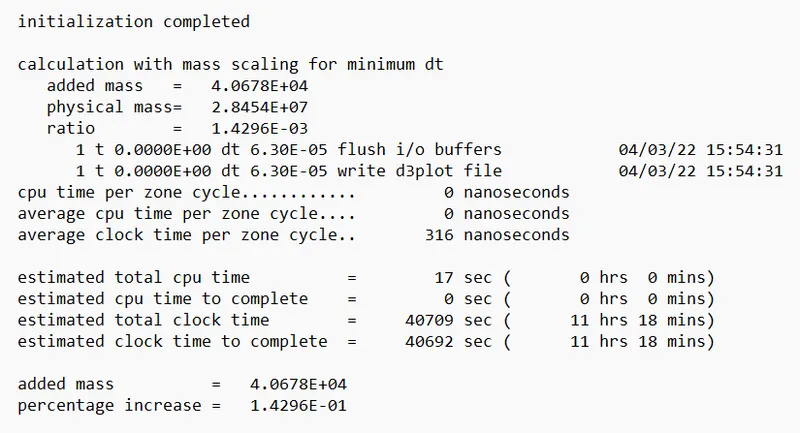
Case-4 The dt2ms is specified as -7e-5, The Estimated time to Complete the simulation is 11Hrs & 18mins. The Percentage of Extra mass Added = 0.14%. Since the Mass addition upto 8% is allowed, the Maximum limit for mass addition is computed as 2.276e6. The Non physical mass added with dt2ms value of -7e-5 is less than the maximum limit
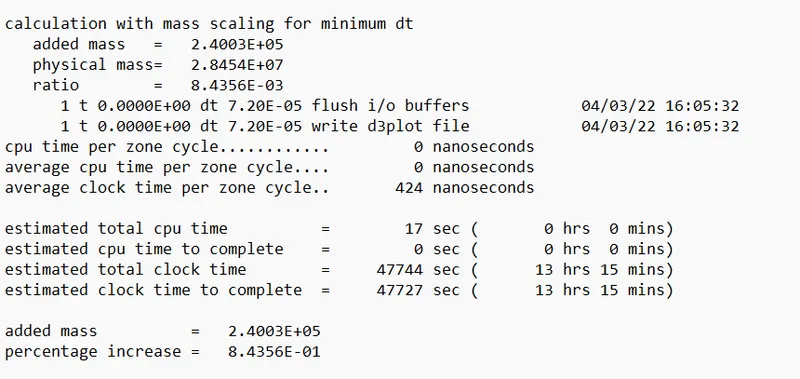
Case-5 The dt2ms is specified as -8e-5, The Estimated time to Complete the simulation is 13Hrs & 15mins. The Percentage of Extra mass Added = 0.8%. Since the Mass addition upto 8% is allowed, the Maximum limit for mass addition is computed as 2.276e6. The Non physical mass added with dt2ms value of -8e-5 is less than the maximum limit.
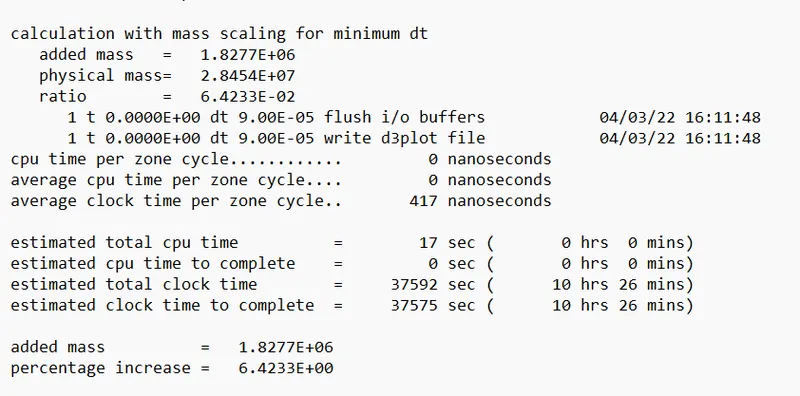
Case-6 The dt2ms is specified as -10e-5, The Estimated time to Complete the simulation is 10Hrs & 26mins. The Percentage of Extra mass Added = 6.4%. Since the Mass addition upto 8% is allowed, the Maximum limit for mass addition is computed as 2.276e6. The Non physical mass added with dt2ms value of -10e-5 is less than the maximum limit.
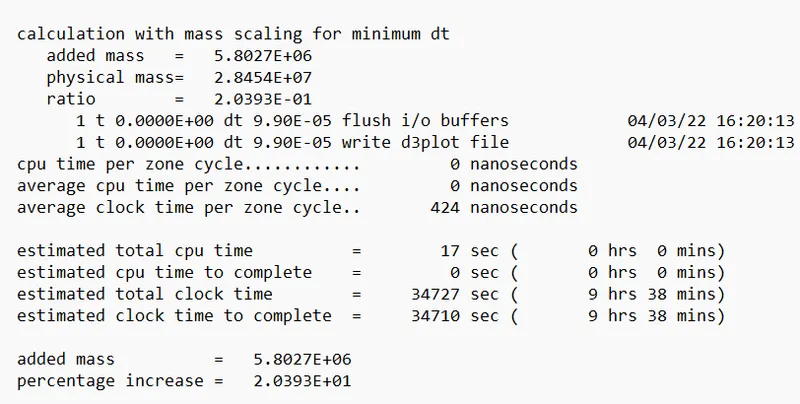
Case-7 The dt2ms is specified as -11e-5, The Estimated time to Complete the simulation is 9Hrs & 38mins. The Percentage of Extra mass Added = 20%. Since the Mass addition upto 8% is allowed, the Maximum limit for mass addition is computed as 2.276e6. The Non physical mass added with dt2ms value of -11e-5 is greater than the maximum limit.
The Value of dt2ms Vs Time is plotted in form of graph, The linear Trend line is drawn which shows the Decreasing trend of Simulation time with increase in dt2ms Value.
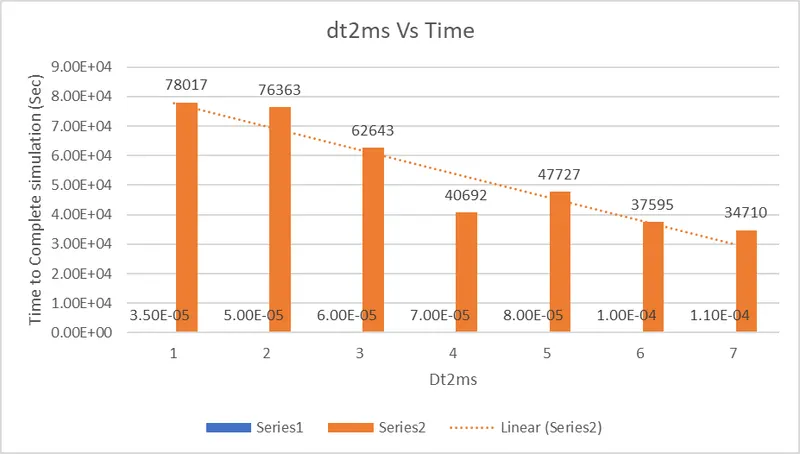
| S.NO | dt2ms | Simulation Time (Seconds) |
| 1 | 3.50E-05 | 78017 |
| 2 | 5.00E-05 | 76363 |
| 3 | 6.00E-05 | 62643 |
| 4 | 7.00E-05 | 40692 |
| 5 | 8.00E-05 | 47727 |
| 6 | 1.00E-04 | 37595 |
| 7 | 1.10E-04 | 34710 |
Unit-2 Influence of "tssfac" on Mass Scaling:
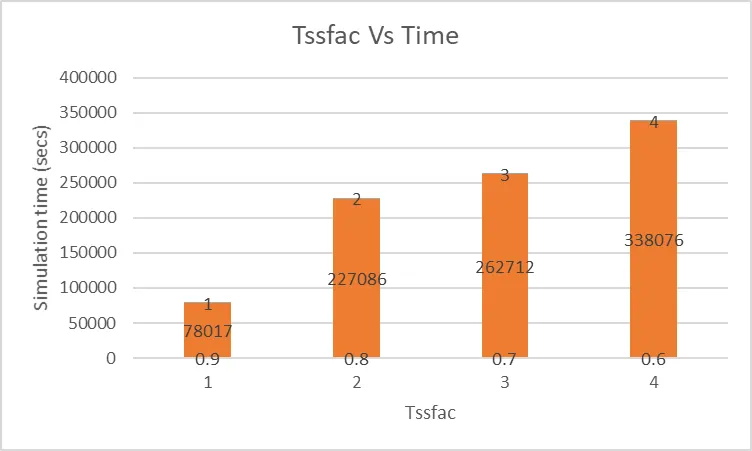
Decreasing "Tssfac", increases the Time taken to solve the given problem. The result make sense because the Tssfac is the time step factor which acts upon the minimum timestep specified in Dt2ms, Hence decreasing tssfac will decrease the minimuim timestep and hence the time taken to compete simulation increases. Tssfac can be reduced if the objective is to increase the stability of the problem at the cost of computational time.
Unit-3 Implicit Analysis:
The Problem is solved by using Implicit Method,The Influence of Dt2ms & tssfac is studied when solving problem by implicit method. The Implicit Settings are provided below.
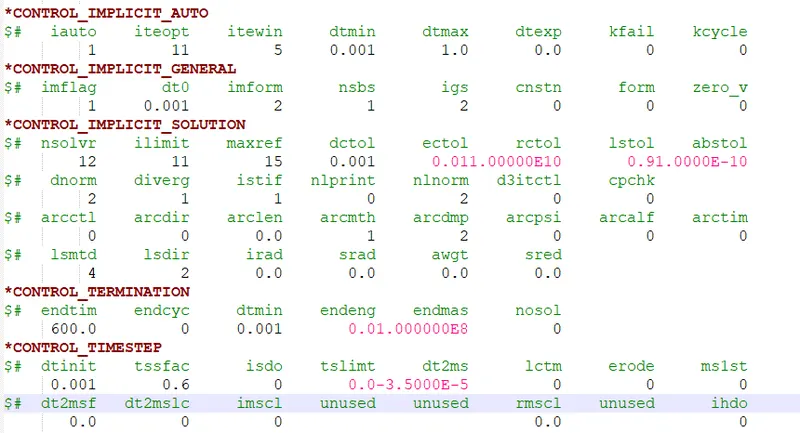
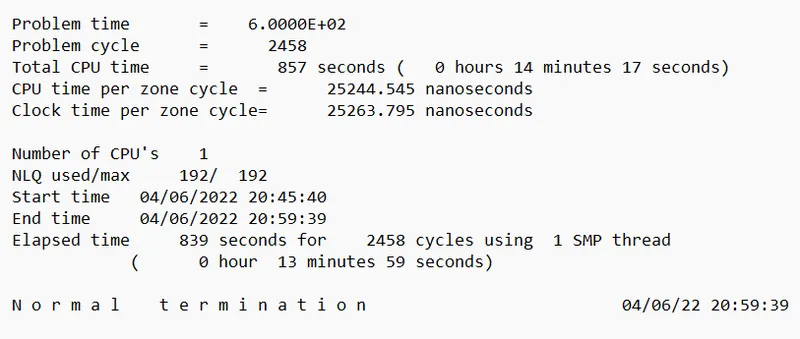
Case-1 Dt2ms Value = -3.5e-5, Time taken to complete the Simulation is 14 Minutes.
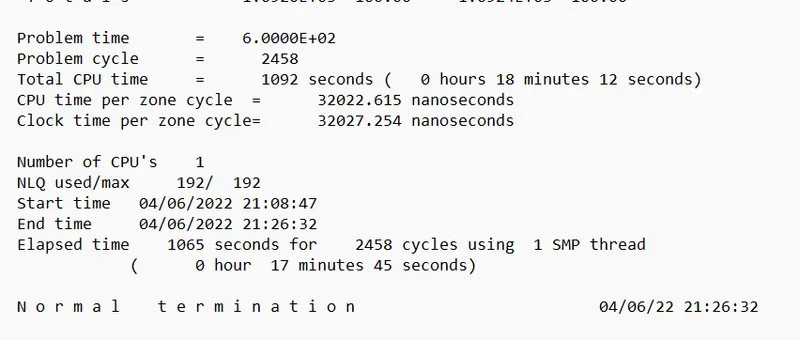
Case-2 Dt2ms Value = -7e-5, Time taken to complete the simulation is 18 minutes.
Conclusion:
1. The Increase the Value of Dt2ms increase the mass addition and decrease the time required to solve the implicit problem.
2. The Value of non-physical mass addition increases with increase in value of Dt2ms.
3. The tssfac is the timescale factor is multiplied by timestep specified under dt2ms, to get the minimum time step. Hence reducing timescale factor will increase the time taken to complete the simulation. The advantage of decreasing the timescale factor is it improves the stability of implicit problem.
4. The Effect of Dt2ms & Tssfac is not significant incase of Implicit Analysis.
5. The Parameters which affects the time taken of Implicit analysis are dtmin & Dtmax specified under the CONTROL_IMPLICIT_AUTO card. Reducing the Dtmin & Dtmax will increase the time taken to solve the Implicit problem.