Week - 8 Mass Scaling
MASS SCALING
AIM:
To use mass scaling to reduce the runtime of a model and ensure the stability of mass scaling.
To reduce the runtime required to run the analysis of the given model using mass scaling technique and stability has to be completely intact.
To plot a histogram to compare the runtime with mass scaling trials.
To optimize both the DT and TSSFAC parameters.
To run the same model using implicit solver with necessary changes and compare implicit and explicit runtime
Note: The hard limit on mass scaling is 8%.
INTRODUCTION:
Mass scaling refers to a technique whereby a non-physical mass is added to a structure to achieve a larger explicit timestep. One can selectively employ mass scaling by artificially increasing the material density of the parts you want to mass-scale. The primary motivation is to change the global compute timestep which is limited by the Courant’s stability criteria.
- LS-DYNA allows two different types of mass-scaling using the DT2MS parameter from *CONTROL_TIMESTEP with the default set to no mass-scaling.
- When DT2MS is less than zero, LS-DYNA adds mass of each element whose timestep is below abs (DT2MS) such that the element’s updated DT is equal to abs (DT2MS).
- When DT2MS is greater than zero, LS-DYNA adds mass to elements whose DT is below abs (DT2MS) and “removes” mass from elements whose DT is greater than zero.
- DT2MS>0 is seldom used while DTM2<0 is frequently used for overcoming the smallest computed timestep.
- Care must be taken when using DT2MS<0 to ensure that the added mass does not have an adverse effect on the simulation accuracy. It is common practice to limit the percentage of added mass to less than 5% (at part level) in dynamic simulations.LS-DYNA outputs the percentage of added mass at component level which is a better indicator of amount of added mass due to mass-scaling.
GIVEN MODEL :
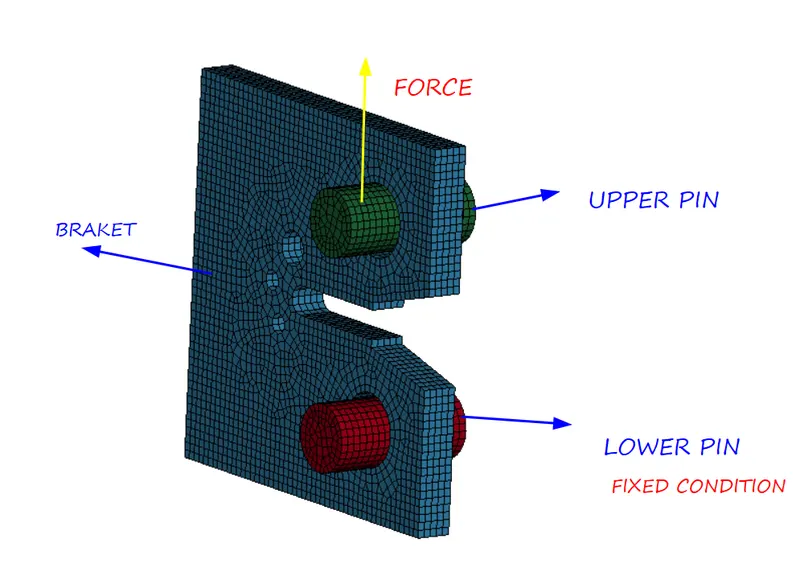
CASES :
mass scaling have two main parameter DT2MS and TSFF, two case is below
1. take constant value of TSFF and vary DT2MS
2. take optimum value from case 1 as constant DT2MS and vary TSFF
CASE 1
AFTER defining the all required card
define TSFF = 0.9 and DT2MS =0.00005 and run the simulation
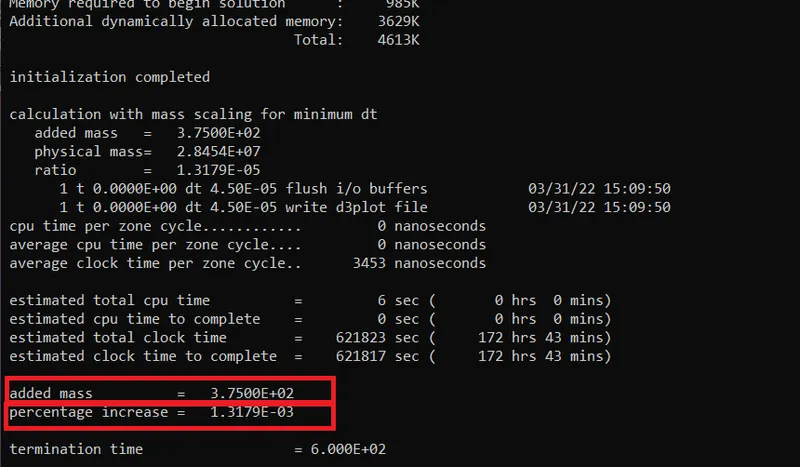
from the cmd we can get mass added and percentage increase.
if time is to high and mass added is too low then we can terminate the session safely
1. type clt+c
2. type sw1
3. select Y
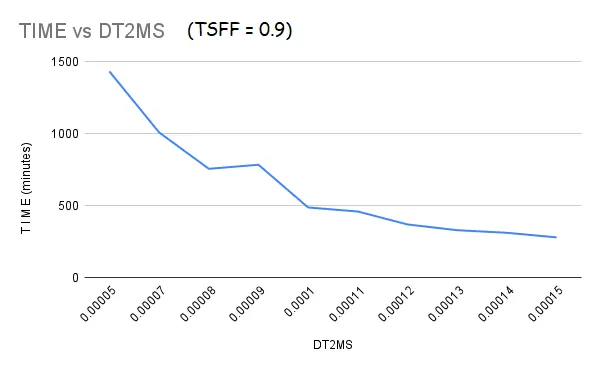
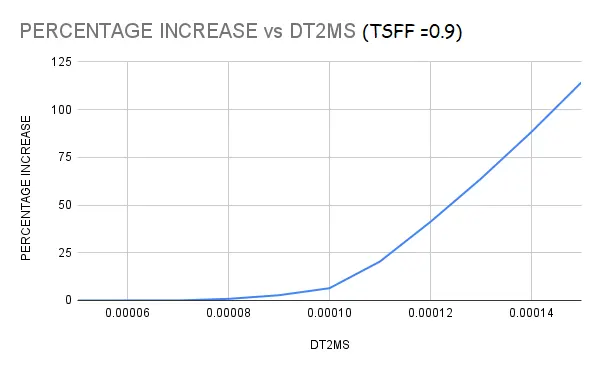
After running simulation for different-2 DT2MS values are shown below
| DT2MS | TIME | MASS | PERCENTAGE INCREASE |
| 0.00005 | 23 hr 54 min | 3.75 E+02 | 0.0001317 |
| 0.00007 | 16 hr 50 min | 4.06 E+04 | 0.0142 |
| 0.00008 | 12 hr 37min | 2.40 E+05 | 0.843 |
| 0.00009 | 13 hr 05 min | 7.80 E+05 | 2.744 |
| 0.00010 | 8 hr 08 min | 1.82 E+06 | 6.42 |
| 0.00011 | 7 hr 40 min | 5.80 E+06 | 20.39 |
| 0.00012 | 6 hr 10 min | 1.16 E+07 | 41.11 |
| 0.00013 | 5 hr 30min | 1.81 E+07 | 63.68 |
| 0.00014 | 5 hr 12min | 2.50 E+07 | 88.11 |
| 0.00015 | 4 hr 40 min | 3.25 E+07 | 114.32 |
Mass increase % is limited to 10% , from above table we can use 0.0001 as DT2MS
CASE2 :
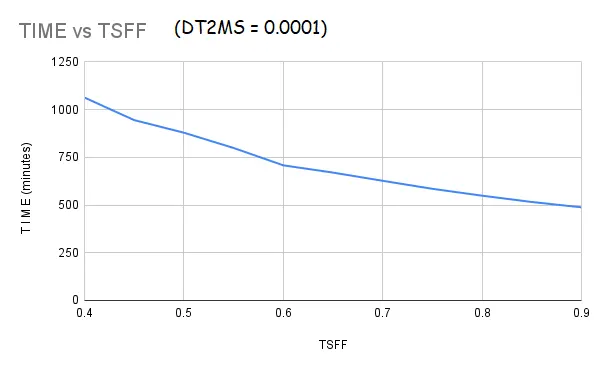
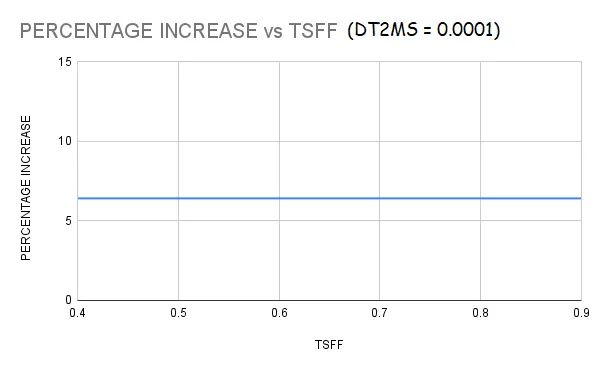
using DT2MS = 0.0001 as constant and vary TSFF , shown in below table
| TSFF | TIME | MASS ADDED | PERCENTAGE INCREASE |
| 0.4 | 17 hr 43 min | 1.82 E+06 | 6.42 |
| 0.45 | 15 hr 45 min | 1.82 E+06 | 6.42 |
| 0.5 | 14 hr 39 min | 1.82 E+06 | 6.42 |
| 0.55 | 13 hr 19 min | 1.82 E+06 | 6.42 |
| 0.6 | 11 hr 48 min | 1.82 E+06 | 6.42 |
| 0.65 | 11 hr 10 min | 1.82 E+06 | 6.42 |
| 0.7 | 10 hr 27 min | 1.82 E+06 | 6.42 |
| 0.75 | 9 hr 45 min | 1.82 E+06 | 6.42 |
| 0.8 | 9 hr 09 min | 1.82 E+06 | 6.42 |
| 0.85 | 8 hr 36 min | 1.82 E+06 | 6.42 |
| 0.9 | 8 hr 08 min | 1.82 E+06 | 6.42 |
from the table it is cleear that TSFF =0.9 take minimum time
PROBLEM IS DEFINED IN THIS CASE IS NOT MUCH DYNAMIC . IT IS QUASI STATIC SO WE CAN ALSO PERFORM THE IMPLICIT ANALYSIS
for implicit simulation , only we need to define the implicit control card
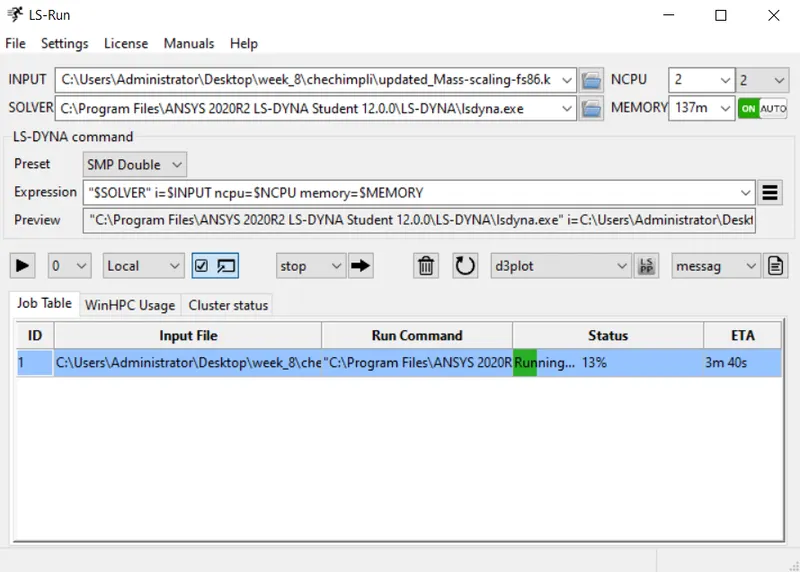
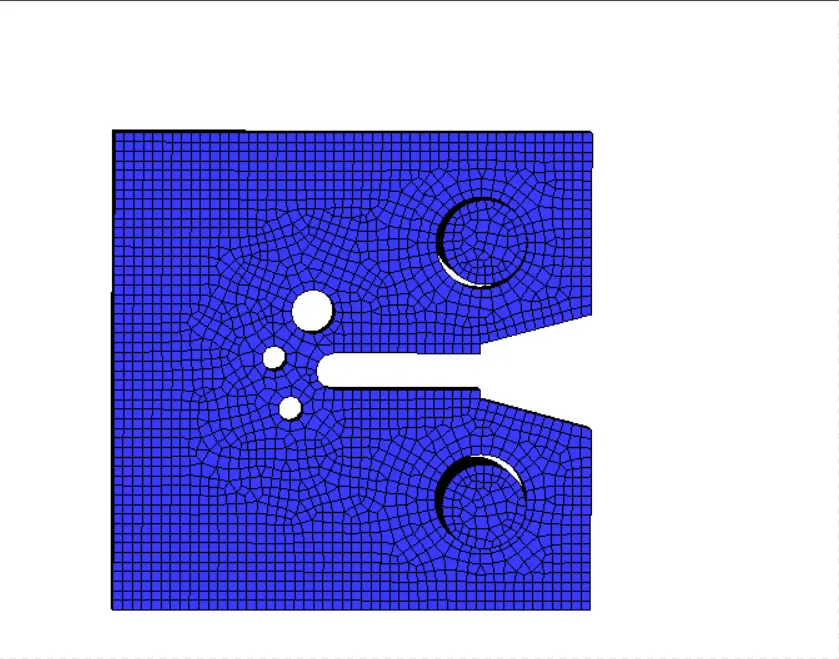
after running the implicit analysis from below image of cmd we can see simulation only take 3 min 40sec, which is drastically decrease in time
RESULT :
from the above tables it is clear that
- As DT2MS increse mass percentage is increase
- As TSFF increase time to run simulation decrease
If problem is not much dynamic we should run as implicit which runs faster then explicit