Week - 8 Mass Scaling
AIM:
i. To reduce the runtime required to run the analysis of the given model using mass scaling technique and stability has to be completely intact.
ii. To plot a histogram to compare the runtime with mass scaling trials.
iii. To optimize both the DT and TSSFAC parameters.
iv. To run the same model using implicit solver with necessary changes and compare implicit and explicit runtime.
Note: The hard limit on mass scaling is 8%.
INTRODUCTION:
Mass-scaling is a term that is used for the process of scaling the element's mass in explicit simulations to adjust its timestep. The primary motivation is to change the global compute timestep which is limited by the Courant's stability criteria.
LS-DYNA allows two different types of mass-scaling using the DT2MS parameter from *CONTROL_TIMESTEP with the default set to no mass-scaling.
When DT2MS is less than zero, LS-DYNA adds mass of each element whose timestep is below abs (DT2MS) such that the element's updated DT is equal to abs DT2MS).
When DT2MS is greater than zero, LS-DYNA adds mass to elements whose DT is below abs (DT2MS) and "removes" mass from elements whose DT is greater than zero.
DT2MS>O is seldom used while DTM2O is frequently used for overcoming the smallest computed timestep.
Care must be taken when using DT2MSO to ensure that the added mass does not have an adverse effect on the simulation accuracy. It is common practice to limit the percentage of added mass to less than 5% (at part level) in dynamic simulations. LS-DYNA outputs the percentage of added mass at component level which is a better indicator of amount of added mass due to mass-scaling.
PROCEDURE:
In this project, the runtime has to be reduced using mass scaling technique by varying the values of DT2MS and TSSFAC with percentage increase of mass within 8% using Explicit and Implicit analysis.
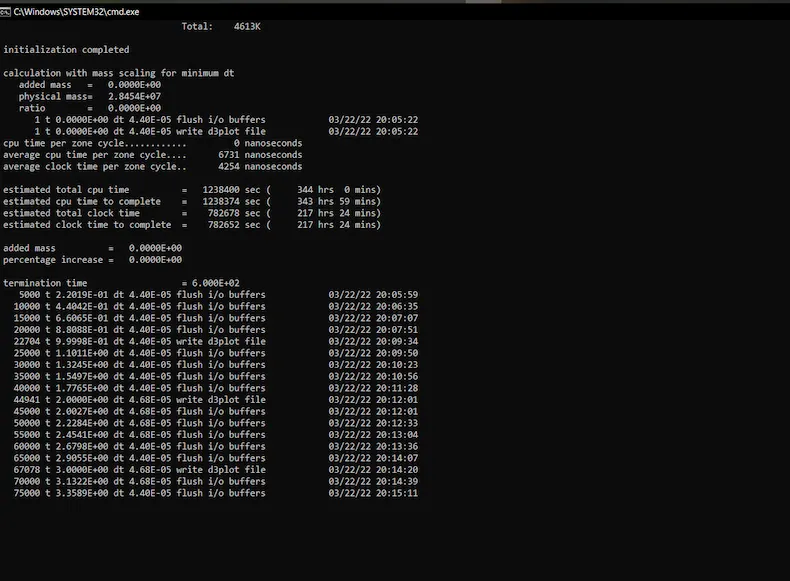
Control Timestep Card: - DT2MS = -3.500 E-05 & TSSFAC= 0.9

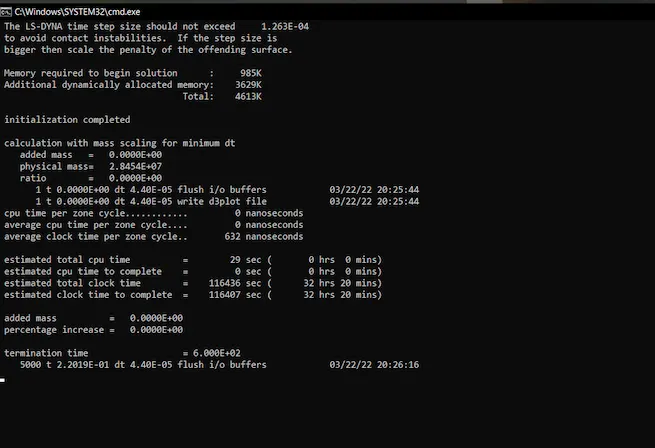
Control Timestep Card: - DT2MS = -3.000 E-05 & TSSFAC= 0.9

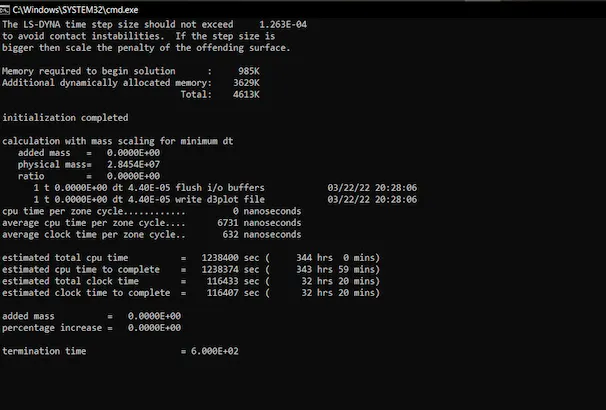
Control Timestep Card: - DT2MS = -4.000 E-05 & TSSFAC= 0.9

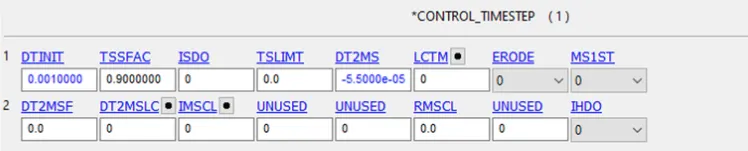
Control Timestep Card: - DT2MS = -5.500 E-05 & TSSFAC= 0.9
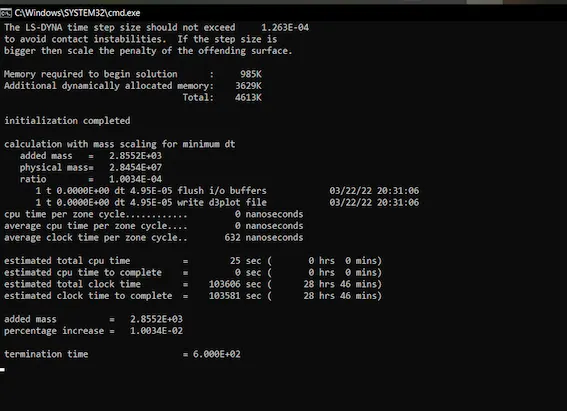
Control Timestep Card: - DT2MS = -7.500 E-05 & TSSFAC= 0.9

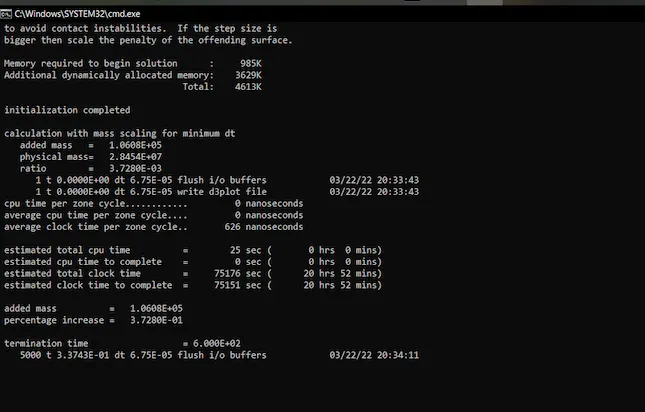
Control Timestep Card: - DT2MS = -9.500 E-05 & TSSFAC= 0.9

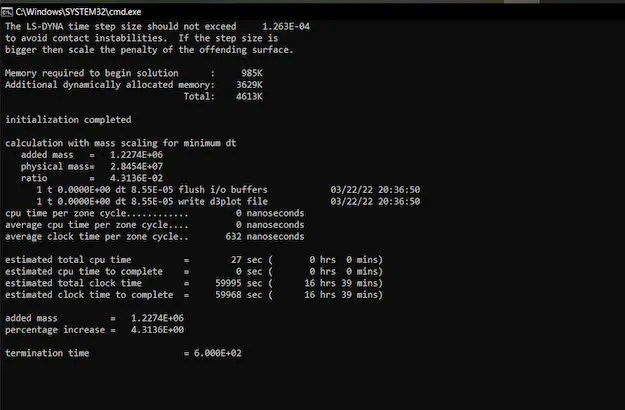
Control Timestep Card: - DT2MS = -1.000 E-04 & TSSFAC= 0.9

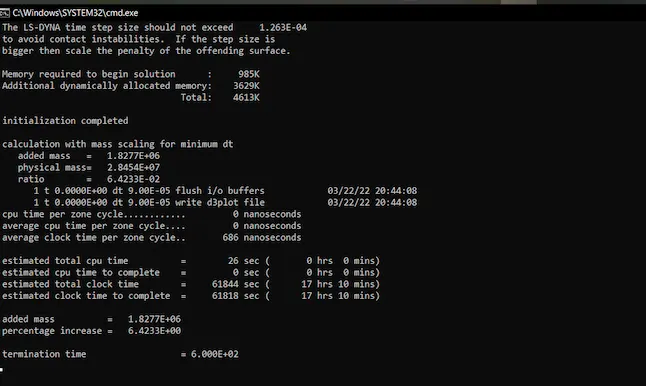
Control Timestep Card: - DT2MS = -1.010 E-04 & TSSFAC= 0.9

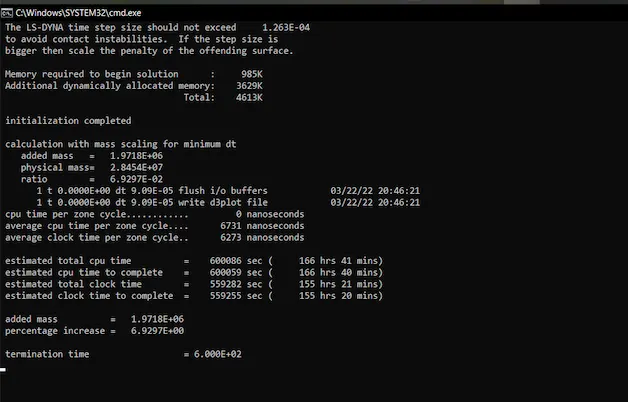
Control Timestep Card: - DT2MS = -1.020 E-04 & TSSFAC= 0.9

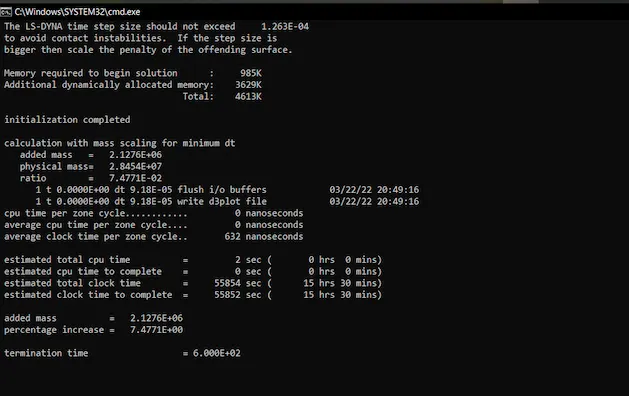
Control Timestep Card: - DT2MS = -1.0288 E-04 & TSSFAC= 0.9

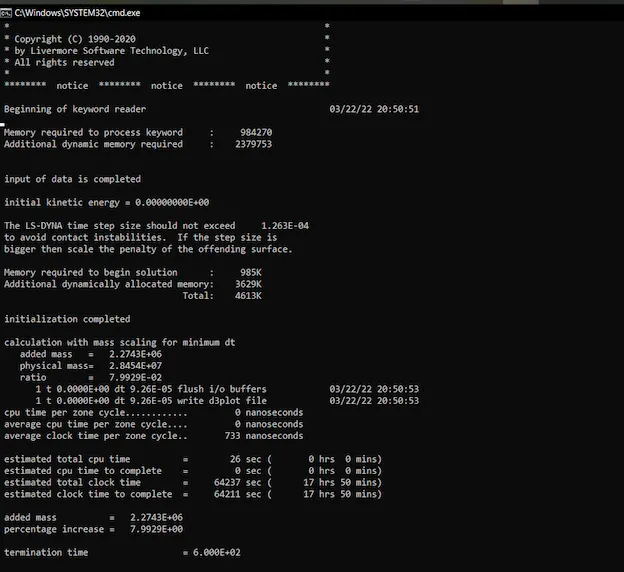
Control Timestep Card: - DT2MS = -1.0288 E-04 & TSSFAC= 0.9

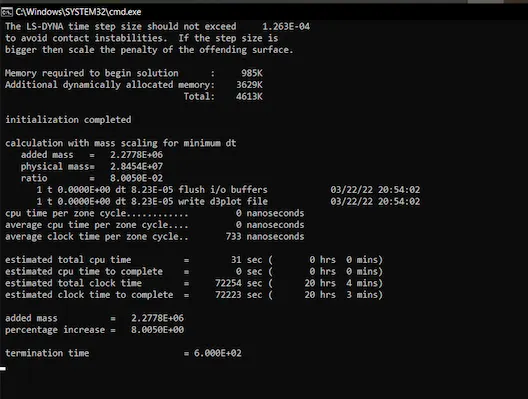
Control Timestep Card: - DT2MS = -1.0288 E-04 & TSSFAC= 0.9

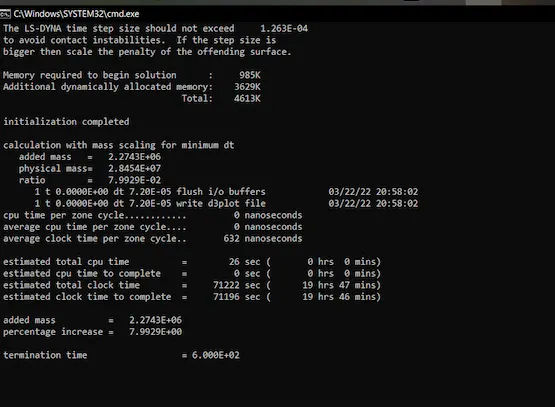
Control Timestep Card: - DT2MS = -1.0288 E-04 & TSSFAC= 0.9

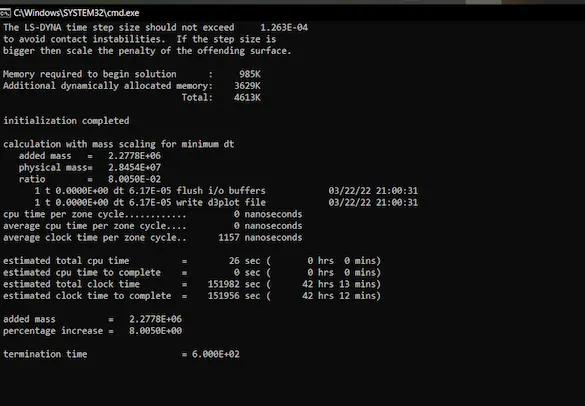
Table 1- Trial and Error method used to achieve hard limit of 8% for the mass scaling while keeping TSSFAC constant.
| DT2MS | TSSFAC | Run Time (hrs) | Run Time (sec) | Added Mass | Percentage Increase |
| -3.50E-05 | 0.9000 | 217HRS 24MIN | 782678 SEC | 0.0000 | 0.0000 |
| -3.00E-05 | 0.9000 | 32HRS 20MIN | 116407 SEC | 0.0000 | 0.0000 |
| -4.00E-05 | 0.9000 | 32HRS 20MIN | 116407 SEC | 0.0000 | 0.0000 |
| -5.50E-05 | 0.9000 | 28HRS 46MIN | 103606 SEC | 2855.2 | 0.01 |
| -7.50E-05 | 0.9000 | 20HRS 52MIN | 75176 SEC | 106080 | 0.3728 |
| -9.50E-05 | 0.9000 | 16HRS 39MIN | 59995 SEC | 1227400.0000 | 4.3136 |
| -1.00E-04 | 0.9000 | 17HRS 10MIN | 61844 SEC | 1827700.0000 | 6.4233 |
| -1.01E-04 | 0.9000 | 155HRS 21 MIN | 559282 SEC | 1971800.0000 | 6.9297 |
| -1.02E-04 | 0.9000 | 15HRS 30 MIN | 55854 SEC | 2127600.0000 | 7.4771 |
| -1.0288E-04 | 0.9000 | 17HRS 50MIN | 64237 SEC | 2274300.0000 | 7.9929 |
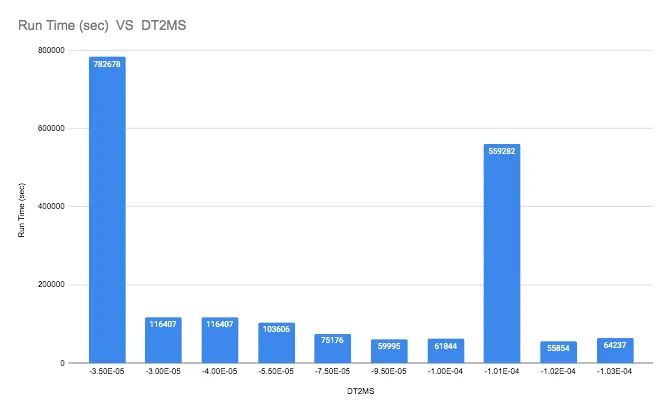
Graph 1- Computational run time versus DT2MS histogram graph for TSSFAC having value of 0.9.
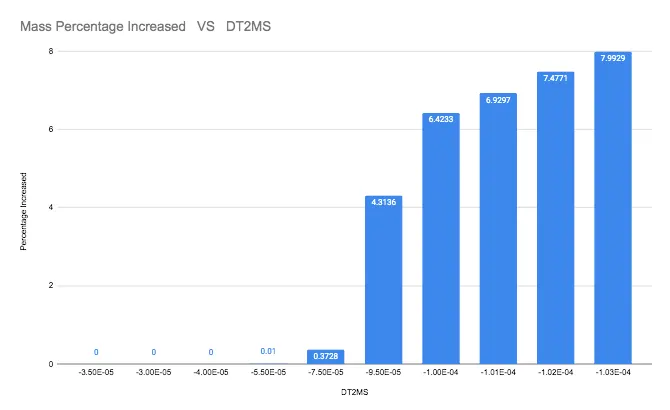
Graph 2-Mass percentage increase vs DT2MS histogram graph.
| DT2MS | TSSFAC | Run Time (hrs) | Run Time (sec) | Added Mass | Percentage Increase |
| -1.02880E-04 | 0.9000 | 17hrs 50min | 64237 | 2274300.0000 | 7.9929 |
| -1.02880E-04 | 0.8000 | 20hrs 4min | 72254 | 2274300.0000 | 7.9929 |
| -1.02880E-04 | 0.7000 | 19hrs 47min | 71222 | 2274300.0000 | 7.9929 |
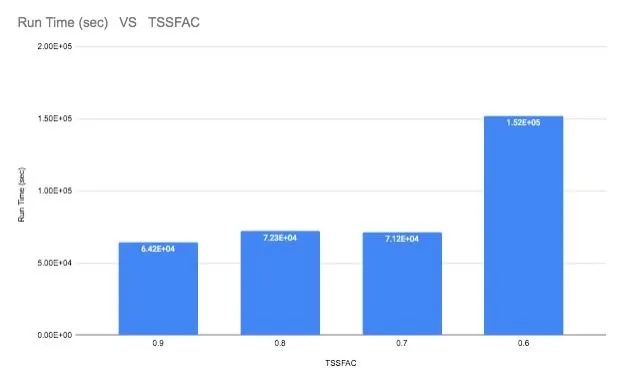
| -1.02880E-04 | 0.6000 | 42hrs 13min | 151982 | 2274300.0000 | 7.9929 |
Considering the challenge requirements of achieving the hard limit of 8% on mass scaling by adjusting the values of DT2MS and TSSFA parameters in the CONTROL TIMESTEP card, a trial and error approach was followed to obtain optimum values of DT2MS and TSSFC parameters and the results are presented in Table 1.
From the Table 1, it can be seen that the mass percentage increase becomes approximately 8 % at DT2MS= -1.0288E-04 & TSSFAC=0.9. From figure 1, it can be observed that with an increase of DT2MS parameter value, there is not only an increase in mass percentage but also there is a significant reduction in computational runtime of the simulation.
From table 2, it can be seen that by keeping DT2MS constant and adjusting or decreasing the values of the TSSFAC parameter there is an increase of computational runtime for simulation.
Figures 2 and 3 conclude that the optimal values to be used for the DT2MS and TSSFAC parameters to establish a hard limit of 8% on the mass scaling are - 1.0288E-04 and 0.9 respectively.
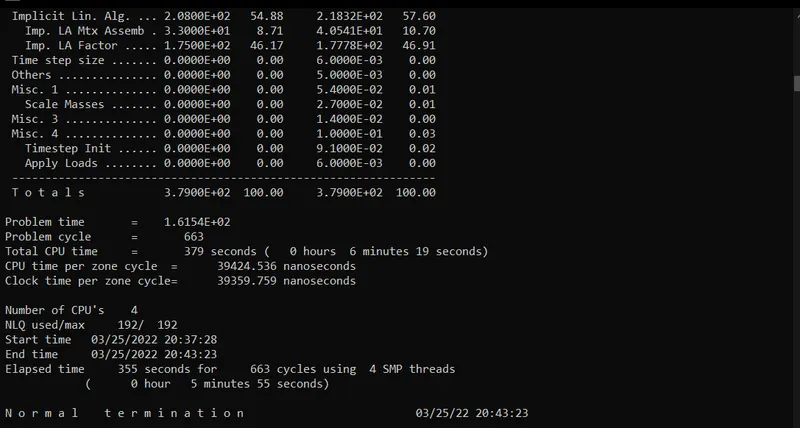
After creating the input deck and running simulation for implicit analysis, it was found that the total computational run time was around 6 mins and 19seconds.
CONCLUSION:
i. The objective of mass scaling is achieved for the given model by varying the values of DT2MS and TSSFAC using trial and error method.
ii. By considering the hard limit on mass scaling being 8%, the optimized value of DT2MS = -1.0288E-4 and TSSFAC= 0.9 with lowest possible runtime required to complete the simulation is 17 hrs 50 mins.
iii. The values of DT2MS and TSSFAC does not affect the runtime required to complete the simulation for implicit analysis.
iv. Learned the concept of mass scaling and its necessity in explicit analysis.