Week 8: Literature review - RANS derivation and analysis
JORGE LOZANO
Advanced CFD for IC Engine Applications using Converge
Literature review - RANS derivation and analysis
Objective
Apply reynold's decomposition to the NS equations and come up with the expression for reynold's stress.
- Explain your understanding of the terms reynold's stress
- What is turbulent viscosity? How is it different from molecular viscosity?
Reynold's decomposition
Continuity equation
`(∂u)/(∂x)+(∂v)/(∂y)=0`
Momentum equation
`ρ((∂u)/(∂t)+u (∂u)/(∂x)+v (∂v)/(∂y))=-(∂P)/(∂x)+μ (∂^2 u)/(∂x^2 )`
Energy equation
`ρc((∂T)/(∂t)+u (∂T)/(∂x)+v (∂T)/(∂y))=k(∂^2 T)/(∂x^2 )+μ ((∂ u)/(∂x ))^2`
Several components are generalized in space average and its temporal and space fluctuating variables, obtaining an instantaneous components
`u=u ̅+u^'`
`v=v ̅+v'`
`w=w ̅+w^'`
`p=p ̅+p'`
If this averaging method is being applied:
`u ̅=(1 )/(∆T) ∫_(T0)^(T0+T1)udt`
Therefore the descomposition of the variable Reynolds have the following form:
`u(x,y,z,t)=u ̅(x,y,z)+u^' (x,y,z,t)`
`v(x,y,z,t)=v ̅(x,y,z)+v^' (x,y,z,t)`
By having the average operator froms:
`u ̅(x,y)=(1 )/T ∫_0^Tu(x,y,t)dt`
`v ̅(x,y)=(1 )/T ∫_0^Tv(x,y,t)dt`
It's expanded into its average and fluctuating components
`u ̅(x,y)=(1 )/T[∫_0^Tu ̅dt+∫_0^Tu' dt]`
`v ̅(x,y)=(1 )/T[∫_0^Tv ̅dt+∫_0^Tv' dt]`
Ending with the decompostion of the Navier-Stokes equation as a time average form:
`(1 )/T ∫_0^Tu^' dt=0`
Beggining with the continuity equation:
`(∂u)/(∂x)+(∂v)/(∂y)=0`
And changing the average and temporal values:
`(∂(u ̅+u^'))/(∂x)+(∂(v ̅+v^'))/(∂y)=0`
Applying the temporal average of the whole equation:
`1/T ∫_0^T(∂(u ̅+u^'))/(∂x )dt+1/T ∫_0^T(∂(v ̅+v^'))/(∂y) dt=0`
Expanding further the components:
`1/T ∫_0^T(∂u ̅)/(∂x) dt+1/T ∫_0^T(∂u^')/(∂x) dt+1/T ∫_0^T(∂v ̅)/(∂y) dt+1/T ∫_0^T(∂v^')/(∂y) dt=0`
And applying the time average quantities
`(∂u ̅)/(∂x) 1/T ∫_0^Tdt+1/T ∂/(∂x) ∫_0^Tu'dt+(∂v ̅)/(∂y ) 1/T ∫_0^Tdt+1/T ∂/(∂x) ∫_0^Tv'dt=0`
The final continuity equation averaged has the following form:
`(∂u ̅)/(∂x)+(∂v ̅)/(∂y)=0`
Having the beggining of the momentum equation as:
`ρ((∂u)/(∂t)+u (∂u)/(∂x)+v (∂v)/(∂y))=-(∂P)/(∂x)+μ (∂^2 u)/(∂x^2 )`
Passing the rho to the other side
`((∂u)/(∂t)+u (∂u)/(∂x)+v (∂v)/(∂y))=-1/ρ (∂P)/(∂x)+ϑ (∂^2 u)/(∂x^2 )`
Adding the continuity equation to the left side, being possible as it equals to zero and solving it.
`((∂u)/(∂t)+2u (∂u)/(∂x)+v (∂v)/(∂y))+(∂v)/(∂y)=-1/ρ (∂P)/(∂x)+ϑ (∂^2 u)/(∂x^2 )`
By remembering the product rule as:
`(∂(u.v))/(∂y)=v (∂u ̅)/(∂x)+u (∂v ̅)/(∂y)=0`
And substituting it in the formula
`((∂u)/(∂t)+(∂u^2)/(∂x)+(∂(u.v))/(∂y))=-1/ρ (∂P)/(∂x)+ϑ (∂^2 u)/(∂x^2 )`
Substituting the average and fluctuating components of u and v and expanding the components:
`1/T ∫_0^T(∂u ̅)/(∂t) dt+(∂u')/(∂x) dt+(∂u ̅^2)/(∂x) dt+(∂u^'2)/(∂x) dt+(∂(2u ̅u^'))/(∂x) dt+(∂(u ̅v ̅))/(∂y) dt+(∂(v ̅u^'))/(∂y) dt+(∂(u'v'))/(∂y) dt=1/T ∫_0^T-1/ρ (∂p ̅)/(∂t) dt-1/ρ (∂p^')/(∂x) dt+ϑ (∂^2 u ̅)/(∂y^2 ) dt+ϑ (∂^2 u')/(∂y^2 ) dt`
The fluctuating components are equal to zero:
`(∂u ̅)/(∂t) dt+(∂u ̅^2)/(∂x) +(∂(u ̅v ̅))/(∂y)=-1/ρ (∂p ̅)/(∂x) dt+ϑ (∂^2 u ̅)/(∂y^2 ) dt-1/T ∫_0^T(∂u^'2)/(∂x) dt-1/T ∫_0^T(∂(u^' v'))/(∂y) dt`
By having the description that the gradients in velocity components are much more stronger in the y direction compared to the x direction, the values could be estimated by the orded of magnitud analysis to estimate the value of the assumption, but in this occasion it will be considered as zero.
`-1/T ∫_0^T(∂u^')/(∂x) dt=0`
Ending with the final result:
`((∂u ̅)/(∂t)+(∂u ̅^2)/(∂x)+v (∂(u ̅ .v ̅))/(∂y))=-1/ρ (∂p ̅)/(∂x)+1/ρ ∂/(∂y)(μ (∂u ̅)/(∂y)+ρ/T ∫_0^T(u ̅ .v ̅)dt)`
by sectioning the components, the inertial section is:
`((∂u ̅)/(∂t)+(∂u ̅^2)/(∂x)+v (∂(u ̅ .v ̅))/(∂y))`
The pressure term:
`-1/ρ (∂p ̅)/(∂x)`
The molecular viscosity:
`μ (∂u ̅)/(∂y)`
The molecular diffusivity of turbulence:
`ρ/T ∫_0^T(u^' v')dt`
The Viscous stresses, also known as molecular viscosity:
`∂/(∂x) (μ (∂u ̅)/(∂y))`
The reynolds stresses:
`∂/(∂y)(ρ/T ∫_0^T(u^'.v')dt)`
Documentation
Explain your understanding of the terms reynold's stress
It represents a value of the relationship between viscous and inertial forces in the momentum equations. Being a stress tensor in a fluid domain, considering an incompressible, homogeneous fluid to be defined.
What is turbulent viscosity? How is it different from molecular viscosity?
Molecular viscosity is the transport of mass motion momentum solely by the random motions of individual molecules not moving together in coherent groups. Molecular viscosity is analogous in laminar flow to eddy viscosity in turbulent flow. This presents a characteristic of a fluid of all turbulent, transient of laminar flow, being possible to be measured.
The mean shear stress has both viscous and turbulent parts. In simple shear (i.e. where 𝜕𝑈/𝜕𝑦 is the only non-zero mean gradient):
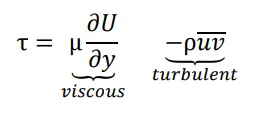
The most popular type of turbulence model is an eddy-viscosity model (EVM) which assumes that turbulent stress is proportional to mean-velocity gradient in a manner like viscous stress. In simple shear:
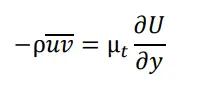
u𝑡 is called an eddy viscosity or turbulent viscosity. The overall mean shear stress is then
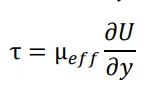
where the total effective viscosity
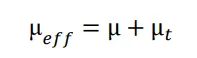
Note:
(1) This is a model!
(2) μ is a physical property of the fluid and can be measured; μ𝑡 is a hypothetical property of the flow and must be modelled.
(3) μ𝑡 varies with position.
(4) At high Reynolds numbers, μ𝑡 ≫ μ throughout much of the flow.
Eddy-viscosity models are widely used and popular because:
- they are easy to implement in existing viscous solvers
- extra viscosity aids stability
- they have some theoretical foundation in simple shear flows.
However:
- there is little theoretical foundation in complex flows
- modelling turbulent transport is reduced to a single scalar, μ𝑡, and, hence, at most one Reynolds stress can be represented accurately.
References