Week 8: Literature review - RANS derivation and analysis
Aim:
- To apply Reynold's decomposition to the N-S equations to obtain the RANS equation.
- To understand Reynolds stress.
- To understand turbulent viscosity.
WHAT IS TURBULENCE?
In fluid dynamics, turbulence or turbulent flow is fluid motion characterized by chaotic changes in pressure and flow velocity. It is in contrast to a laminar flow, which occurs when a fluid flows in parallel layers, with no disruption between those layers. Turbulence is commonly observed in everyday phenomena such as surf, fast flowing rivers, billowing storm clouds, or smoke from a chimney, and most fluid flows occurring in nature or created in engineering applications are turbulent. Turbulence is caused by excessive kinetic energy in parts of a fluid flow, which overcomes the damping effect of the fluid's viscosity. For this reason turbulence is commonly realized in low viscosity fluids. In general terms, in turbulent flow, unsteady vortices appear of many sizes which interact with each other, consequently drag due to friction effects increases. This increases the energy needed to pump fluid through a pipe.
What is turbulence modelling?
Turbulence modeling is the construction and use of a mathematical model to predict the effects of turbulence. Turbulent flows are commonplace in most real life scenarios, including the flow of blood through the cardiovascular system, the airflow over an aircraft wing, the re-entry of space vehicles, besides others. In spite of decades of research, there is no analytical theory to predict the evolution of these turbulent flows. The equations governing turbulent flows can only be solved directly for simple cases of flow. For most real life turbulent flows, CFD simulations use turbulent models to predict the evolution of turbulence. These turbulence models are simplified constitutive equations that predict the statistical evolution of turbulent flows.
Types:
- Reynold's Average Navier-Stroke method (RANS)
- Large Eddy Simulation (LES)
- Direct numerical Simulation (DNS)
What is RANS?
The Reynolds-averaged Navier–Stokes equations (or RANS equations) are time-averaged equations of motion for fluid flow. The idea behind the equations is Reynolds decomposition, whereby an instantaneous quantity is decomposed into its time-averaged and fluctuating quantities, an idea first proposed by Osborne Reynolds. The RANS equations are primarily used to describe turbulent flows. These equations can be used with approximations based on knowledge of the properties of flow turbulence to give approximate time-averaged solutions to the Navier–Stokes equations. For a stationary flow of an incompressible Newtonian fluid, these equations can be written in Einstein notation in Cartesian coordinates as:.

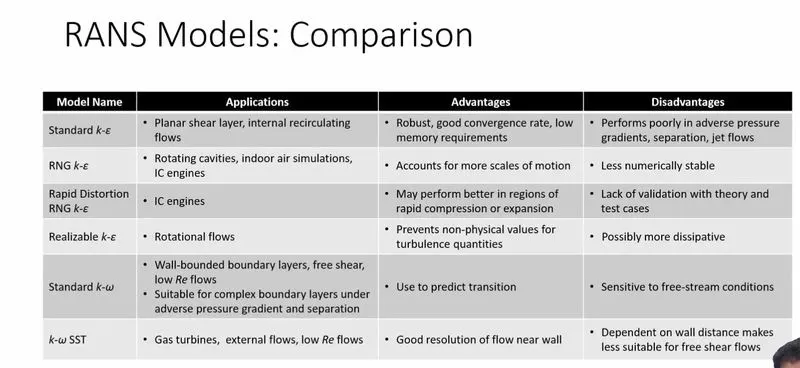
Below is the comparisons of RANS models:
DERIVATION:
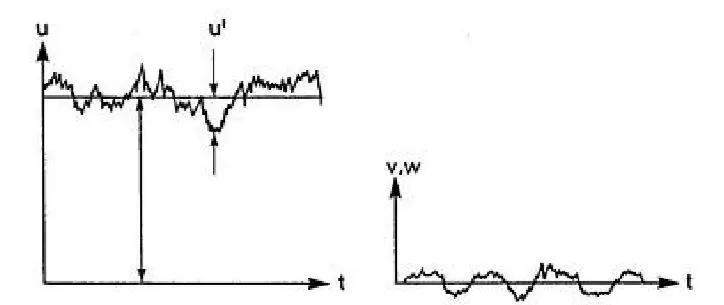
The variation in velocity of a flowing fluid in a pipe is shown above.
The momentary velocity components is u , the time-averaged value is named u and the fluctuating velocity has the letter u′. With help of this definition the decomposition can mathematically be written as:

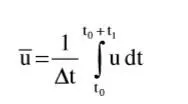
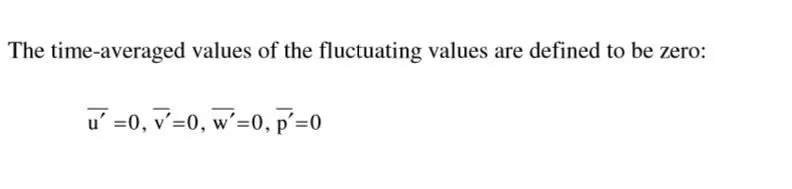
The chosen averaging method takes the mean values at a fix place in space and averaged over a time span that is large enough for the mean values to be independent of it.
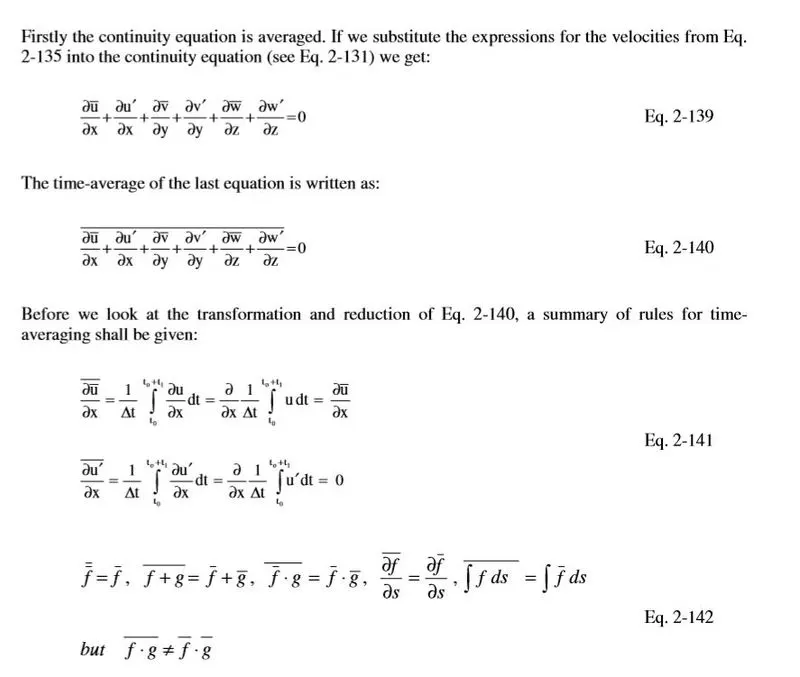
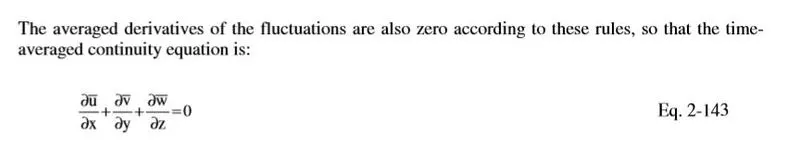
REYNOLDS STRESS:
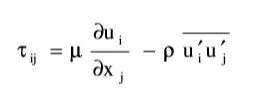
Reynolds stress is the component of the total stress tensor in a fluid obtained from the averaging operation over the Navier–Stokes equations to account for turbulent fluctuations in fluid momentum.
We consider a homogeneous fluid, whose density ρ is taken to be a constant. For such a fluid, the components τ'ij of the Reynolds stress tensor are defined as:
The units are Pa s
Turbulent/eddy viscosity:
- Turbulent viscosity is an imaginary whereas molecualr velocity is dynamic ans present in all fluids.
- Turbulent viscosity is dependant on flow of fluid and the latter is dependant on fluid properties.
- As the name suggests turbulent viscosity is present in turbulent flow regions and the latter in all flow types.
- Turbulent viscosity is hard to estimate whereas the latter is easy to estimate.