Week 8: Literature review - RANS derivation and analysis
Aim: Reynolds-averaged Navier-Stokes derivation and analysis
Introduction and Theory: The RANS equations are time-averaged equations of motion for fluid flow. The idea behind the equation is Reynolds decomposition, wherein an instantaneous quantity is decomposed into its time-averaged and fluctuating quantities. The RANS equations are primarily used to describe turbulent flows. These equations can be used with approximations based on knowledge of the properties of flow turbulence to give approximate time-averaged solutions to the Navier-Stokes equations.
Derivation:
Reynolds Decomposition:
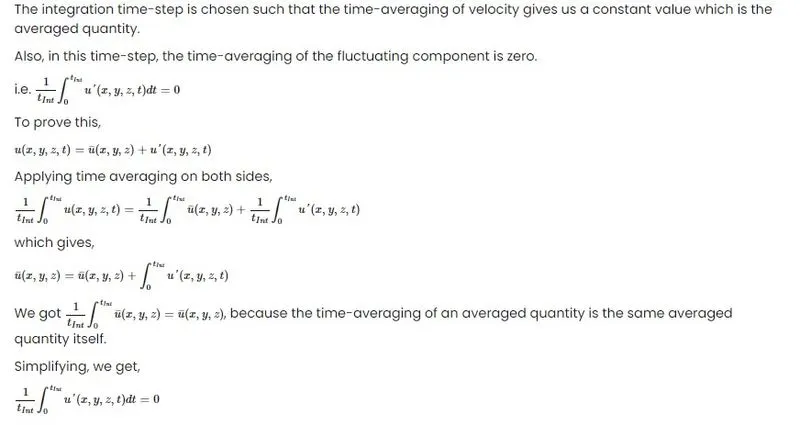
Reynolds decomposition is a mathematical technique used to separate the expectation value of a quantity from its fluctuations. For example, for a quantity u the decomposition would be
u(x, y, z,) = u(x,y,(z) + u' (x, y, z, t)
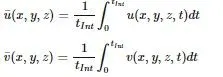
where u denotes the expectation value of u, (often called the steady component/time, spatial or ensemble average),and u', are the deviations from the expectation value (or fluctuations). The fluctuations are defined as the expectation value subtracted from quantity u such that their time average equals zero. Time - Averaged velocity in x and y directions.
Governing Equations for the boundary layer:
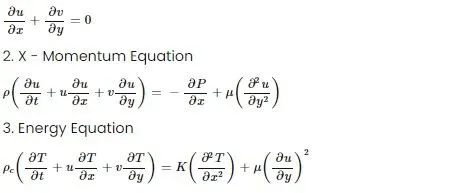
Assumptions: 2D Incompressible.
Using the order of magnitude analysis, some terms have been deleted.
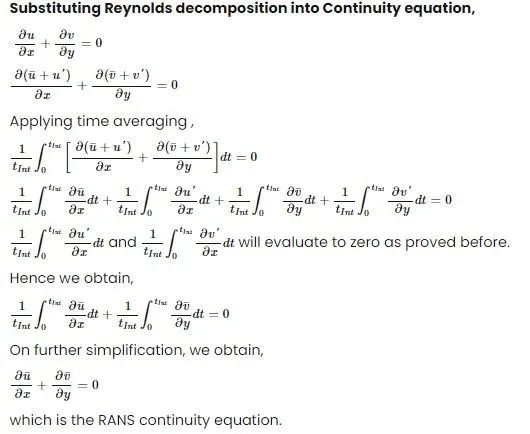
1. Continuity Equation
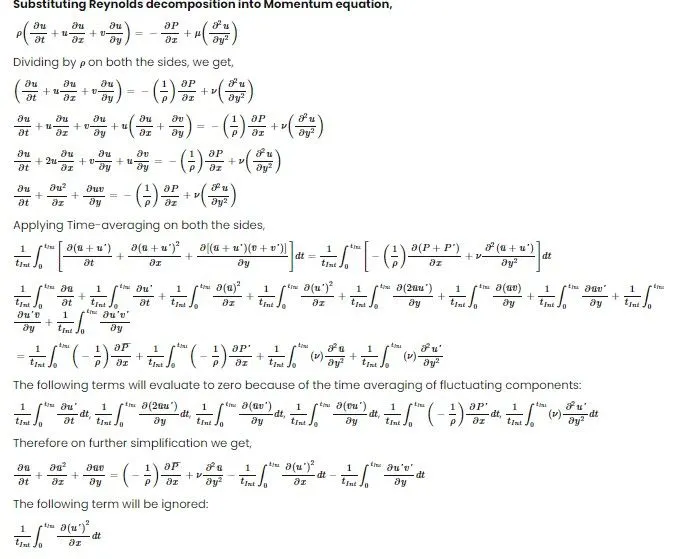
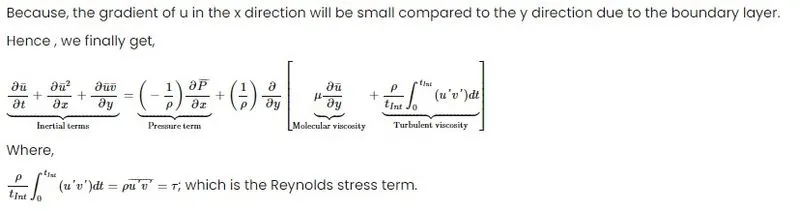
Reynolds Stress:
Reynolds stress results from the turbulent transport of momentum. It can be defined as the component of the total stress tensor in a fluid obtained from the averaging operation over the Navier-Stokes equations to account for turbulent fluctuations in fluid momentum.
Turbulence and Molecular viscosity:
The turbulent viscosity is also known as eddy viscosity. It is due to the velocity fluctuations in a turbulent flow at a high Reynolds number. It depends on the flow, it is not a fluid property. However, molecular viscosity is a fluid property.
Reynolds number. It depends on the flow, it is not a fluid property. However, molecular viscosity is a fluid property. Molecular viscosity is the same as dynamic viscosity. Molecular viscosity depends on the type of fluid and the ambient pressure and temperature conditions.