Week 8: Literature review - RANS derivation and analysis
RANS Derivation and Analysis
Aim:
To derive the Reynolds averaged Navior stokes (RANS) equation.
Objective:
To find the expression for Reynolds stress by applying Reynolds decomposition to the Navier-stocks equation. Also understanding the difference between the turbulent viscosity and molecular velocity.
Literature review:
The fluid flow is basically divided into three types’ i.e. laminar flow, transient flow, and turbulent flow. Generally the flow can be determined using Reynolds number. A low Reynolds number corresponds to laminar flow where the flow is in a sequential manner and parameters such as pressure and velocity remains constant. A high Reynolds number corresponds to turbulent flow where the flow is chaotic and the parameters are fluctuating.
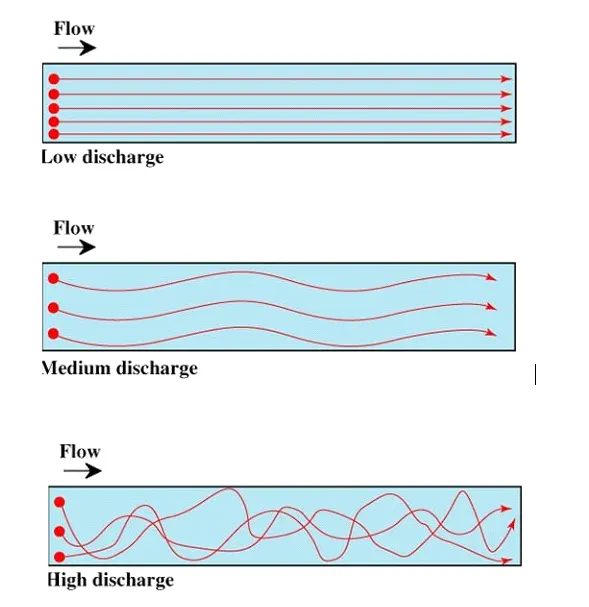
Turbulent modeling is the construction and use of a mathematical model to predict the effect of turbulence. Turbulence modeling is used to calculate the Reynolds stress and turbulent viscosity. The effect of turbulence can be modelled using a method called direct numerical simulation (DNS), where the Navier stokes equation is solved over a turbulent time step. As the turbulent time step is very small, the computational cell size is required to solve, hence, the turbulent model is used to capture the effect of turbulent in a coarse grid size.
The Navier stokes equation govern the velocity and pressure of a fluid flow. In a turbulent flow, each of these quantities may be decomposed into a mean part and a lactating part. Averaging the equations gives the Reynolds Averaged navier stokes equations which govern the mean flow. The non-linearity of Navier stokes equation means the velocity fluctuations appear in the RANS equations in the nonlinear term from the convective acceleration. This term is known as the Reynolds stress.
The navier stokes equation govern the motion of fluid and can be seen as newton’s second law of motion for fluids and can be seen as newton’s second law of motion for fluids. The equation consists of solving the continuity equation, momentum equation and energy equation of fluid together. This is important in the fluid flow modelling.
RANS:
Decomposing the Navier stokes equation into the RANS equation makes it possible to simulate practical engineering flows, such as the airflow over an airplane. The assumption (known as the Reynolds decomposition) behind the RANS equation is that the time-dependent turbulent (chaotic) velocity fluctuations can be separated from the mean flow velocity. This transform then introduces a set of unknowns called the Reynolds stress, which are function of the velocity fluctuation, and which require a turbulence model (e.g., the two-equation K-epsilon model) to produce a closed system of solvable equation. The reduced computational requirement for the RANS equation, while still significant, are orders of magnitude less than that required for the original Navier stokes equation. Another advantages of using the RANS equation for steady fluid flow simulation is that the mean flow velocity is calculated as a direct results without the need to average the instantaneous velocity over a series of time steps.
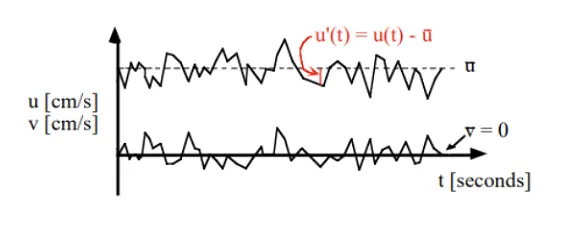
Derivation of RANS equation:
The derivation of the RANS equation from the instantaneous Navier stokes equation is the Reynolds decomposition. Reynolds decomposition refers to separation of the flow variable into the mean time averaged component u and the fluctuating component u’.
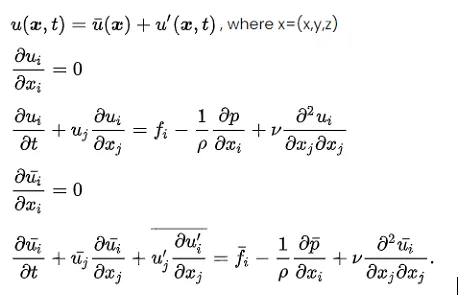
The momentum equation can also be written as,
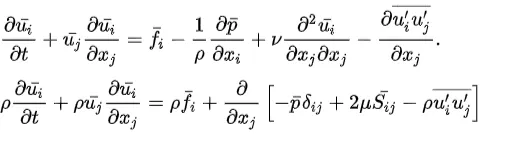
Continuity equation:
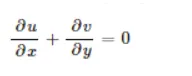
Reynolds decomposition of continuity equation

We are going to solve fluctuating component is equal to zero u’=v’=0.
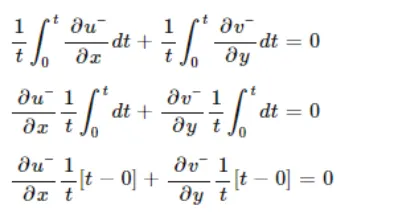
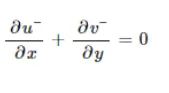
Finally we getting Reynolds time average equation.
Momentum equation for Navier stokes equation:
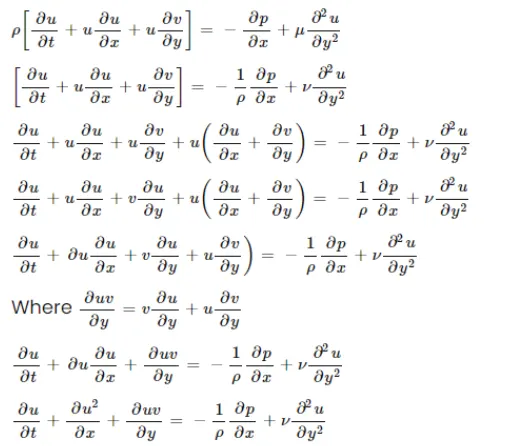
Apply Reynolds decomposition

Fluctuating term going to zero
When fluid flow inside cylinder the boundary layer have less thickness the velocity gradient changes at y direction and x direction impossible because the flow is stable so should be neglected.
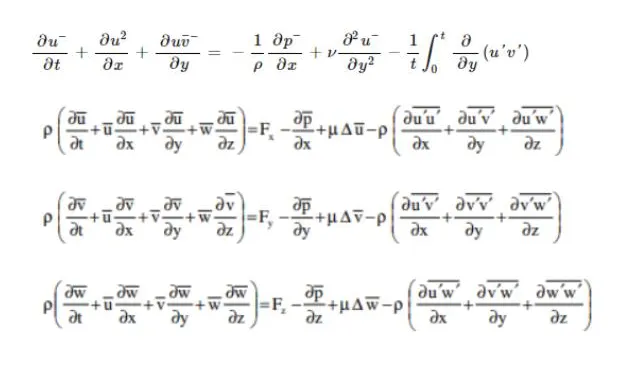
Reynolds stress:
Is the component of the total stress in a fluid obtained from the averaging operation over the Navier stokes equation to account for turbulent fluctuation in fluid momentum.
Turbulent viscosity:
The turbulent viscosity hypothesis assumes that the Reynolds stresses can be related to mean velocity gradients and turbulent viscosity by gradient diffusion hypothesis, in a manner analogous to the relationship between the stress and strain tensors in laminar Newtonian flow. The turbulent viscosity is not homogeneous i.e. it various in space. It is however assumed to be isentropic. It is same in all directions.
In a turbulent fluid, linear interface between different fluid breaks apart to form sim-scale structures which are called as eddies. As these grow and diminish the size, they effectively alter the surface area of the interface between the fluid with various properties, thus by altering the net transfer of momentum and scalar properties through the interface.
Molecular viscosity:
It is a resistance to the movement of one layer of fluid over the adjacent layer. It is linear and easy to measure. It is always independent of geometry. Molecular viscosity is the transport of mass motion momentum by random motion of individual molecules not moving together in coherent groups. Molecular viscosity is analogous in laminar flow to eddy viscosity in turbulent flow.
The turbulent viscosity is an imaginary concept but the molecular viscosity is a dynamic viscosity that is present in real fluids. Molecular viscosity depends on the properties of fluid but the turbulent viscosity depends on the fluid flow. Turbulent viscosity is dominant in regions with high Reynolds number whereas molecular velocity is dominant in the regions with low Reynolds number. Molecular viscosity is linear and hence easy to measure.
Conclusion:
Hence by applying Reynolds’s decomposition to the NS equation, we have derived for the expression for the expression for Reynolds stress. The theory behind the Reynolds stress is also studied.