Week 8 Challenge
Aim : To design an ultracapacitor model and study it's voltage, current and SOC characteristics.
Theory:
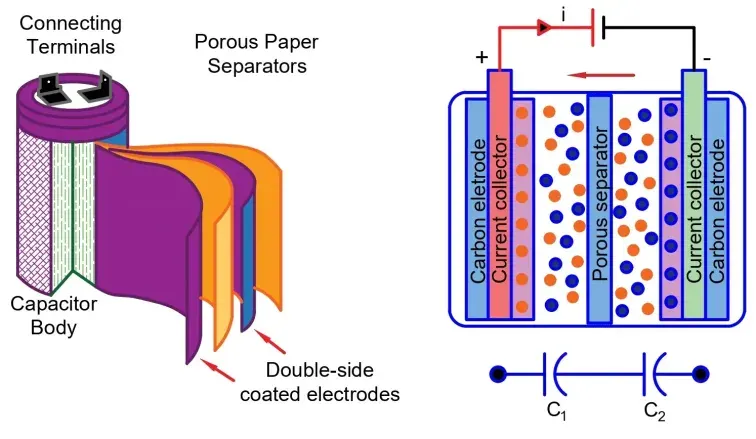
An ultracapacitor, also known as a supercapacitor, or electrochemical capacitor, is a device for storing electrical energy.Like a battery, a single ultracapacitor cell consists of a positive and negative electrode separated by an electrolyte. However, they store energy electrostatically, like a regular capacitor, not chemically like a battery - a dielectric separator divides the electrolyte, like a capacitor.
Capacitors store energy as a result of their ability to store charge with the amount of charge stored on a capacitor depending on the voltage, V applied across its plates, and the greater the voltage, the more charge will be stored by the capacitor as: Q ∞ V.
A capacitor has a constant of proportionality, called capacitance, symbol C, which represents the capacitor’s ability or capacity to store an electrical charge with the amount of charge depending on a capacitor capacitance value as: Q ∞ C.
Then ultra-capacitors make excellent energy storage devices because of their high values of capacitance up into the hundreds of farads, due to the very small distance d or separation of their plates and the electrodes high surface area A for the formation on the surface of a layer of electrolytic ions forming a double layer. This construction effectively creates two capacitors, one at each carbon electrode, giving the ultracapacitor the secondary name of “double layer capacitor” forming two capacitors in series.
Simulation model:
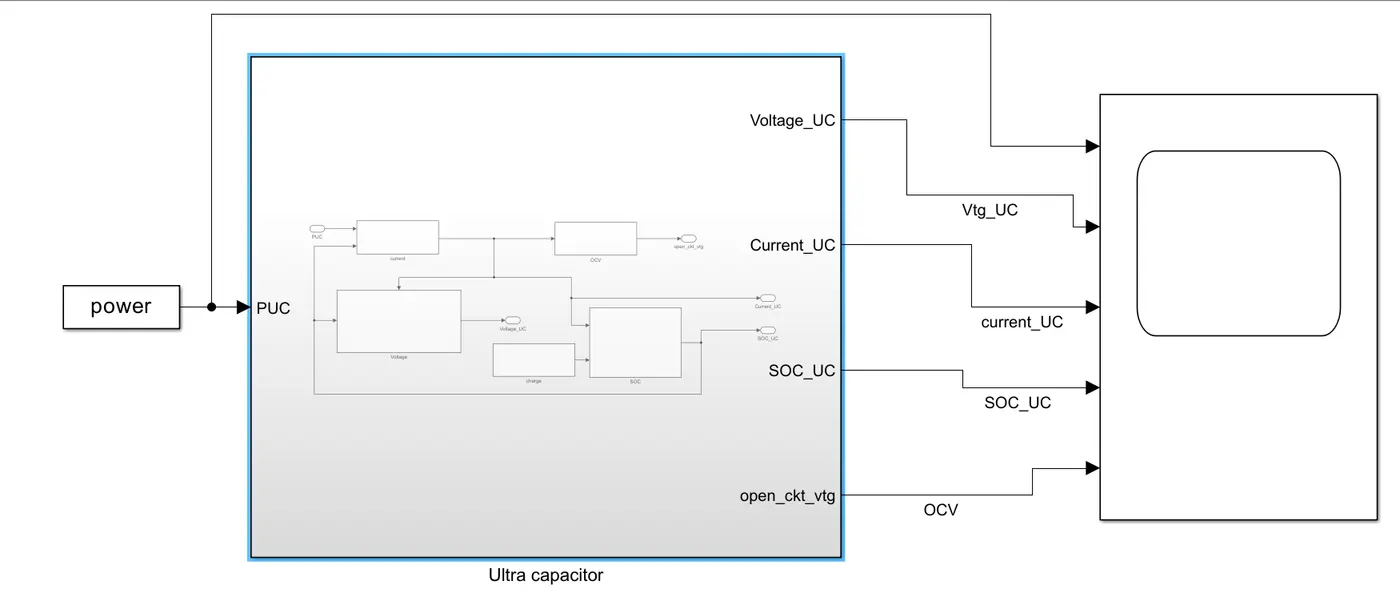
In the model the power is taken from the excel sheet and would give the corresponding output.
Subsystems:
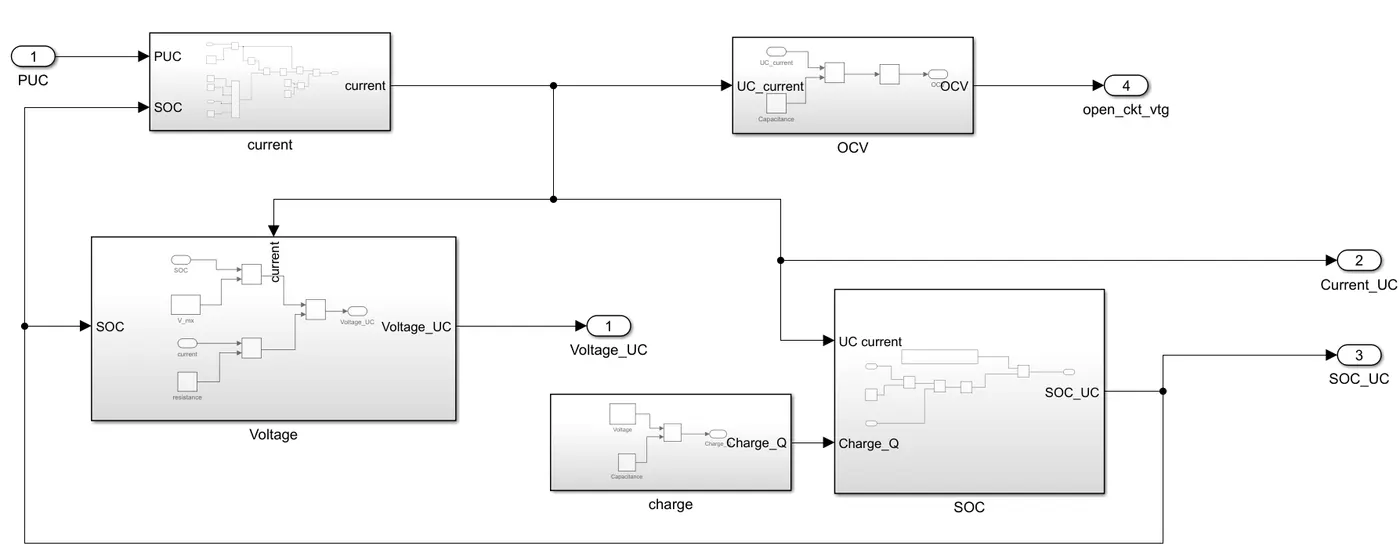
For different parameters of the ultracapacitor different equations and different subsytems are there.
1) Current:
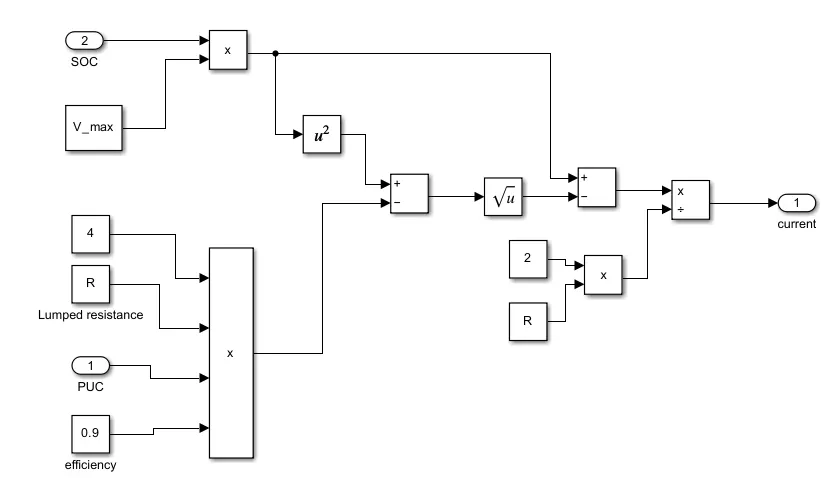
the current equation is as follows:
`I = ((SOC*V_max)-sqrt((SOC*V_max)^2-(4*R*PUC*eff)))/(2*R)`
where, SOC = state of charge
V_max= maximum voltage
R= lumped resistance
PUC=Power to Ultra capacitor
eff=efficiency of UC
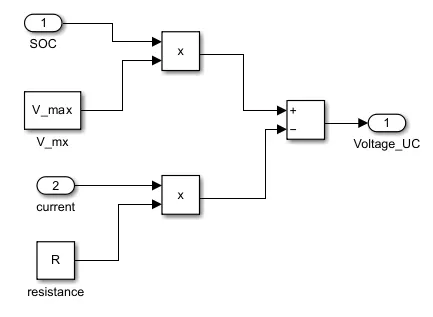
2) Voltage:
The voltage of ultra capacitor is given as follows:
V=(SOC*V_max)-(I*R)
3)Open circuit voltage:
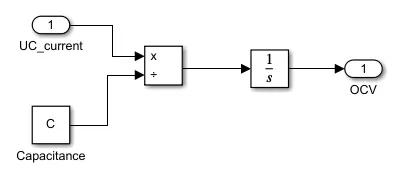
The open circuit voltage of ultra capacitor is given as follows:
`OCV=int(I/C)dt`
where C= capacitance
4) Charge:
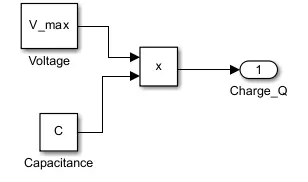
The charge of ultra capacitor is given as follows:
Q=C*V_max
Q=charge
5) State of Charge:
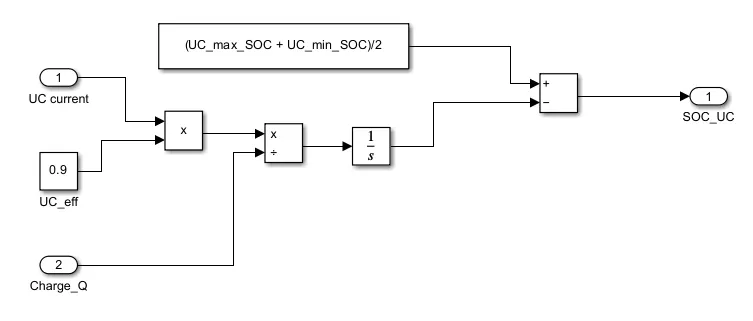
The SOC of ultra capacitor is given as follows:
`SOC=((SOC_min+SOC_max)/2)+int((I*eff)/Q)dt`
SOCmin=minimum SOC of UC
SOCmax=maximum SOC of UC
Output:
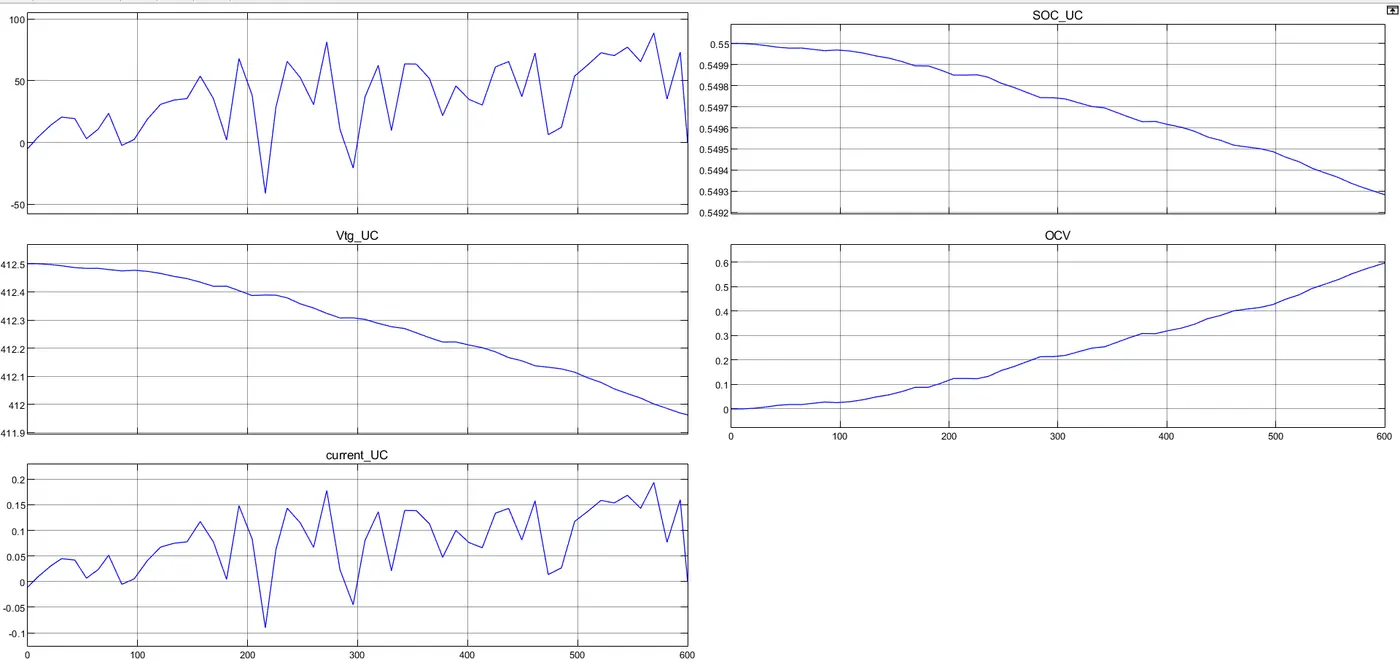
The above graph shows the output of the UC.Here the power to be positive means the UC discharge and the power to b negative means the UC charges.In the above the power is varied in between 80 to 30W and the voltage is of 412.5V to 412V as the current is varied in between -0.1 to 0.2A.